⚖️ Lecture 2: Animals in Other Forms of Regulations + Animals in International Law

0.0(0)
studied byStudied by 0 people
0.0(0)
call with kaiCall with Kai
learnLearn
examPractice Test
spaced repetitionSpaced Repetition
heart puzzleMatch
flashcardsFlashcards
GameKnowt Play
Card Sorting

1/41

encourage image

There's no tags or description

Looks like no tags are added yet.

Study Analytics
Name
Mastery
Learn
Test
Matching
Spaced
Call with Kai

No study sessions yet.

42 Terms

1
New cards

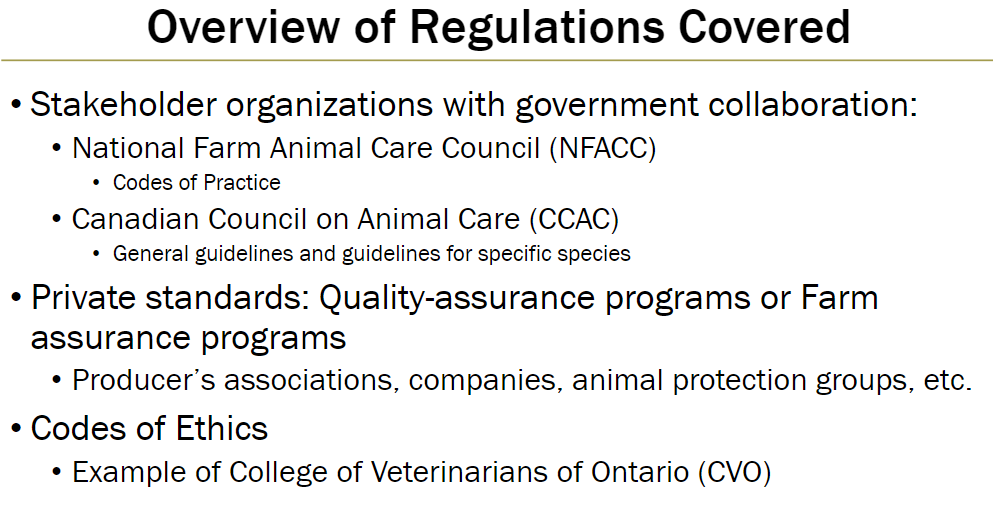
Overview of Regulations – Stakeholder Organizations and Collaboration

Government Collaboration Organizations
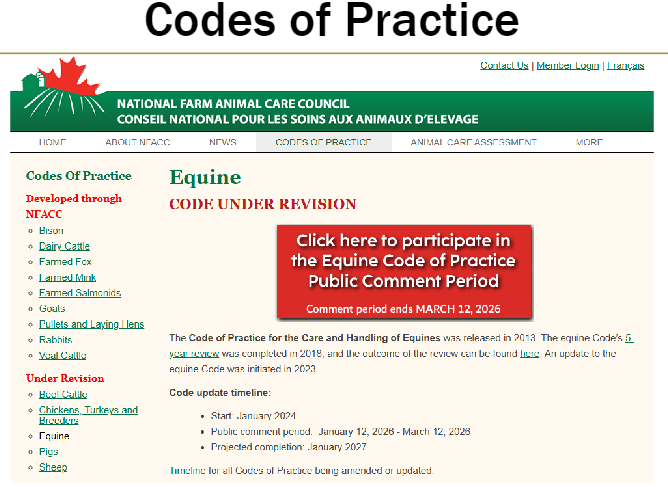
 National Farm Animal Care Council (NFACC) – develops Codes of Practice
 Canadian Council on Animal Care (CCAC) – issues general guidelines and species-specific guidelines

Private Standards
 Quality-assurance programs or farm assurance programs
 Run by producers’ associations, companies, animal protection groups, etc.

Codes of Ethics
 Example: College of Veterinarians of Ontario (CVO)
<p><strong>Government Collaboration Organizations</strong><br> National Farm Animal Care Council (NFACC) – develops Codes of Practice<br> Canadian Council on Animal Care (CCAC) – issues general guidelines and species-specific guidelines</p><p><strong>Private Standards</strong><br> Quality-assurance programs or farm assurance programs<br> Run by producers’ associations, companies, animal protection groups, etc.</p><p><strong>Codes of Ethics</strong><br> Example: College of Veterinarians of Ontario (CVO)</p>
2
New cards

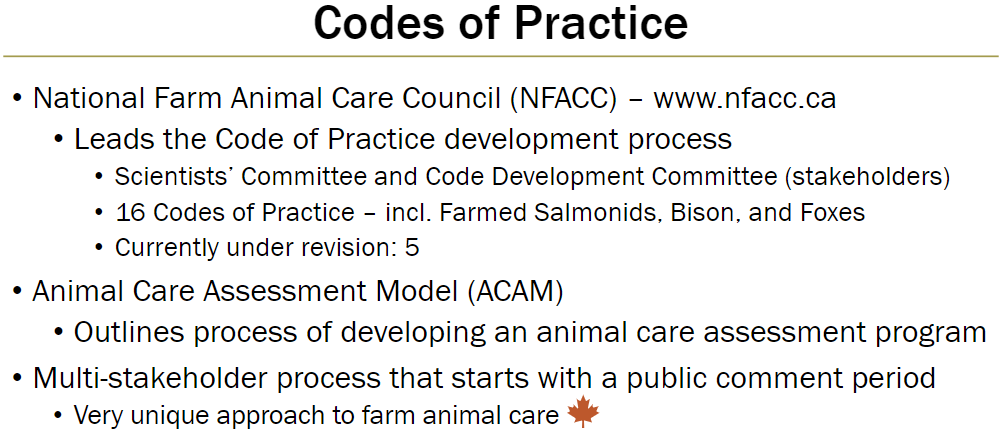
National Farm Animal Care Council (NFACC)

Role
 Leads development of Codes of Practice for farm animals

Committees
 Scientists’ Committee and Code Development Committee include multiple stakeholders

Codes of Practice
 16 codes, including farmed salmonids, bison, and foxes
 Currently under revision: 5 codes

Animal Care Assessment Model (ACAM)
 Outlines process to develop an animal care assessment program
 Uses a multi-stakeholder process starting with a public comment period
 Unique approach to farm animal care
<p><strong>Role</strong><br> Leads development of Codes of Practice for farm animals</p><p><strong>Committees</strong><br> Scientists’ Committee and Code Development Committee include multiple stakeholders</p><p><strong>Codes of Practice</strong><br> 16 codes, including farmed salmonids, bison, and foxes<br> Currently under revision: 5 codes</p><p><strong>Animal Care Assessment Model (ACAM)</strong><br> Outlines process to develop an animal care assessment program<br> Uses a multi-stakeholder process starting with a public comment period<br> Unique approach to farm animal care</p>
3
New cards

Codes of Practice

knowt flashcard image
4
New cards

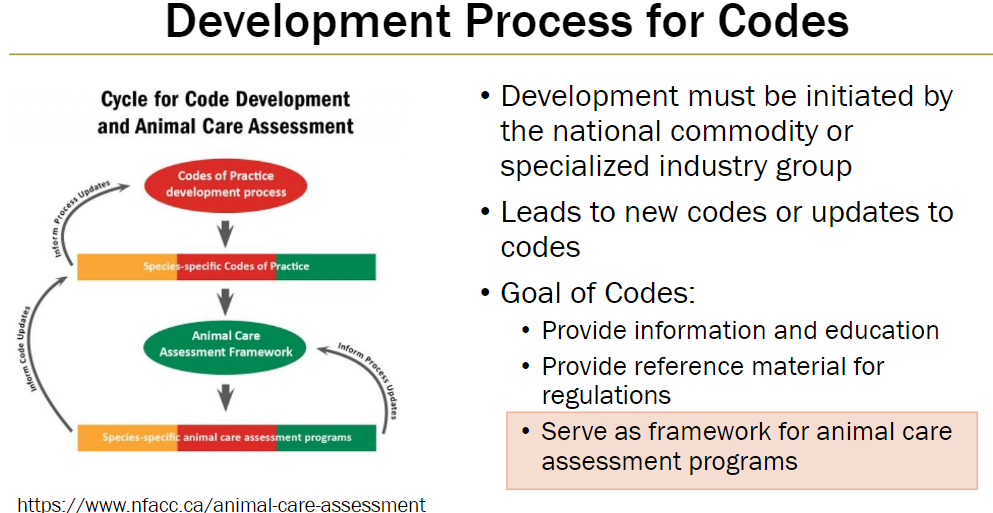
Development Process for NFACC Codes of Practice

Initiation
 National commodity or specialized industry group starts the development process

Purpose
 Develop new codes or update existing codes

Goals of Codes
 Provide information and education on animal care
 Offer reference material for regulations
 Serve as framework for animal care assessment programs
<p><strong>Initiation</strong><br> National commodity or specialized industry group starts the development process</p><p><strong>Purpose</strong><br> Develop new codes or update existing codes</p><p><strong>Goals of Codes</strong><br> Provide information and education on animal care<br> Offer reference material for regulations<br> Serve as framework for animal care assessment programs</p>
5
New cards

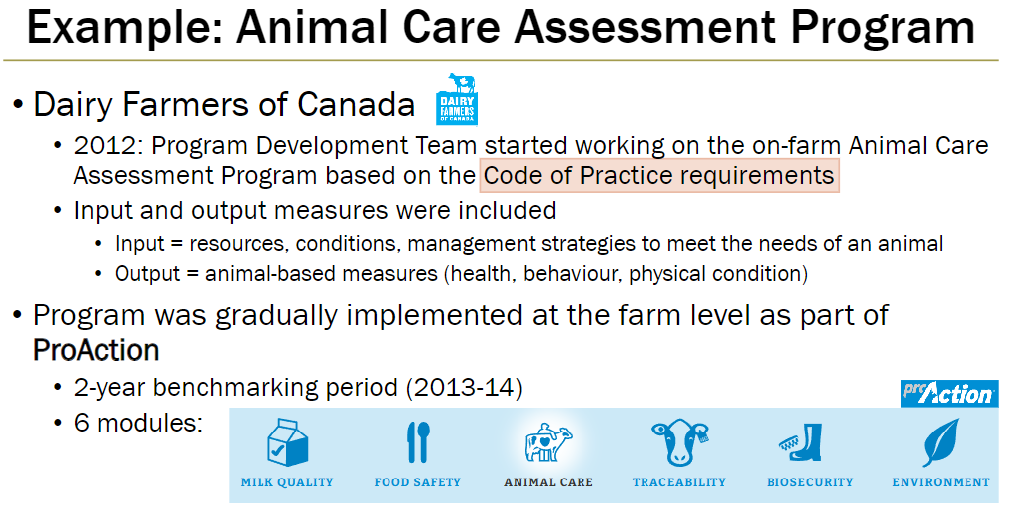
Dairy Farmers of Canada – On-Farm Animal Care Assessment Program

Program Development
 2012: Program Development Team started working on program based on Code of Practice requirements

Assessment Measures
 Input measures = resources, conditions, management strategies to meet animal needs
 Output measures = animal-based measures such as health, behaviour, and physical condition

Implementation
 Gradually implemented at farm level as part of ProAction program
 2-year benchmarking period: 2013–2014

Program Structure
 Consists of 6 modules: Milk quality, food safety, animal care, traceability, biosecurity, environment
<p><strong>Program Development</strong><br> 2012: Program Development Team started working on program based on Code of Practice requirements</p><p><strong>Assessment Measures</strong><br> Input measures = resources, conditions, management strategies to meet animal needs<br> Output measures = animal-based measures such as health, behaviour, and physical condition</p><p><strong>Implementation</strong><br> Gradually implemented at farm level as part of ProAction program<br> 2-year benchmarking period: 2013–2014</p><p><strong>Program Structure</strong><br> Consists of 6 modules: Milk quality, food safety, animal care, traceability, biosecurity, environment</p>
6
New cards

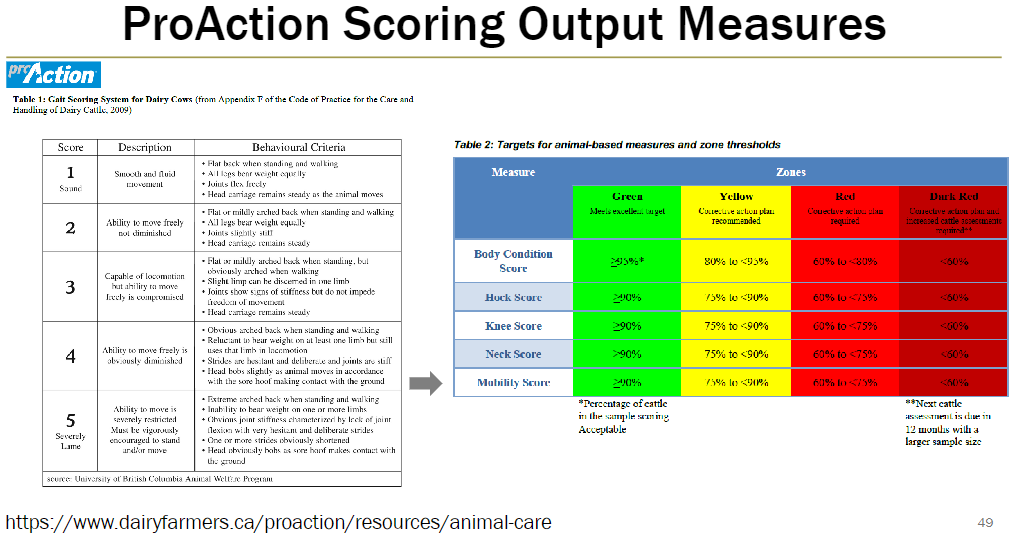
ProAction – Scoring Output Measures

Purpose
 Assesses animal-based outcomes such as health, behaviour, and physical condition on farms

Implementation
 Part of Dairy Farmers of Canada on-farm Animal Care Assessment Program
<p><strong>Purpose</strong><br> Assesses animal-based outcomes such as health, behaviour, and physical condition on farms</p><p><strong>Implementation</strong><br> Part of Dairy Farmers of Canada on-farm Animal Care Assessment Program</p>
7
New cards

ProAction – Decision-Making for Down Cattle

Purpose
 Provides guidance to producers on humane and timely euthanasia of down cattle

Implementation
 Part of Dairy Farmers of Canada on-farm Animal Care Assessment Program
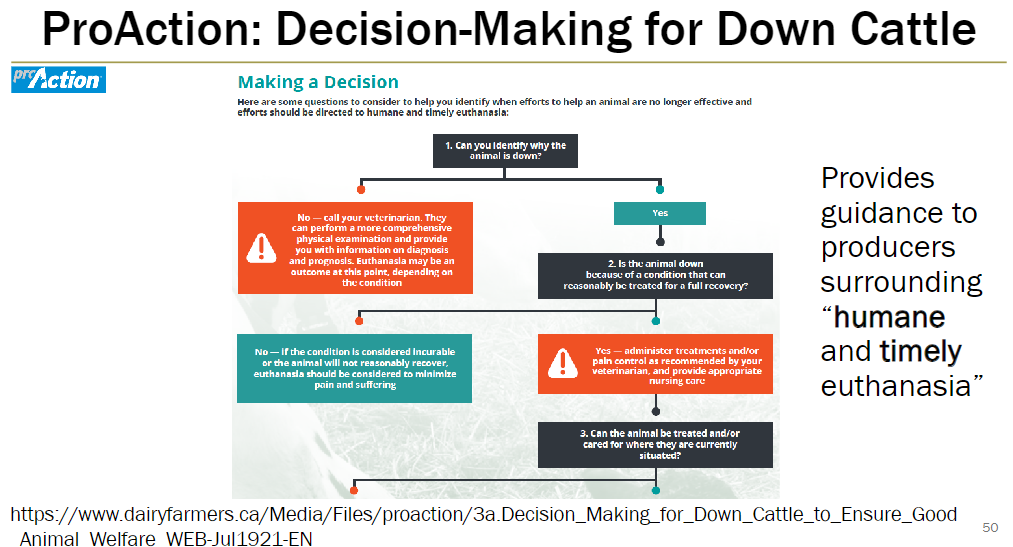
<p><strong>Purpose</strong><br> Provides guidance to producers on humane and timely euthanasia of down cattle</p><p><strong>Implementation</strong><br> Part of Dairy Farmers of Canada on-farm Animal Care Assessment Program</p>
8
New cards

Other Animal Care Assessment Frameworks – Canada

Purpose
 Provide species-specific animal care standards and assessment programs

Examples of Frameworks
 CERTIFUR CANADA – Mink Welfare Assurance
 Egg Farmers of Canada – CPEP (Canadian Poultry & Egg Processors)
 TVOC (Transformateurs de volailles & d'œufs du Canada)
 National Cattle Feeders Association – Association Nationale des Engraisseurs de Bovins
 Chicken Farmers of Canada – Les Producteurs de Poulet du Canada
 Turkey Farmers of Canada – Les Éleveurs de Dindon du Canada
<p><strong>Purpose</strong><br> Provide species-specific animal care standards and assessment programs</p><p><strong>Examples of Frameworks</strong><br> CERTIFUR CANADA – Mink Welfare Assurance<br> Egg Farmers of Canada – CPEP (Canadian Poultry &amp; Egg Processors)<br> TVOC (Transformateurs de volailles &amp; d'œufs du Canada)<br> National Cattle Feeders Association – Association Nationale des Engraisseurs de Bovins<br> Chicken Farmers of Canada – Les Producteurs de Poulet du Canada<br> Turkey Farmers of Canada – Les Éleveurs de Dindon du Canada</p>
9
New cards

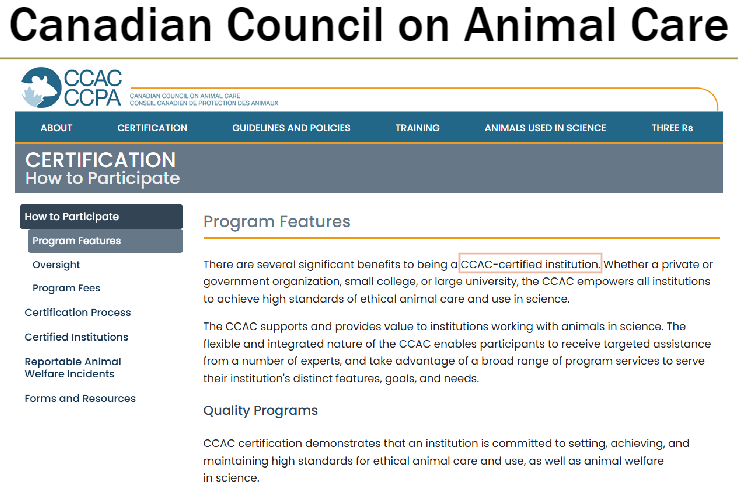
Canadian Council on Animal Care (CCAC) – Program Features

Purpose
 Supports institutions in achieving high standards of ethical animal care and use in science

Benefits of CCAC Certification
 Applicable to private or government organizations, small colleges, or large universities
 Demonstrates commitment to ethical animal care and animal welfare in scientific research

Support and Services
 Flexible, integrated program tailored to institution’s needs
 Provides targeted assistance from experts
 Offers broad range of program services to meet distinct institutional goals
<p><strong>Purpose</strong><br> Supports institutions in achieving high standards of ethical animal care and use in science</p><p><strong>Benefits of CCAC Certification</strong><br> Applicable to private or government organizations, small colleges, or large universities<br> Demonstrates commitment to ethical animal care and animal welfare in scientific research</p><p><strong>Support and Services</strong><br> Flexible, integrated program tailored to institution’s needs<br> Provides targeted assistance from experts<br> Offers broad range of program services to meet distinct institutional goals</p>
10
New cards

Quality Assurance Programs – Animal Welfare in Food Production

Purpose
 Recognize animal welfare as an important attribute of food quality
 Provide reassurance to consumers

Development
 Many programs developed over last 2–3 decades
 Programs may be science-based
 Welfare outcomes can vary widely

Initiators
 Retailers (e.g., fast food chains)
 Producers or producer groups
 Government standards (e.g., organic standards)
 Civil society standards (non-profit organizations)
<p><strong>Purpose</strong><br> Recognize animal welfare as an important attribute of food quality<br> Provide reassurance to consumers</p><p><strong>Development</strong><br> Many programs developed over last 2–3 decades<br> Programs may be science-based<br> Welfare outcomes can vary widely</p><p><strong>Initiators</strong><br> Retailers (e.g., fast food chains)<br> Producers or producer groups<br> Government standards (e.g., organic standards)<br> Civil society standards (non-profit organizations)</p>
11
New cards

Quality Assurance Programs – Societal Influence

Purpose
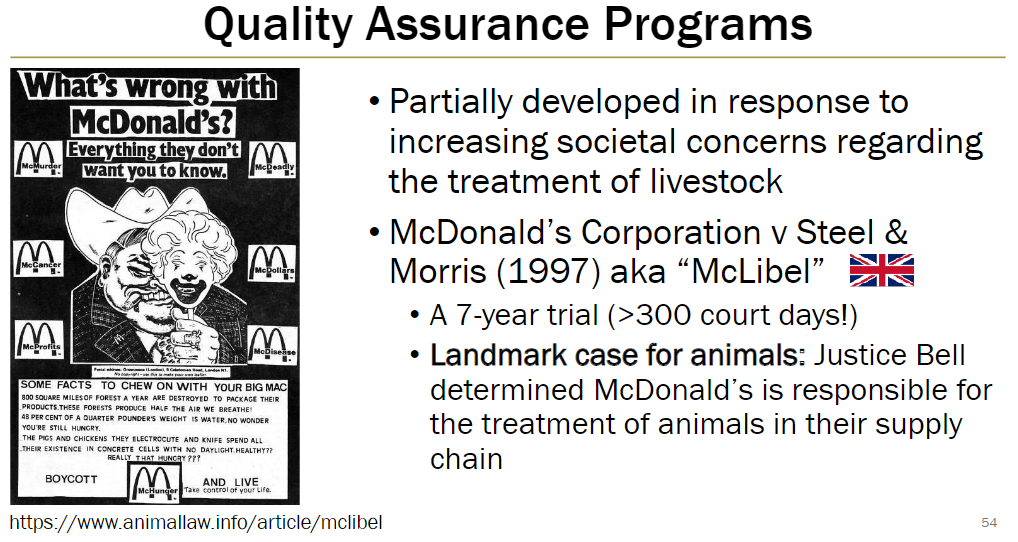
 Partly developed in response to growing societal concerns about livestock treatment

Landmark Case (Very Important Case for Legal Precedence)
 McDonald’s Corporation v Steel & Morris (1997), aka “McLibel”
 7-year trial spanning over 300 court days
 Justice Bell ruled McDonald’s is responsible for treatment of animals in their supply chain
<p><strong>Purpose</strong><br> Partly developed in response to growing societal concerns about livestock treatment</p><p><strong>Landmark Case (Very Important Case for Legal Precedence)</strong><br> McDonald’s Corporation v Steel &amp; Morris (1997), aka “McLibel”<br> 7-year trial spanning over 300 court days<br> Justice Bell ruled McDonald’s is responsible for treatment of animals in their supply chain</p>
12
New cards

Quality Assurance Programs – McDonald’s Animal Welfare Initiatives

Program Launch
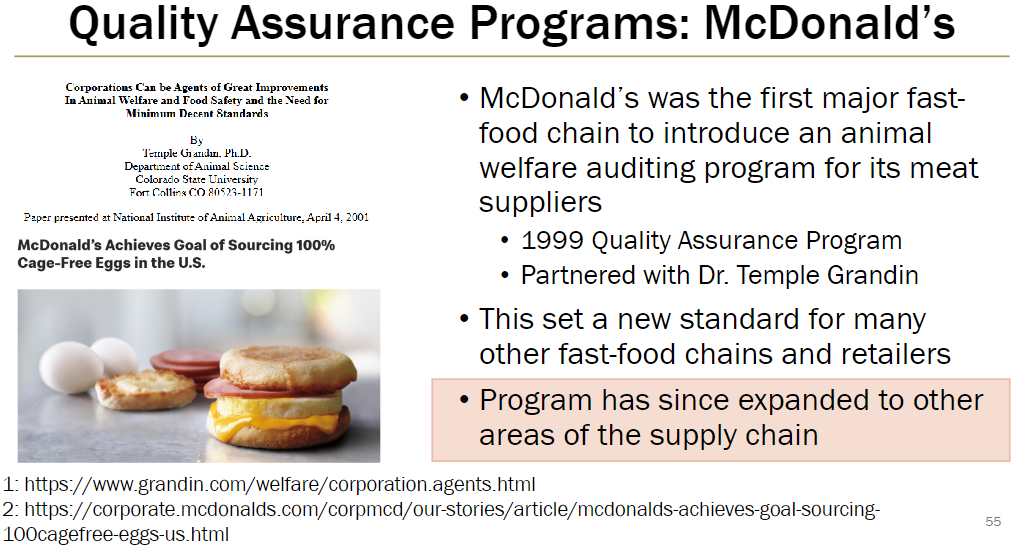
 First major fast-food chain to introduce animal welfare auditing for meat suppliers
 1999: Quality Assurance Program launched

Partnerships
 Collaborated with Dr. Temple Grandin to develop program

Impact
 Set a new standard for other fast-food chains and retailers
 Program has expanded to additional areas of the supply chain
<p><strong>Program Launch</strong><br> First major fast-food chain to introduce animal welfare auditing for meat suppliers<br> 1999: Quality Assurance Program launched</p><p><strong>Partnerships</strong><br> Collaborated with Dr. Temple Grandin to develop program</p><p><strong>Impact</strong><br> Set a new standard for other fast-food chains and retailers<br> Program has expanded to additional areas of the supply chain</p>
13
New cards

Quality Assurance Program – Organic (Government Standard)

Purpose
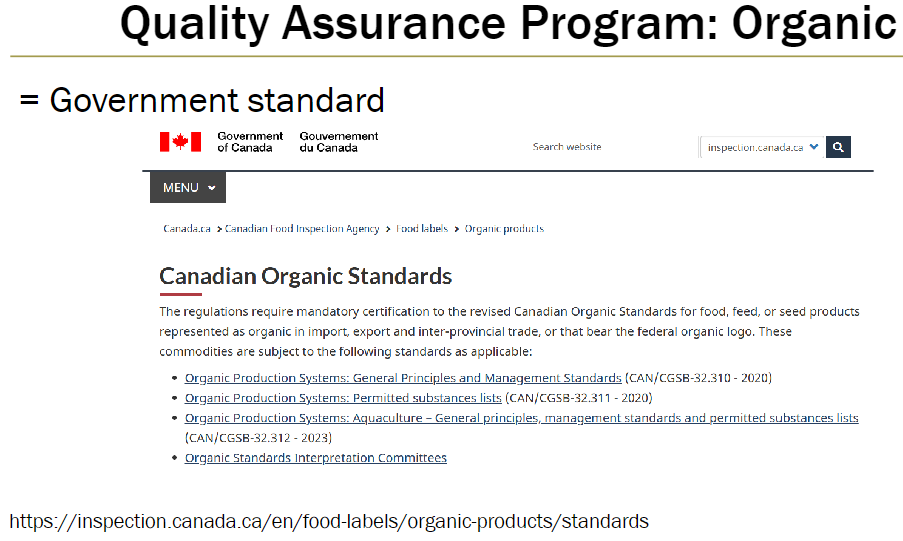
 Ensures food, feed, or seed products represented as organic meet national standards

Requirements
 Mandatory certification to revised Canadian Organic Standards
 Applies to products in import, export, and inter-provincial trade
 Products bearing the federal organic logo must comply
<p><strong>Purpose</strong><br> Ensures food, feed, or seed products represented as organic meet national standards</p><p><strong>Requirements</strong><br> Mandatory certification to revised Canadian Organic Standards<br> Applies to products in import, export, and inter-provincial trade<br> Products bearing the federal organic logo must comply</p>
14
New cards

Codes of Ethics – Supporting Legislation

Purpose
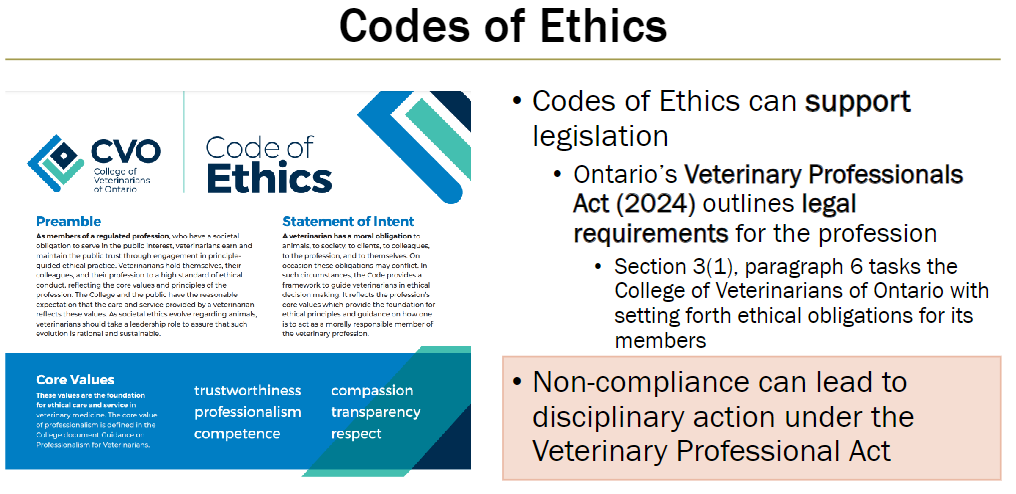
 Support legislation by setting ethical obligations for professionals

Example – Ontario Veterinary Professionals Act (2024)
 Section 3(1), paragraph 6: College of Veterinarians of Ontario sets ethical obligations for members
 Non-compliance can result in disciplinary action under the Veterinary Professionals Act
<p><strong>Purpose</strong><br> Support legislation by setting ethical obligations for professionals</p><p><strong>Example – Ontario Veterinary Professionals Act (2024)</strong><br> Section 3(1), paragraph 6: College of Veterinarians of Ontario sets ethical obligations for members<br> Non-compliance can result in disciplinary action under the Veterinary Professionals Act</p>
15
New cards

Codes of Ethics – Decision-Making in Veterinary Practice

College of Veterinarians of Ontario (CVO)
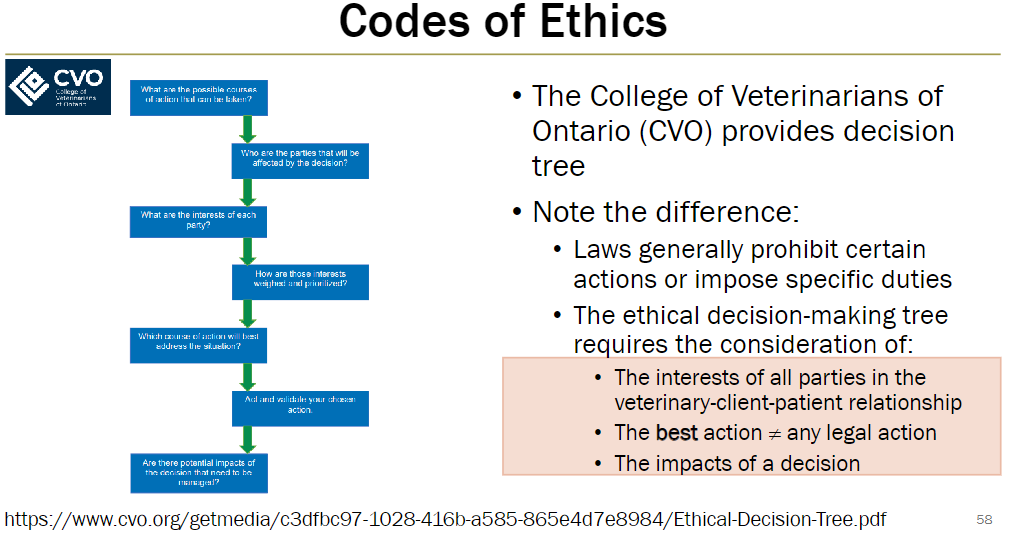
 Provides an ethical decision-making tree for veterinarians

Key Points
 Laws generally prohibit certain actions or impose specific duties
 Ethical decision-making requires considering:
  • Interests of all parties in the veterinary-client-patient relationship
  • Best action may not align with legal action
  • Potential impacts of the decision
<p><strong>College of Veterinarians of Ontario (CVO)</strong><br> Provides an ethical decision-making tree for veterinarians</p><p><strong>Key Points</strong><br> Laws generally prohibit certain actions or impose specific duties<br> Ethical decision-making requires considering:<br>  • Interests of all parties in the veterinary-client-patient relationship<br>  • Best action may not align with legal action<br>  • Potential impacts of the decision</p>
16
New cards

Example – “Cosmetic” Veterinary Surgeries

CVO Position
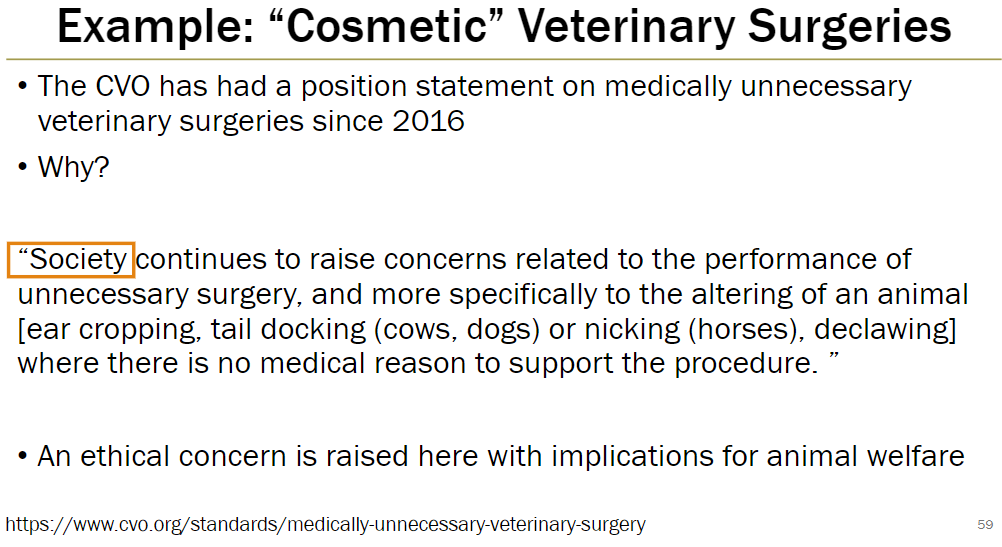
 Since 2016, the College of Veterinarians of Ontario has had a position on medically unnecessary veterinary surgeries

Reason
 Society raises concerns about unnecessary surgeries that alter animals without medical justification
 Examples include ear cropping, tail docking (cows, dogs), nicking (horses), and declawing

Ethical Concern
 Procedures have implications for animal welfare
<p><strong>CVO Position</strong><br> Since 2016, the College of Veterinarians of Ontario has had a position on medically unnecessary veterinary surgeries</p><p><strong>Reason</strong><br> Society raises concerns about unnecessary surgeries that alter animals without medical justification<br> Examples include ear cropping, tail docking (cows, dogs), nicking (horses), and declawing</p><p><strong>Ethical Concern</strong><br> Procedures have implications for animal welfare</p>
17
New cards

Example – “Cosmetic” Veterinary Surgeries (continued)

CVO Statement
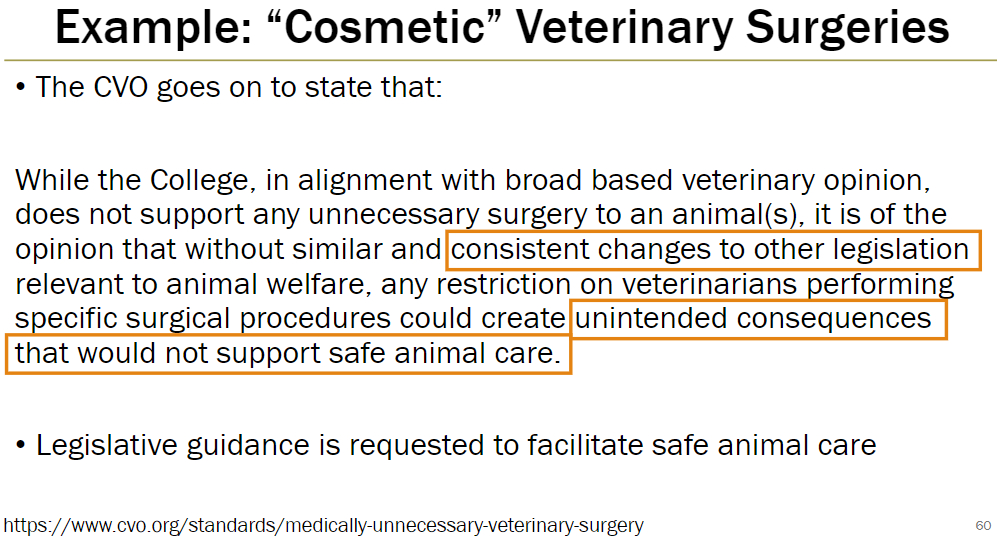
 The College, aligning with broad veterinary opinion, does not support unnecessary surgery on animals

Caution
 Without consistent changes to other animal welfare legislation, restricting veterinarians from specific surgeries could create unintended consequences that may compromise safe animal care

Request
 Legislative guidance is needed to ensure safe animal care
<p><strong>CVO Statement</strong><br> The College, aligning with broad veterinary opinion, does not support unnecessary surgery on animals</p><p><strong>Caution</strong><br> Without consistent changes to other animal welfare legislation, restricting veterinarians from specific surgeries could create unintended consequences that may compromise safe animal care</p><p><strong>Request</strong><br> Legislative guidance is needed to ensure safe animal care</p>
18
New cards

Example – “Cosmetic” Veterinary Surgeries (2025 Update)

Proposed Initiative
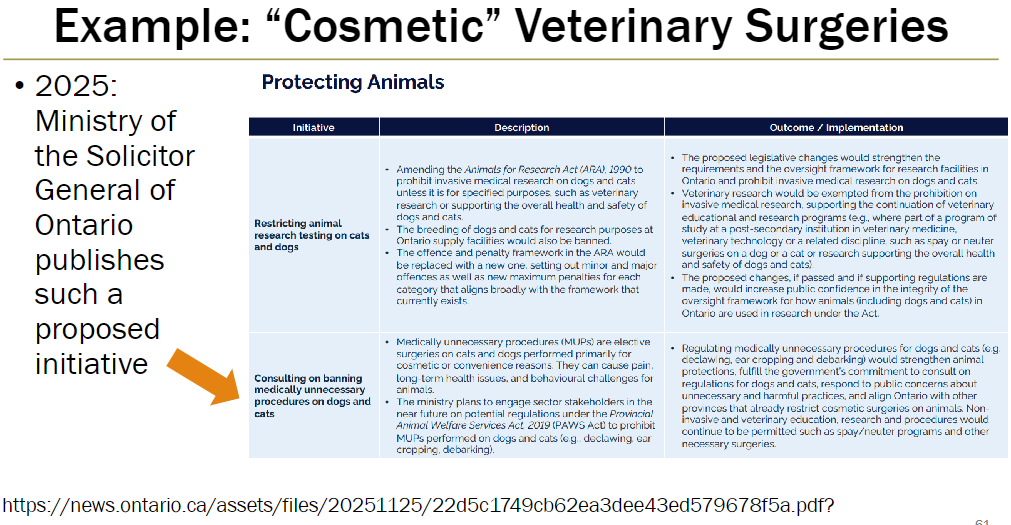
 In 2025, the Ministry of the Solicitor General of Ontario published a proposed initiative related to medically unnecessary veterinary surgeries
<p><strong>Proposed Initiative</strong><br> In 2025, the Ministry of the Solicitor General of Ontario published a proposed initiative related to medically unnecessary veterinary surgeries</p>
19
New cards

International Law – Relevance to Animals

Definition
 Rules governing relationships between countries and other global actors

Importance for Animals
 Livestock and animal by-products are traded internationally
 Species protection crosses national borders

Additional Note
 Carbon biomass = amount of carbon (tonnes) stored in an animal
 Poultry biomass exceeds wild bird biomass by more than 2×
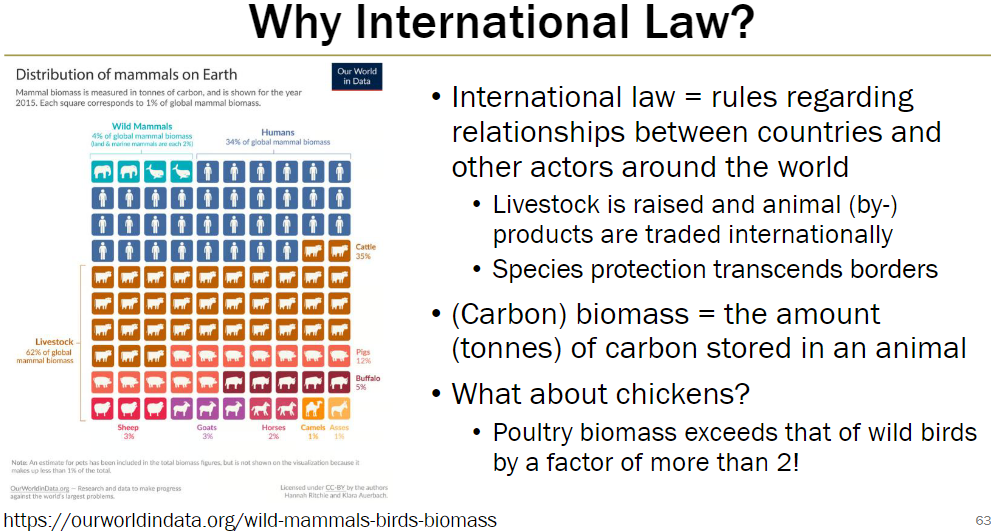
<p><strong>Definition</strong><br> Rules governing relationships between countries and other global actors</p><p><strong>Importance for Animals</strong><br> Livestock and animal by-products are traded internationally<br> Species protection crosses national borders</p><p><strong>Additional Note</strong><br> Carbon biomass = amount of carbon (tonnes) stored in an animal<br> Poultry biomass exceeds wild bird biomass by more than 2×</p>
20
New cards

International Law – Types and Scope

Public International Law
 Applies to sovereign states

Supranational Law
 Applies to states that transfer some sovereignty to a higher jurisdiction
 Examples: European Union (EU), International Criminal Court (ICC)

Private International Law
 Also called “conflict of laws”
 Deals with jurisdiction, foreign court rulings, and choice of law

Note
 Private international law was not covered in class
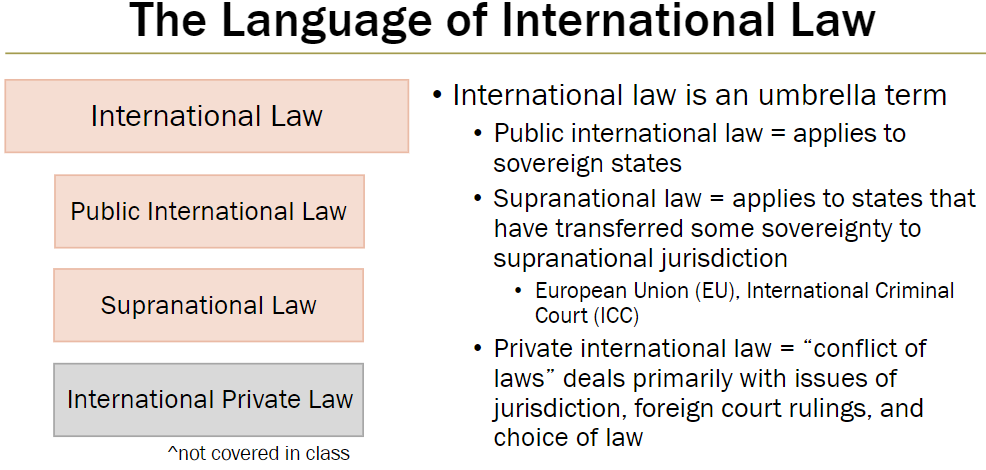
<p><strong>Public International Law</strong><br> Applies to sovereign states</p><p><strong>Supranational Law</strong><br> Applies to states that transfer some sovereignty to a higher jurisdiction<br> Examples: European Union (EU), International Criminal Court (ICC)</p><p><strong>Private International Law</strong><br> Also called “conflict of laws”<br> Deals with jurisdiction, foreign court rulings, and choice of law</p><p><strong>Note</strong><br> Private international law was not covered in class</p>
21
New cards

How International Law Works – Key Features

Sovereignty
 International agreements: signatory nations retain sovereignty
 Supranational agreements: sovereignty partially transferred to a supranational entity
 Definition: the right of a nation or people to self-govern and exercise ultimate authority over a specific geographic area

Decision-Making
 International agreements: always require consent, usually consensus or unanimity
 Supranational agreements: majority voting can impose binding decisions on all members

Enforcement
 International agreements: rely on state compliance, cannot override national sovereignty
 Supranational agreements: enforcement often handled by the designated supranational entity

Examples
 International agreements: World Trade Organization (WTO) rules, World Organisation for Animal Health (WOAH) standards
 Supranational agreements: Treaty on the Functioning of the European Union (TFEU), EU directives and regulations
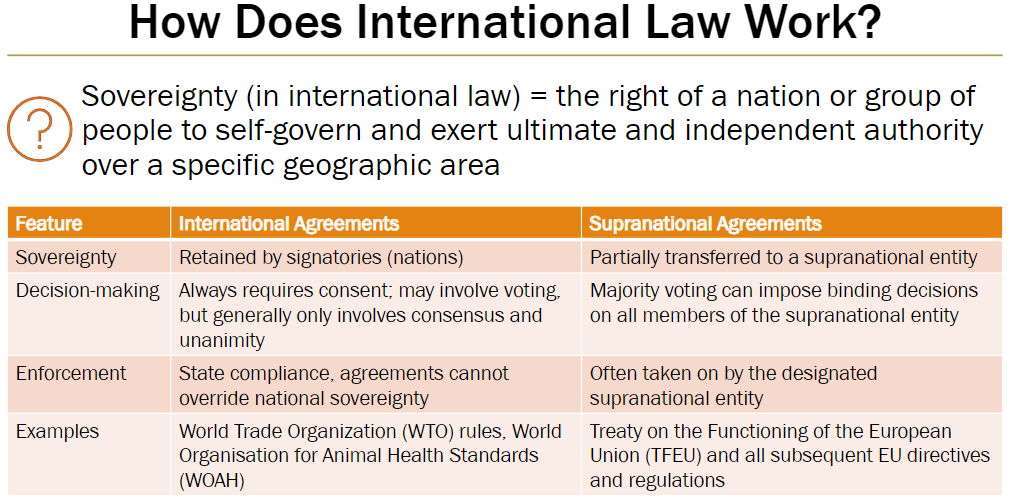
<p><strong>Sovereignty</strong><br> International agreements: signatory nations retain sovereignty<br> Supranational agreements: sovereignty partially transferred to a supranational entity<br> Definition: the right of a nation or people to self-govern and exercise ultimate authority over a specific geographic area</p><p><strong>Decision-Making</strong><br> International agreements: always require consent, usually consensus or unanimity<br> Supranational agreements: majority voting can impose binding decisions on all members</p><p><strong>Enforcement</strong><br> International agreements: rely on state compliance, cannot override national sovereignty<br> Supranational agreements: enforcement often handled by the designated supranational entity</p><p><strong>Examples</strong><br> International agreements: World Trade Organization (WTO) rules, World Organisation for Animal Health (WOAH) standards<br> Supranational agreements: Treaty on the Functioning of the European Union (TFEU), EU directives and regulations</p>
22
New cards

Enforcement in International Law

 International laws are often even harder to enforce than national laws
 Recall Martin’s Act as an example of how enforcement challenges can limit the effectiveness of laws
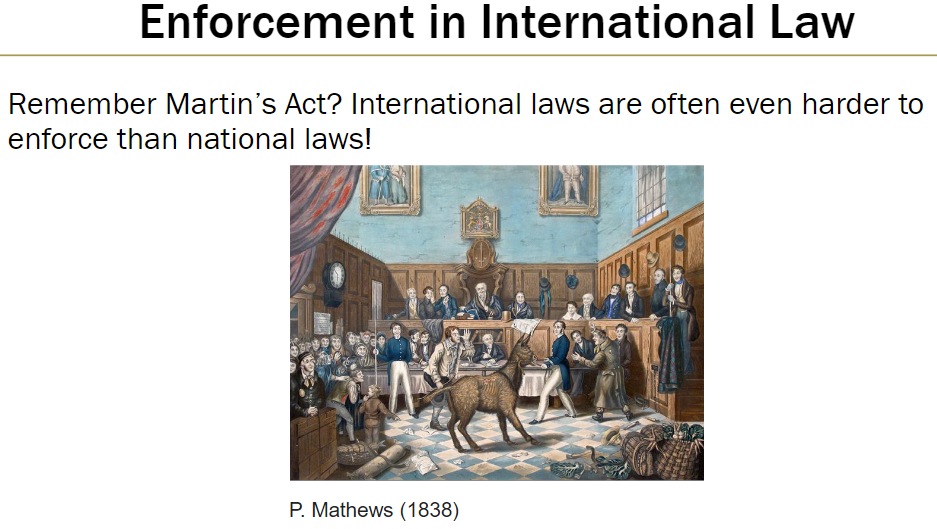
<p> International laws are often even harder to enforce than national laws<br> Recall Martin’s Act as an example of how enforcement challenges can limit the effectiveness of laws</p>
23
New cards

Wildlife in International Law

Goal
 Species conservation is a key objective of international legislation
 Note: species conservation does not directly improve individual animal welfare

Key Agreements
 International Convention for the Regulation of Whaling (1946) – established the International Whaling Commission (IWC)
 Convention on International Trade in Endangered Species (CITES, 1975)
 Convention on Migratory Species (1983)
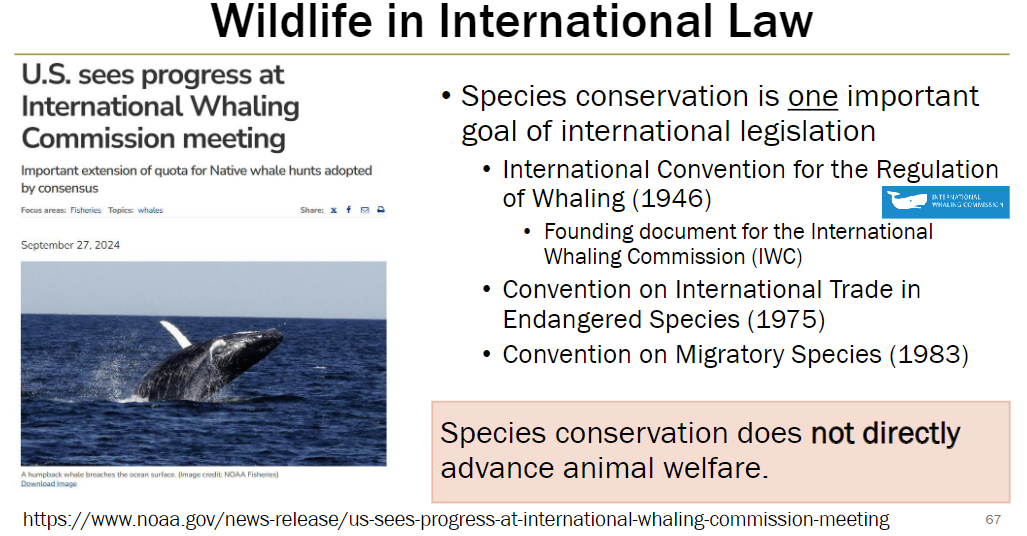
<p><strong>Goal</strong><br> Species conservation is a key objective of international legislation<br> Note: species conservation does not directly improve individual animal welfare</p><p><strong>Key Agreements</strong><br> International Convention for the Regulation of Whaling (1946) – established the International Whaling Commission (IWC)<br> Convention on International Trade in Endangered Species (CITES, 1975)<br> Convention on Migratory Species (1983)</p>
24
New cards

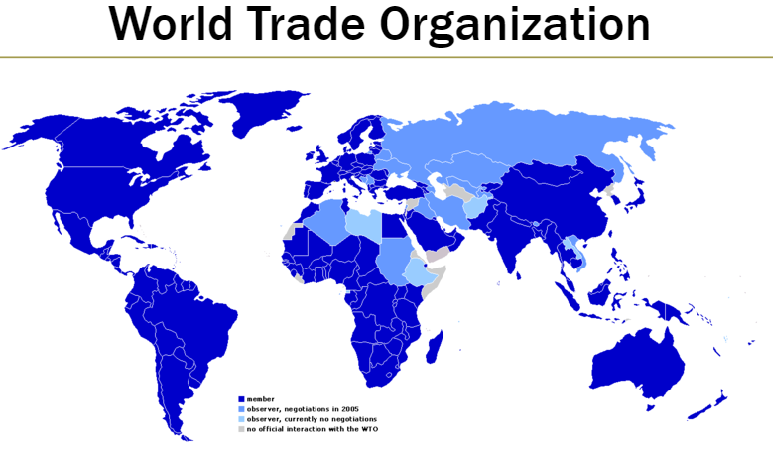
World Trade Organization

knowt flashcard image
25
New cards

World Trade Organization (WTO) and Trade Law

History
 1947: General Agreement on Tariffs and Trade (GATT) – focused on industrial goods, principle of non-discrimination in trade
 1995: WTO replaces GATT and includes agricultural products

Purpose
 Prevent unjustified discrimination based on country of origin

Current Issues
 Disputes often involve production methods, which indirectly relate to country of origin

Example
 Trade between EU and India – import across borders
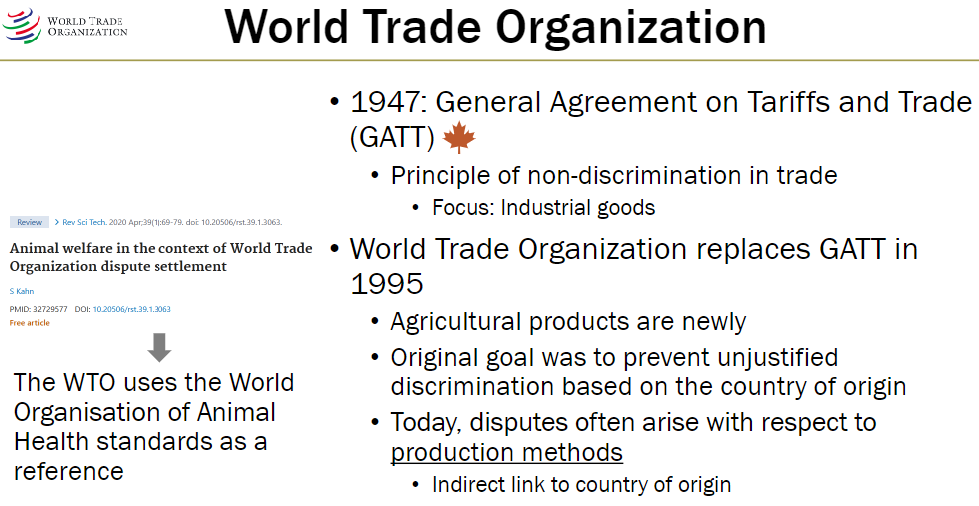
<p><strong>History</strong><br> 1947: General Agreement on Tariffs and Trade (GATT) – focused on industrial goods, principle of non-discrimination in trade<br> 1995: WTO replaces GATT and includes agricultural products</p><p><strong>Purpose</strong><br> Prevent unjustified discrimination based on country of origin</p><p><strong>Current Issues</strong><br> Disputes often involve production methods, which indirectly relate to country of origin</p><p><strong>Example</strong><br> Trade between EU and India – import across borders</p>
26
New cards

World Trade Organization (WTO) and Animal Trade

History
 1947: General Agreement on Tariffs and Trade (GATT) – focused on industrial goods, principle of non-discrimination in trade
 1995: WTO replaces GATT and includes agricultural products

Purpose
 Prevent unjustified discrimination based on country of origin

Current Issues
 Disputes often arise regarding production methods – indirectly linked to country of origin

Reference Standards
 WTO uses World Organisation for Animal Health (WOAH) standards as a reference
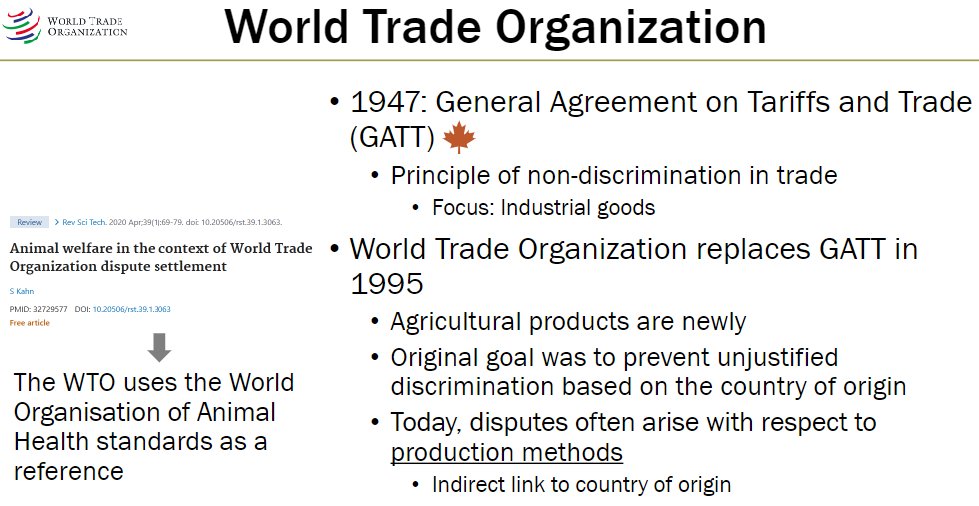
<p><strong>History</strong><br> 1947: General Agreement on Tariffs and Trade (GATT) – focused on industrial goods, principle of non-discrimination in trade<br> 1995: WTO replaces GATT and includes agricultural products</p><p><strong>Purpose</strong><br> Prevent unjustified discrimination based on country of origin</p><p><strong>Current Issues</strong><br> Disputes often arise regarding production methods – indirectly linked to country of origin</p><p><strong>Reference Standards</strong><br> WTO uses World Organisation for Animal Health (WOAH) standards as a reference</p>
27
New cards

Seal Products Landmark Case

Parties
 Complainants: Canada and Norway
 Respondent: European Union (EU)

Dispute
 Whether the EU can ban import of seal products without unfairly restricting trade or violating WTO rules
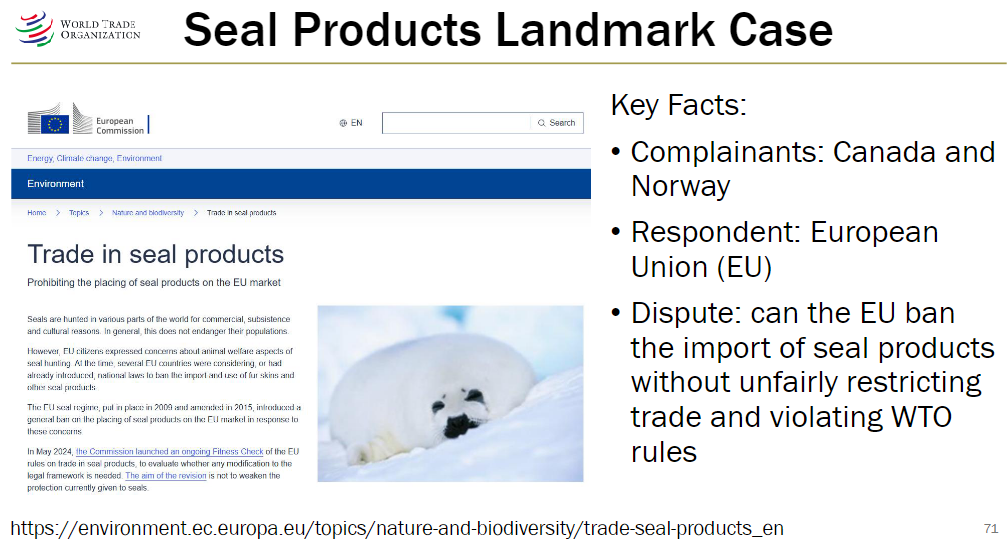
<p><strong>Parties</strong><br> Complainants: Canada and Norway<br> Respondent: European Union (EU)</p><p><strong>Dispute</strong><br> Whether the EU can ban import of seal products without unfairly restricting trade or violating WTO rules</p>
28
New cards

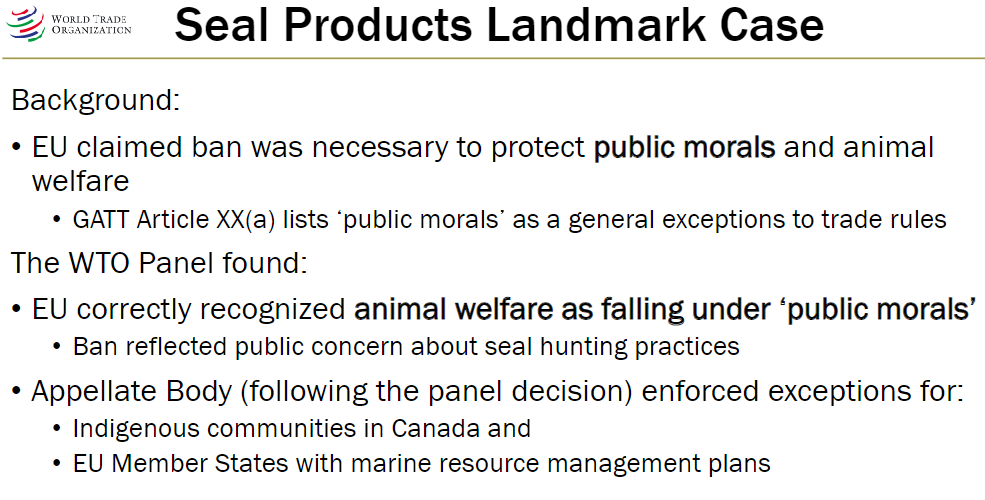
Seal Products Landmark Case – Background & WTO Decision

EU Position
 Ban on seal product imports necessary to protect public morals and animal welfare
 GATT Article XX(a) allows exceptions for public morals

WTO Panel Findings
 Animal welfare falls under ‘public morals’
 Ban reflected public concern about seal hunting practices

Appellate Body Enforcement
 Exceptions allowed for:
  Indigenous communities in Canada
  EU Member States with marine resource management plans
<p><strong>EU Position</strong><br> Ban on seal product imports necessary to protect public morals and animal welfare<br> GATT Article XX(a) allows exceptions for public morals</p><p><strong>WTO Panel Findings</strong><br> Animal welfare falls under ‘public morals’<br> Ban reflected public concern about seal hunting practices</p><p><strong>Appellate Body Enforcement</strong><br> Exceptions allowed for:<br>  Indigenous communities in Canada<br>  EU Member States with marine resource management plans</p>
29
New cards

Seal Products Landmark Case – Importance

Significance
 Consumer concerns led to trade ban
 WTO recognized ethical concerns as legally relevant
 Set precedent for considering animal welfare in international trade
 Emphasizes growing role of ethics in global trade

Limitations
 Shows challenges of balancing cultural expectations globally
 Has not been applied as precedent for livestock trade
<p><strong>Significance</strong><br> Consumer concerns led to trade ban<br> WTO recognized ethical concerns as legally relevant<br> Set precedent for considering animal welfare in international trade<br> Emphasizes growing role of ethics in global trade</p><p><strong>Limitations</strong><br> Shows challenges of balancing cultural expectations globally<br> Has not been applied as precedent for livestock trade</p>
30
New cards

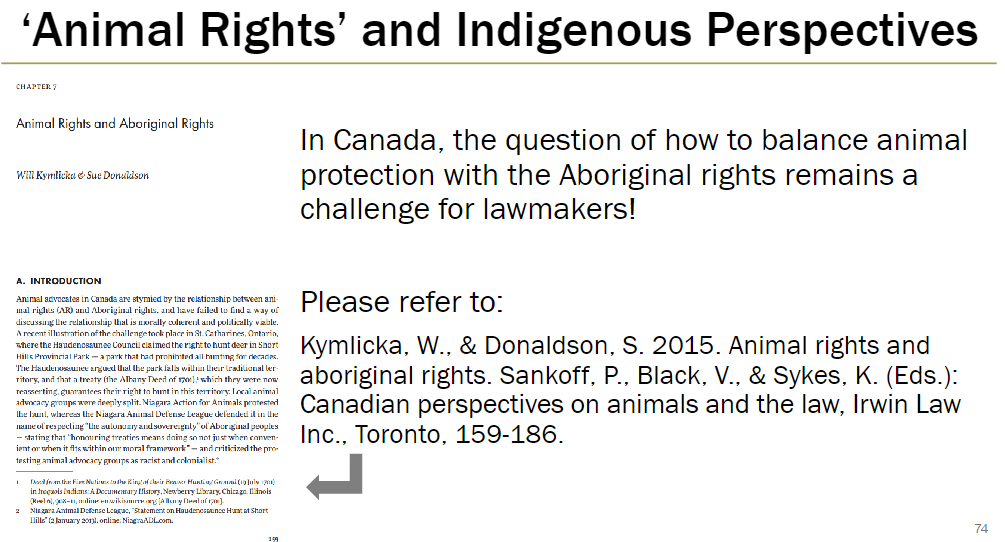
Animal Rights and Indigenous Perspectives

Challenge
 Balancing animal protection with Aboriginal rights in Canada
 Indigenous perspectives may differ from mainstream animal welfare approaches

Reference
 Kymlicka, W., & Donaldson, S. 2015
Animal rights and aboriginal rights
 In Sankoff, P., Black, V., & Sykes, K. (Eds.), Canadian perspectives on animals and the law, Irwin Law Inc., Toronto, 159‑186
<p><strong>Challenge</strong><br> Balancing animal protection with Aboriginal rights in Canada<br> Indigenous perspectives may differ from mainstream animal welfare approaches</p><p><strong>Reference</strong><br> Kymlicka, W., &amp; Donaldson, S. 2015<br> <em>Animal rights and aboriginal rights</em><br> In Sankoff, P., Black, V., &amp; Sykes, K. (Eds.), <em>Canadian perspectives on animals and the law</em>, Irwin Law Inc., Toronto, 159‑186</p>
31
New cards

World Organisation of Animal Health (WOAH)

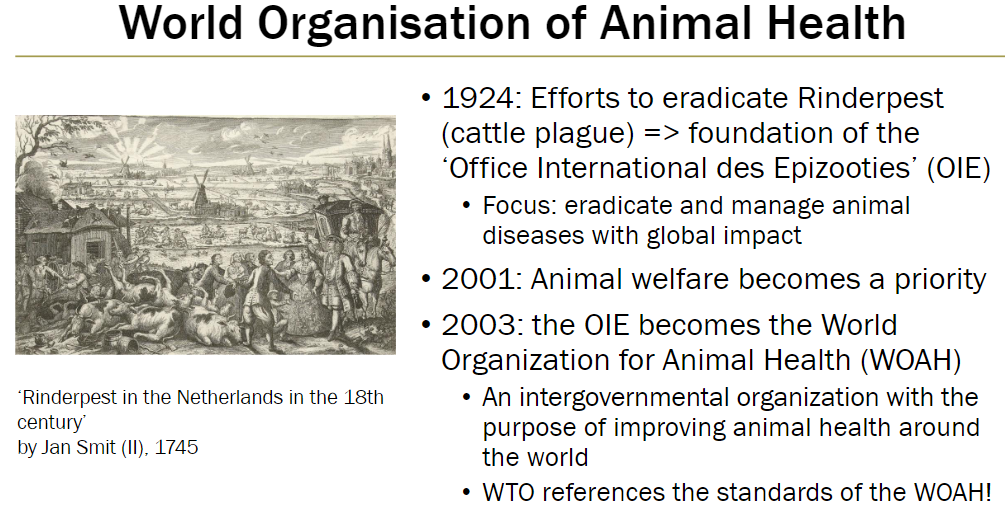
History
 1924: Efforts to eradicate Rinderpest (cattle plague) led to creation of Office International des Epizooties (OIE)
 2001: Animal welfare added as priority
 2003: OIE renamed World Organization for Animal Health (WOAH)

Purpose
 Eradicate and manage animal diseases with global impact
 Improve animal health worldwide
 Standards referenced by the World Trade Organization (WTO)
<p><strong>History</strong><br> 1924: Efforts to eradicate Rinderpest (cattle plague) led to creation of <em>Office International des Epizooties</em> (OIE)<br> 2001: Animal welfare added as priority<br> 2003: OIE renamed World Organization for Animal Health (WOAH)</p><p><strong>Purpose</strong><br> Eradicate and manage animal diseases with global impact<br> Improve animal health worldwide<br> Standards referenced by the World Trade Organization (WTO)</p>
32
New cards

WOAH: Terrestrial Animal Health Code

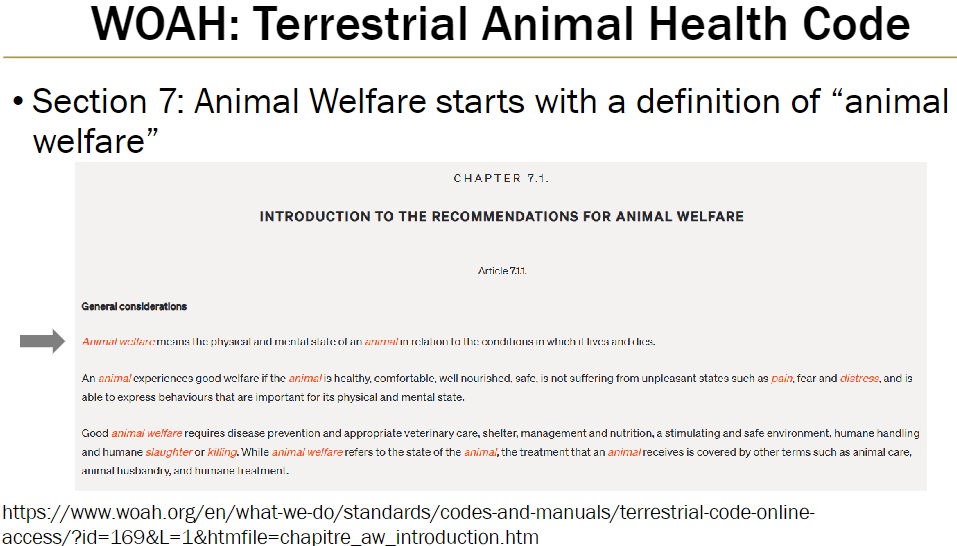
Section 7: Animal Welfare
 Starts with a definition of “animal welfare”
<p><strong>Section 7: Animal Welfare</strong><br> Starts with a definition of “animal welfare”</p>
33
New cards

WOAH: Terrestrial Animal Health Code – Section 7: Animal Welfare

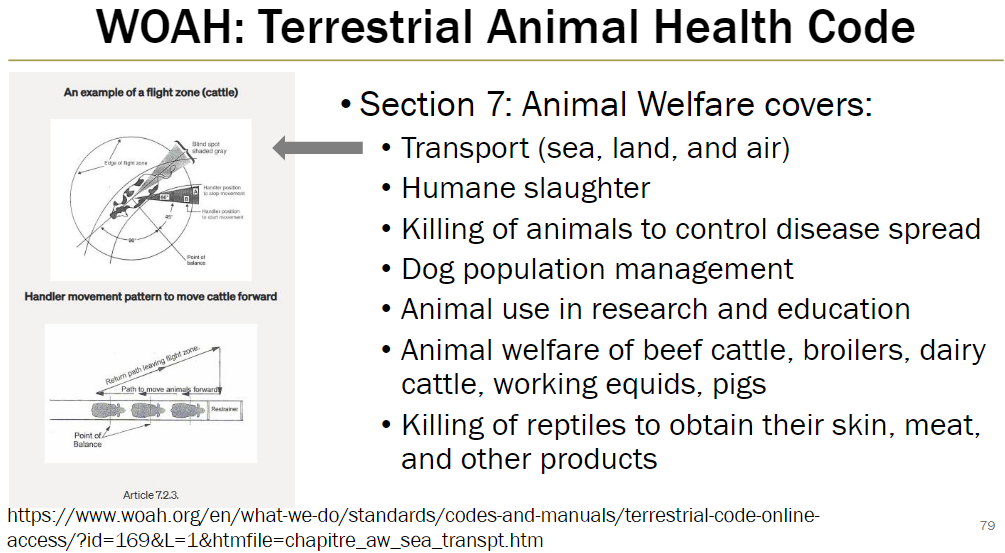
Topics Covered
 Transport of animals (sea, land, and air)
 Humane slaughter
 Killing animals to control disease spread
 Dog population management
 Animal use in research and education
 Animal welfare of beef cattle, broilers, dairy cattle, working equids, pigs
 Killing of reptiles to obtain skin, meat, and other products
<p><strong>Topics Covered</strong><br> Transport of animals (sea, land, and air)<br> Humane slaughter<br> Killing animals to control disease spread<br> Dog population management<br> Animal use in research and education<br> Animal welfare of beef cattle, broilers, dairy cattle, working equids, pigs<br> Killing of reptiles to obtain skin, meat, and other products</p>
34
New cards

WOAH Standards – Importance

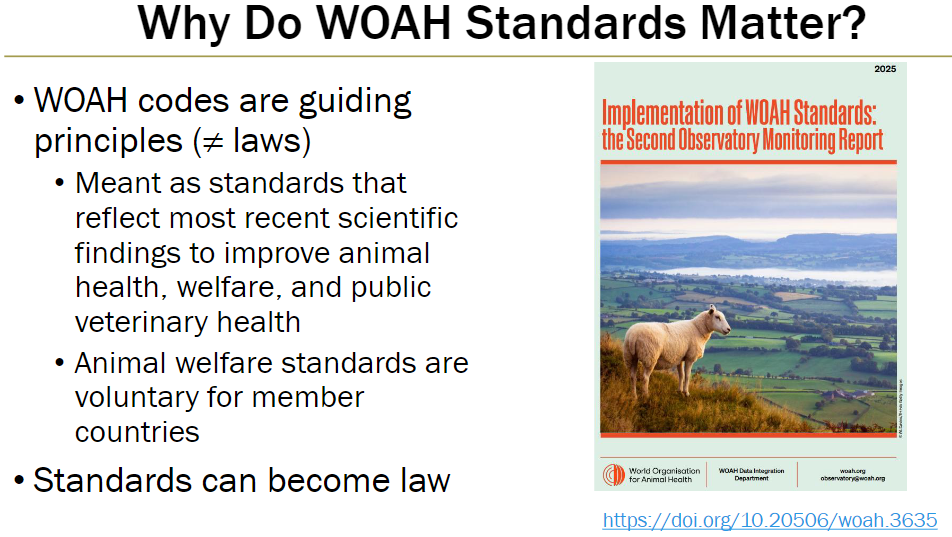
Guiding Principles
 WOAH codes serve as guiding principles, not laws
 Reflect the latest scientific findings to improve animal health, welfare, and public veterinary health
 Animal welfare standards are voluntary for member countries
 Standards can be adopted into law
<p><strong>Guiding Principles</strong><br> WOAH codes serve as guiding principles, not laws<br> Reflect the latest scientific findings to improve animal health, welfare, and public veterinary health<br> Animal welfare standards are voluntary for member countries<br> Standards can be adopted into law</p>
35
New cards

WOAH Standards – National Implementation & Support

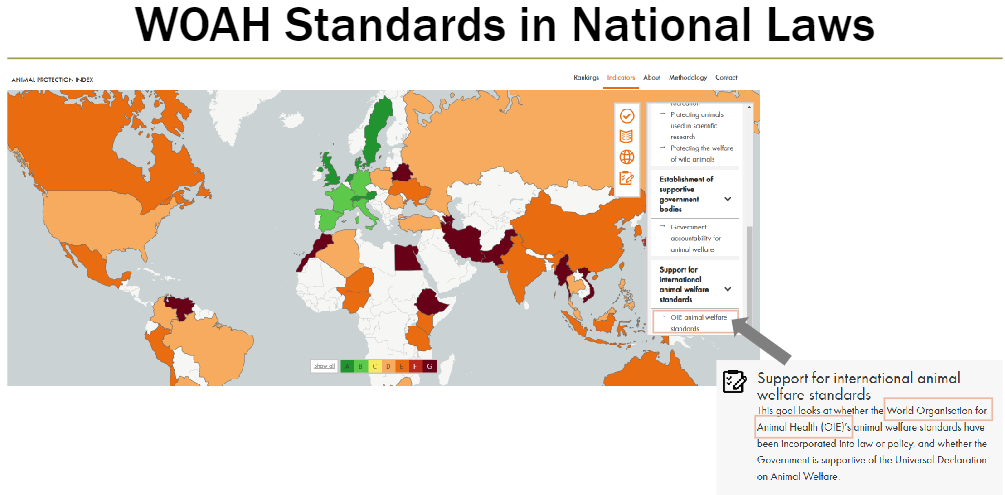
Purpose
 Assesses whether the World Organisation for Animal Health (WOAH) animal welfare standards have been incorporated into national law or policy
 Checks whether the government supports the Universal Declaration on Animal Welfare
<p><strong>Purpose</strong><br> Assesses whether the World Organisation for Animal Health (WOAH) animal welfare standards have been incorporated into national law or policy<br> Checks whether the government supports the Universal Declaration on Animal Welfare</p>
36
New cards

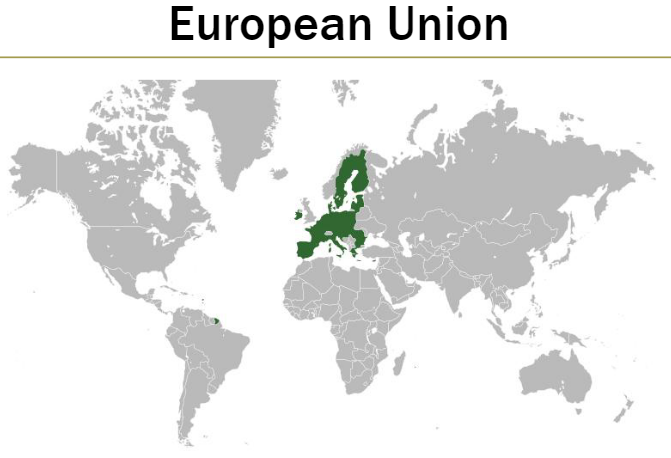
European Union

knowt flashcard image
37
New cards

European Union (EU) – Early Foundations

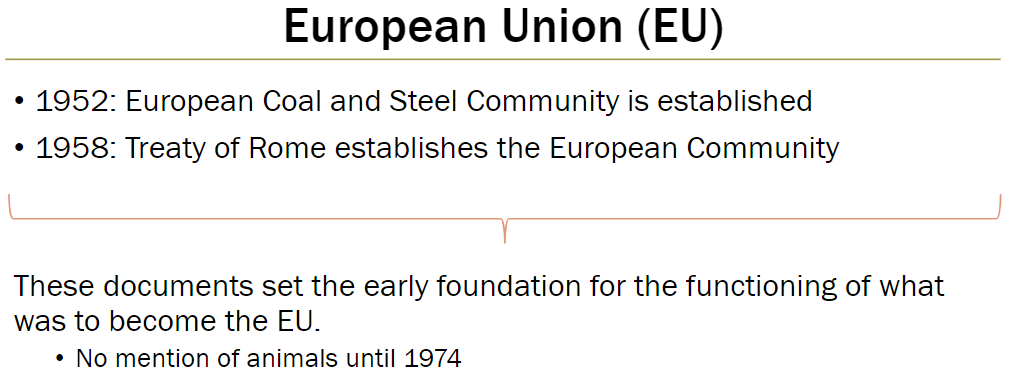
Timeline
 1952: European Coal and Steel Community established
 1958: Treaty of Rome establishes the European Community

Significance
 Set the early foundation for what later became the European Union (EU)
 No mention of animals in these founding documents until 1974
<p><strong>Timeline</strong><br> 1952: European Coal and Steel Community established<br> 1958: Treaty of Rome establishes the European Community</p><p><strong>Significance</strong><br> Set the early foundation for what later became the European Union (EU)<br> No mention of animals in these founding documents until 1974</p>
38
New cards

Early EU Animal Law

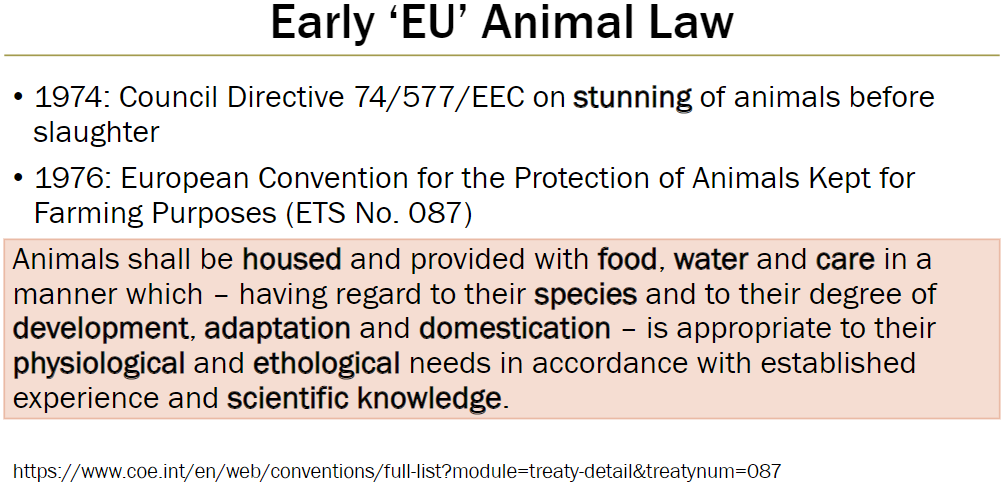
Council Directive 74/577/EEC (1974)
 Required stunning of animals before slaughter

European Convention for the Protection of Animals Kept for Farming Purposes (ETS No. 087, 1976)
 Animals must be housed and provided with food, water, and care appropriate to their species
 Consider physiological and ethological needs, adaptation, domestication
 Guided by established experience and scientific knowledge
<p><strong>Council Directive 74/577/EEC (1974)</strong><br> Required stunning of animals before slaughter</p><p><strong>European Convention for the Protection of Animals Kept for Farming Purposes (ETS No. 087, 1976)</strong><br> Animals must be housed and provided with food, water, and care appropriate to their species<br> Consider physiological and ethological needs, adaptation, domestication<br> Guided by established experience and scientific knowledge</p>
39
New cards

European Union (EU) – Historical Overview

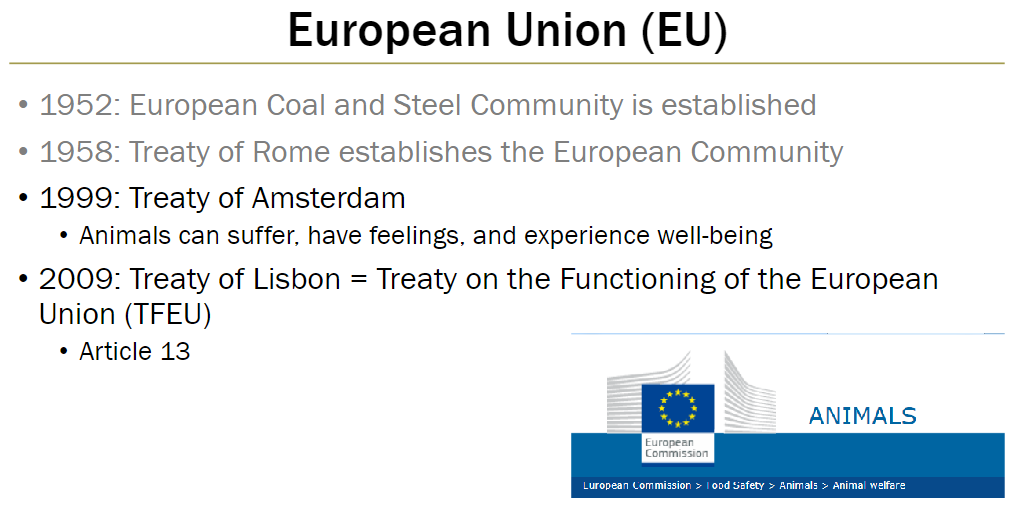
1952 – European Coal and Steel Community
 Early economic integration, no mention of animals

1958 – Treaty of Rome
 Established the European Community, still no animal provisions

1999 – Treaty of Amsterdam
 Recognizes that animals can suffer, have feelings, and experience well-being

2009 – Treaty of Lisbon (Treaty on the Functioning of the EU, TFEU)
Article 13 acknowledges animal sentience and requires EU and member states to pay full regard to the welfare requirements of animals
<p><strong>1952 – European Coal and Steel Community</strong><br> Early economic integration, no mention of animals</p><p><strong>1958 – Treaty of Rome</strong><br> Established the European Community, still no animal provisions</p><p><strong>1999 – Treaty of Amsterdam</strong><br> Recognizes that animals can suffer, have feelings, and experience well-being</p><p><strong>2009 – Treaty of Lisbon (Treaty on the Functioning of the EU, TFEU)</strong><br> <strong>Article 13</strong> acknowledges animal sentience and requires EU and member states to pay full regard to the welfare requirements of animals</p>
40
New cards

TFEU Article 13 – Animal Welfare

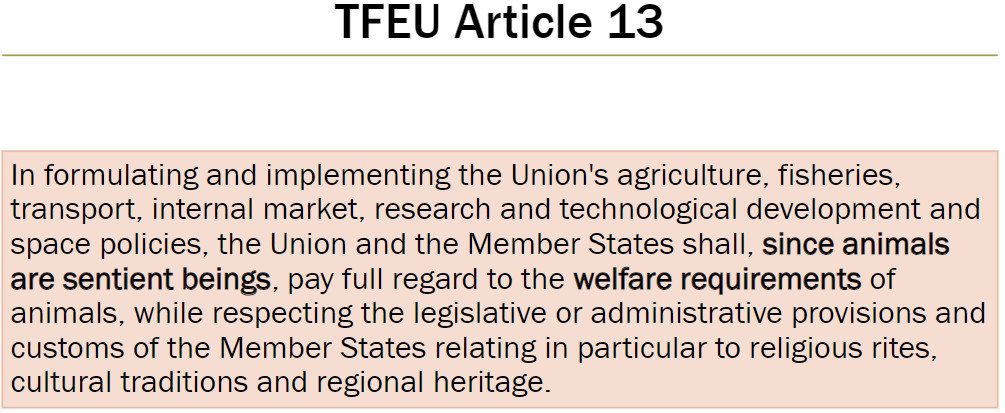
Key Principle
 Animals are recognized as sentient beings in EU policies on agriculture, fisheries, transport, internal market, research, technological development, and space.

Obligation
 The EU and its Member States must fully consider the welfare requirements of animals.

Limitations / Considerations
 Respect legislative or administrative provisions and customs of Member States
 Including religious rites, cultural traditions, and regional heritage
<p><strong>Key Principle</strong><br> Animals are recognized as sentient beings in EU policies on agriculture, fisheries, transport, internal market, research, technological development, and space.</p><p><strong>Obligation</strong><br> The EU and its Member States must fully consider the welfare requirements of animals.</p><p><strong>Limitations / Considerations</strong><br> Respect legislative or administrative provisions and customs of Member States<br> Including religious rites, cultural traditions, and regional heritage</p>
41
New cards

Current EU Animal Law Goals

Focus Areas
 Updating rules on the transport of animals
 Establishing welfare rules for dogs and cats in breeding establishments, shelters, and pet stores

Standards for Dogs and Cats
 Minimum requirements for housing, care, and handling
 Traceability requirements for online pet purchases

Fur Farming
 European Food Safety Authority (EFSA) tasked with assessing welfare of farmed animals for fur
 EU decision on a potential ban on fur farming expected by 2026
<p><strong>Focus Areas</strong><br> Updating rules on the transport of animals<br> Establishing welfare rules for dogs and cats in breeding establishments, shelters, and pet stores</p><p><strong>Standards for Dogs and Cats</strong><br> Minimum requirements for housing, care, and handling<br> Traceability requirements for online pet purchases</p><p><strong>Fur Farming</strong><br> European Food Safety Authority (EFSA) tasked with assessing welfare of farmed animals for fur<br> EU decision on a potential ban on fur farming expected by 2026</p>
42
New cards

Animal Law Differs between EU Member States

Highest Grades – B
 Austria
 Denmark
 Netherlands
 Sweden
 (Switzerland and United Kingdom – not EU Member States)

Medium Grades – C
 Germany
 France
 Italy
 Poland
 Spain

Lowest Grade – D
 Romania
 Canada
 USA

Other Member States
 The remaining 17 EU Member States have not yet been assessed by World Animal Protection
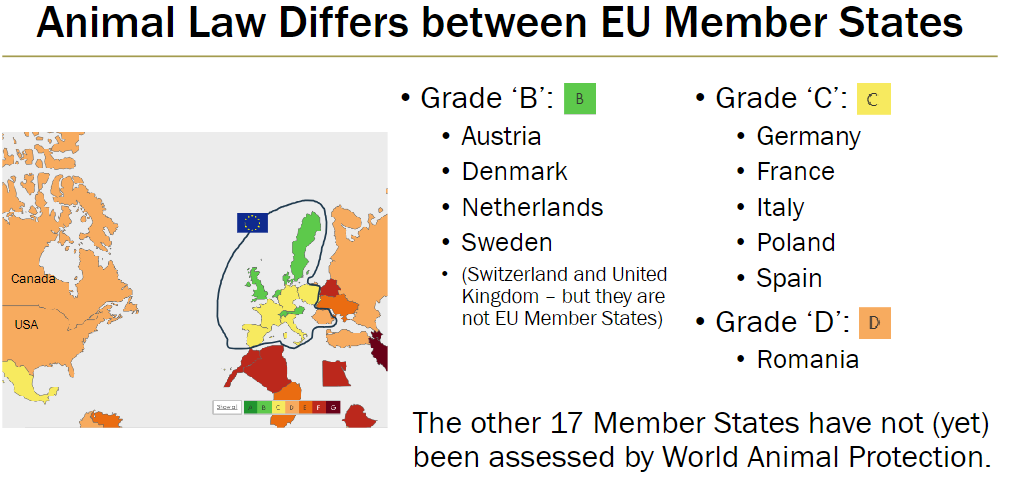
<p><strong>Highest Grades – B</strong><br> Austria<br> Denmark<br> Netherlands<br> Sweden<br> (Switzerland and United Kingdom – not EU Member States)</p><p><strong>Medium Grades – C</strong><br> Germany<br> France<br> Italy<br> Poland<br> Spain</p><p><strong>Lowest Grade – D</strong><br> Romania<br> Canada<br> USA</p><p><strong>Other Member States</strong><br> The remaining 17 EU Member States have not yet been assessed by World Animal Protection</p>