Unit 3 Electrical Circuits
 Studied by 0 people
 Call Kai
 Learn
Learn Practice Test
 Spaced Repetition
 Match
Match Flashcards
 Knowt Play
1/35

There's no tags or description
Looks like no tags are added yet.
Name | Mastery | Learn | Test | Matching | Spaced | Call with Kai |
|---|
No analytics yet
Send a link to your students to track their progress
36 Terms
Direction of Coventional Current
Direct of positive hole charge, opposite of electron flow.
Sides of battery and reminders when drawing
longer is positive side, shorter is negative, ALWAYS CONNECT IT DIRECTLY TO WIRE
Current
dq/dt. Is a VECTOR
EMF (ε)
Basically voltage (causes it)
NOT a force
Potential Difference of an open curcuit
STILL exists, just no current
ZERO charge flows
Finding amount of charge in a circuit
MUST take into the account the amounts of time
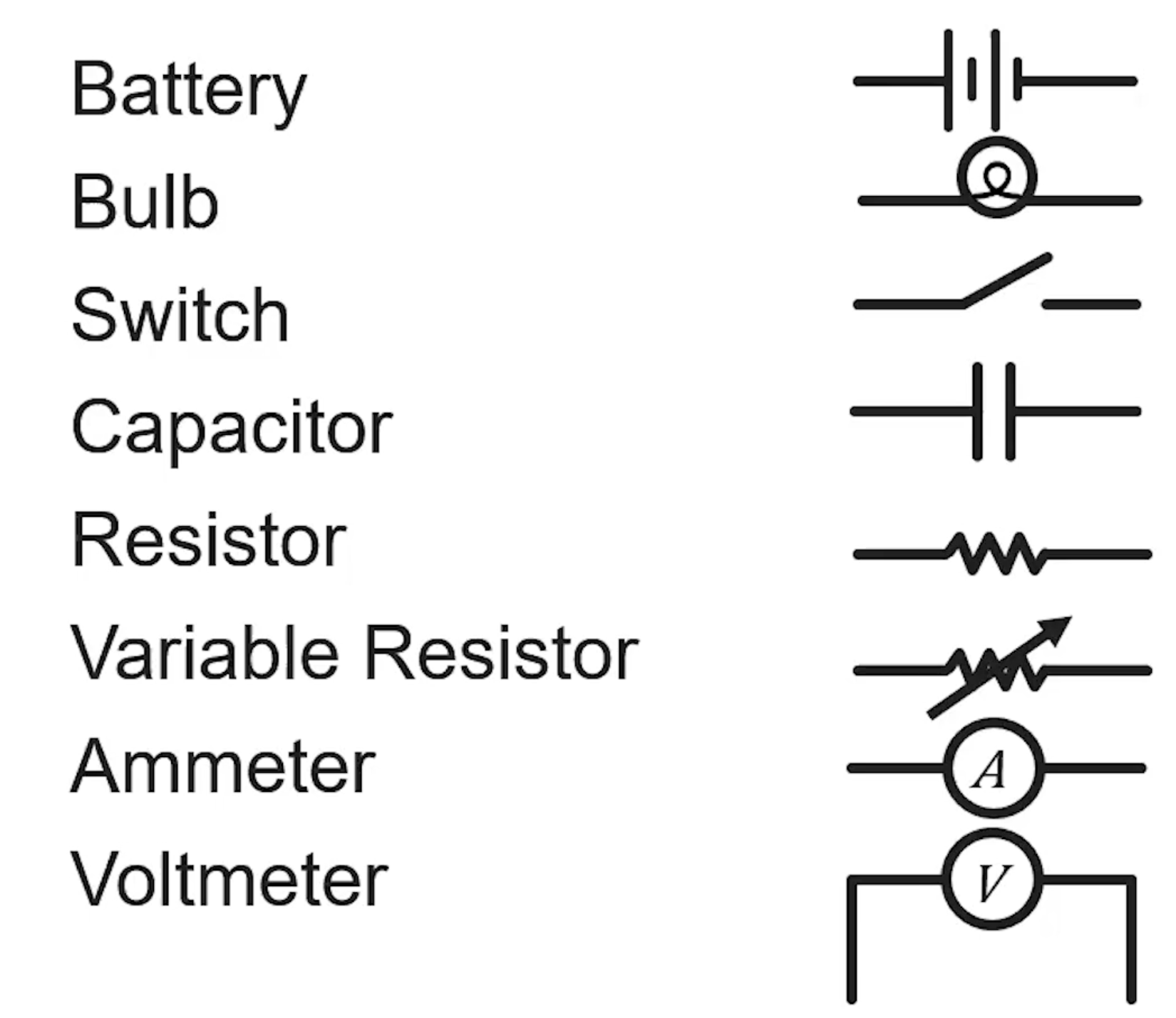
Circuit Symbols
Series Circuit Rules for V,I,R,C,Q
V: Sum
I: Equal
R: Sum
C: Inverses
Q: Equal
Parallel Circuit Rules for V,I,R,C,Q
V: Equal
I: Sum
R: Inverses
C: Sum
Q: Sum
Which circuit rules are opposite?
V and I/Q are opposite, C and R are opposite
What happens if there is a parallel branch with nothing on the branch? (circuit with 2+ branches)
Fuse blows
What happens to the Resistance of a wire if it is folded in half?
Length halves but AREA DOUBLES, so ¼ of Resistance
How to find total power and work
SCALAR sum
Resistivity
R = rho*L/A. As temperature increases, rho increases (for conductors). For insulators, it is inverse with temperature.
Ohmic means
Ideal
Direct Current
Current goes from the positive side of the battery (higher potential) to negative, supplied by a battery
Nonideal circuits parts
Have own internal resistance: voltmeter, ammeter, battery (tiny r)
For the battery, the voltage is V = emf - Ir
What happens to power if voltage is doubled?
Power is QUADRUPLED bc V²/R. Have to choose what is CONSTANT in the power formula to do 1:1:1 method
Resistance in parallel if all resistors have same value
R/# = Req
Equivalent Resistance
Series just add, parallel its the inverses - REMEMBER TO FLIP
How to check over circuits
Kirchoff’s Loop Rule: Total Voltage must be equal to 0 (count resistors as negative voltage)
Kirchoff’s Junction Rule: Sum of current going into a point must be same as sum going out
What happens to a nonideal battery over time?
Battery loses voltage and gains resistance
Current ALWAYS
Takes the path of least resistance
Power in Series vs parallel
Power increases with increasing resistance in series circuit (I²R) but decreases with increasing resistance in parallel (V²/R)
If a meter is NOT ideal, then…
it becomes a pathway in the circuit
Batteries use more power in
parallel than series because voltage is supplied to each branch he same in parallel (unless battery is put to maximum output)
What effect does adding branches in a parallel circuit have?
Voltage constant, power increases and total current increases while Req decreases
Why does resistance decrease in a parallel circuit?
Resistance decreases because there are multiple paths for the current to pass through
How to approach complex circuits
Split it into loops and do Kirchoff rules or break it into series and parallel (mashing sections of the circuit together to make it more simple and then working backwards towards the more complex circuit)
It’s like having multiple systems
Going from the positive end of a battery to the negative end indicates…
a voltage LOSS
Graphing voltage
must start and end at the same y value, going up if there is a battery or down with a resistor, flat for wire
Capacitors in a circuit
Take time to charge when attached to voltage source or discharge when not attached to source.
When charging, voltage increasing slowly over time until it levels off
Current decreases over time until it gets to 0
Capacitor takes ALL current from a circuit and acts as a short (even other parallel branches making them 0 A) until it is fully charged at which point it does not take any more current and the other pathways take all the current (slow exchange from capacitor to resistors)
Capacitor also changes I and P until it reaches steady state
Time Constant (τ)
τ = ReqCeq
The time constant is the amount of time it takes a capacitor to go from 0% to 63% of its total charge or steady state (or for discharging to go from 100% to 37%)
A larger τ means it takes more time to charge up (LESS steep slope)
Percentage derviived from V(t) = V0(1-et/tau)
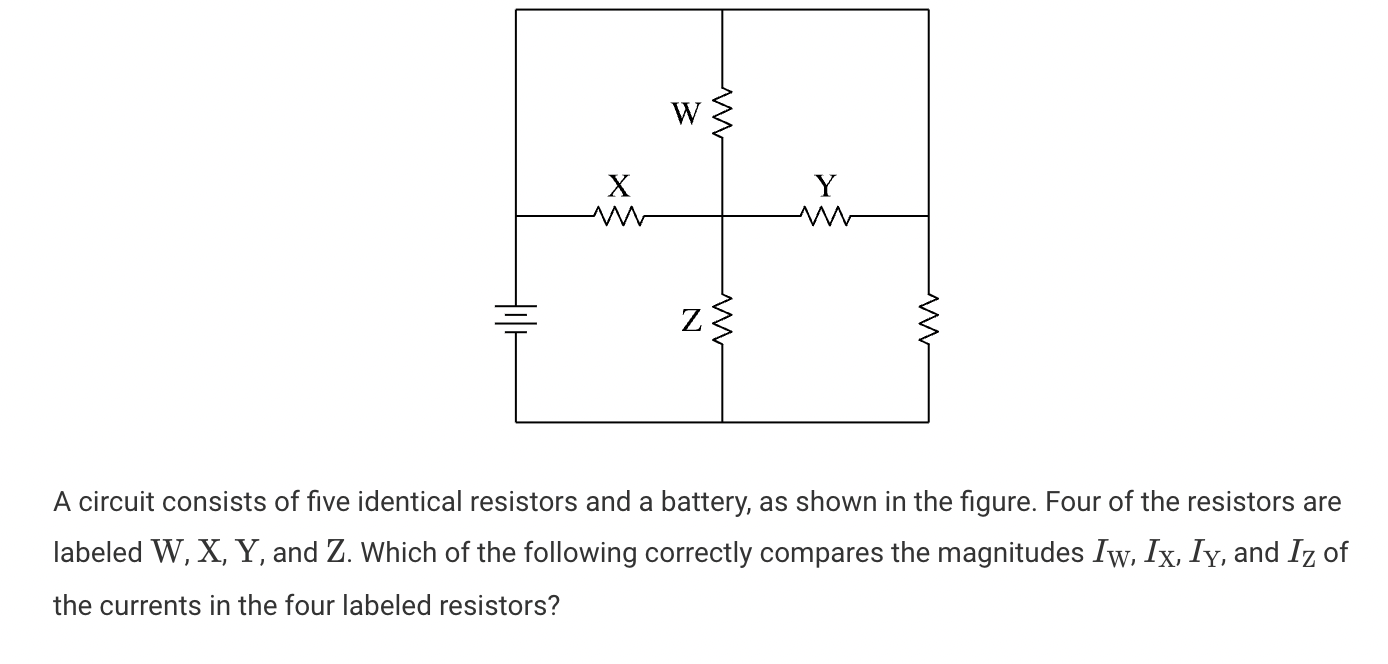
Rank the currents in this circuit
IZ > ( IW = IX = IY )
W, X, and Y can all be connected to the battery without any resistors and then all converge and go downward, so Z has to have greater current equal to the magnitude of all 3 paths
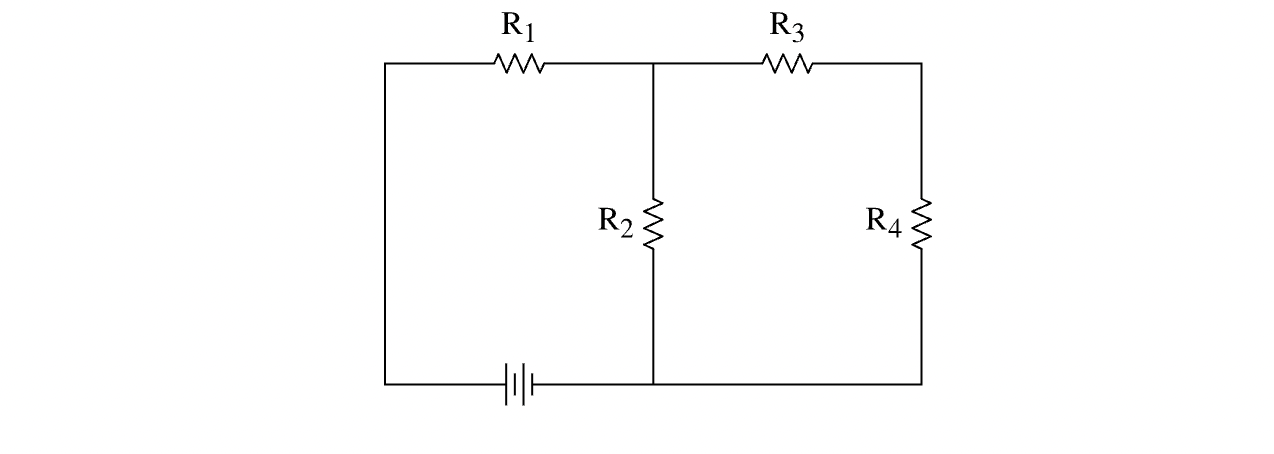
Rank Currents
1 > 2 > 3=4
1 = 2+3, 3 and 4 are in series and have current equal to 2
How does a capacitor change as it charges?
Acts as a wire at first and then acts as an open switch where no current passes (0 resistance to infinite)
 Note
Note  Flashcards (94)