BSCI170 Midterm 2 Review Part 1: Cell Membrane & Junctions, Membrane Transport
 Call Kai
 Learn
Learn Practice Test
 Spaced Repetition
 Match
Match Flashcards
 Knowt Play
1/99

There's no tags or description
Looks like no tags are added yet.
Name | Mastery | Learn | Test | Matching | Spaced | Call with Kai |
|---|
No analytics yet
Send a link to your students to track their progress
100 Terms
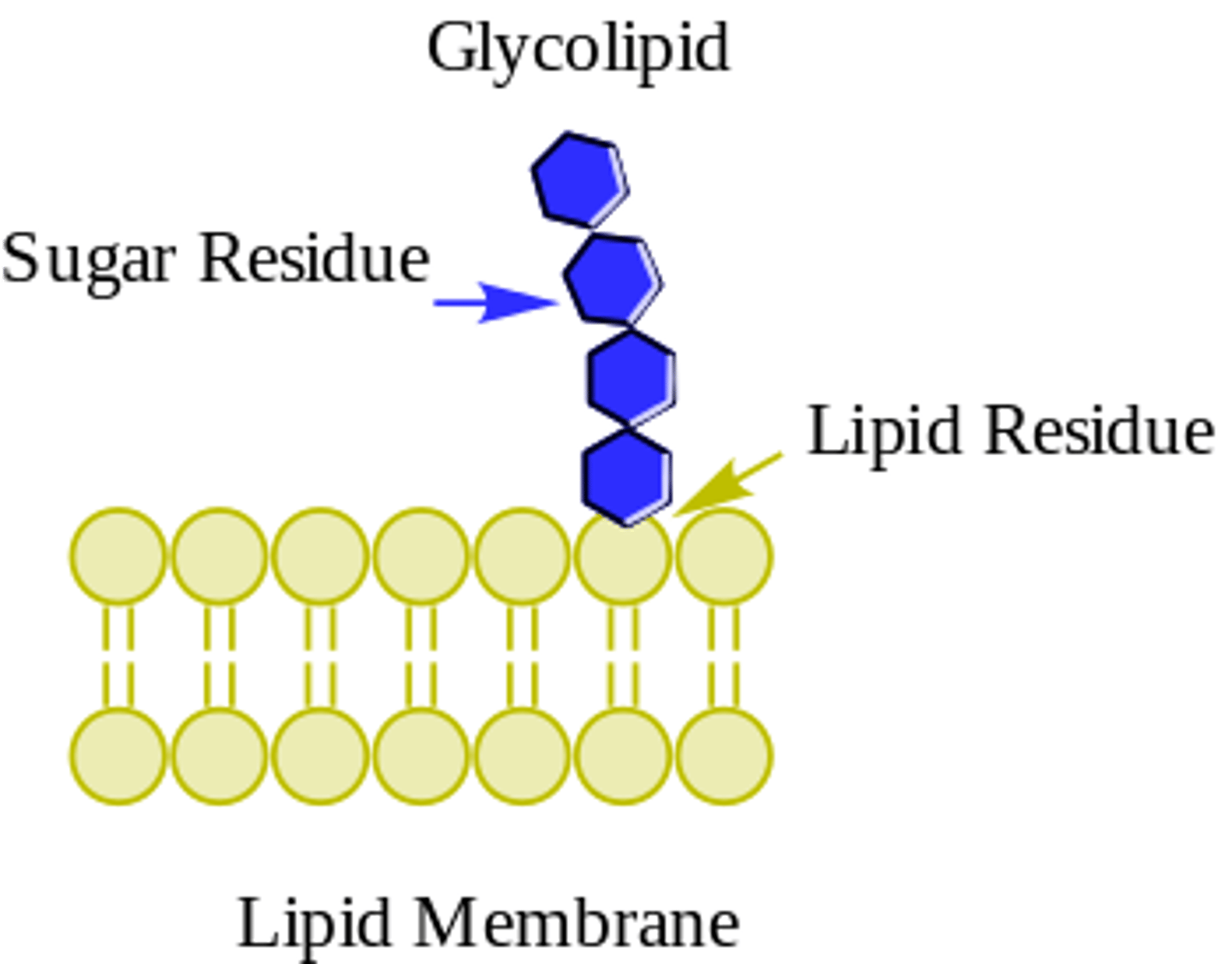
What are glycolipids?
Carbohydrates attached to a lipid on the outside of the cell membrane
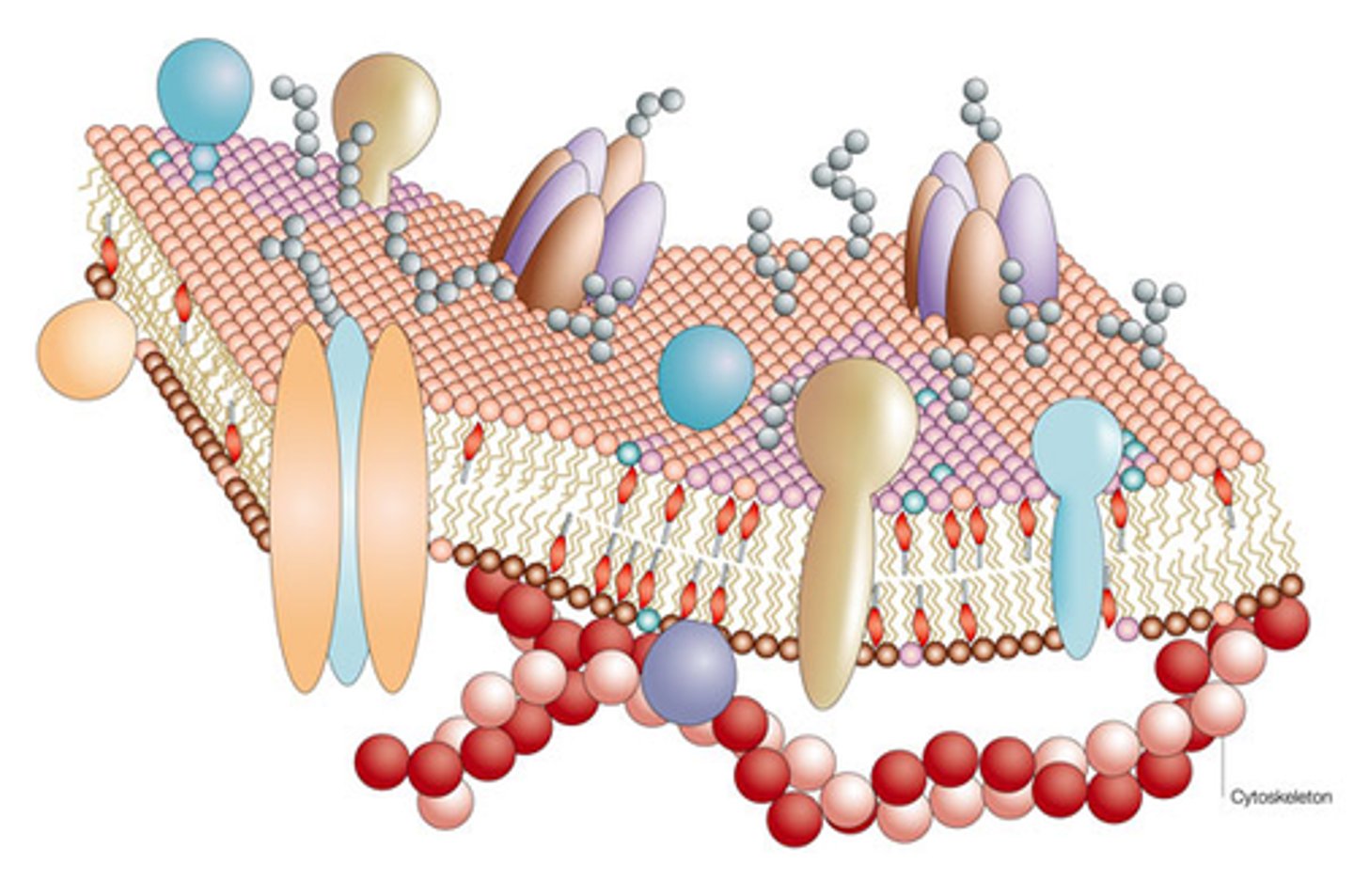
What are the two parts of the Fluid Mosaic Model of cell membranes? *
1. Phospholipid Bilayer = the Fluid component
2. Membrane Proteins and Carbs = the Mosaic component
What are the parts that make up the Fluid component and Mosaic component of the Fluid Mosaic Model? *
1. Phospholipid bilayer = fluid component
- hydrophilic heads facing out and hydrophobic tails facing in
- cholesterol stuck between the fats
2. Proteins and carbs = mosaic component
- peripheral proteins = on the bilayer's inner or outer surface, not embedded
- integral proteins = embedded within the phospholipid layer(s)
- carbs = usually attached to proteins on the outer membrane layer
What is the protein-to-phospholipid ratio in the cell membrane?
1 protein per 25 phospholipids (although it varies depending on the cell's function)
What are the "cell surface markers" on the cell membrane?
They are specific proteins or glycoproteins on the cell's surface that act as the cell's ID tags: this is how our body identifies whether a molecule belongs inside the cell or is an invader!
What are the groups that make up a phospholipid? Which sections are polar and nonpolar?
Phospholipid head: phosphate and glycerol, polar
Phospholipid tail: fatty acids (saturated and unsaturated), nonpolar
What is the role of the proteins and carbohydrates within the cell membrane?
They let the cell talk, move things, and stay recognized
What is the difference between integral proteins and peripheral proteins? (Mosaic component of cell membranes)
Integral proteins are deeply embedded tunnels in the membrane that move materials
Peripheral proteins are surface anchors that help with signals
What is the role of carbohydrates in the cell membrane?
Surface ID tags (glycoproteins and glycolipids)
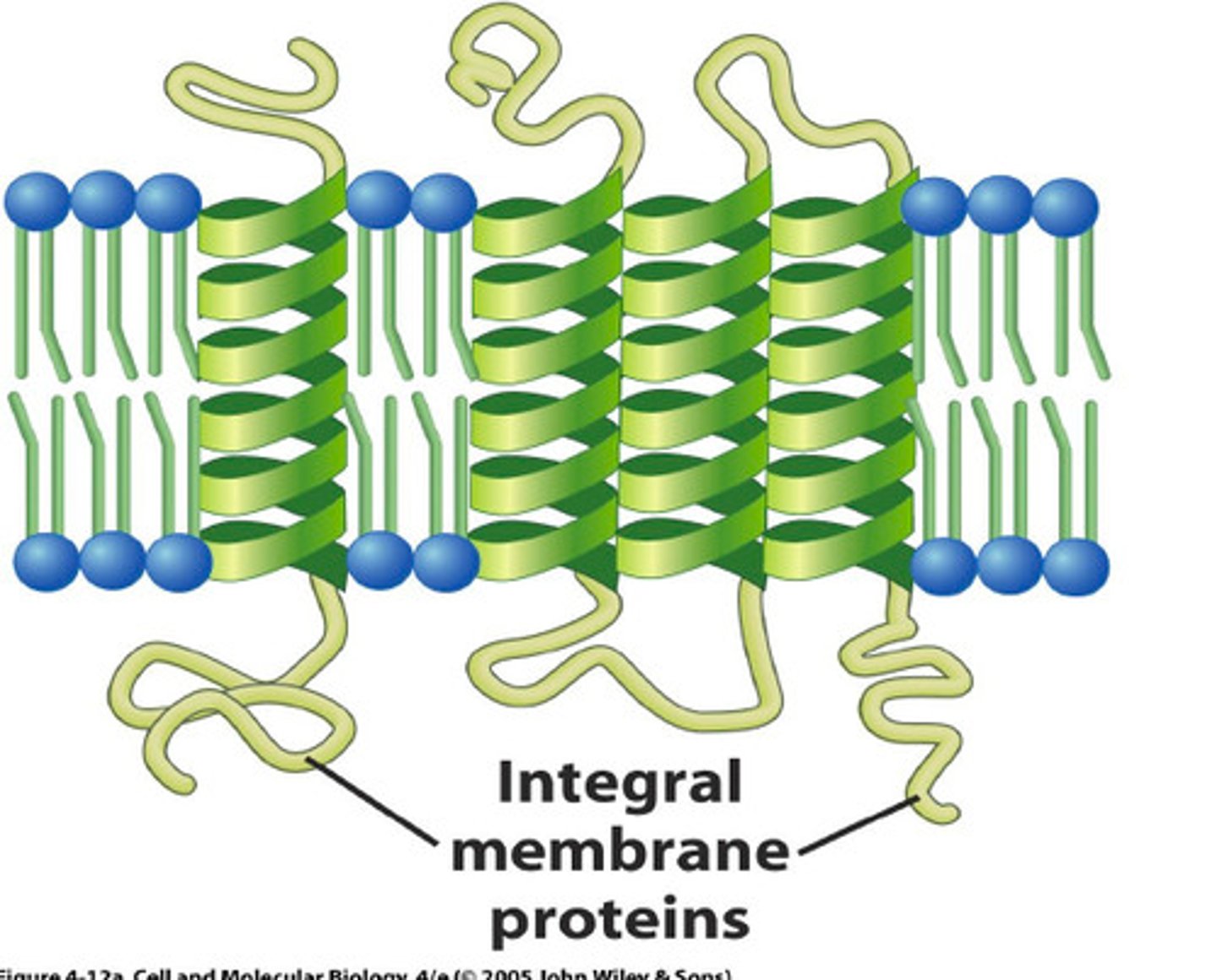
Describe integral membrane proteins (how they function, where they are located, how far across the membrane they span)
- Deeply embedded in the bilayer of the cell membrane
- Act as tunnels/gates fro molecules to move in and out
- Rely on alpha helices and beta pleated sheets shapes to stay stable in the membrane
- Alpha helix - helps molecules cross the membrane
- Beta pleated sheet - creates a wide tunnel
- Don't always span the entire membrane: can be partially embedded
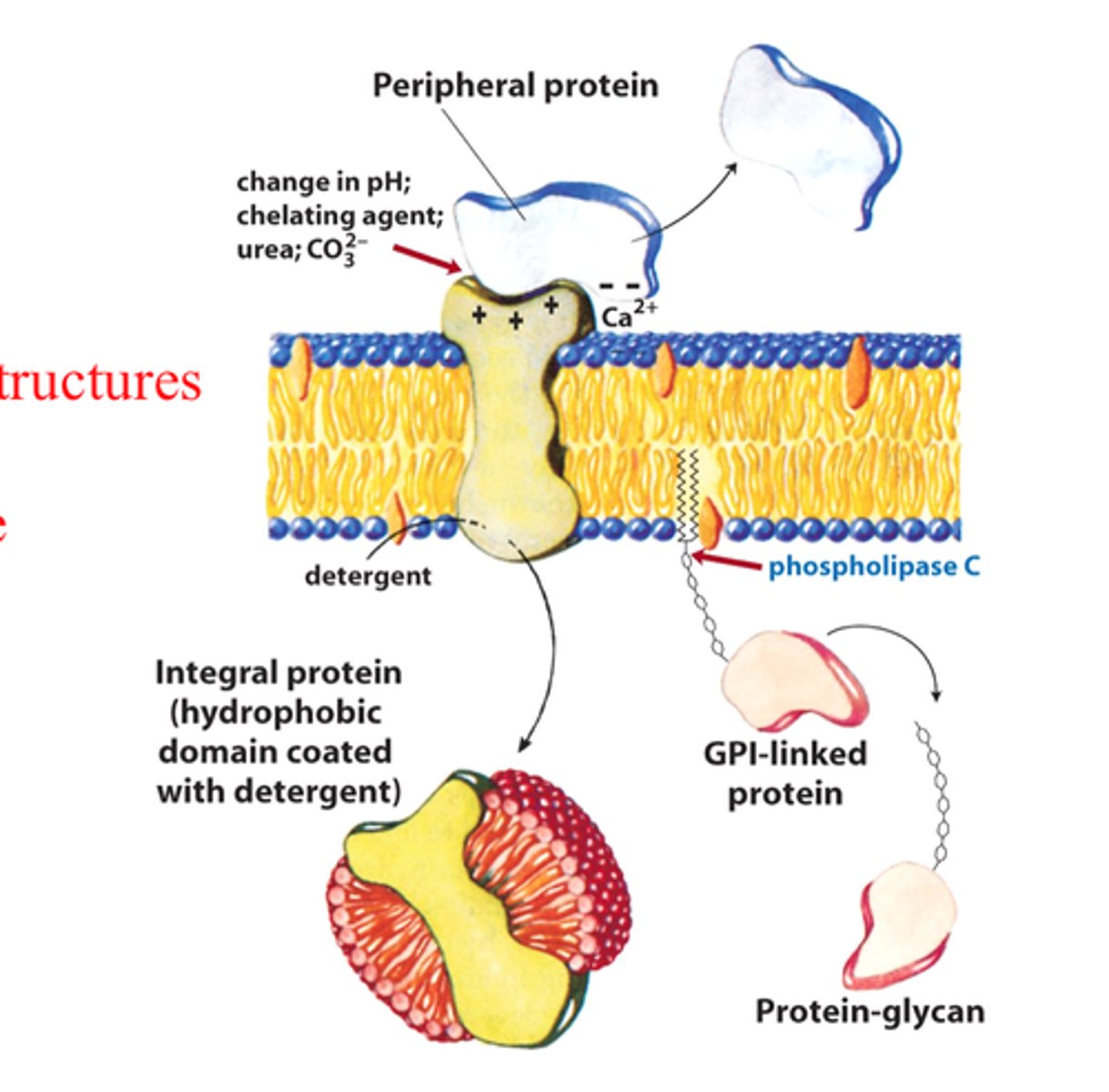
Describe peripheral membrane proteins (how they function, where they are located)
- On the cell membrane's surface: either on the inside or the outside
- Help anchor the cell's skeleton
- They are noncovalently attached to either side of the membrane
- There are NO hydrophobic parts, so they can't be in the bilayer
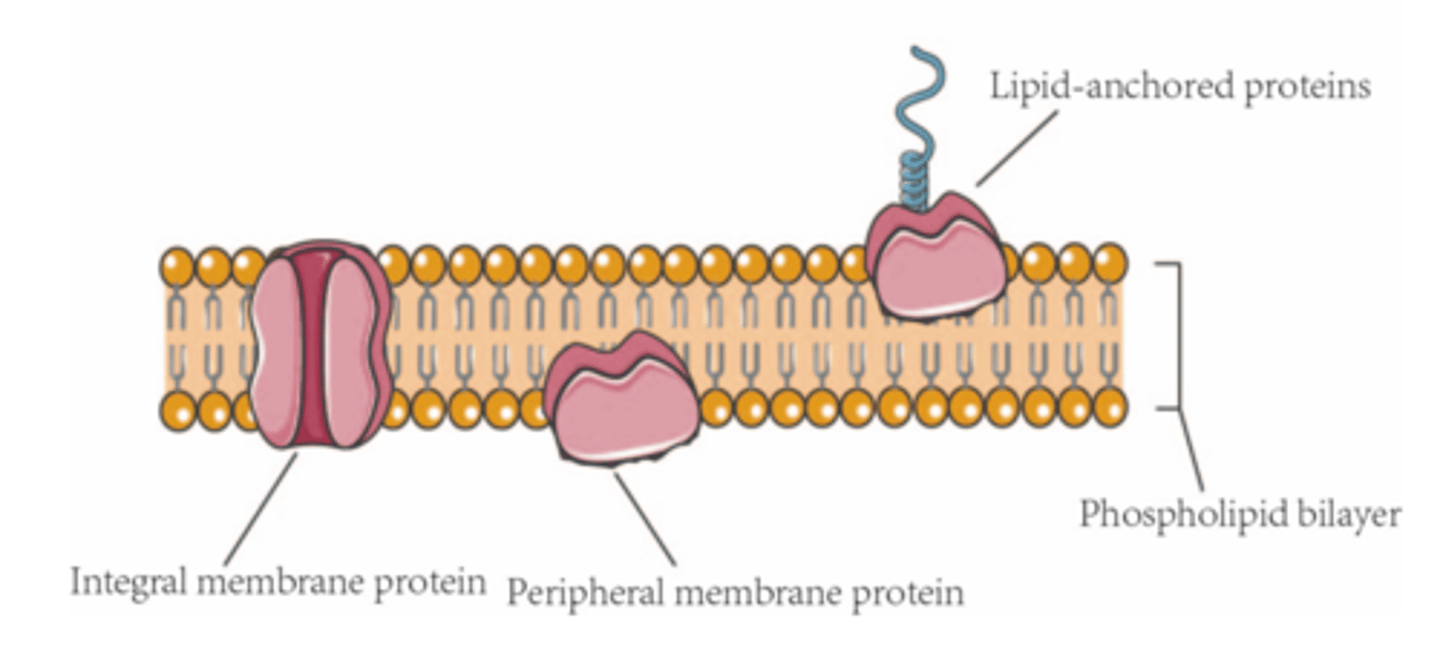
Describe anchored membrane proteins (how they function, where they are located)
- Attach themselves to the lipid bilayer using a strong covalent bond = an anchor
- Tucked into the membrane by a lipid tail
What are the three types of carbohydrates located on the outside of the cell membrane?
Glycolipids, glycoproteins, proteoglycans
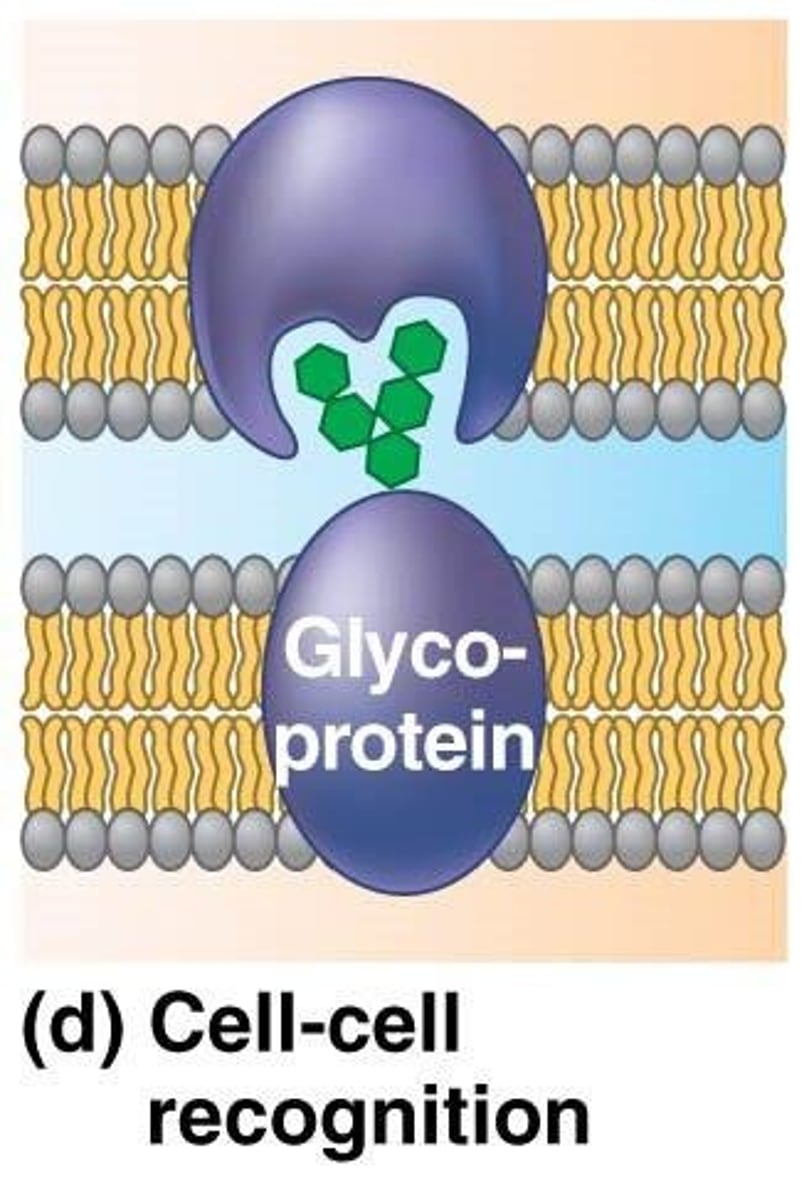
What are glycoproteins?
Carbohydrates attached to proteins on the outside of the cell membrane
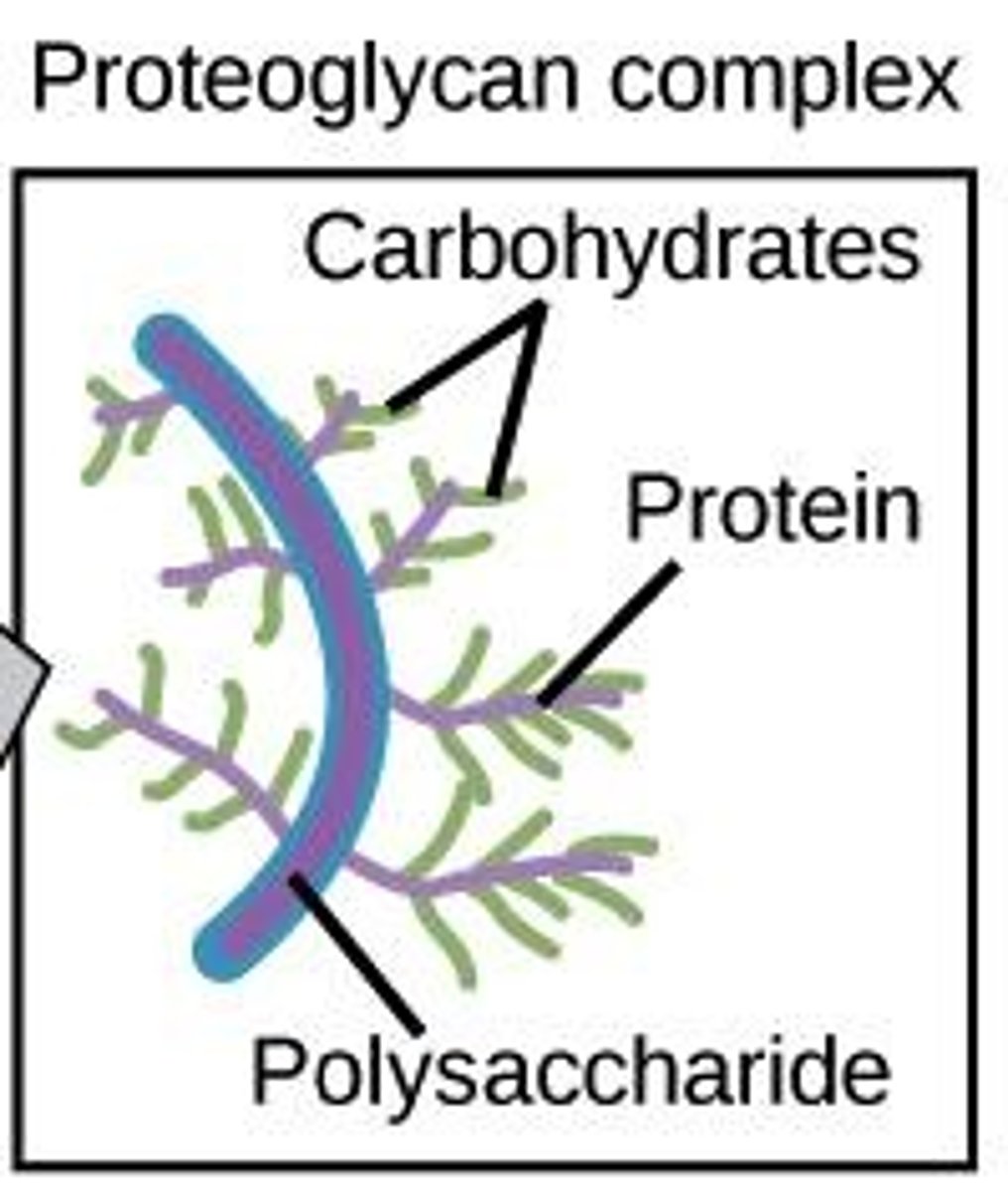
What are proteoglycans?
Proteins with many long carbohydrate chains
Which plasma membrane component can be either found on its surface or embedded in the membrane structure: protein, cholesterol, carbohydrate, or phospholipid?
Protein
What is the primary function of carbohydrates attached to the exterior of the cell membrane?
Identification of the cell
How do the phospholipids in the fluid mosaic model move?
Lateral movement (side to side) and flip-flop movement (phospholipids shifting between the inner and outer layer)
How do proteins move in the fluid mosaic model?
They are either anchored (don't move) or non-anchored (move)
How do saturated (viscous) fatty acids versus unsaturated (fluid) fatty acid chains in the cell membrane act differently?
Saturated (Viscous) fatty acids:
- Only have single bonds between carbons
- More tightly packed → lower permeability, lets less things in
Unsaturated (Fluid) fatty acids:
- Have carbon-carbon double bonds
- Less tightly packed → higher permeability, lets more things in
In the fluid mosaic model, why is the membrane described as fluid?
The phospholipids and proteins can move around laterally within the layer
What are the six roles of membrane proteins?
1. transporting molecules in/out of the cell
2. enzymatic activity
3. sending and receiving signals between cells
4. joining cells together
5. helping cells identify and recognize each other using unique "id tages" (proteins or lipids w/ short sugar chains or glycoproteins/glycolipids)
6. attaching to the cytoskeleton → strength and shape
What is an enzyme?
Enzymes are specialized protein molecules that act as biological catalysts, accelerating essential chemical reactions in the body (vital for metabolism)
How do proteins help cells receive and respond to signals/messages from their environment? Describe the receptor, relay, and response process
Receptor: a protein on the outside catches a specific signal (like a hormone)
Relay: the protein changes shape and passes the message into the cell
Response: the cell acts on the message (grows, moves, etc.)
What can connections between cells achieve?
Facilitate communication between cells, help with tissue formation
Describe how proteins can provide internal and external support to the cell
Proteins anchor to the cytoskeleton to provide the cell strength and help it maintain its shape.
For internal support: proteins hook onto the cytoskeleton
For external support: proteins grab onto the extracellular matrix = the sticky mesh outside cells
What are the four ways a substance can cross the cell membrane?
1. Simple diffusion = slipping directly through the bilayer
2. Facilitated diffusion = using a protein "doorway"
3. Active transport = using a protein "pump"
4. Vesicle transport = moving big loads via vesicles
What are the two factors that affect permeability of a molecule through the cell membrane?
The molecule's size and chemical nature
Which molecules can move through the cell membrane easily? Which ones have more difficulty? *
Fast pass: small, nonpolar molecules
Slow pass: small, polar, uncharged molecules
No pass: large, polar, uncharged molecules and ions
What type of molecules can diffuse directly across the lipid bilayer?
Nonpolar molecules
What are cell junctions and how are they different from cell membranes?
Cell junctions are special regions of the cell membrane
They are the connection between cells for direct contact and communication
The cell membrane is the wall of the building, while the cell junction is the specific door connection two buildings.
What are the three types of cell junctions?
Tight junctions, desmosomes, and gap junctions
How does the tight junction between cells hold two cells together? What is their role?
It creates a firm, watertight seal between two adjacent animal cells
How do desmosomes hold two cells together? What is their role?
They form a very strong, intense bond between two cells at a specific spot
They are specific points of contact and communication
How does the gap junction hold two cells together? What is their role?
They are a direct channel (a protein-lined pore) between adjacent animal cells for ions and nutrients to flow between cells
Diseased animal cells may produce molecules that activate death
cascades to kill the cells in a controlled manner. Why would
neighboring healthy cells also die?
The death molecule passes through gap junctions
Are cell membranes symmetrical or asymmetric? Why?
They are asymmetric because the two layers (the outside and inside of the phospholipid bilayer) are structurally different
What are the big three types of passive transport? *
Simple diffusion = slipping through the lipids
facilitated diffusion = using a protein doorway
osmosis = the special movement of water
What is simple diffusion? What types of molecules can diffuse by simple diffusion? *
Simple diffusion is the natural shift of molecules from high to low concentration (the basic way things move!) Only small nonpolar molecules (such as CO2, O2, small lipids) can diffuse by simple diffusion.
What are all the factors that determine the rate of diffusion?
1. Size of molecules - smaller diffuse faster
2. Temp of solution - higher temp speeds up diffusion
3. Electric charge of molecules - charged particles diffuse slower
4. Concentration gradient - steeper gradients mean faster diffusion
5. Molecule mass - lighter molecules bounce around faster and spread out quickly
6. Solvent density - thicker fluids slow things down
7. Travel distance - farther distance means slower process
How does simple diffusion work when there is diffusion of two or more different solutes? Do these solutes affect each other's diffusion?
Each solute moves according to its own concentration gradient, they don't disturb each other
What is dynamic equilibrium? Describe
Molecules are never sitting still, they are always moving. Even when a cell reaches equilibrium, simple diffusion stops, but the molecules keep moving with no net charge
What is the principal force driving movement in diffusion?
Concentration gradient
What is facilitated diffusion? What are the two "helpers" in facilitated diffusion? What kind of molecules does it let through? *
Facilitated diffusion is how polar and charged molecules diffuse across the lipid bilayer (passive transport)
Specialized transport proteins are involved: channel proteins and carrier proteins
What is the difference between channel proteins and carrier proteins in facilitated diffusion? *
Channel proteins are open, high speed tunnels for quick access that only fit specific ions or polar molecules through the tunnel. (FASTER PROCESS)
Carrier proteins bind and carry specific molecules through them. It's a slower process. They are shape-shifters! (SLOWER PROCESS)
What are the three types of channel proteins in facilitated diffusion?
Ligand/ion gated channels
Voltage gated channels
Aquaporin channels
What are aquaporins? What type of transport do they help with?
Aquaporins are a type of channel protein that allow water to pass through the membrane at very high rates. They are a part of facilitated diffusion (passive).
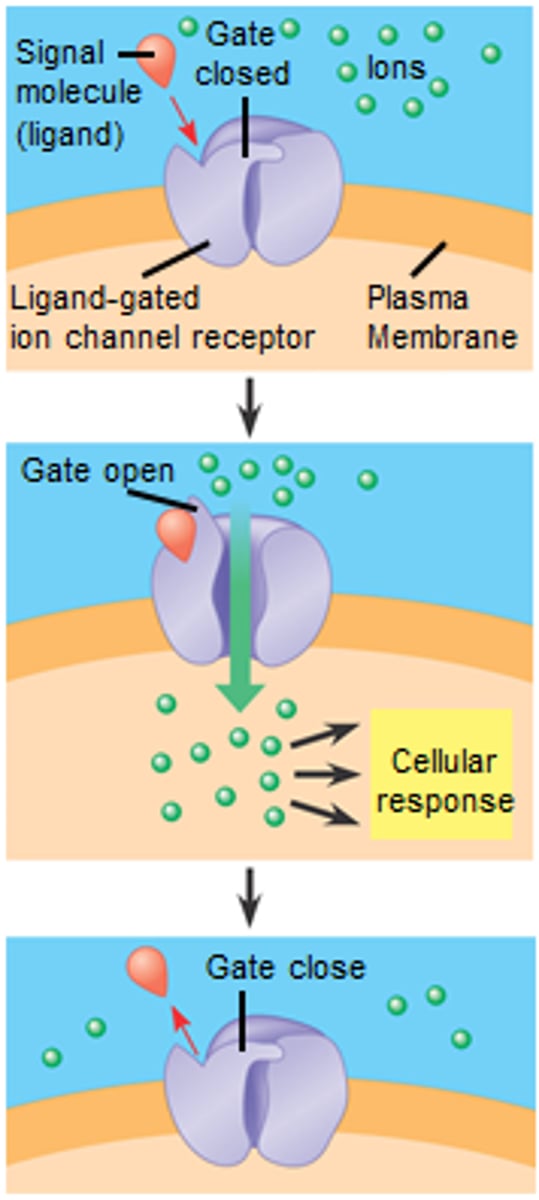
What are ligand/ion channel proteins? What type of transport do they help with?
Ligand/ion channel proteins are gated: they open and close to block or let in ions through the cell membrane. The ligand binds to the protein and causes the channel to open. They are a part of facilitated diffusion (passive).
What are voltage gated channels? What type of transport do they help with?
Voltage gated channels open and close depending on the change in voltage / change in charges across the membrane. They allow for near-instantaneous movement of ions. They are a part of facilitated diffusion (passive).
What are carrier proteins in facilitated diffusion?
Carrier proteins are integral proteins that change shape to transport molecules through the lipid bilayer. They are specific and picky with which molecules they choose. They are a part of facilitated diffusion, meaning they are passive - no energy is required
What is osmosis? In osmosis, what is moving across the cell membrane? Describe.
Osmosis is a special type of diffusion in which water moves across a semipermeable membrane. This happens because in a semipermeable membrane, water can flow through, but solutes like salt are blocked. No energy is required - osmosis is a type of passive transport!
Water moves via osmosis from an area of ___ concentration of ___ to one of ___ concentration.
Water moves via osmosis from an area of HIGH concentration of WATER to one of LOWER concentration.
Beaker 1 and Beaker 2 are connected by a membrane that only allows passage of water. Beaker 1 has 1M NaCl and Beaker 2 has 2M NaCl. Which direction will water move (osmosis)?
Water will move from Beaker 1 to Beaker 2 because there is more water in Beaker 1
What is a hypertonic solution? How does a cell react in this solution?
Environment around the cell has a HIGHER solute concentration than the cell
→ Cell LOSES water and SHRINKS
What is a hypotonic solution? How does a cell react in this solution?
Environment around the cell has a LOWER solute concentration than the cell
→ Cell GAINS water and EXPANDS
What is an isotonic solution? How does a cell react in this solution?
Environment around the cell has the SAME concentration as the cell
→ NO net water movement across the membrane
How do plant cells and animal cells have a different adaptation towards osmosis?
Plant cells have a rigid cell wall that prevent them from bursting (lysis) when water floods into the cell.
This is called turgor pressure: water fills the vacuole of the plant cell, pushing against the membrane, and keeps the plant upright
The cytoplasm in plants is always slightly ___ to the cellular environment
Hypertonic: this is so that water will enter the cell if it is available - plant cells are hungry for water!
What are the characteristics of active transport? *
Active transport is when molecules are moving against the concentration gradient (from low to high concentration)
Requires energy (ATP)
Uses specialized membrane protein pumps!
What are the three types of active transport? (Just list them) *
Primary (direct) active transport, secondary (indirect) active transport, bulk transport
What is the difference between primary active transport, secondary active transport, and bulk transport? *
Primary active transport:
- Directly burns ATP to move ions
- Creates a charge difference across the membrane
Secondary active transport:
- Indirect
- Uses the pre-existing gradient made during primary active transport to move molecules
- "Hitching a ride"
Bulk transport:
- Moves large groups or big molecules through endocytosis and exocytosis
- Moves entire cells, fluid droplets, or large proteins
- Wraps the cargo in a membrane vesicle (not a single pump/gateway)
What are the three types of carrier proteins/pumps for active transport?
Uniporter: moves one molecule at a time
Symporter: moves 2 molecules in the same direction
Antiporter: moves 2 molecules in opposite directions
True or false: in active transport, each protein carrier can move any type of molecule
False: in active transport, each protein carrier is designed to only move specific molecules
True or false: passive and active transport are both two-way processes (they move molecules both in and out of the cell)
False: passive transport is a two-way process, while active transport is considered a one-way process
What is ATP hydrolysis? Describe the process and its role in active transport.
ATP Hydrolysis is when a water molecule breaks down an ATP molecule into ADP + an inorganic phosphate, releasing energy. This reaction provides the energy needed to move molecules AGAINST their concentration gradient (active transport!)
Describe how the Sodium-Potassium Pump works (active direct/primary transport) **
The sodium-potassium pump brings:
- 3 Na+ ions outside the cell
- 2 K+ ions inside the cell
→ This creates a negative charge inside the cell
- It burns ATP directly to power its pump, so it's primary/direct transport
- Moving the ions creates an electrochemical gradient, which the cell will later use to move other molecules through secondary/indirect transport!
What is the electrochemical gradient and how is it different from the chemical gradient or the electrical gradient alone?
Electrochemical gradients form from the combined effects of both the chemical gradient (the different in the amount of substance) and the electrical gradient (the difference in charge of substance)
Example: the sodium-potassium pump creates an electrochemical gradient with the inside of the cell being mostly negative
Describe how Sodium-Glucose Co-Transport works (active indirect/secondary transport) **
In Sodium-Glucose co-transport, the cell uses the preexisting electrochemical gradient created by the sodium-potassium pump to move glucose.
- Na+ ions move from high to low concentration (releasing power, DOWN the concentration gradient)
- Glucose moves from low to high concentration (using the energy from Na+, hitchhiking, UP the concentration gradient)
→ This is how the cell pulls in fuel (sugar)
Fill in the blank: the sodium-potassium pump is an example of ___ transport, whereas the sodium-glucose movement is an example of ___ transport.
1. primary active transport (uses ATP directly)
2. secondary active transport/cotransport (hitchhiking a ride, using the ATP indirectly, using the preexisting electrochemical gradient)
Why does the cell put so much effort into its primary and secondary protein pumps (active transport)?
Because the cell is very leaky: ions are constantly drifting in and out of the membrane in attempts to reach equilibrium. The cell is constantly pumping ions in and out to keep its balance!
What is endocytosis? What are the three types of endocytosis? (Just list them) *
Endocytosis is a type of active transport process (bulk transport) that brings molecules INTO the cell by engulfing it along with the membrane
→ 3 types:
1. Phagocytosis
2. Pinocytosis
3. Receptor-modified endocytosis
Describe the process of phagocytosis.
Phagocytosis = "cell eating", a type of endocytosis (active transport, bulk transport)
- The membrane engulfs large particles or entire cells into the cell by forming a large vesicle called a phagosome
- (The membrane makes a vesicle that "eats" the substance being moved and carries it inside to the end destination)
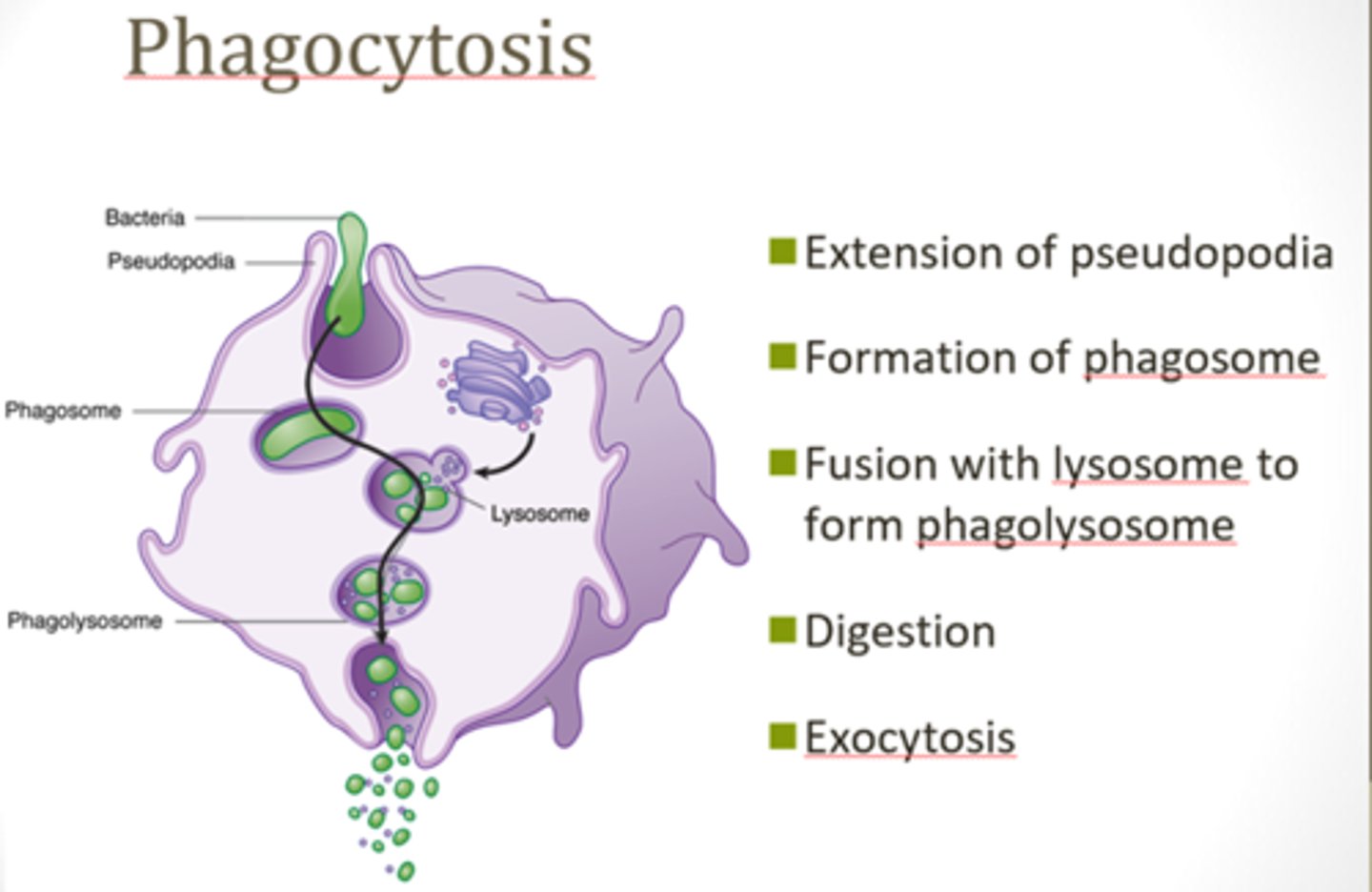
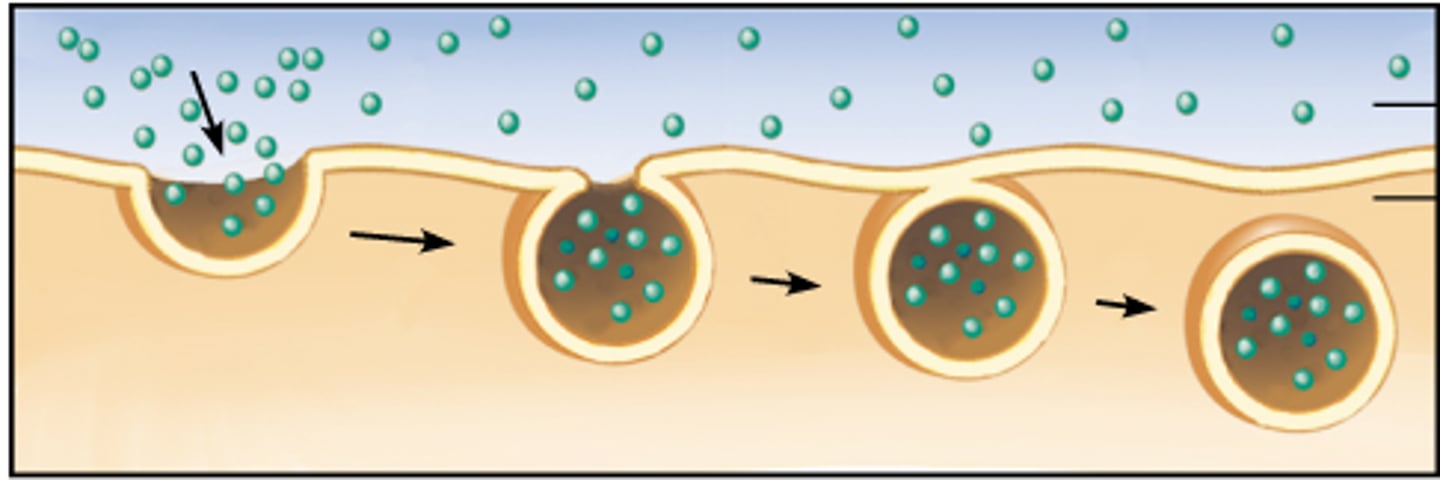
Describe the process of pinocytosis.
Pinocytosis = "cell drinking", a type of endocytosis (active transport, bulk transport)
- Forms small vesicles called a pinosome that intake small dissolved molecule or fluids from outside the cell
- These vesicles move the small dissolved molecules or fluids INTO the cell
Describe the process of receptor-mediated endocytosis
A highly selective active/bulk transport process
Specific molecules from outside of the cell bind to receptor proteins on the cell membrane
→ Triggers the vesicle to form
→ The vesicle carries the molecules into the cell
- Occurs in special regions of the membrane called clathrin-coated pits (clathrin = a peripheral protein) (clathrin-coated pits = areas of the membrane with a special coat made of clathrin proteins)
Describe the specific step-by-step process of how the molecules from outside the cell binding to receptor proteins on the cell membrane causes a vesicle to form (receptor-mediated endocytosis)
- Ligands bind to specific receptors on the cell surface
- Receptor-ligand complexes move across the membrane until they reach the coated pit
- The coated pit forms
- The membrane starts to engulf the receptor-ligand complexes
- The "invaginated" membrane pinches off from the outside of the cell and creates a vesicle
What is exocytosis? How does it differ from endocytosis?
- Exocytosis is the reverse of endocytosis: moving things OUT of the cell
- A type of active transport (bulk transport)
- Uses membrane-bound vesicles to transport items to the cell membrane!
Why is exocytosis important for plant and animal cells?
Removes waste, sends chemical messages between cells, rebuilds the cell membrane
In exocytosis, how are the membrane-bound vesicles formed?
The vesicles in exocytosis are formed by:
- The Golgi Apparatus (mostly for exocytotic vesicles containing protein products)
- Endosomes (mostly for exocytotic vesicles containing proteins, lipids, and microbes)
- Pre-synaptic neurons
What are the three types of exocytosis? How do they differ from one another? (Describe)
1. Constitutive exocytosis = regular secretion of molecules
2. Regulated exocytosis = relies on the presence of extracellular signals to secrete molecules
3. Lysosome-mediated exocytosis = lysosomes carry their digested material to the cell membrane for fusing
What are the 5 steps of exocytosis? (Hint: each step has a name for it)
1. VESICLE TRAFFICKING = vesicles move to membrane
2. TETHERING = vesicles are linked to and pulled towards the membrane
3. DOCKING = vesicles attach to the membrane, the phospholipid bilayers of the vesicles and the cell membrane merge together
4. PRIMING = (only occurs in regulated exocytosis, NOT in constitutive exocytosis:) modifications are made in the cell membrane molecules
5. FUSION = the vesicle membrane fully fuses with the cell membrane, ATP is required for this step, then the "fusion pore" releases the stored content into the vesicle and the vesicle becomes part of the membrane
How selective are the three types of endocytosis (phagocytosis, pinocytosis, and receptor-mediated endocytosis)?
Phagocytosis: selective, targeted eating
Pinocytosis: non-selective, cell drinking
Receptor-mediated endocytosis: highly selective, requires specific molecules binding to the receptor protein to build the vesicle
Define bioenergetics
Bioenergetics = how energy flows through living systems
What is a spontaneous reaction? What is a non-spontaneous reaction?
Spontaneous: releases energy, happens naturally
Non-spontaneous: requires energy, doesn't happen naturally
Fill in the blanks: Energy is stored in ___ and can be released and transformed by ___.
Energy is stored in CHEMICAL BONDS and can be released and transformed by METABOLIC PATHWAYS
Define metabolism
Metabolism = the sum of all the biochemical reactions happening in every cell
Basically: metabolism is all of the chemical reactions that take place in the cell, including building up or breaking down molecules
What are metabolic pathways?
Metabolic pathways are chain reactions that help cells put their energy to use
What are the two types of metabolic pathways? How do they differ from one another? Describe.
Anabolism = building things up, creating more complex molecules from simpler ones (energy is required)
Catabolism = breaking things down, breaking down more complex molecules into simpler ones (energy is released)
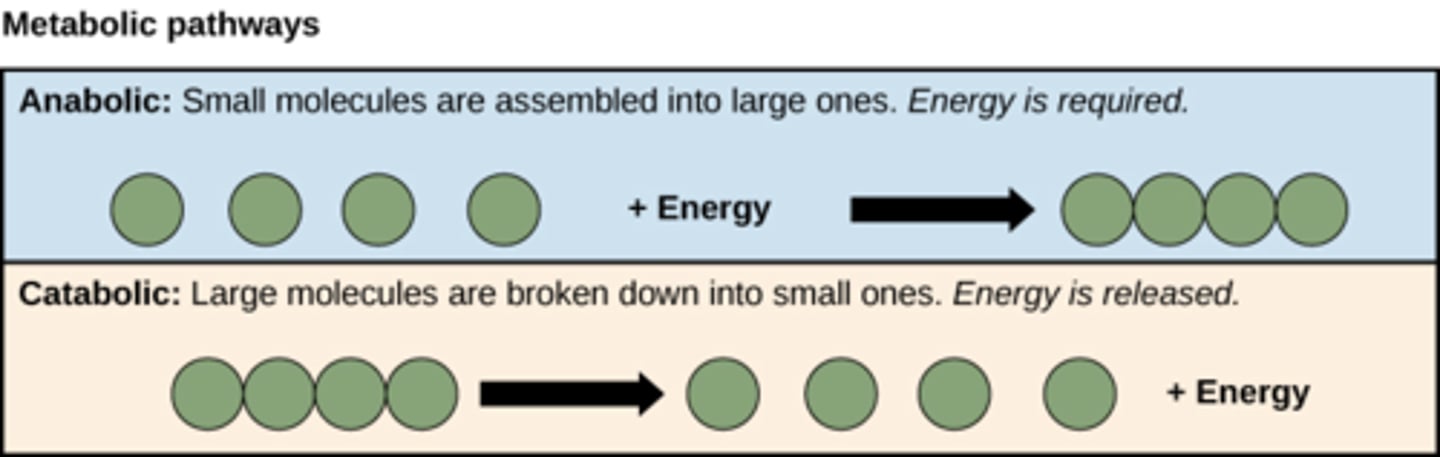
Fill in the blank: Cells use energy made from ___ to create macromolecules
Catabolic reactions
What is the equation/reaction for cellular respiration? How exactly does cellular respiration release energy for the cell to use?
C6H12O6 + 6O2 → 6CO2 + 6H2O + Energy (ATP)
Breaking the bonds in glucose releases energy that is captured and converted into ATP, which the cell can then use for energy :)
Basically: cells harvest the energy from glucose and convert it into ATP
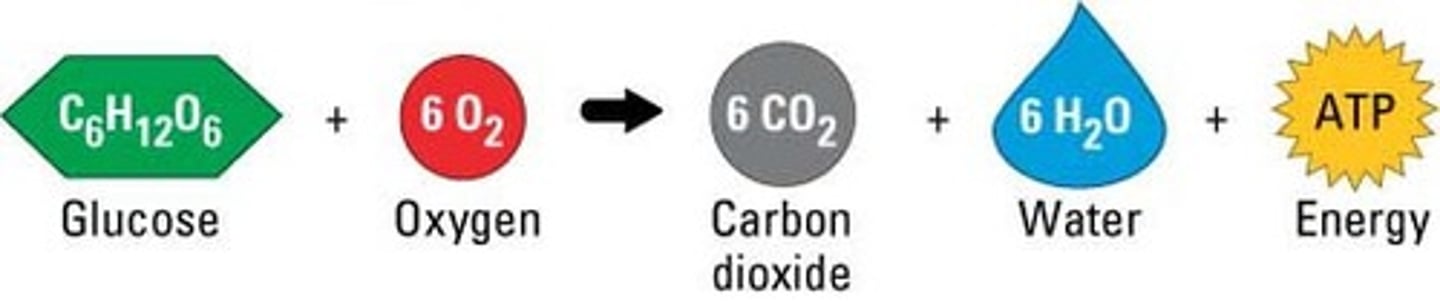
How do the processes of catabolism and anabolism work together to create the macromolecules needed for life?
Catabolism provides the energy by breaking apart chemical bonds and releasing energy.
Anabolism puts this energy to work by building up more complex macromolecules
Fill in the blank: Energy released by ___ reactions is stored in the bonds of ATP. When ATP hydrolyzes, free energy is released to drive all ___ reactions.
Energy released by EXERGONIC REACTIONS is stored in the bonds of ATP. When ATP hydrolyzes, free energy is released to drive all ENDERGONIC REACTIONS.
Explanation:
When energy is released from reactions, it doesn't just disappear. Instead, the cell captures this energy and stores it as ATP (think of ATP like a rechargeable battery).
More specifically:
- the cell uses the energy to add a phosphate to ADP, creating ATP
- energy is now stored in ATP's bonds
- when the cell needs energy, it can break the bonds in ATP and "spend" it (during ATP hydrolysis)
Define phosphorylation and hydrolysis. How are they different from each other?
Phosphorylation = the process of adding a third phosphate group to ADP to add energy
Hydrolysis = the process of removing the phosphate group from ATP to release energy
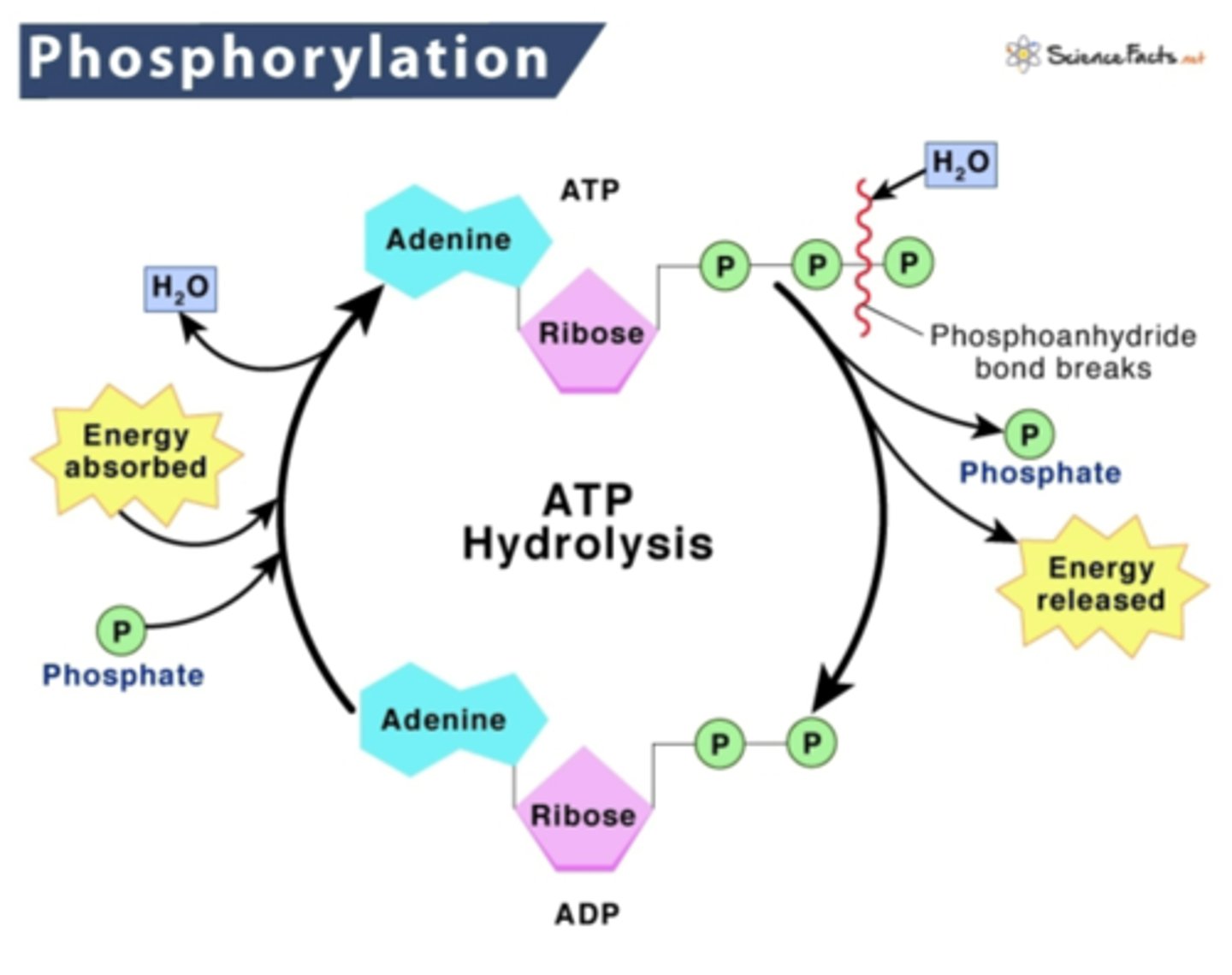
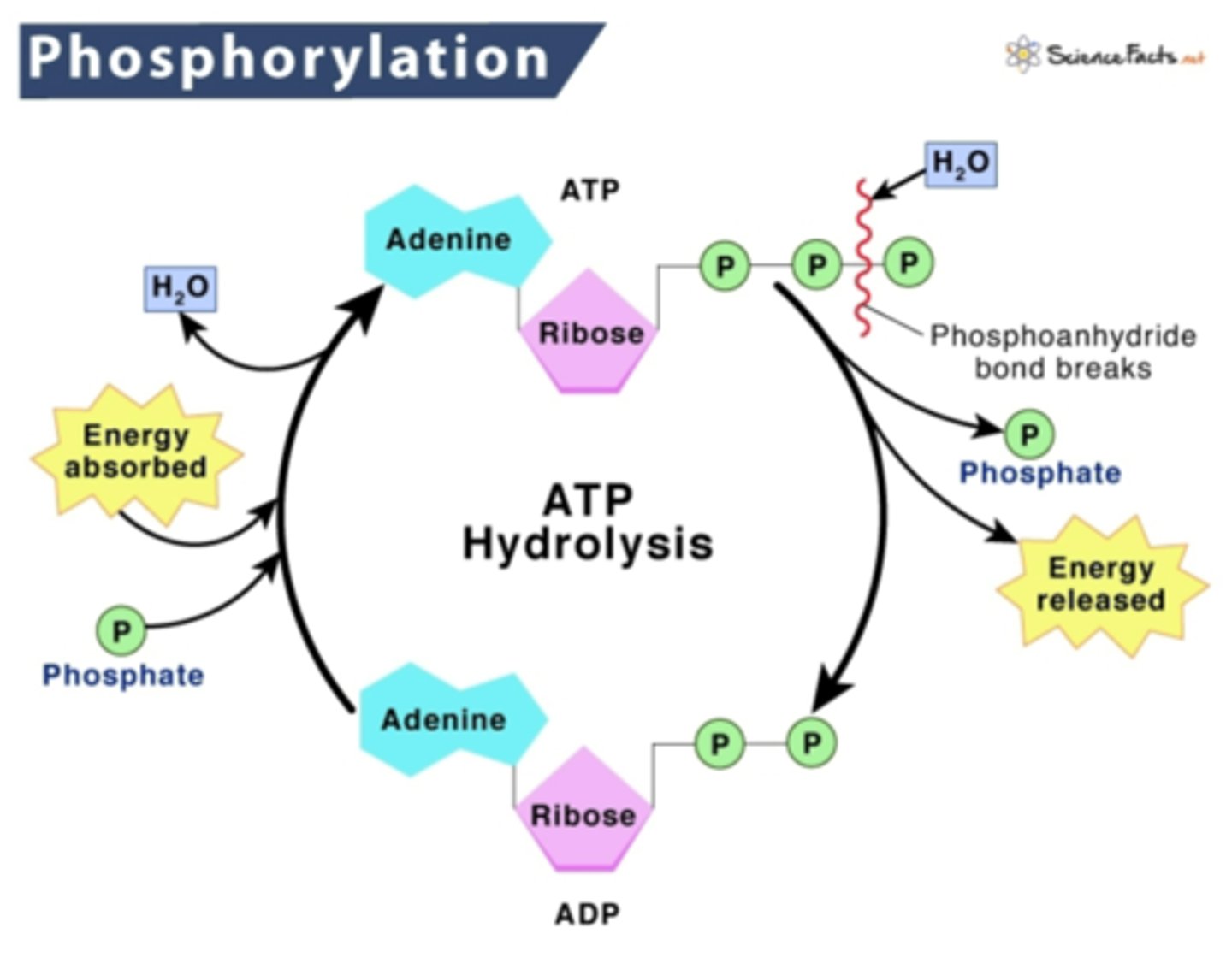
What are the specific steps within the cycle between exergonic and endergonic reactions? (Hint: this includes ADP and ATP)
Exergonic reactions: ATP hydrolysis:
ATP → ADP + Pi
- this releases energy
Endergonic reactions: Phosphorylation:
ADP + Pi → ATP
- this stores energy
Draw out the ATP-ADP cycle.
Fill in the blank:
Amino acids, monosaccharides, and fatty acids are produce from the ___ of proteins, carbs, and fatty acids, respectivel
Metabolism
What are the two ways in which ATP can be generated? Describe their specific characteristics and how they differ from one another.
1. Substrate-level Phosphorylation
- produces small amounts of ATP
- no oxygen required
- a simple, direct transfer using the enzyme as the middle man
2. Oxidative Phosphorylation
- produces a large amount of ATP
- requires oxygen
- a complex, multistep process
- happens mostly in mitochondria
What are the three uses of ATP?
1. CHEMICAL: energy from ATP hydrolysis can be used to form chemical bonds
2. MECHANICAL: the hydrolysis of ATP to ADP changes the protein shape (aka a conformation change) and generates a mechanical force (such as moving a muscle)
3. TRANSPORT: ATP is used in transport processes such as the sodium-potassium pump
Describe the properties of ATP as a nucleotide.
ATP is a ribonucleotide. It contains:
- a nitrogenous base: adenine
- a five-carbon sugar: ribose
- phosphate groups: 1-3 phosphate groups attached to the sugar
What are the differences in primary role, structure, and phosphate count between ATP and RNA? (Remember: ATP not only acts as an energy source, but also a nucleotide)
ATP:
- short-term energy currency
- a single monomer/unit
- usually 3 phosphate groups
RNA:
- genetic storage, protein synthesis, regulation
- a long polymer (chain of nucleotides)
- 1 phosphate group per nucleotide in the chain (many)
Still learning (14)
You've begun learning these terms. Keep up the good work!

