EXS 407: Repeated Measures and Factorial ANOVA
 Studied by 0 people
 Call Kai
 Learn
Learn Practice Test
 Spaced Repetition
 Match
Match Flashcards
 Knowt Play
1/23

There's no tags or description
Looks like no tags are added yet.
Name | Mastery | Learn | Test | Matching | Spaced | Call with Kai |
|---|
No analytics yet
Send a link to your students to track their progress
24 Terms
What is a repeated measures design?
A design where participants complete all conditions and serve as their own controls.
What is the main advantage of repeated measures designs?
They are more sensitive to effects of independent variables (IVs) and require smaller sample sizes.
Repeated measures ANOVA
within-subjects, compare 2 dependent samples, most common in kinesiology bc its cost-effective and more powerful (controls for differences between participants)
What does the F ratio in RM ANOVA represent?
The variability attributable to the treatment compared to the unexplained variability/error.
Degrees of freedom in RM ANOVA
between-conditions: k-1
between-subjects: N-1
unexplained variance (error): (k-1)(N-1)
What does the term 'unexplained variance' refer to in ANOVA?
The variance that cannot be attributed to the treatment effects
SS_E = SS_T - SS_C - SS_S.
What are the assumptions of a repeated measures ANOVA?
1. Normal distribution of samples 2. Homogeneity of variance 3. Continuous data 4. Dependent scores equal in number 5. Equal variances of differences between groups (sphericity).
What is sphericity in the context of repeated measures ANOVA?
The assumption that variances of the differences between groups/conditions are equal.
What happens if the sphericity assumption is violated?
It inflates the risk of Type I error, requiring corrections to degrees of freedom.
What is the Greenhouse-Geisser adjustment?
A correction that divides degrees of freedom (between-conditions and df for error) by (k-1) to counteract sphericity violations.
-adjusted dfc=1, assumes max violation of sphericity (inflate type II error risk)
What is the Huynh-Feldt adjustment?
A correction that multiplies degrees of freedom by a factor epsilon (ε) to account for sphericity violations.
What is the purpose of post-hoc tests in ANOVA?
To determine where significant differences lie when an F ratio is significant.
What is the role of Tukey HSD test in ANOVA?
It is used for post-hoc analysis to find where significant differences lie when the sphericity assumption is not violated.
Bonferroni correction
if sphericity IS violated, use dependent samples t test with a Bonferroni correction (0.05/number of tests)
What is a factorial ANOVA?
An ANOVA that examines the effects of multiple independent variables (IVs) on a single dependent variable (DV).
2 or 3 way ANOVA vs one way for the others
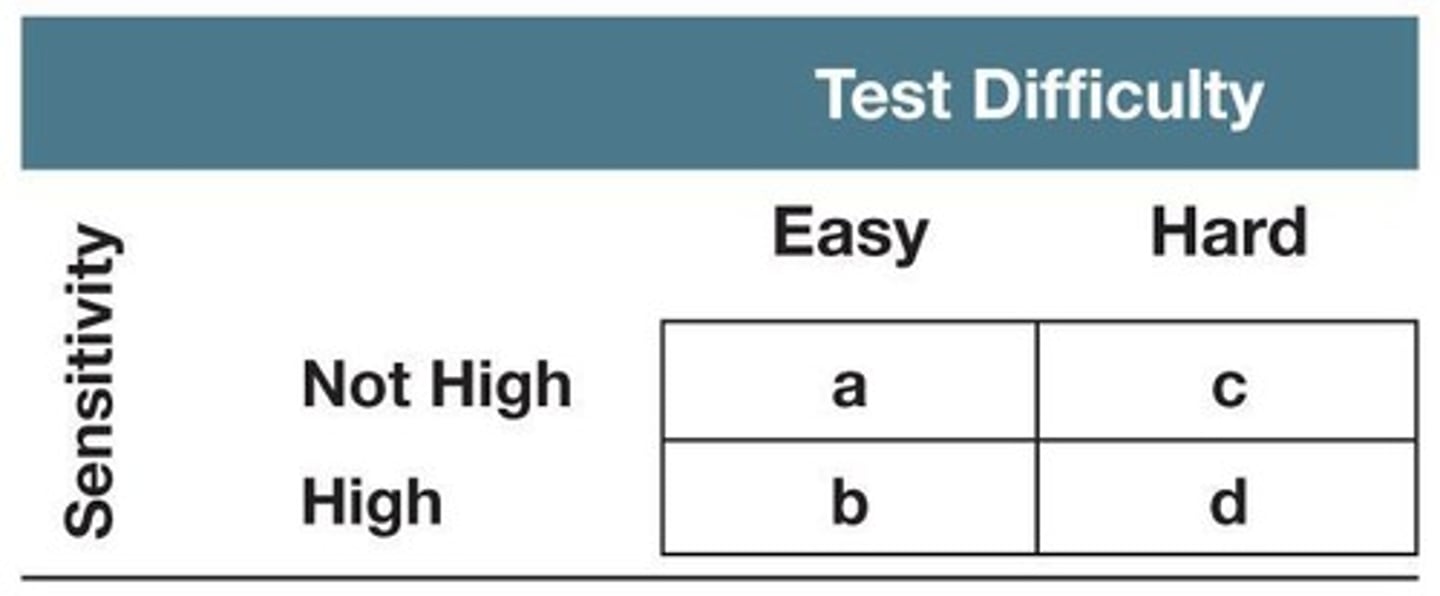
What is the difference between crossed and nested IVs in factorial ANOVA?
Crossed IVs have all levels of one IV occur at all levels of the other IVs; nested IVs have certain levels of one IV only occur at specific levels of other IVs.
-factorial ANOVAs use fully crosses IVs (every level occurs together)
What are main effects in factorial ANOVA?
The mean differences between levels of the same factor.
-F ratio for each factor that compares marginal means
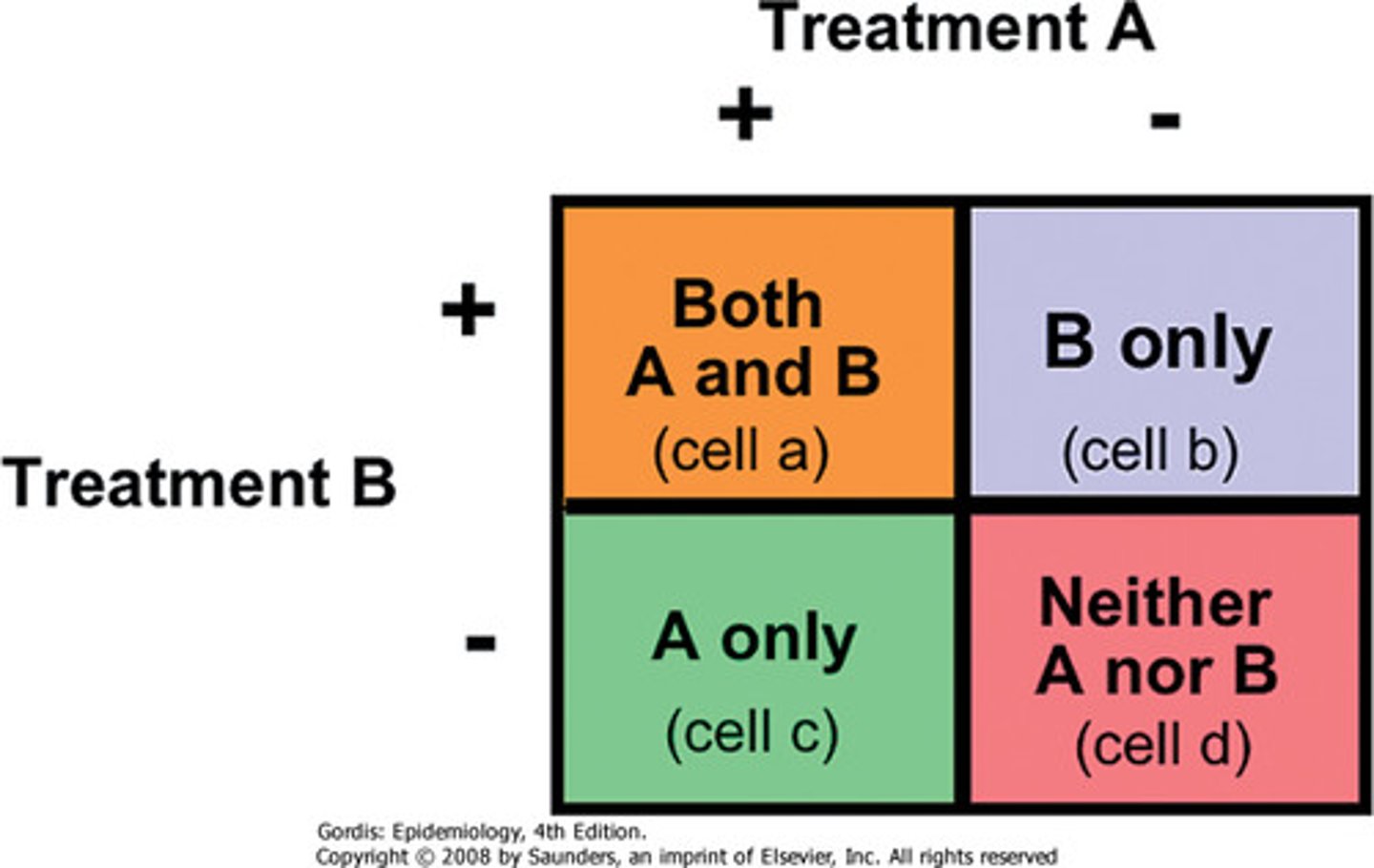
What are interactions in factorial ANOVA?
The combined effect of all factors on the dependent variable, where the differences between means of one factor depend on the level of another factor.
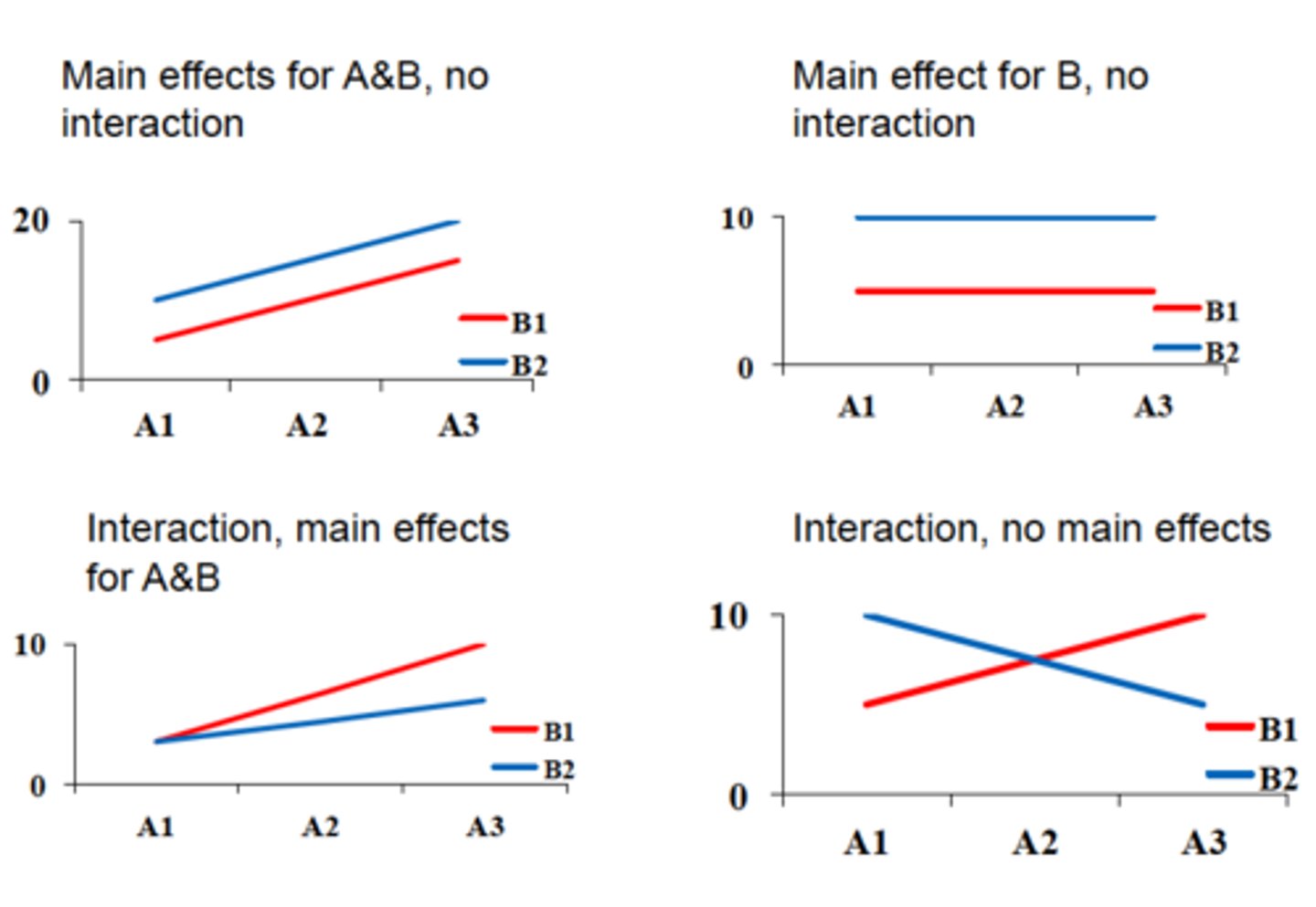
What is the step-down process for interpreting factorial ANOVA results?
1. if no F ratios are significant=STOP
2. if a main effect is significant but interaction is not and theres more than 2 levels= Post-hoc tests.
3. if an interaction is significant= Conduct one-way ANOVAs across levels of one factor at every level of another factor
omega-squared in the context of factorial ANOVA
A measure of effect size for main effects and interactions
How do you interpret a significant interaction in factorial ANOVA?
It indicates that the effect of one independent variable depends on the level of another independent variable.
What is a mixed ANOVA?
An ANOVA that includes both independent and repeated measures factors.
What is the impact of larger sample sizes in factorial ANOVA?
Larger sample sizes are needed as more factors are added, making the design complex.
types of factorial ANOVA
between-between: all factors consist of independent levels
within-within: all factors consist of dependent levels (RM)
between-within (mixed): at least 1 factor consists of independent levels, at least 1 factor consists of repeated measures
 Note
Note  Flashcards (21)