Midterm 3: Lecture 16 - predation concepts
 Call Kai
 Learn
Learn Practice Test
 Spaced Repetition
 Match
Match Flashcards
 Knowt Play
1/11

There's no tags or description
Looks like no tags are added yet.
Name | Mastery | Learn | Test | Matching | Spaced | Call with Kai |
|---|
No analytics yet
Send a link to your students to track their progress
12 Terms
Lotka-Volterra predator prey equations
Start with assumption of exponential growth
N = prey population size
P = predator population size
In absence of predators:
In absence of predators: dN/dt = rN
In absence of prey: dP/dt = -mP
For predators, m = mortality rate of predator, replaces r
Key assumptions of equation
Prey is only limited by its predator
Predator is a specialist - eats only one prey species
Predator population can eat an unlimited # or prey
Equation for prey
Prey
dN/dt = [exponential growth] - [consumption by predators]
dN/dt = rN - cNP
New terms:
c = capture efficiency of prey
Equation for predator
Predator
dP/dt = [ability to reproduce due to consumption of prey] - [deaths]
dP/dt = acNP - mP
New terms:
c = capture efficiency of prey
a = rate at which predator converts prey to offspring
Graphical approach: prey
Prey
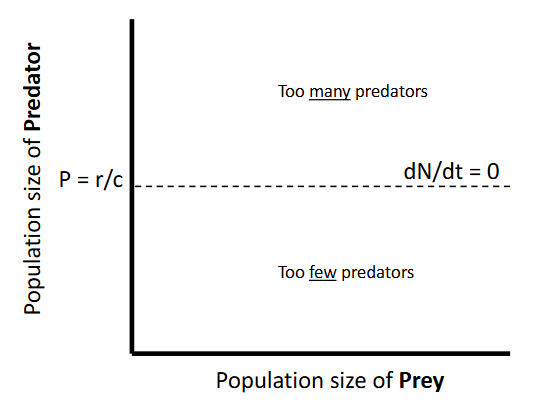
Step 1: Solve Lotka-Volterra equations - one species at a time for solutions at equilibrium (when population size isn’t changing)
dN/dt = rN - cNP = 0
r = cP
P = r/c
*For Prey, dN/dt = 0 when P = r/c
Graphical approach: predators
Predators
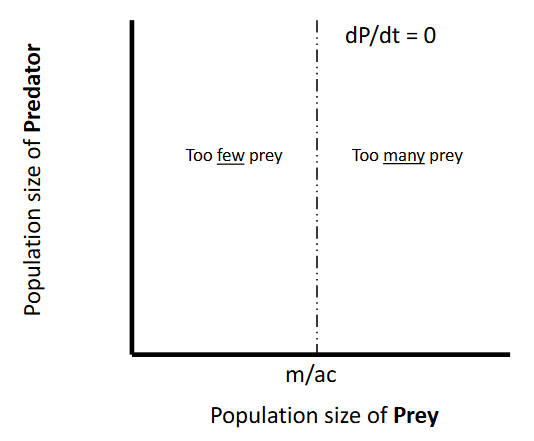
Step 1: Solve Lotka-Volterra equations - one species at a time for solutions at equilibrium (when population size isn’t changing)
dP/dt = acNP - mP = 0
acN = m
N = m/ac
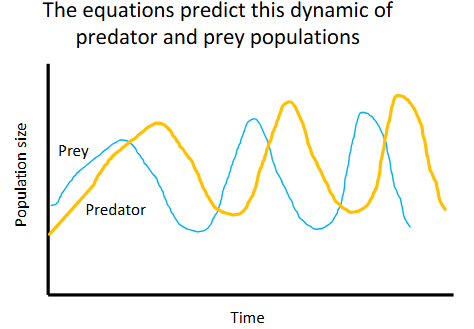
The equations predict this dynamic of predator and prey populations
Our key assumptions are unrealistic
Remove assumption 1 (prey is only limited by its predator):
Prey controlled by predator and by other density-dependent factors (like limits on)
Implications: no oscillations
Remove Assumption 2 (predator is a specialist - eats only one prey species):
In addition to last slide, prey population growth limited at low prey population sizes
Might be hard to find mates
Implications: Fluctuations in population sizes depend on predator efficiency.
If they are efficient, then predators will hunt prey to extinction
Remove Assumption 3 (Predators can’t consume an unlimited number of prey. Functional response of predators to prey density):
Predators can’t consume an unlimited number of prey. Functional response of predators to prey density
Implications: If predators switch prey or reach carrying capacity, population sizes of predator and prey don’t fluctuate
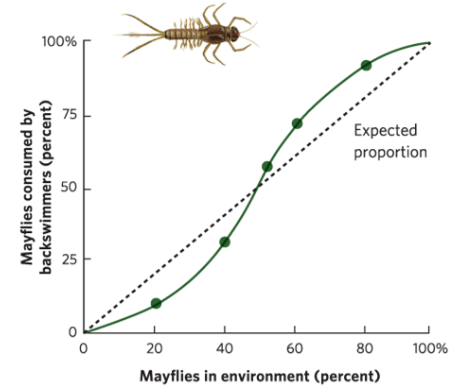
Functional response of predators to prey abundance
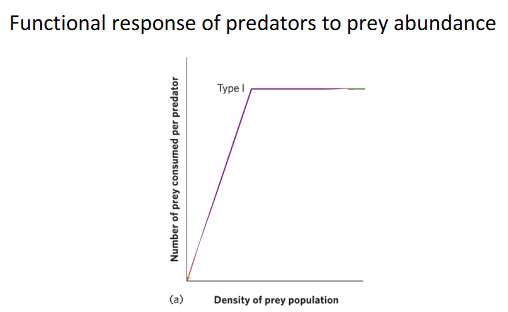
Example of type III functional response
Habitat edges can:
Increase abundance of wildlife like deer, quail, and turkeys
Increase abundance of harmful invasive species
Be managed to reduce harmful effects on native species
All of the above
Ro = (b/g)S, 6 years ago, MSU closed to attempt to reduce R0 by reducing which variable in this equation?
S

