Marine Biology and Classification
 Studied by 0 people
 Call with Kai
 Learn
Learn Practice Test
 Spaced Repetition
 Match
Match Flashcards
 Knowt Play
1/9

Earn XP
Description and Tags
Marine Animals invertebrates and vertebrates
Name | Mastery | Learn | Test | Matching | Spaced | Call with Kai |
|---|
No analytics yet
Send a link to your students to track their progress
10 Terms
Porifera
Sponges
Sessile animals and are also asymmetrical, they are made up of cells BUT NOT tissues
Cnidaria
Jellies, Corals, & Anemones
Radially symmetrical and have tentacles that contain nematocysts (poison harpoons), also has a digestive cavity with one opening (feces and food go through same hole)
Platyhelminthes
Flat Worms
Contain body organs and a simple digestive/nervous system, and are also bilaterally symmetrical.
Nematoda
Round Worms
Usually parasites that have unsegmented bodies (tapered worms), they also move by coiling and uncoiling their body
Annelida
Segmented Worms
Segmented body wall, has surface scales or bristles and can be bothh sessile and motile species
Echinodermata
Sea Stars & Sea Urchins
5 point radial symmetry, contains a calcareous (CaCO3) exoskeleton, has tube-feet which is operated by fluid pressure (hydrostatic skeleton)
Anthropoda
Crustaceans- lobster, crab, shrimp
Joint apendages, has a hard exoskeleton made of chitin, bilateral symmetry
Mollusca
Snails, Squids, Clams
Open circulating system, animal covered with a shell of 1,2, or 8 pieces. Can be without an external shell & tentacles but with a muscular foot
Chordata
Mammals, reptiles, birds, fish, sharks
Animal body, bilateral symmetry, Animals with a notochord often becoming a vertebrate, most chordates have a backbone and skull
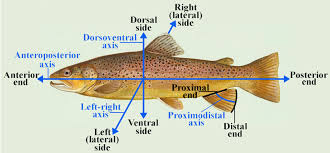
Anatomical Directions
Dorsal, Ventral, Anterior, Posterior
 Note
Note  Flashcards (53)