4. Sequences, Series, and Convergence
 Studied by 0 people
 Call Kai
 Learn
Learn Practice Test
 Spaced Repetition
 Match
Match Flashcards
 Knowt Play
1/9

There's no tags or description
Looks like no tags are added yet.
Name | Mastery | Learn | Test | Matching | Spaced | Call with Kai |
|---|
No analytics yet
Send a link to your students to track their progress
10 Terms
Convergence
(∀ε > 0)(∃N ∈ N)(∀n ≥ N)|aₙ − L| < ε.
Explain the defenition (∀ε > 0)(∃N ∈ N)(∀n ≥ N)|aₙ − L| < ε
ε - epsilon (an arbitrarily small number)
L - the limit
|aₙ − L| - the difference between a term in the sequence and the limit
aₙ converges to L, if for all ε > 0, there is some N ∈ N such that whenever n > N, we have |aₙ − ℓ| < ε
Convergence topological defenition
(∀ε > 0)(∃N ∈ N)(∀n ≥ N)aₙ ∈ Vϵ(a)
the sequence term xₙ lies inside the epsilon neighbourhood of a (a is the limit)
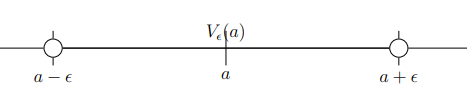
epsilon-neighborhood of a definition
Given a real number a ∈ R and a positive number ϵ > 0, the set
Vϵ(a) = {x ∈ R : |x − a| < ϵ}
diagramatic representation of the e-neighborhood of a
expand |a - L| < ϵ
-ϵ < a - L < ϵ
L - ϵ < a < L + ϵ
Template proof the xₙ → x
let ϵ > 0 be arbitrary
Demonstrate a choice for N ∈ N
Now, show that N actually works
Assume n ≥ N
with N well chosen, you should be able to get to |xₙ - x| < ϵ
Prove that 1/√n → 0
general case
let e >0 be arbitrary, solve 1/√n < e for
n > 1/e²
for every e > 0, we can pick N with N > 1/e² (because the natural numbers are unbounded)
(∀n ≥ N) 1/√n < ϵ
therefore, (∀e>0)(∃n ∈ N)(∀n ≥ N)(|1/√n - 0| < e)
defenition of a bounded sequence
(∃L, U ∈ R)(∀n ∈ N)L ≤ an ≤ U
Prove A sequence (an) is bounded if and only if (∃C ∈ R)(∀n ∈ N)|an| ≤ C
We assume that (∃C ∈ R)(∀n ∈ N)|aₙ| ≤ C
(∃C ∈ R)(∀n ∈ N) − C ≤ aₙ ≤ C.
By setting L = −C and U = C, we can see that
→(∃L, U ∈ R)(∀n ∈ N)L ≤ aₙ ≤ U.
now we assume
(∃L, U ∈ R)(∀n ∈ N)L ≤ aₙ ≤ U.
We set C = max{|L|, |U|}
(∃L, U ∈ R)(∀n ∈ N)L ≤ aₙ ≤ U
→(∃C ∈ R)(∀n ∈ N)|aₙ| ≤ C
 Note
Note  Flashcards (78)