24. Cardiopulmonary Interventions
 Studied by 0 people
 Call Kai
 Learn
Learn Practice Test
 Spaced Repetition
 Match
Match Flashcards
 Knowt Play
1/35

There's no tags or description
Looks like no tags are added yet.
Name | Mastery | Learn | Test | Matching | Spaced |
|---|
No study sessions yet.
36 Terms
Review:
Blood Pressure:
HR:
RPP:
CO:
SV:
Blood Pressure:
Force of blood against vessel walls
HR:
Number of beats per minute (bpm)
RPP:
Measure used to estimate myocardial workload and oxygen demand of the heart
CO:
Blood pumped per minute
SV:
Total amount of blood ejected by the left ventricle per beat

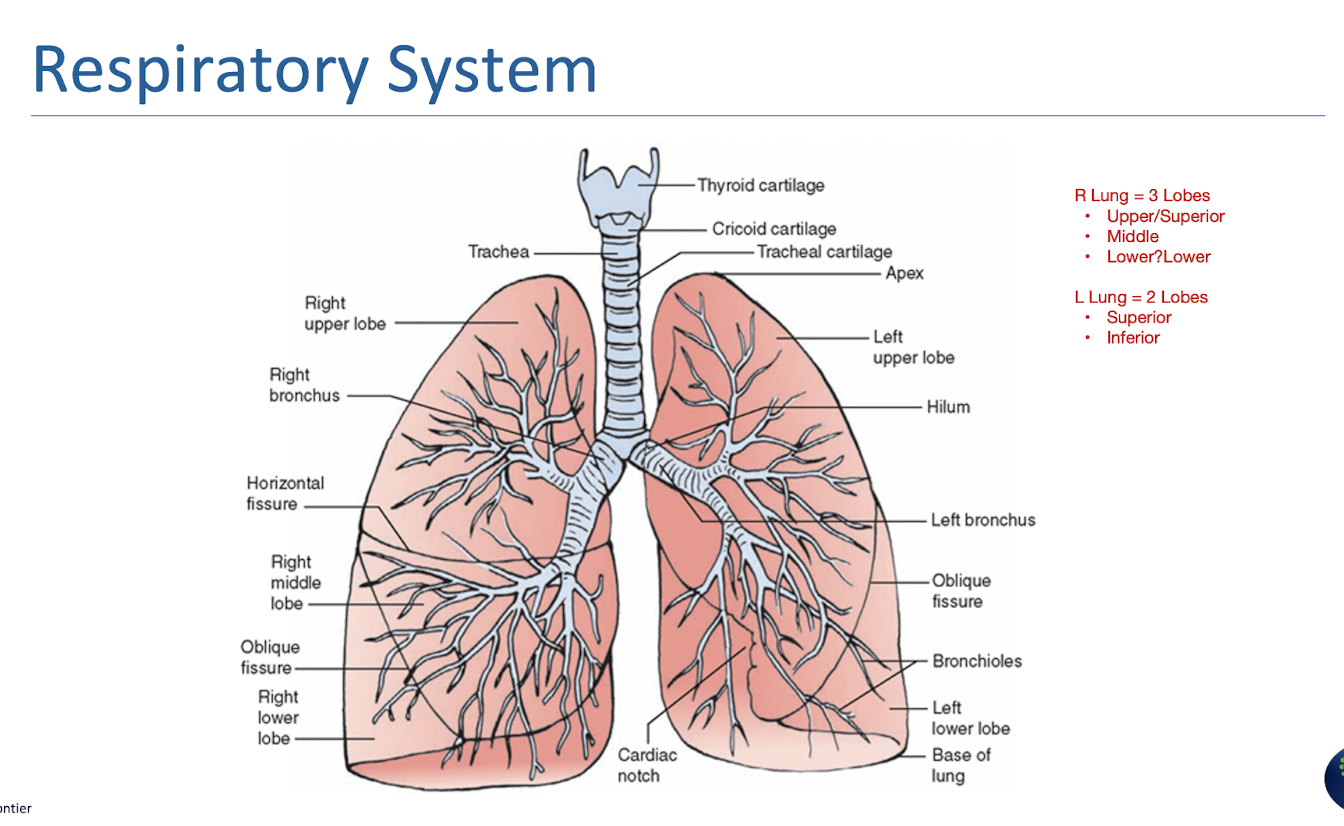
Respiratory System:
How my lobes does the ___ have:
L Lung:
R Lung:
L Lung » 2 Lobes
Superior/Upper
Inferior/Lower
R Lung » 3 Lobes
Superior/Upper
Middle
Inferior/Lower
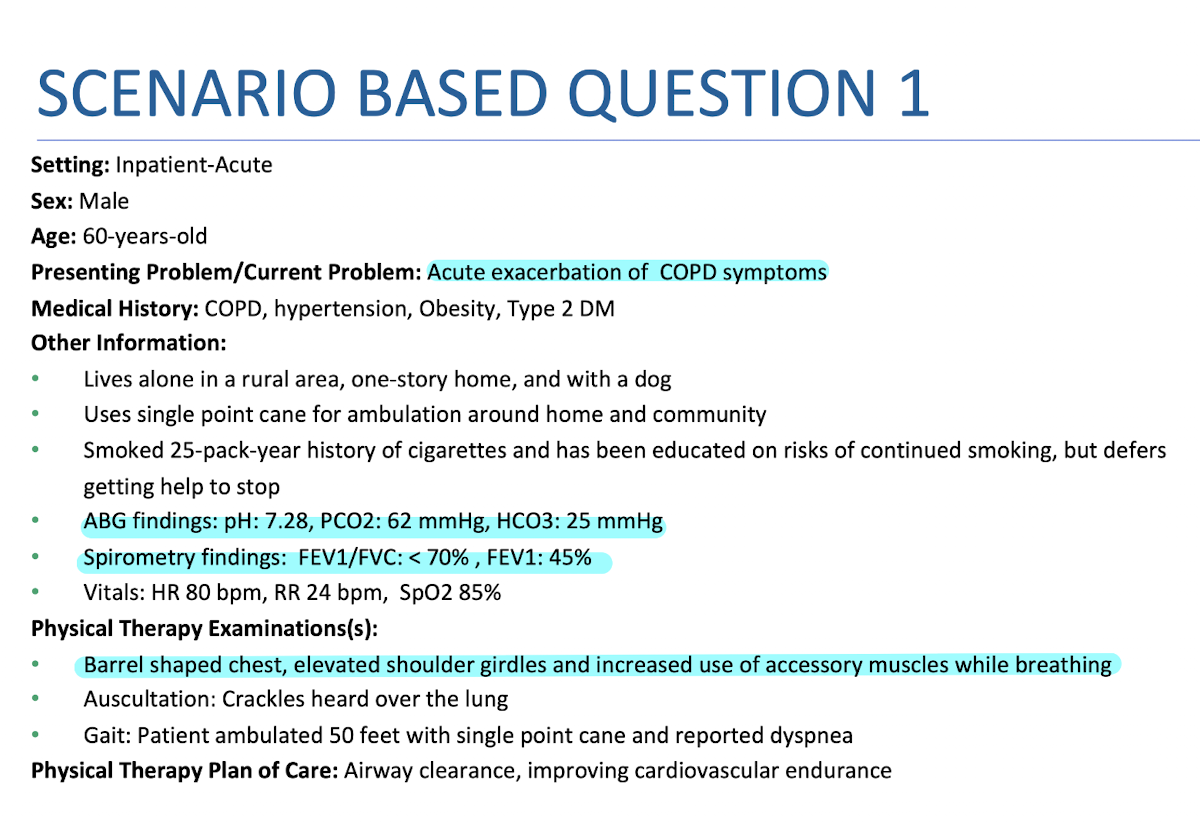
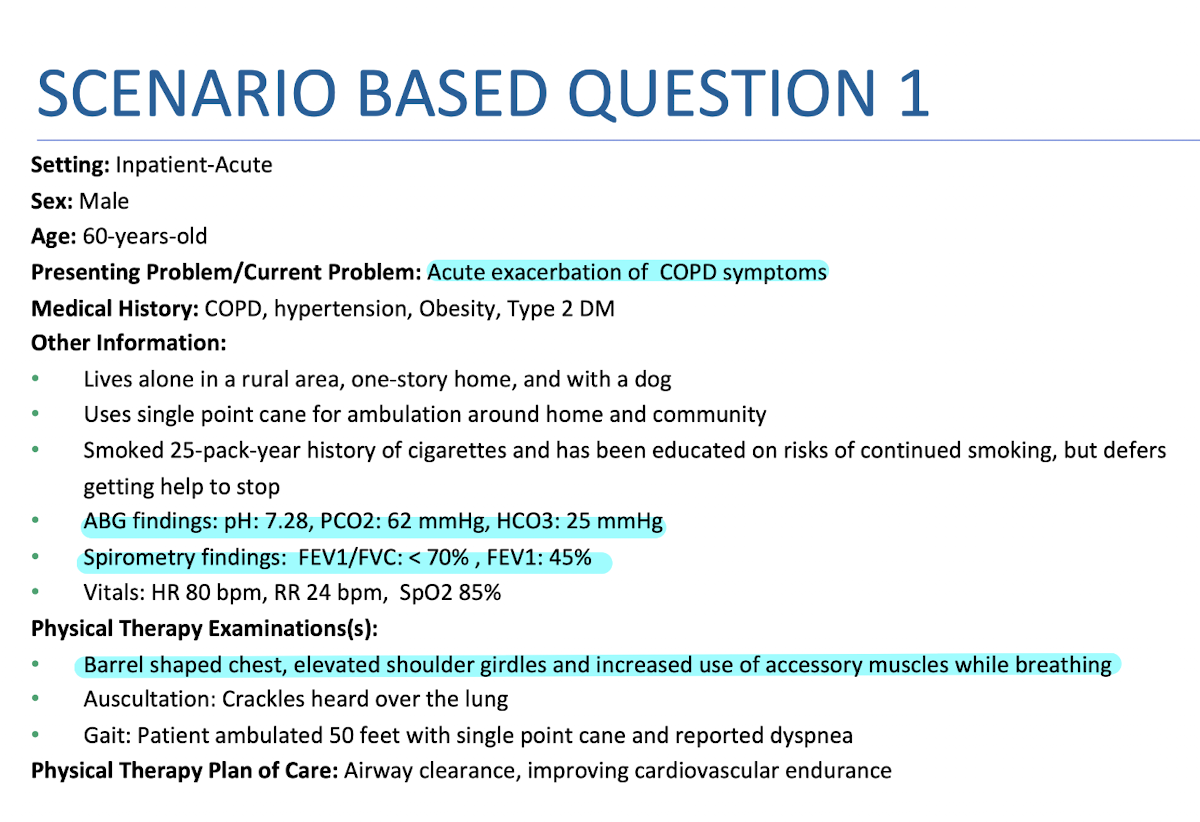
Scenario Based Q 1:
Which of the following is the MOST LIKELY treatment?
A. Bicarbonate infusion to decrease metabolic acidosis
B. Have the patient to breath into a rebreathing mask to decrease respiratory alkalosis
C. Fluid and saline infusion to decrease metabolic alkalosis
D. Use of supplemental oxygen to decrease respiratory acidosis
D. Use of supplemental oxygen to decrease respiratory acidosis
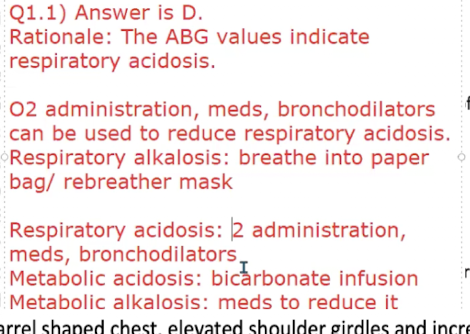
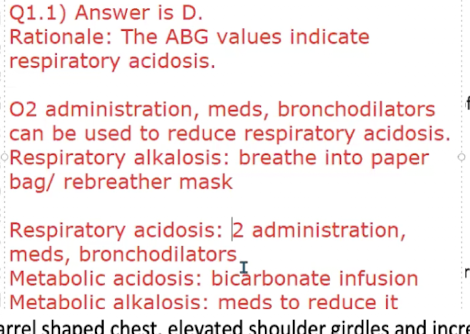
How to Manage/Treat:
Respiratory Acidosis:
Respiratory Alkalosis:
Metabolic Acidosis:
Metabolic Alkalosis:
Respiratory Acidosis:
Supplemental O2 Administrations
Medications
Brochodialtors
Respiratory Alkalosis:
Breath into paper bag // rebreather mask
Metabolic Acidosis:
Bicarbonate Infusion
Metabolic Alkalosis:
Medications to reduce it
Scenario Based Q 2:
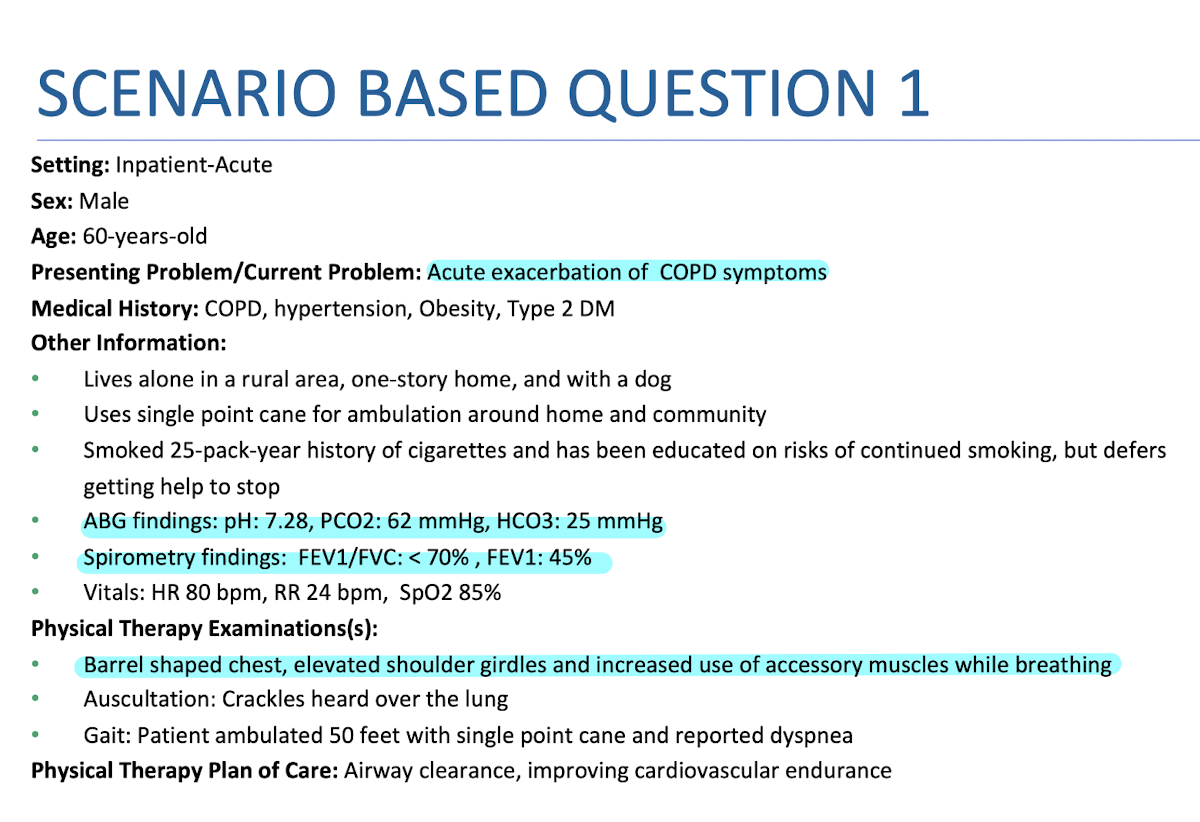
Which of the following exercises would be MOST LIKELY recommended for this patient?
A. Inspiratory muscle training
B. Pursed lip breathing exercises
C. Segmental breathing exercises
D. Incentive spirometry
B. Pursed lip breathing exercises
Describe:
Inspiratory muscle training
Pursed lip breathing exercises (3)
Segmental breathing exercises
Incentive spirometry
Inspiratory muscle training
Strengthen inspiratory muscles in CHRONIC COPD pts but not ACUTE COPD
Pursed lip breathing exercises
Helps maintain POSITIVE BACKWARD PRESSURE
Prevents early airway closure
Helps remove air from lungs
Segmental breathing exercises
Appropriate to expand a segment/lobe of the lung with RESTRICTIVE issues
Incentive spirometry
Inflate collapsed lung post op and/or after atelectasis
Scenario Based Q 3:
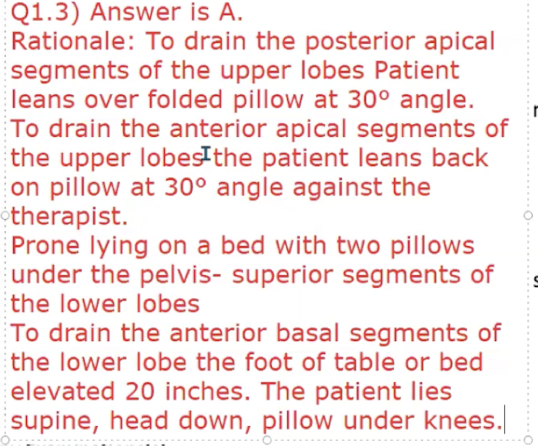
The physical therapist decided to use postural drainage for airway clearance. The physical therapist positions the patient in a seated position leaning forward over a folded pillow. Based on this position, which lobe is MOST LIKELY being drained?
A. Posterior apical segments of upper lobe
B. Anterior apical segments of upper lobes
C. Superior segments of the lower lobes
D. Anterior basal segments of lower lobes
A. Posterior apical segments of upper lobe
Postural Drainage:
Bronchus of the involved lung segment is ___ to the ground.
Using ___, these positions assist the mucociliary transport system in removing ___ ___ from the tree.
Indications: (3)
Maintain each position for:
Secretions cleared by:
Perpendicular
Gravity; Excessive Secretions
Indications:
Pulmonary Complications
Weak/Elderly pts
Atelectasis, PNA, COPD
Maintain: 5-10 mins
Secretions Cleared: Coughing or Suctioning
NOTE:
Bad Lung (Has Secretions) = Facing UP
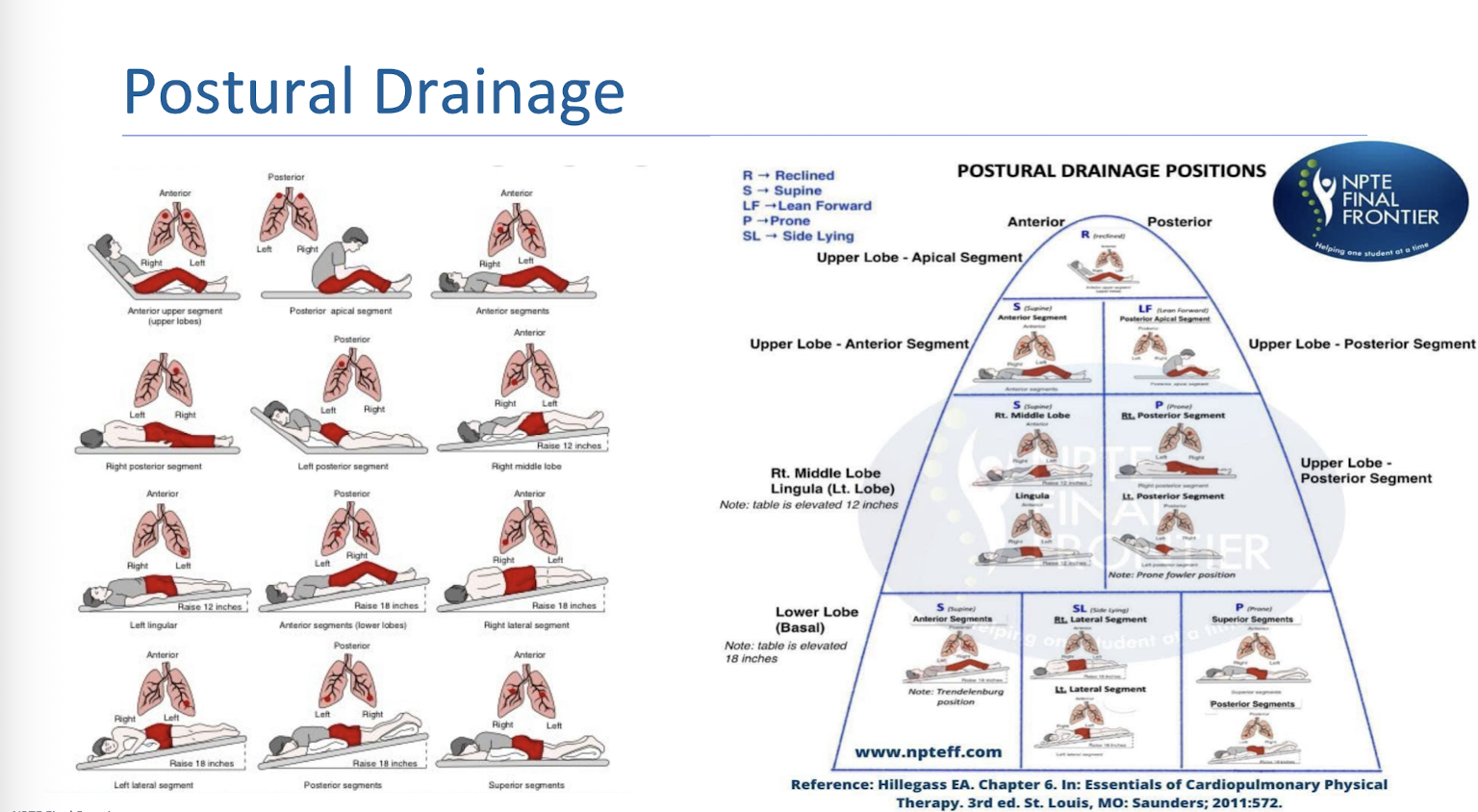
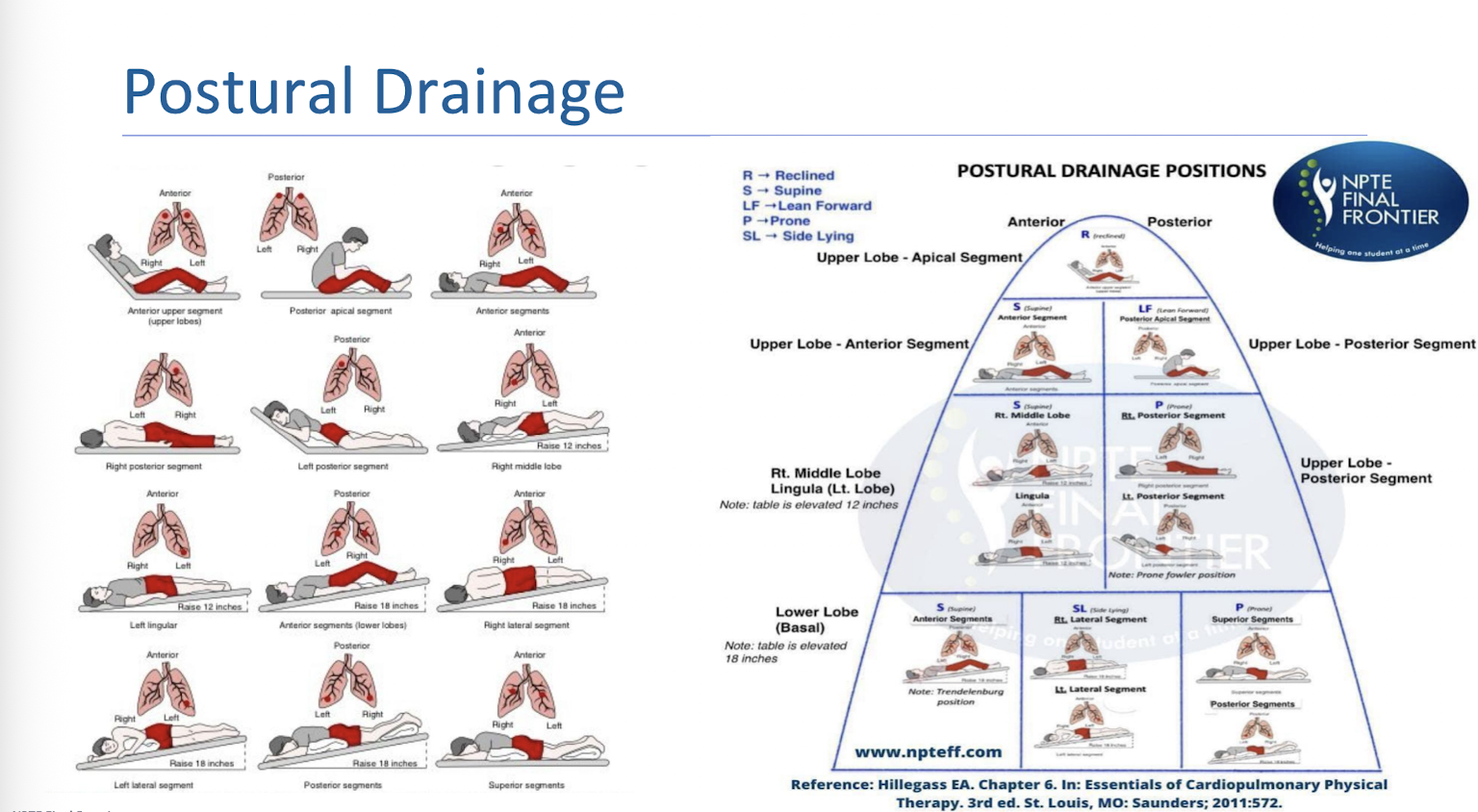
Key Positions:
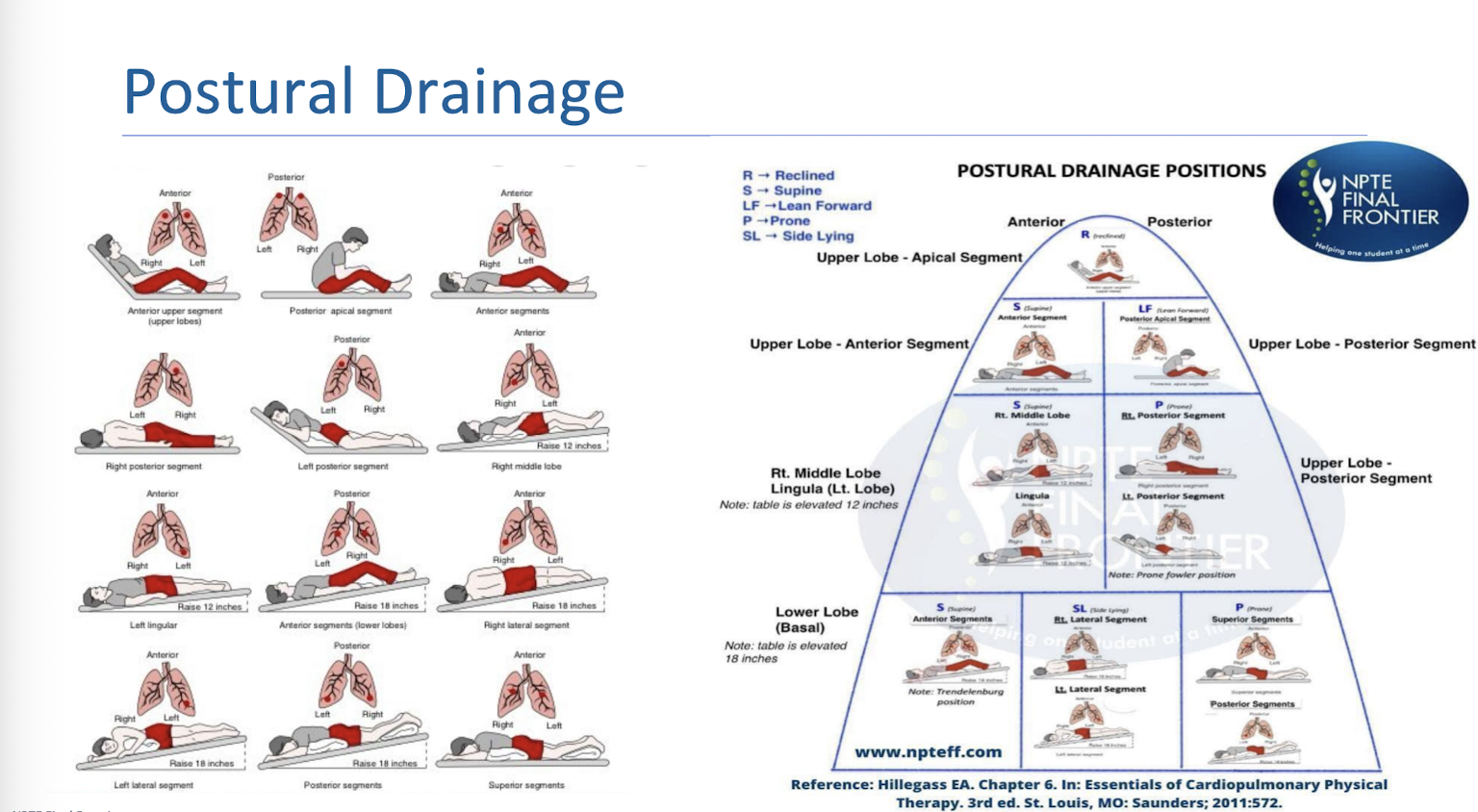
Prone lying on a bed with two pillows under pelvis:
Sitting on a chair, leaning forwards over folded pillow:
Supine lying on a bed with pillows under knee:
Sitting in a recliner, leaning slightly backwards:
Prone lying on a bed with two pillows under pelvis:
Superior Segments of the Lower Lobe
Sitting on a chair, leaning forwards over folded pillow:
Posterior Apical Segment of the Upper Lobe
Supine lying on a bed with pillows under knee:
Anterior Segment of the Upper Lobes
Sitting in a recliner, leaning slightly backwards:
Anterior Apical Segments of the Upper Lobes
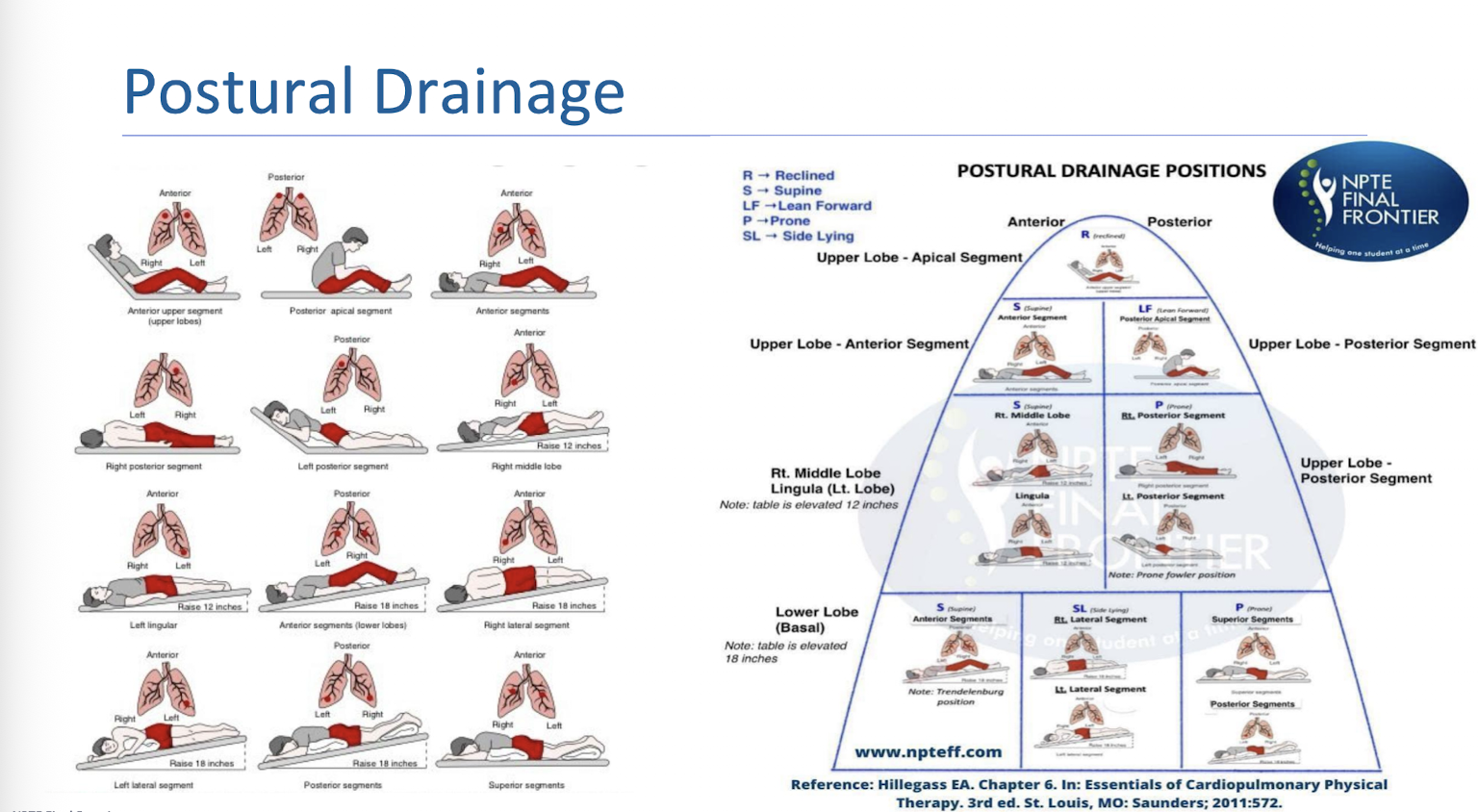
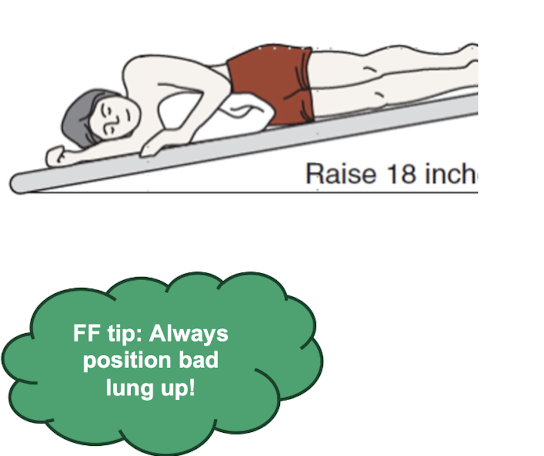
Practice Q 2:
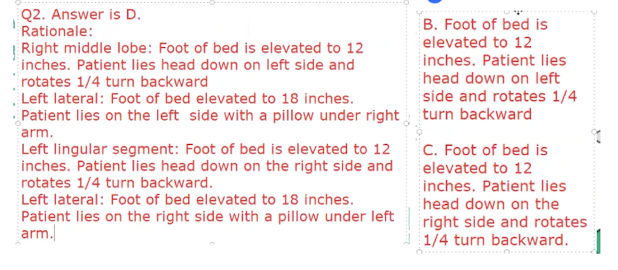
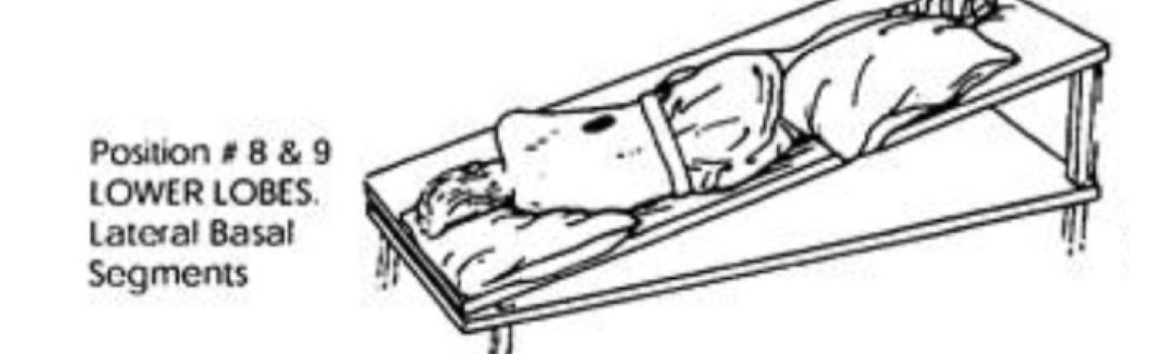
A clinician is educating the patient's parents on postural drainage. The clinician places the patient in a position, as shown in the image below. Which of the following segments of the lungs is MOST LIKELY being drained?
A. Right lateral basal segment
B. Right middle lobe
C. Left lingular segment
D. Left lateral basal segment
D. Left lateral basal segment
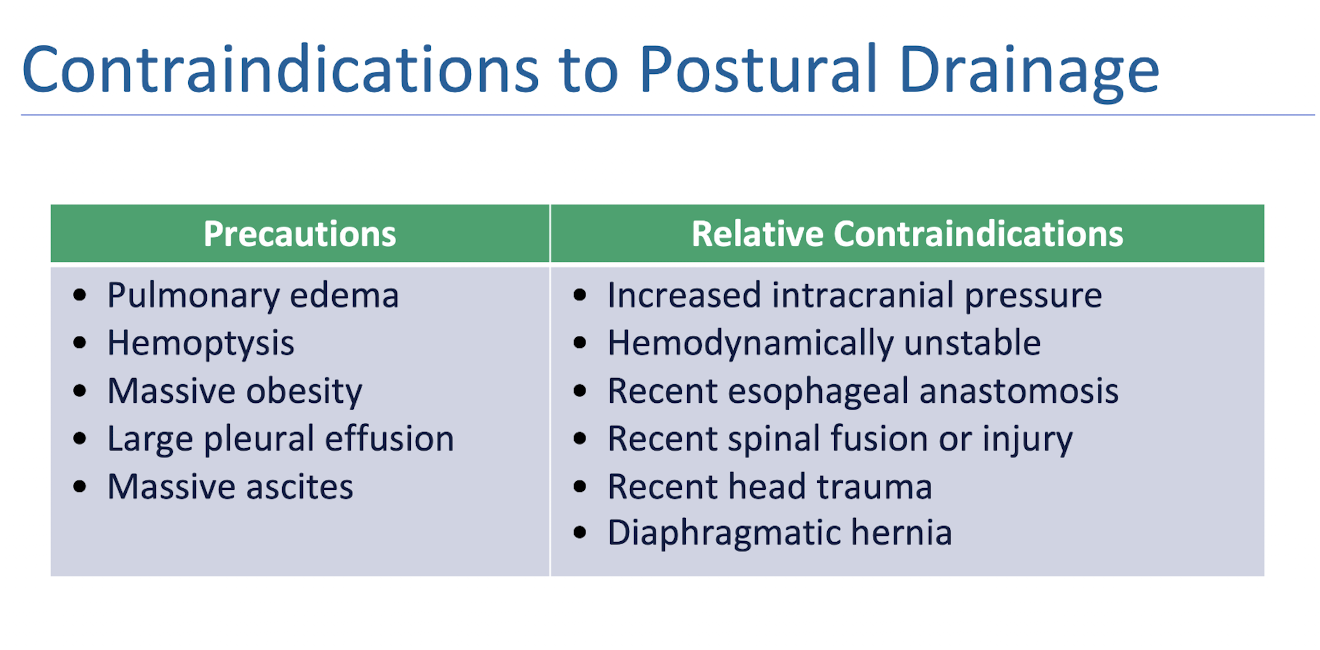
Contraindications and Precautions to Postural Drainage:
Practice Q 3:
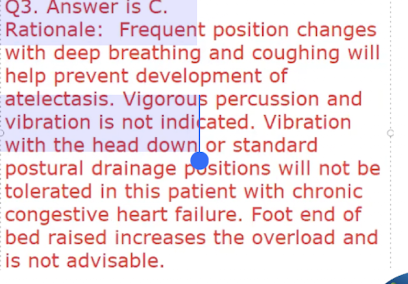
A patient with chronic congestive heart failure was recently admitted to the hospital. Which of the following plans for prophylactic respiratory care is most likely to be CONTRAINDICATED?
A. Frequent turning and positioning every 2 waking hours
B. Gentle percussion 2 times per day
C. Vigorous chest vibrations, with the foot of the bed elevated, 4 times per day
D. Gentle coughing and deep breathing exercises every 4 hours
C. Vigorous chest vibrations, with the foot of the bed elevated, 4 times per day
How to Predict HR:
2 Age Predicted Formulas:
Karvoven’s Formula:
Example:
Age Predicted:
HR Max = 220 - age (NPTE)
HR MAX = 207 - 0.7 x age (ACSM)
Karvonen’s Formula:
HR Reserve multiplied by the percentage of intensity plus Resting HR
Ex:
Max HR = 200
HR Resting = 7
HR Reserve » HR Max (200) - HR Resting (70) = 130 HR Reserve
NOTE:
Starting Early: Lower % HR Max
Elite: Higher % HR Max
Practice Q 4:
A 65-year-old individual has limited endurance with no history of cardiorespiratory problems. Exercise tolerance test was negative for coronary heart disease. What is the BEST initial exercise prescription for this individual?
A. 90-100% HR max
B. 60-70% HR max
C. 40-50% HR max
D. 30-40% of HR max
B. 60-70% HR max

Practice Q 5:
A clinician is supervising a patient with a history of cardiovascular disease during an exercise session. Baseline vitals: HR = 72 bpm, SpO₂ = 98%, BP = 116/78 mmHg. Which of the following findings would be considered MOST LIKELY to require termination of exercise?
A. Systolic BP increases to 160 mmHg
B. Diastolic BP drops to 74 mmHg
C. HR drops to 60 bpm
D. HR increases to 110 bpm
C. HR drops to 60 bpm
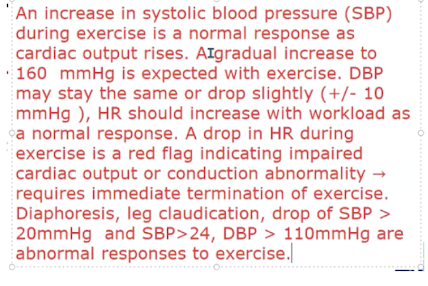
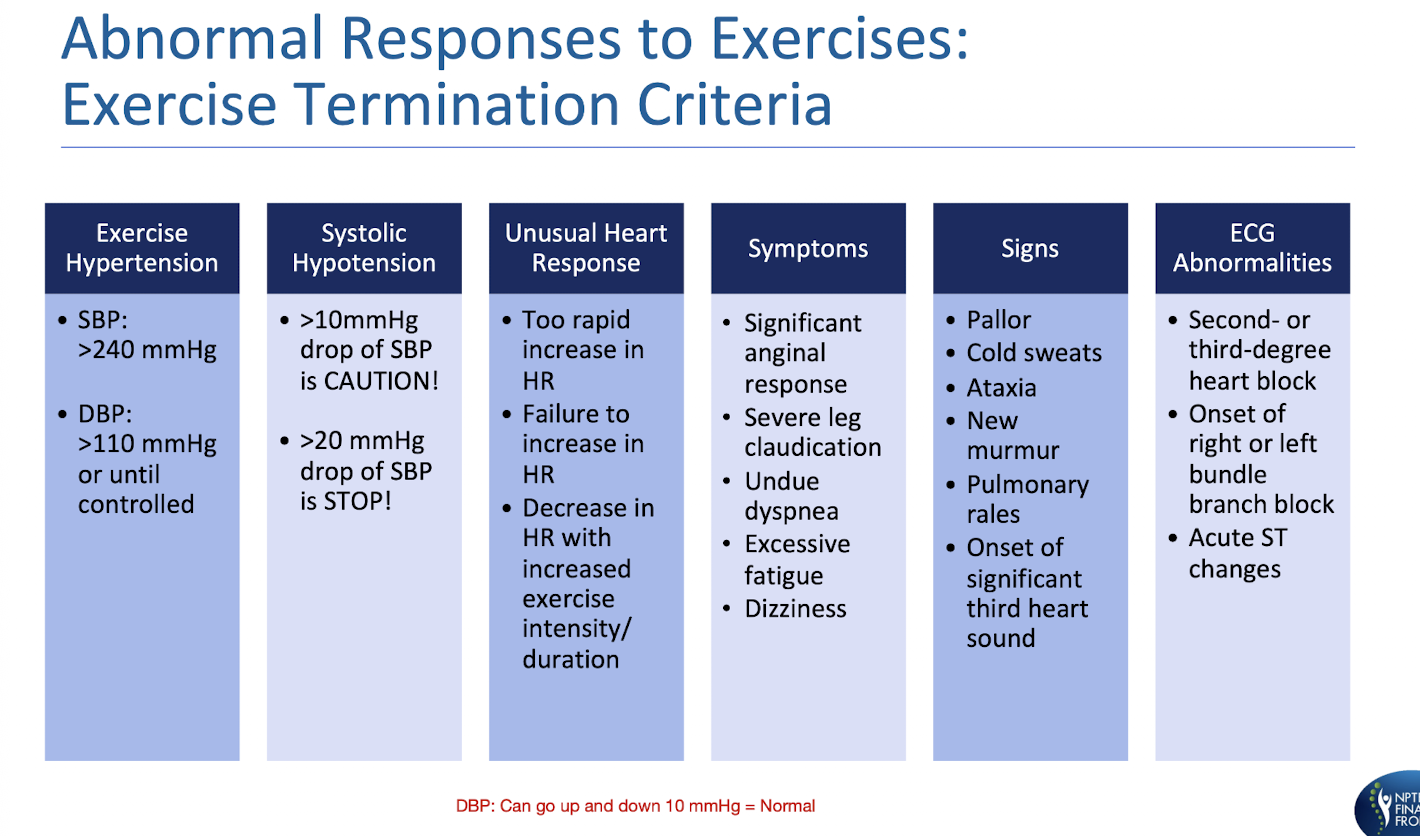
Abnormal Responses to Exercises: Exercise Termination Criteria
Exercise HTN:
Systolic HYPOtension
Unusual Heart Response:
Symptoms:
Signs:
ECG Abnormalities:
Cardiac Rehabilitation:
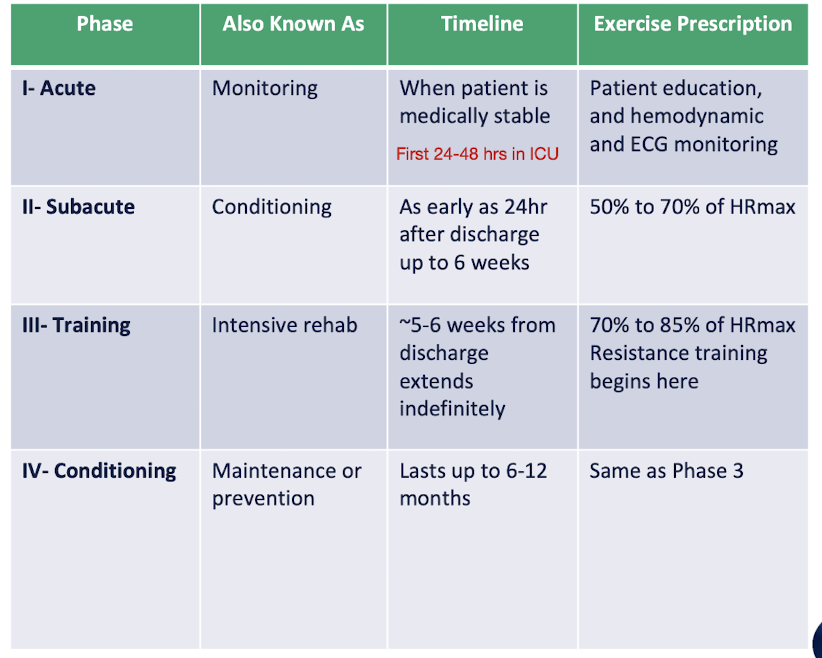
When does Cardiac Rehab:
Begin:
Extends:
Phase I =
Phase II =
Phase III =
Phase IV =
When does Cardiac Rehab:
Begin: In the hospital
Extends: Indefinitely into the maintenance phase
Phase I = Acute Phase // Monitoring Phase
Phase II = Subacute Phase // Conditioning Phase
Phase III = Training Phase // Intensive Rehab Phase
Phase IV = Maintenance Period // Prevention Period
Cardiac Rehab » Phase I and II:
Inpatient Phase I can be initiated when?
Resistance Training? YES OR NO
F:
I:
T:
T:
Patients commonly undergo what test at how many weeks after MI?
Inpatient Phase I can be initiated:
after 24 hours of being stable
Resistance Training? NO
F:
Short Sessions 2-3x a day
I:
50% - 70% HR Max
T:
10-15 mins (Phase I)
30 mins (Phase II)
T:
ADLs
Supervised Ambulation
Patients commonly undergo:
Symptom Limited Maximal Stress Test (ETT)
4-6 weeks after MI
Practice Q 6:
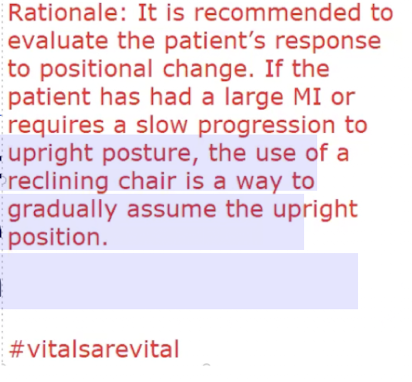
A patient is undergoing cardiac rehabilitation post complicated myocardial infarction in the hospital. On day two, the clinician wants to progress the patient to sitting. Which of the following is an APPROPRIATE INITIAL task for this patient?
A. Make the patient stand and do weight-bearing activities
B. Make the patient sit on the upright chair during the visitor’s time
C. Make the patient sit on reclining chair and check vitals
D. Patient is not ready for upright posture yet
C. Make the patient sit on reclining chair and check vitals
Cardiac Rehab » Phase 3 FITT
Resistance Training: YES OR NO
F:
I:
T:
T:
Resistance Training: YES
Phase III is beginning of Resistance Training
F:
2-3 sessions/week
I:
70%-85% of the peak achieved on the test (HR Max)
T:
30-60 minutes
5-10 min warm up and cool down
T:
Single mode of training (Walking)
Multiple modes of Training (Treadmills, Cycle, Ergometer)
Cardiac Rehab » Phase III Strength Training Guidelines
(3)
Begin with the use of elastic band and light hand weights (1-3 lbs) OR 30%-50% of max weight used to complete 1RM
Begin c 8-10 reps » Progress to 12-15 reps
Avoid UE Resistance as soft tissue is still healing
Sternal Precautions
Practice Q 7:
A patient with uncomplicated myocardial infarction has been discharged from the acute care. Which of following activities would be MOST APPROPRIATE during early phase 2 rehabilitation?
A. 30 minutes walking at 3 mph with no incline
B. 15 minutes of elastic band training with yellow elastic bands
C. 15 minutes upper limb workout with 2-pound hand weights
D. 30 minutes walking at 5 mph with 5% incline
A. 30 minutes walking at 3 mph with no incline
Cardiac Rehab » Phase IV
Location: (3)
Conditions Allowed to Exercise: (2)
Progression: (3)
Discharge:
Location:
Community Centers
YMCA
Clinical Facilities
Conditions Allowed to Exercise:
Clinically Stable Angina
Medically Controlled Arrhythmias
Progression:
50-85% of Functional Capacity
3-4x/week
45 min or more per session
Discharge:
Typically, 6-12 months
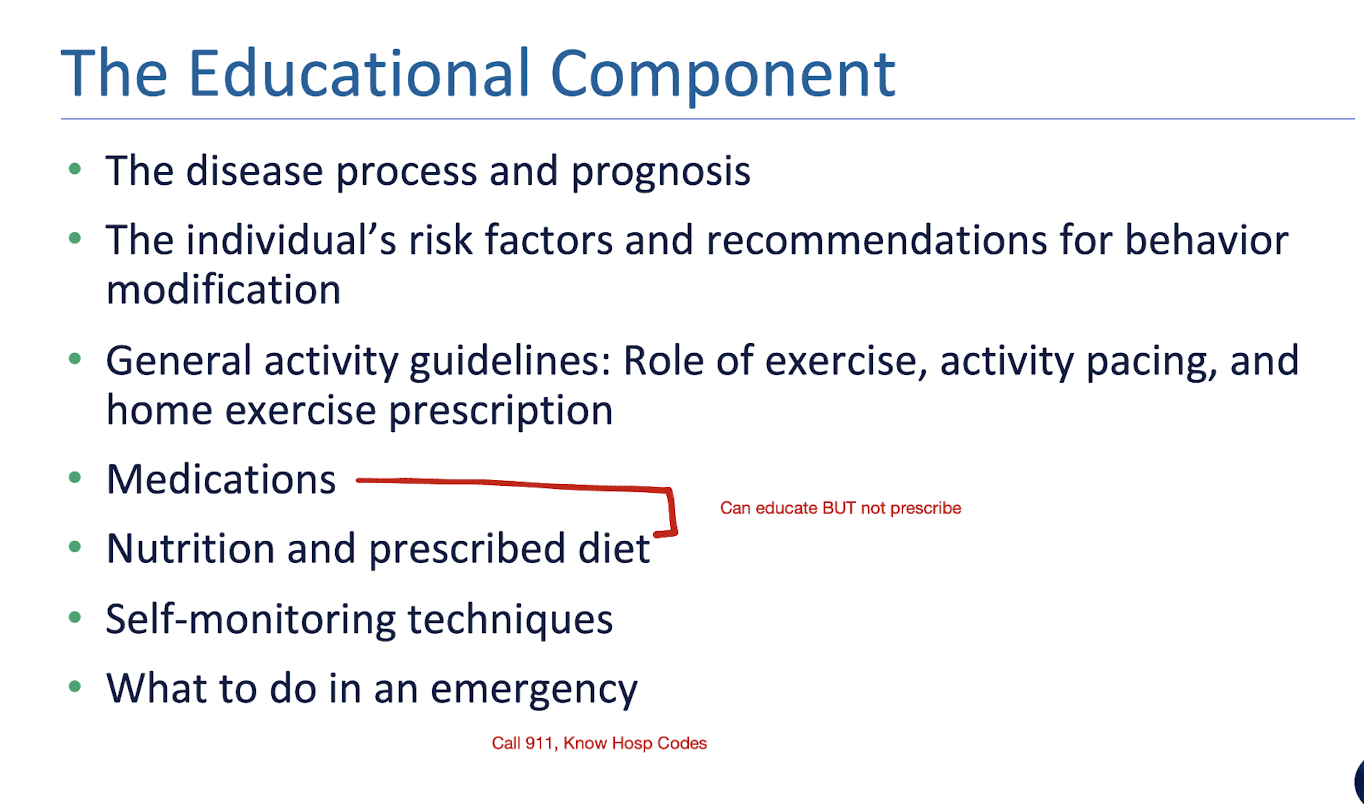
Educational Component:
What can a PT educate the patient? (7)
Practice Q 8:
A patient with a BMI of 31 kg/m² has been walking three days/week for 20 minutes, for the past three weeks. Which of the following modifications is MOST APPROPRIATE to achieve the goal of weight loss?
A. Walk 6 days/week at current walking speed and increase the duration to 45 minutes
B. Increase the walking speed and keep the duration at 20 minutes
C. Walk 5 days/week and decrease the duration to 10 minutes
D. Decrease the walking speed and increase the duration at 25 minutes
A. Walk 6 days/week at current walking speed and increase the duration to 45 minutes
Weight Reduction Guidelines for Obesity:
Minimum min/week:
F:
I:
T:
T:
Minimum min/week:
250-300 min/week required
F:
Greater than 5 days/week to maximize caloric expenditure
I:
Initially Moderate » 40-60% VO2, Progression to > 60%
T:
45-60 min/day
T:
Moderate Exercise
Aerobic
Resistance
Flexibility
CardioPulm Postural Drainage Lab
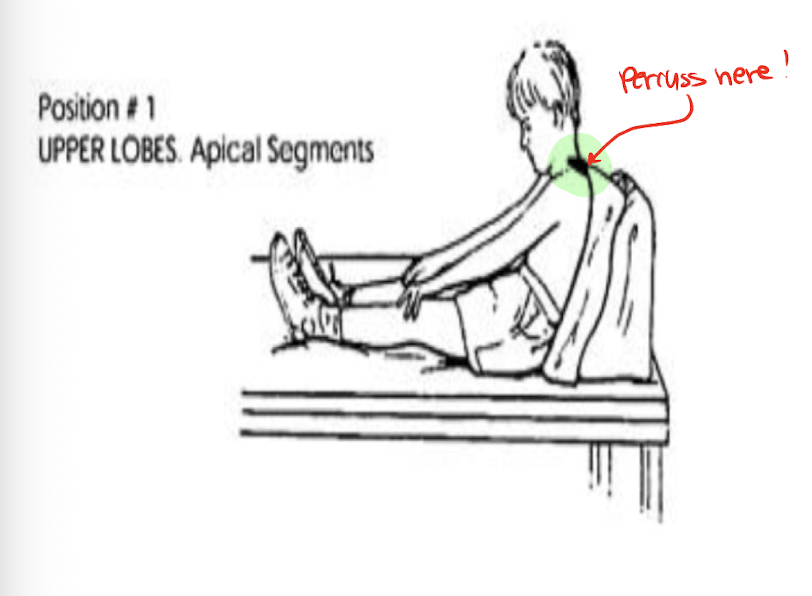
Upper Lobe » Apical Segment
Long Sitting Position
Lean Back 30 degrees
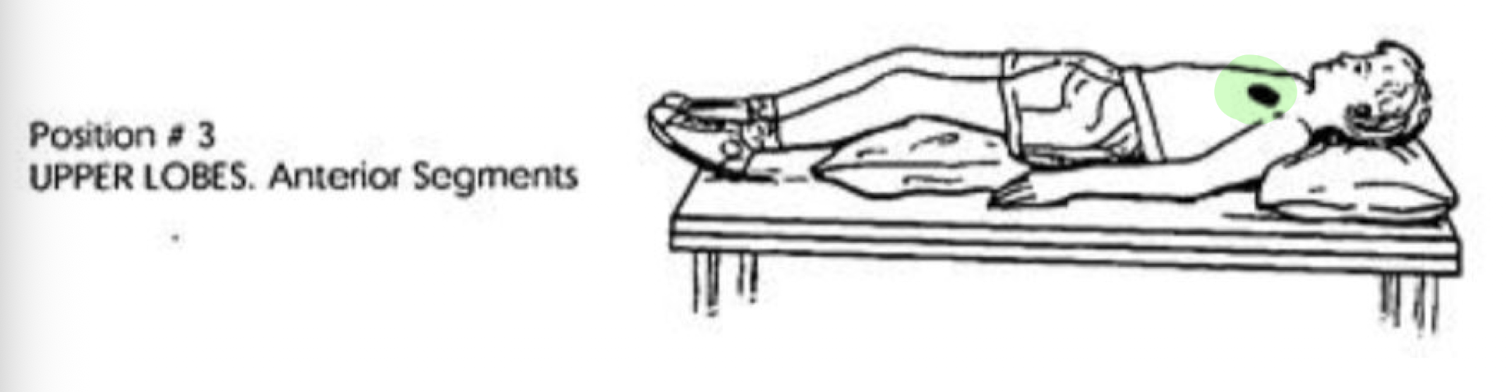
Upper Lobe » Anterior Segment
Supine with the Table Level
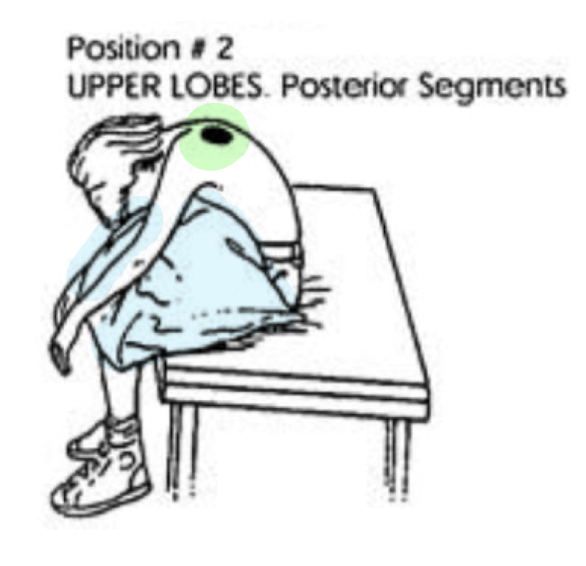
Upper Lobe » Posterior Segment
Seated, Leaning Forwards 30 deg
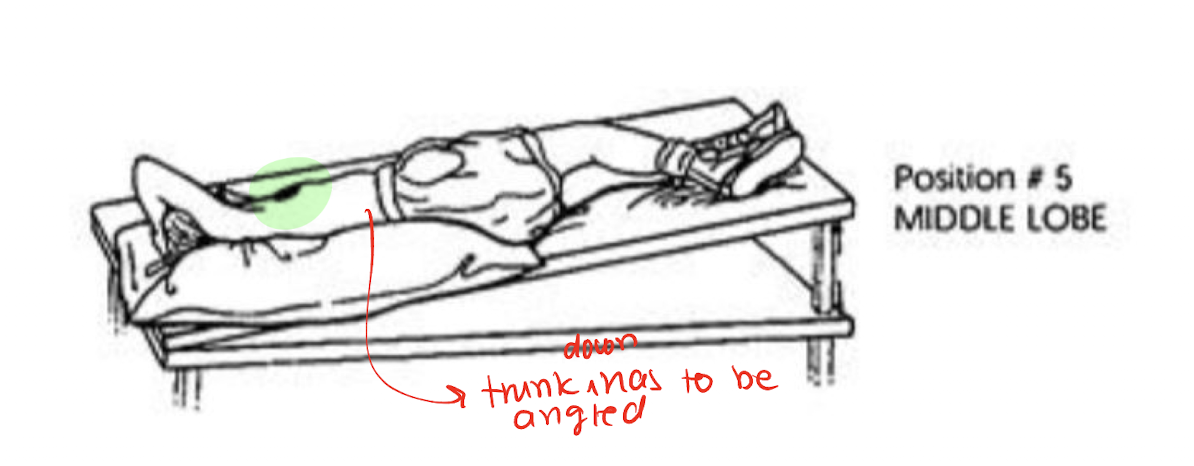
Middle Lobe
Left Sidelying
head Down 15 deg
¼ Turn Backwards
NOTE:
FOR R Lung » Only R Lung has Middle Lobe
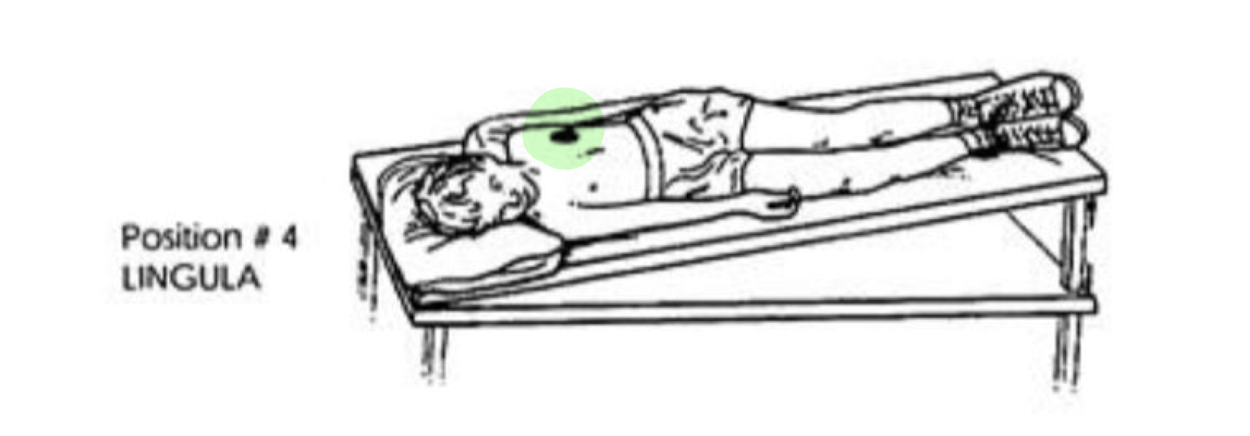
Lingula
Right Side Lying
Head Down 15 degrees
¼ Turn Backwards
NOTE:
FOR L LUNG » Only L Lung had Lingula
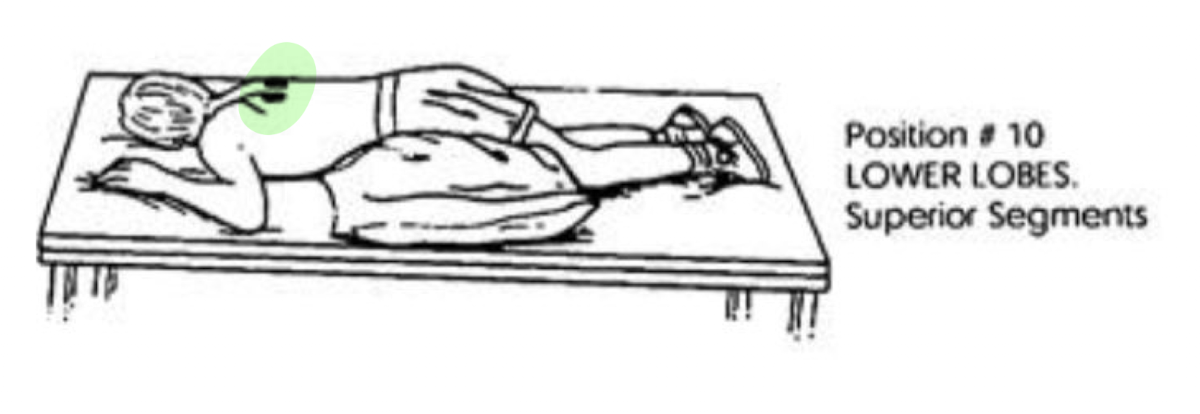
Lower Lobe » Superior Segment
Prone with the Table Level
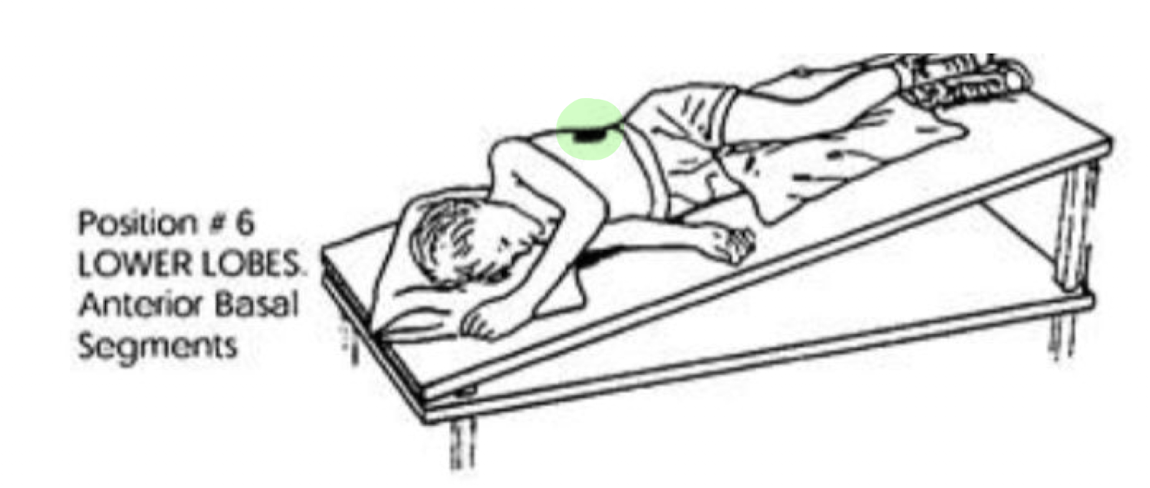
Lower Lobe » Anterior Basal Segement
R or L Side Lying with Head Down 30 deg
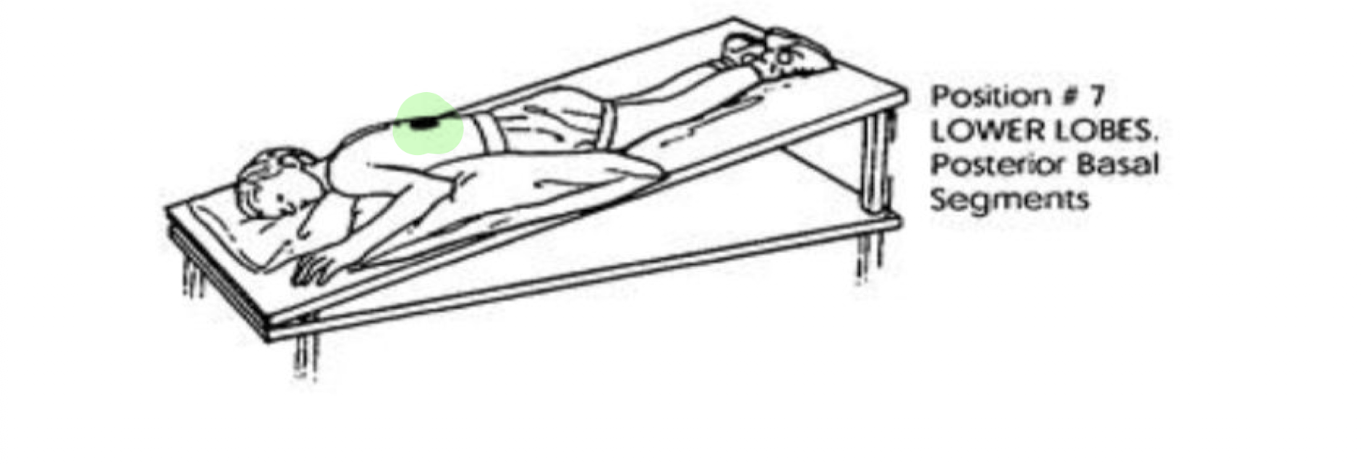
Lower Lobe » Posterior Basal Segment
Prone c Head Down 30 deg
Lower Lobe » Lateral Basal Segment
R or L Side Lying
Head Down 30 deg
¼ Turn Forward
 Note
Note  Flashcards (21)