disease due to gram negative
 Call Kai
 Learn
Learn Practice Test
 Spaced Repetition
 Match
Match Flashcards
 Knowt Play
1/47

There's no tags or description
Looks like no tags are added yet.
Name | Mastery | Learn | Test | Matching | Spaced | Call with Kai |
|---|
No analytics yet
Send a link to your students to track their progress
48 Terms
what are the 3 major pathogens we learned about for enterobacteriaceae?
E.coli, salmonella and yersinia
Tell me some characteristics about enterobacteriaceae
Bacilli (rod-shaped
gram negative
facultative anaerobe
non-spore formine
fermenting sugars (b-galactosidase)
mostly motile except for shigella and klebsiella
where do we find enterobacteriaceae? how is it transmitted?
worlwide
inhabits gut
found in soil and sewage
fecal-oral transmission
What type of infections can E.bacterioceae cause?
GI illness
pneumonia
wound infection, mastitis
invasive infections of the blood or internal organs
Is escherichia coli commensal or pathogenic? what are some of the virulence factors? is it zoonotic? serotyped by what antigens?
Both
virulence factors:
motility (petririchous flagelle)
adhesions (fimbriae)
Endotoxins: LPS
Exotoxins: shigatoxins, verotohxin, enterotoxins
Alpha-hemolysin
It is zoonotic
serotyped by O,H and K antigens
What is the disease caused by E.coli
Colibacillosis, all starts in the gut
EC e.coli pathotypes
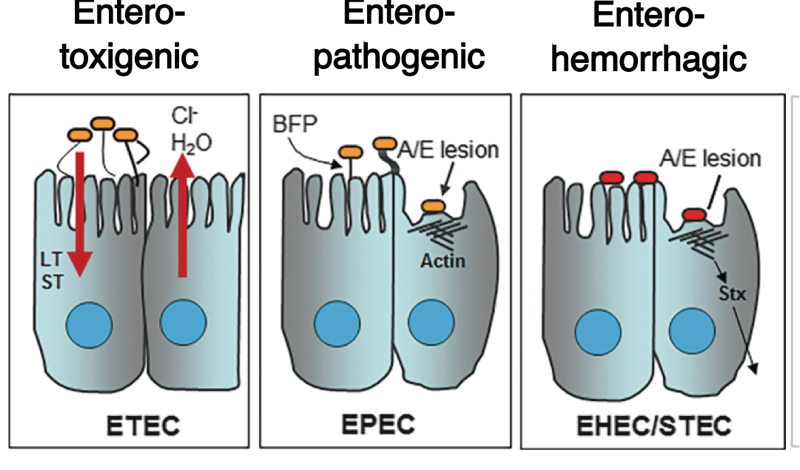
Entero-toxigenic (ETEC)
Entero-pathogenic (EPEC)
eNTERO-HEMORRHAGIC (EHEC/STEC)
What does ETEC lead to and how
Hypersecretory diarrhea bc it attaches to surface with fibril adhesions and produces enterotoxins (exotoxins) which causes secretion of sodium and chloride this water draw out to lumen.
What is a disease of enteric colibacillosis that is caused by ETEC, what is the clinical presentation?
Calf scours, disease of newborn calves, lambs, piglets
Clinical presentation: Very profuse and watery brown diarrhea is typical
They are depressed and recumbent and won’t drink or suckle. Dehydrated
What are some factors favoring infection for calf scours?
Environment contamination
overcrowding
STRESS- transport
Naive immunity
No colostrum
How is calf scours contracted?
Ingestion from the environment
Tell me some characteristics of EPEC
Adhesion, no toxin
Watery diarrhea with mucus, no blood
EHEC tell me some information about it and what it causes
Adhesion, shigatoxin
Watery diarrhea with mucus and blood
What do both EPEC and EHEC lead to
Microvilli effacement
Malabsorption/maldigestion in small intestine
Reduced absorptive capacity of colonic mucosa
Osmotic diarrhea- draws water into colon
Inflammation ± hemorrhage
ETEC colisepticemia, what is it and who does it infect
invasion of blood stream by intestinal or extraintestinal coliform
Infects: calves, lambs, poultry or -immune compromised animals
What does ETEC colisepticemia cause and what are some clinical signs from it?
Inflammation and endotoxic shock from LPS
Clinical signs from endotoxin LPS:
pyrexia, depression, tachycardia
meningitis, pneumonia (common)
profuse salivation, distended abdomen
joint swelling, arthritis, lameness
With or without diarrhea
What is oedema disease of pigs? In who does it occur in?
Toxemia= toxin presence in blood
Hemolytic E.coli colonizing gut→ production of shigatoxin (STEC) → absorption into blood stream → damage to endothelial cells → perivascular oedema
Occurs in: young pigs, 1-2 weeks post-weaning, sudden onset of
What are symptoms of oedema disease:
No diarrhea
oedema of eyelid and frontal face, laryngeal oedema (dysphonia), paresis, tumor, flaccid paralysis before death
Fatal within 36-48 hours
morbidity about 30% and mortality around 90%
What is an example of systemic colibacillloses
Oedema disease in pigs
Local ascending collibacilloses, what are some disease?
Coliform mastitis, Urogenital tract infections in domestic carnivores
Coliform mastitis, what type of infection is it? how is it spread? how does the milk look?
Etiology: E.coli, Klebsiella, Enterobacter (coliforms)
Opportunic infection (environment + immunity)
Spread from: fecal contamination of udder skin
Milk appears watery with white specks. Is mostly self-limiting
Tell me about the etiology of UTI in domestic carnivores? what can it cause in female dogs, male dogs, cats?
Etiology: uropathogenic E.coli (UPEC)
An opportunistic ascending infection of urogenital tract
In female cats can cause: pyometrya and cystitis
In male dogs: prostatitis
In cats: nephritis
What is treatment and also control and elimination of colibacillosis
Tx: isolation, immediate rehydration and electrolytes, antimicrobials (if systemic symptoms), NSAID
Control and prevention: (eliminate opportunity)
quarantine new arrivals
Pasture for pregnant cows
Isolation of newly-calved cows
Immunization of dams against ETEC during pregnancy
Colostrum in first hours of life
Improved hygiene (bedding + pasture)
Which of the following causes a hypersecretory diarrhea in calves, lambs, and piglets?
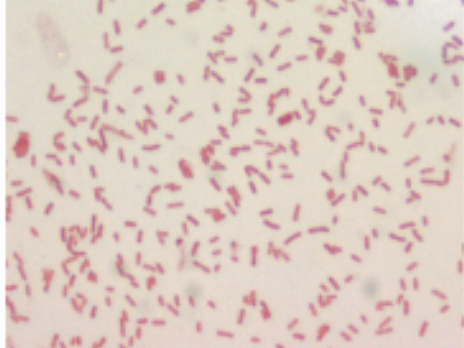
What type of mastitis is depicted by this type of bacteria?
E.coli recap, tell me the enteric, systemic, and local colibacillosis diseases
Enteric colibacillosis
Calves, lambs, piglets
Hypersecretory diarrhea: ETEC
Osmotic diarrhea: EHEC and EPEC
Systemic:
colisepticemia
oedema disease in pigs
Local:
UPEC, E.coli In carnivores
Coliform mastitis
Tell me traits of salmonella spp. GRAM what? virulence factors? commensal?
gRAM (-) rods
Motile (flagella)
adhesion (fimbriae)
Do not ferment lactose or sucrose (not a coliform)
Not a commensal = never a friend, always a foe
Salmonella spp. is a common infection in what? how is it transmitted? serotyped by what?
Mammals, birds and reptiles
Common fecal contaminant of environmen, underlying is stress and poor hygiene
Serotyped by O (somatic) and H (flagellar) antigens
What are the two species for salmonella
S.bongori and S.enterica (veterinary species is mostly this one)
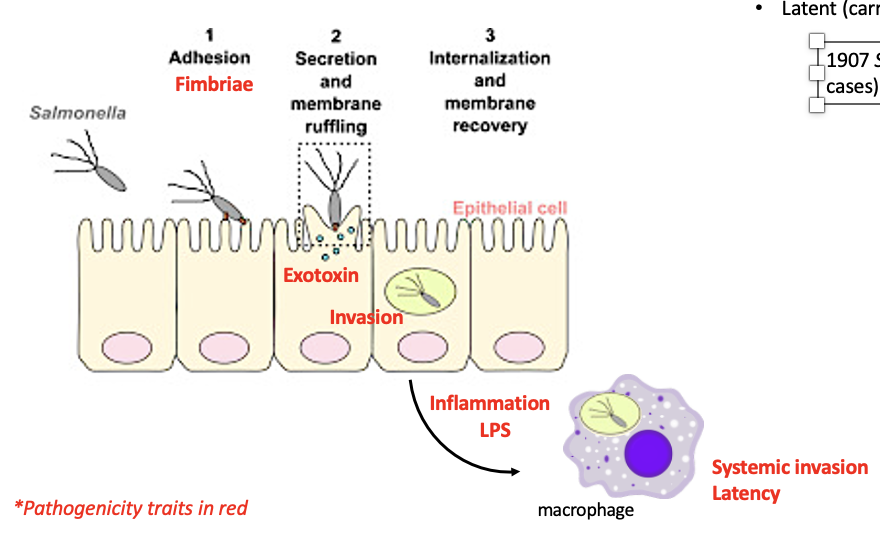
Salmonella pathogenesis
Adhesion (fimbriae)
Secretion and membrane ruffling
Internalization and membrane recovery
Enteric salmonellosis of pigs, explain acute and chronic and some symptoms
Acute:
profuse, could-smelling diarrhea, often with blood, mucus, epithelial casts
Dehydration, weight loss, fever
Abortion in pregnant
Mortality in young
Chroic
Can follow acute disease
Intermittent: fever, soft stool
Slow emaciation
Septicemic salmonellosis of pig, tell me presentation
Mostly in pig growers
Fever, depression, recumbency
Cyanosis
Mortality within 48h
Survivors: meningitis, arthritis, pneumonia, diarrhea
Enteric and septicemia salmonellosis of poultry how is it transmitted and what are some of the species
Transovarian transmission: S.pullorum, S.gallinarum, S.enteritidis, S.arizonae
Tell me about pullorum disease and what species of salmonella causes it, other name for it? what is seen post mortem?
AKA bacillary white diarrhea, pasty butt
S.pollorum
Seen in young chickd and poults (2-3 weeks)
High mortality
Postmortem-white nodes in lungs, necrotic liver
Tell me about town typhoid and what salmonella species causes it
S.gallinarum
Occurs in young and growing chicks and poults
Raw eggs, rusk of human food poisoning
What is one of the most common zoonoses and why
Salmonella due to contamination of water and soil in feces, meat, eggs, and offal.
Which of the following cause destruction of the microvilli in the gastrointestinal tract of young calves causing diarrhea?
Which serotype of S.enterica does not cause disease in birds
Tell me about yersinia spp. and the types that they want us to know
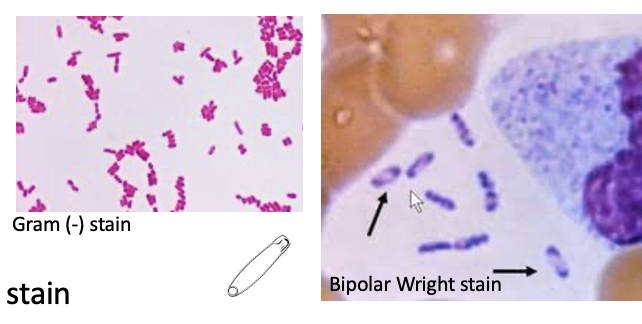
It is gram (-) rods
bipolar on giemsa and wright stain
Enteric or systemic infections
Types:
Y.pestis (spread from flea)
Y.enterocolica
Y.pseudotuberculosis
What is the pathogenesis of yersinia spp.
Intracellular invasion of macrophages.
Blood and/or lymph → lymph nodes
Replication in lymph nodes
Development of necrotic lesions
Infiltration of neutrophils
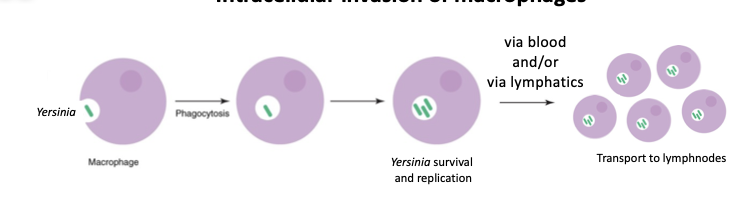
Y.pestis in humans (pneumonic, septicemic and bubonic)
P: bacteria enters respiratory. tract
S: bacteria enters blood
Bubonic: bacteria enters lymph nodes
Feline plague (Y.pestis) how are they infected, what do they develop and what are the clinical forms? how does it transmit to humans?
•Cats are highly susceptible to Y. pestis infection
•Infection through ingestion of infected rodents
•Develop sub-mandibular lymphadenitis (necrosis, rapture, oozing), dyspnea
•Clinical forms: bubonic, pneumonic and septicemic (often fatal)
•Transmissible to humans via aerosols, bites, scratches, fleas (indication for euthanasia)
•Dogs less likely to develop clinical illness than cats.
How can one try to prevent feline plague
Flea control and rodent control
What animal (s) is the natural reservoir (s) for yersinia pestis?
Enteric yersiniosis tell me about the different types and who they infect
•Y. enterocolica: pigs, wildlife, human
•Y. pseudotuberculosis: farmed deer, sheep, goats, cattle, pigs, human, laboratory rodents
•Stable in environment (pasture)
What are some signs of enteric yersiniosis
•< 1 year old animals
•Often subclinical
•Clinical enterocolitis develops with stress (winter, transport)
•Colitis à Diarrhea
What is the pathology and treatment and prevention of enteric yersiniosis
•Pathology: necrotic colitis and liver, adenopathy
•Treatment: fluid replacement, antibiotics
•Prevention: Y. ptuberculosis vaccine (killed), hygiene, stress reduction
Are E.coli, salmonella and yersinia all zoonotic?
Yes!!!
Explore top notes

Explore top flashcards
