UCLA EPS SCI 1 Midterm 1
 Studied by 0 people
 Call Kai
 Learn
Learn Practice Test
 Spaced Repetition
 Match
Match Flashcards
 Knowt Play
1/27

There's no tags or description
Looks like no tags are added yet.
Name | Mastery | Learn | Test | Matching | Spaced | Call with Kai |
|---|
No analytics yet
Send a link to your students to track their progress
28 Terms
Provide a definition of "science"
The study of the natural world and its phenomenon to understand how it works using evidence-based theory.
Provide a definition of "geology"
The study of rocks, minerals, and the physical earth.
Give examples of how science can be useful.
Reduces harmful misconceptions and practices (i.e bloodletting, eugenics), advances progression in society (medical development, transportation, technology, etc.)
Distinguish between "basic" and "applied" science, and explain how the former can lead to the latter.
Basic science is science simply for the pursuit of knowledge and exploring questions about the natural world, with no direct intention of applying these answers to everyday problems. This can often unintentionally give knowledge for applied science, which attempts to use scientific research to better everyday life. (i.e radio-wave experiments -> WiFi, study of genetics -> hereditary diseases)
State different ways in which geology can be useful, and give examples.
Geology helps people identify where and how to extract valuable minerals such as oil from the earth. Geology also helps understand how natural disasters form, when they occur, and what can be done to reduce damage/other preventative measures. (i.e earthquake warning systems, tsunami evacuation efforts)
Distinguish between a science, the thing being studied scientifically, and the people doing it.
Science aims to explore questions about the natural world and its phenomenon. Scientists, however, may use science for both the good of society, or to harm individuals.
Give examples of scientists doing good.
Edward Jenner coming up with the idea for vaccines, Jonas Salk creating the Polio vaccine, Rachel Carson writing "Silent Spring" to battle DDT in an environmentalist effort, George Washington Carver's pursuit for sustainable agriculture.
Discuss how science considered morally bad can be
prevented.
A clear goal when conducting science can help keep scientists on-track and prevent them from deviating their research into ethical concerns. A set of regulations or laws (such as a board of ethics) can also legally hold scientists accountable for keeping their studies ethical. Funding by organizations and governments such as NASA can also ensure scientists remain ethical at the risk of losing their money.
Describe how human flaws can negatively impact the quality of the science that they do.
Scientists are susceptible to human error such as misinterpreting/miscalculating data, or having prejudices and biases that may cause them to make inaccurate conclusions.
List the steps/components of the scientific method.
1. Make observations
2. Ask relevant questions
3. Form hypotheses
4. Create testable predictions based on hypotheses
5. Gather data to support, reject, or edit the predictions and repeat
6. Develop general theories using the data found to provide tentative answers to the original question.
Describe how adherence to the scientific method ensures evidence-based explanations for phenomena.
The scientific method ensures data collected is factual and objective, and helps to eliminate any biases or prejudices when forming theories. The method of constantly forming relevant predictions, and then collecting data to see if these predictions hold true helps back up these theories to be as valid as possible as well. Although there is never a true, singular answer to most questions in science, the scientific method helps bring well-supported theories to provide at least one potential conclusion.
Discuss factors in good experimental design.
A control group (does not receive the treatment to serve as a basis of comparison), a large enough sample size, a representative sample size (to extrapolate to the general population), retestability
Explain how the scientific method is applicable to historical sciences, using the Cretaceous-Paleogene extinction event as an example.
Although history cannot be re-simulated to run experiments on, the scientific method can still be used to formulate theories regarding historical scientific events. Geologists, for example, were able to observe certain details regarding the Cretaceous-Paleogene extinction event, such as dinosaur fossils being found in certain layers, but disappearing after a certain number of years. This signaled not only about roughly when the dinosaurs went extinct, but also showed the presence of meteor minerals in these same layers, which provided evidence to the theory that a meteor caused the great extinction. The presence of shocked quartz, markings which are usually only found as a result of high-impact explosions such as meteors, was also found around these dinosaur fossils. With these observations confirming the scientists' predictions, scientists also found a buried crater site dating roughly the same time as the dinosaur fossils, along with the presence of shocked quartz, once more giving evidence to the meteor extinction theory.
Define data, and distinguish between different types (quantitative vs. qualitative, and continuous vs. discrete vs. categorical).
Qualitative data is non-numerical data that is typically collected to describe something, such as interviews and photographs. Quantitative data is any numerical data, with three different types. Continuous qualitative data is values that can vary infinitely, such as height, temperature, etc. Discrete data is values that do not vary infinitely, and are always whole integers such as number of students in a classroom. Categorical data are also values that do not vary, but track data into non-numerical groups such as sex.
Convert between different units of measure.
Remember to cancel your units of measurement out in a proportion
Explain how data can be analyzed, visualized, and
interpreted.
Data can be analyzed using statistics, such as finding the mean or median. Data can be visualized in graphs, plots, and charts. Data can be interpreted in subjective conclusions about the implications these values hold.
Give an example of how a graph/chart can be misleading, even if not technically inaccurate.
Graphs that do not start at zero tend to appear more visually exaggerated when comparing the difference between two numbers/data points. Correlation also does not equal causation; simply that one value rises with the other value. Ice cream sales go up when death by drowning cases go up, but this does not mean one causes the other. Positive correlation also doesn't necessarily mean the relationship between the two values are strong enough for it to be statistically significant.
Explain the difference between compositional and mechanical layering.
Compositional layering is Earth's layers divided based on their chemical makeup, such as the minerals found. Mechanical layering is Earth's layers divided based on their physical properties, such as states of matter, rigidness, etc.
For both compositional and mechanical layering, list the layers of the Earth from the outside to the center, and briefly describe what distinguishes each layer from the others.
Compositional layering: Crust (oxygen, silicon), mantle (oxygen, magnesium), core (iron)
Mechanical layering: Lithosphere (solid, rocky, brittle), asthenosphere (solid, flowy, plastic), mesosphere (solid, flows, rocky), outer core (liquid iron), inner core (solid iron)
Define density, and use it to explain convection.
Density is an object's amount of mass per unit volume. Denser material sinks, less dense materials rise. In convection, the mantle has hot matter, which as it heats up, will begin to spread and take up more volume, making the matter less dense. This causes the hot matter to rise. As it rises close to the surface, the matter will begin to cool, which causes the volume to contract again, which makes the matter more dense. The cooled matter thus sinks, and the cycle repeats in a circular fashion. This leads to the tectonic plates above it to begin to diverge.
State the three types of plate boundaries, and the relative movement of the plates at each.
Divergent plate boundaries are two plate tectonics that are pulling away from each other, creating more oceanic crust. Convergent plate boundaries are two plates that are pushing against each other. Transform plate boundaries are two plates that are sliding against one another on a fault line.
Outline how a divergent plate boundary evolves over time.
1. Lithosphere is pulled open by convection currents in the mantle.
2. The separating of the continental crust begins to open a rift valley in the middle. The asthenosphere thus rises up, and once it reaches the surface, it begins to cool into new oceanic crust.
3. The continental crust continues to be pulled apart and new oceanic crust generates, until a wide ocean forms.
4. In the center of where the rifting first began, an oceanic mountain ridge is formed due to the increased buoyancy from the cooling asthenosphere.
Draw annotated diagrams of the three kinds of convergent plate boundaries, labelling: oceanic crust, continental crust, lithosphere, asthenosphere, volcanic arc, forearc, accretionary wedge, trench, zone of melting, & suture.
Remember to always include a subducting oceanic plate in the continental-continental convergent boundary
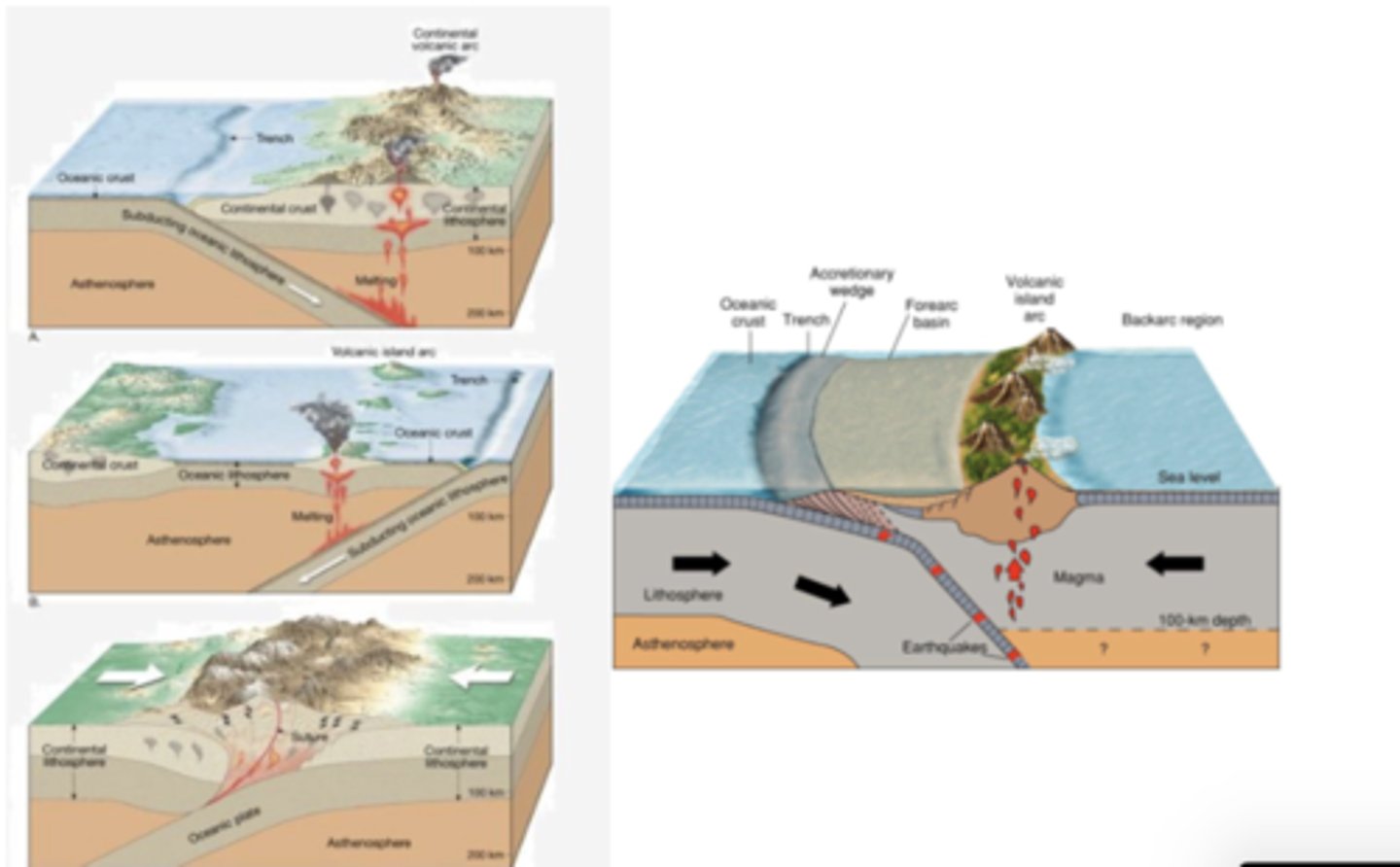
Calculate the amount of time a transform fault takes to slip a given amount, given its slip rate.
Know how to do unit conversions
Describe hotspots, and explain how they can potentially be used to determine absolute (rather than relative) plate motions.
Hot spots are locations on Earth's surface where the mantle rises up and spews hot magma above, fueling active volcano sites and creating islands. Hawaii, for example, rests above a hotspot. As plate tectonics shift, the hotspot will remain fixed on earth. Because magma will continue to spew out onto the surface, even as previously-formed islands moves off the hotspot due to plate movement, new islands will continue to be created. The direction in which the plate is moving can be seen based on the direction the islands formed. Because Hawaii formed in a northwest direction, the Pacific plate can therefore be judged to move northwest as well.
List different types of evidence used to constrain the compositional and mechanical layering of the Earth.
* The crust is visible on earth, and parts of the upper mantle have also floated up to the surface. This allows scientists to study their chemical and physical properties.
* Earth's composition can be compared to a chondrite meteorite, which contains heavy amounts of iron. Because scientists know the crust and mantle do not contain iron, scientists can logically deduce it is the core that must contain the iron instead.
* High-temperature and pressure experiments can be used to mimic the amount of pressure/temperature that is normally found deep in Earth's layers to see how it changes the composition of minerals.
* Seismic shadow zones when an earthquake occurs shows how seismic waves travel through the earth. Because s-waves cannot permeate through liquids and gasses, there is a part of the earth where s-waves do not hit at all, which leads scientists to deduce the outer core is actually a liquid.
* In order to have a magnetic field, there needs to be a constantly moving magnet somewhere. This is explained by Earth's outer core, which is a convecting liquid made of iron.
State some early evidence for a dynamic Earth, pre-plate tectonic hypotheses that tried to explain them, and observations that invalidate these hypotheses.
* Displaced ocean fossils in mountainous environments seemed to indicate early on the continents were shifting in some shape or form. Disproved the hypothesis that landforms were simply "always there".
* Displacement of various species across entirely different continents despite seemingly having been clustered together at one point furthered the idea Earth was dynamic. Disproved the hypothesis that the continents were expanding/shrinking, because that wouldn't be able to explain why species were scattered all over the place.
Explain the observation that led to the hypothesis of continental drift, and the predictions of this hypothesis that proved to be correct.
* Parts of the continents seem to "match up" together in their continental shells, given they were originally a supercontinent of Pangea.
* Earth has various rock formations that seem to match up to each other's continental shells, such as limestone on one coastline appearing on the other.
* Glacier markings on two completely different locations seem to indicate the continents were once formed together during the Ice Age.
 Note
Note  Flashcards (71)