the best ethical theory exam review
 Call Kai
 Learn
Learn Practice Test
 Spaced Repetition
 Match
Match Flashcards
 Knowt Play
1/22

There's no tags or description
Looks like no tags are added yet.
Name | Mastery | Learn | Test | Matching | Spaced | Call with Kai | Chat |
|---|
No analytics yet
Send a link to your students to track their progress
23 Terms
factual issues
claims over the truth of relevant details in a moral argument. resolved by empirical investigation
ex. To decide on the morality of the death penalty, we need to know if it deters crime.
conceptual issues
claims having to do with the meaning of a concept and whether the concept applies to a particular situation. resolved by determining meaning and applicability.
ex. Debate in abortion: Is a fetus a person? It depends on how we define a person and whether a fetus fits that definition.
moral issues
claims made in moral arguments that determine the morality of specific actions or rules. resolved by appealing to MP or MS.
ex. If a fetus is a person, is abortion still sometimes permissible?
moral standard
a single statement defining the good.
ex. In Egoism, an action is right if and only if that action promotes self interest.
moral principle
statements that determine the morality of certain classes of action, involving duties to yourself and others. general rules, duties, and behavior.
ex. In Egoism, our MS is self interest. From that we derive a moral principle that says I have a duty to promote my physical health (positive + self).
moral judgement
give moral evaluation of individual people or actions (case by case). Evaluate whether an action is obligatory, permissible, impermissible, or supererogatory.
ex. In Egoism, it is morally obligatory for you to protect your house, because if you didn't you, it would violate your MS (self interest)
obligatory
a must do action, where if that action is not done, it violates the MS.
ex. Protecting property for an egoist.
impermissible
an action that you must NOT do. if action IS done, violates MS.
ex. Murder is impermissible for most moral systems.
permissible
morally neutral actions, don't violate the MS.
ex. Deciding to undergo a surgery that would extend your life a couple more months. Egoists would say both decisions would be equal, making either permissible.
supererogatory
"above and beyond the call of duty" actions that are good to do and permissible not to do.
ex. the decision to not demand immediate repaying of debt of a friend in financial trouble
characteristics of normative disciplines
prescription of conduct: does it tell us what behavior to engage in
impartiality: is this action universal and should be applied to all
overriding importance: which moral rules take precedence over others, breaking the law overrides poor grammar
independence of arbitrary authority: is the morality based on authoritative bodies, texts, or religion
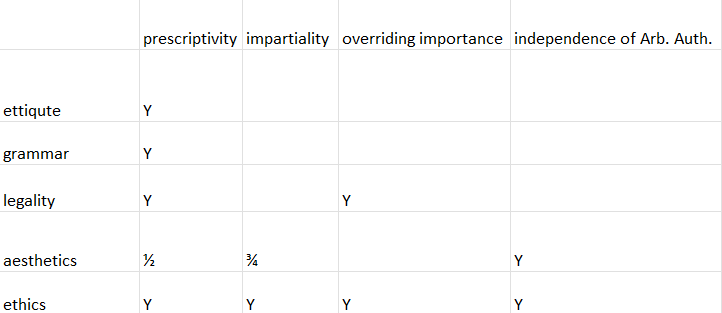
disciplines and their descriptions
moral relativism
morality is not universal, it is dependent upon the standards of a particular culture at a specific time and differs in different contexts
moral absolutism
morality is objective in nature in regards to context, cultural, or individual perspectives. deals with objective moral facts and is divine in nature
our definition of morality
there is no one definition of morality. if we can understand the facts and issues relevant to morality and establish a good criteria for evaluating morality, then we should follow that system or build from that
voting criteria
consistency: does it provide consistent and objective answers? does it show internal coherence? are the internal and external parts all logically compatible with each other?Logical criterion
justification: can you tell a good story to prove the existence of a theory? can the MS be justified? the best justification for a system wins. Head
plausibility: is this how the world really works? does it produce judgments that agree with prior moral beliefs? Heart
usability: is it easy to use or fast to use? is it useful in resolving disagreements? Practicality
duties to self and others
there are both positive and negative duties to the self and others. they are apart of our moral principles that determine what we ought to do or not do for ourselves and others.
ex. and Egoist has positive duties to their self such as maintaining health but does not have positive duties to others.
Act vs. Rule
the evaluation of morality through specific actions or through specific rules. an act moralist determines the morality of something by looking at a specific action as opposed to a rule moralist who determines morality through a set of moral codes with rules of conduct
MS of egoism
an action is right if and only if that action promotes, within the moral side constraints, they promote the person’s self interest (rational and long term SI). self interest is a persons own well-being/happiness/advantage. side constraints are limitations of pursuing self-interest that are imposed by principles
ex. harming another in pursuit of personal gain would violate side constraints
MS for utilitarianism
an action or rule is right if it produced the most utility or at least as much utility as other actions or rules for a specific audience. utility is defined as happiness, pleasure, or preference satisfaction. audience is defined as the individuals or groups that are taken into consideration when making ethical decisions
ex. welfare is good in util. because it produces the most utility for the most amount of people in a certain nation (audience would be citizens of a country for national policy)
hedonistic calculus/ calculus of felicity
the concept that seeks to quantify and measure utility to determine the moral value of actions or rules. describes positive and negative utility and relies on values such as intensity, duration, propinquity, fecundity, purity, and extent
lower vs higher pleasures
lower pleasures are more bodily and sensory, and include things such as food, sex, comfort, etc. higher pleasures are associated with more intellectual and mental pursuits, and include things such as intellectual stimulation, pursuit of knowledge, personal growth, creativity, etc.
consequentialist moral theories
the consequences of actions determine whether an action is right or wrong. these include egoism and utilitarianism