Cognitive Psychology Vocab and People
 Multiple Choice
 Call Kai
1/72

Earn XP
Description and Tags
13-17% of AP
Name | Mastery | Learn | Test | Matching | Spaced | Call with Kai |
|---|
No analytics yet
Send a link to your students to track their progress
73 Terms
Memory
the persistence of learning over time through the storage and retrieval of information
Automatic processing
unconscious encoding of incidental info
Effortful processing
encoding that requires conscious effort and attention
Deep processing
encodes something according to its semantics (meaning)
Shallow processing
unsuccessful
memorization based on looks and sounds, not on meaning
Selective Information
allows for the tuning out of insignificant information, directing awareness to relevant stimuli
Divided attention
multi-tasking
mental focus is on multiple things
Three box - information processing model
Atkinson and Shiffring
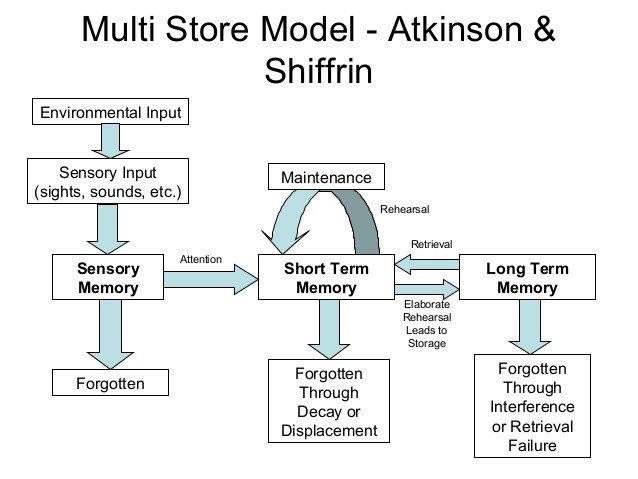
Sensory Memory
A quick, fleeting memory that is activated by the five senses. This information will leave the brain if we don’t pay attention to it.
George Sperling
Iconic Memory
visual stimuli, lasts a split second
Echoic Memory
auditory stimuli (echo), lasts 3-4 seconds
Short Term Memory-Working memory
limited capacity (7 items)
limited duration (very vulnerable to interruption and interference)
located in frontal lobe
George Miller
The Magic Number 7, plus or minus 2
Long Term Memory
limitless and permanent storehouse
located in cerebral cortex
Episodic Memory
Memories of specific events, stored in a sequential series of events
Semantic Memory
general knowledge, stored in facts or meanings
Procedural Memory
skills and how to preform them
Implicit memory
how-to memories you didn’t have to think about
goes through cerebellum
Explicit memory
memories of facts and experiences, “declarative memory”
goes through hippocampus
Eidetic memory
photographic memory
Alexander Luria
Noam Chomsky
Argued that young children possess an innate capability to learn and produce speech
language acquisition device
Hermann Ebbinghaus
forgetting curve
Primacy effect
person is more likely to recall items presented first in a list
Recency effect
recalling information at the end off a list
Serial Position Effect
tendency to forget information in the middle of the list
Elizabeth Loftus
The Misinformation effect
Refers to how people's memories may be
changed by what they are told.
Constructed Memory
recalling false detail of an evet that happened or creating a new memory
Proactive Interference
Old information interferes with the new learned information
OLD blocks NEW
Retroactive Interference
learning new info in interfering with past information
NEW blocks OLD
Anterograde Amnesia
cant encode new memories
can learn skill but wont remember where it was learned
Retrograde Amnesia
unable to recall past memories
Phonemes
The smallest distinctive units of sound used in a language
Morphemes
The smallest units of meaning in a language
Overregularization or overgeneralization
misaplication of grammar rules
Algorithm
A logical, step-by-step procedure that, if followed correctly, will eventually solve a specific problem
Heuristic
general rule-of-thumb or shortcut that is used to reduce the number of possible solutions to a problem
Availability Heuristic
judging a situation based on similar situations that come to mind, personal expirences-news
Representative Heuristic
judging situation based on similar aspects to a protype person has in mind
Mental set
The tendency to continue using belief systems and
problem-solving strategies that have worked in the past, even though it may not be working now
Functional Fixedness
The tendency to think of an object as
functioning only in its usual way o
Limits creativity
Confirmation bias
believing what fits your own beliefs
Framing
Posing a question or wording a phrase in such a way to persuade someone’s thoughts.
Wolfgang Kohler
“a-ha” moment
researching chimpanzees retrieving banana
Convergent Thinking
Using logic and algorithms to solve problems, there is only one answer, doesn’t see things
from various perspectives.
Divergent Thinking
type of thinking in which problem solvers devise a number of possible alternative approaches to problems
more creative
Broca’s Area
production of speech functions
producing complete sentances
Wernicke’s Area
region in brain that is important for language development
Skinner’s Theory of Language Acquistion
he believed children learned language through receiving rewards for using language in functional manners
Francis Galton
pioneer in the study of human intelligence and testing
Reliability
the consistency of the test
Split-half reliability
dividing test into two halves to then test persons performance on two different halves
Test-retest reliability
group of people take test twice
Validity
accuracy of test, measures what its supposed to
Content validity
test samples the behavior that is of interest
Predictive validity
test predicts the behavior it is designed to predict
Aptitude test
measures ability or potential
Achievment test
measures what one has learned or accomplished
Fluid intelligence
our ability to solve abstract
problems and pick up new information.
decreases with age
Crystalized intelligence
using knowledge accumulated over time
holds steady or even increases with age
Charles Spearman
argued intelligence could be expressed by a single factor
Howard Gardner
multiple intelligences
Daniel Goleman
EQ, emotional intelligence
Robert Sternberg
Sternberg’s triarchic theory: \analytic, practical, and creative intelligence
Alfred Binet
designed tests to asses mental ages of children to place them ahead or behind peers
Lewis Terman
Stanford-Binet IQ test
IQ
mental age / chronological age x 100
David Wechsler
Wechsler Intelligence Scales (WAIS)
designed to measure intelligence in adults and teenagers
Flynn Effect (James Flynn)
Increase in IQ scores

