BUSMHR 3200: Social Perception and Managing Diversity
 Studied by 0 people
 Call with Kai
 Learn
Learn Practice Test
 Spaced Repetition
 Match
Match Flashcards
 Knowt Play
1/22

There's no tags or description
Looks like no tags are added yet.
Name | Mastery | Learn | Test | Matching | Spaced | Call with Kai |
|---|
No study sessions yet.
23 Terms
What is perception?
A cognitive process that enables us to interpret and understand our surroundings
What is social perception?
The process whereby we process social information, information related to interactions with other, motives for behaviors, etc.
What are some decisions that are affected by social perception?
- Recruiting practices
- Staffing and selection practices, methodologies
- Internal selection decisions
- Job assignments
- Performance reviews
- Disciplinary action
- Termination
List the steps of the social information processing model.
1) Selective Attention/Awareness
- Environmental Stimuli/Information
- Salient/meaningful information
2) Encoding and Simplification
- Interpretation/Categorization
- Schemas
- Scripts
- Categories
- Stereotypes
3) Storage and Retention
- Memory (Different Types)
- Semantic
- Episodic (event)
- People
4) Retrieval and Response
- Judgements and Decisions
- Attributions
- Ratings/Judgements
- Decisions
- Bias/errors
What are the different types of implicit biases, errors, etc?
- Fundamental Attribution Bias
- Self-Serving Bias
- Halo Error
- Pitchfork Error/Horns Error
- Leniency Error
- Severity Error
- Central Tendency Error
- Recency Effect
- Primacy effect
- Stereotyping
- Projection
- Contrast Effect
- "Similar to Me" Effect
What is attribution theory?
An attribution is made as to whether actions and/or behaviors resulted from internal factors (e.g. ability, amount of work) or external factors (e.g. task difficulty). This attribution is based on the consensus, distinctiveness, and consistency of the observed behavior . Can be made for good or poor performance/outcomes!
What are the three dimensions of Harold Kelley's Attribution Theory?
1) Consensus: Compares an individual's behavior with his/her peers.
2) Distinctiveness: compares an individual's behavior on one task with his/her behavior on other tasks at that time
3) Consistency: compares an individual's behavior on a task with his/her performance on other tasks over time
What does high consensus mean? Low consensus?
High consensus means that his/her behavior is similar to that of his/her peers. Low consensus means that their behavior is different from that of peers.
What does high distinctiveness mean? Low distinctiveness?
High distinctiveness means their behavior here is different in other situations. Low distinctiveness means that their behavior is not different in other situations.
What does high consistency mean? Low consistency?
High consistency means their behavior in this situation is consistent over time. Low consistency means their situation is not consistent over time.
What are is the attribution made when high consensus, high distinctiveness, and low consistency are perceived?
External Causes (task difficulty, environmental influences, etc.)
What is the attribution made when low consensus, low distinctiveness, and high consistency are perceived?
Internal Causes (ability, personal characteristics, hard work)
What is diversity?
The multitude of individual differences and similarities that exist among people
- can tend to focus on differences
- easy to find segregation of groups within organizations
- isn't automatically an advantage (or disadvantage)
What is inclusion?
The extent to which the vast diversity of organizational members are brought together in a meaningful way to increase success (individual, group, and organizational)
- recognizes diversity of organizational members, but
- primary focus is on bringing those differences together
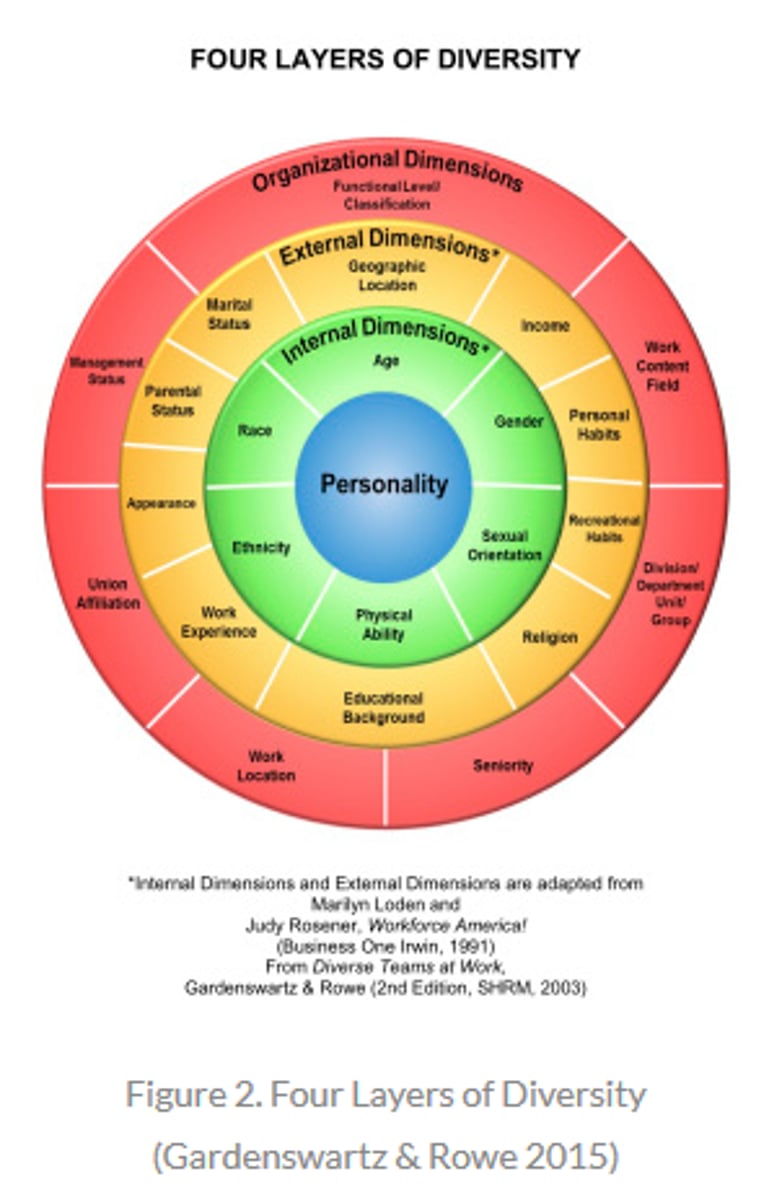
Describe the four layers of diversity.
- Personality is at the core; its a key source of identity
- Internal dimensions ("surface level characteristics") are quickly obvious to outsiders and relatively unchangeable
- External dimensions and Organizational Dimensions ("deep level characteristics") take time to emerge through attitudes, values, etc.
- The more peripheral, the more likely to be changeable
What are some benefits of diversity/inclusiveness?
- Increased creativity/synergy
- Less likelihood of "groupthink" and other bad decisions
- Increased awareness of and success with broad customer base
- More interesting, engaging and developmental work environment
- Decreased likelihood of legal problems
- Better preparation for increased global business focus
- Necessary to be an "Employer of Choice" in changing workforce
- Very important in attracting, recruiting, and acquiring top talent
True or False: Companies in the top quartile for racial and ethnic diversity were 35% more likely to have financial results above their industry medians
TRUE
True or False: Companies in top quartile for gender diversity were 15% more likely to have financial results above their national industry medians
TRUE
Which has more of an impact on financial performance, racial diversity or gender diversity?
Racial diversity, suggesting that gender diversity if further along
What is affirmative action?
Artificial interventions that allow companies to correct imbalances, address diversity problems, etc.
- Required for organizations that are federal contractors
- Can be seen as more of an "enforcement" approach to diversity
- Can be divisive as well as not necessarily beneficial to recipients
What is "managing diversity"?
focuses on changing organizational systems, culture, etc. to drive an inclusive work environment.
What are the three basic strategies exist for managing diversity?
1) Educational: help people develop for success in a diverse workplace (works but not quickly enough; need additional strategies)
2) Enforcement: accountability mechanisms to change the system, etc.
3) Exposure: expose people to others with different backgrounds
 Note
Note  Flashcards (60)