Psych Exam 3
 Call Kai
 Learn
Learn Practice Test
 Spaced Repetition
 Match
Match Flashcards
 Knowt Play
1/60

There's no tags or description
Looks like no tags are added yet.
Name | Mastery | Learn | Test | Matching | Spaced | Call with Kai |
|---|
No analytics yet
Send a link to your students to track their progress
61 Terms
What is Metacognition? Why is it important?
Our thinking about our own thinking
reflecting inward on ones own cognition
We monitor our own cognition & use this information to guide behavior
you read a book b4 bed → realize you aren’t comprehending (monitoring) → realize you’re tired (monitoring) → close the book & go to bed (control)
What is the tip-of-the-tongue state? What causes it?
Subjective experience of knowing the target word for which you are searching, but cannot recall
Occurs because information is available, but not accessable
What is metacognitive monitoring?
What is metacognitive judgement?
What is monitoring accuracy?
What is the difference between prospective & retrospective monitoring?
Assessments about our ongoing cognitive process
Using monitoring judgements to guide the decisions about how to complete a task
Comparing between judgement & performance - how accurately did they monitor their cognition?
Prospective - predicting the likelihood of some future outcome
“How many items will you remember on a future test?”
Retrospective - estimating how you did on something that happened previously
“How many items did you correctly remember on the test you just took?”
What is metacognitive control? Know some examples.
Decisions about how to regulate cognition
How we regulate our cognitive activity
Decisions about what to do
What to do (e.g., study)
When to do it
How to do it
What is the agenda-based model of metacognitive control? What kinds of things influence agendas?
People create a plan (agenda) for how they will complete a task
Influenced by:
Incentives
Time pressures
Difficulty of material
Interest
Metacalfe (2002) conducted some important research. What did she do? What did she find? What does it mean?
Examined metacognitive control
Method:
studied English-Spanish word pairs
Easy (family—?)
Medium (lie—?)
Difficult (skylight—?)
Cued-recall test (e.g., lie—?)
Conditions:
High time pressure: 5 sec per set
Moderate time pressure: 15 sec per set
No time pressure: unlimited time per set
Results:
When time pressure is high, people prioritize easy times
When there is no time pressure, people prioritize hard items
Theide & Dunlosky (1999) conducted some important research. What did they do? What did they find? What does it mean?
Examined the relationship between Monitoring & Control
Method:
study easy & difficult word pairs
make a Judgement of Learning (JOL) for each prospective monitoring judgement
how likely they’d be able to remember that pair
Choose half to restudy
Cued-recall test (e.g., book—?)
Results:
Negative relationship between JOLs & amount of time studying
more time studying items they predicted would be harder to remember
Consistent with the monitoring affects control hypothesis
What is the monitoring affects control hypothesis?
People use their monitoring judgement to guide the decisions about how to complete a task
Dunning, Johnson, Ehrlinger, & Kruger (2003) conduced some important research. What did they do? What did they find? What does it mean?
Monitoring learning in the classroom - how good are students at monitoring their own leadership?
Methods:
Participants: students in a sophomore psych class
Students took an exam & immediately after they estimated how many questions they got correct (retrospective judgement)
Students divided into 4 groups based on their exam performance:
A — B+ students
B- — C+
C — D
F
Results:
Students who performed well made accurate monitoring judgements
Students who performed poorly were overconfident in their performance
What is the unskilled & unaware effect?
Students struggling in class also were more inaccurate when monitoring their learning
Why?
Poor cognition may be related to poor metacognition
Wishful
Carpenter, Wilford, Kornell, & Mullaney (2013) conducted some important research. What did they do? What did they find? What does it mean?
Monitored learning in the classroom — how does the way a professor delivers a lecture influence monitoring & learning
Method:
Participants - undergrad students at ISU
Students were given a short lecture explaining why calico cats are usually female
Fluent Delivery: speaker stood upright before a desk, maintained eye contact, & spoke fluently
Disfluent Delivery: speaker was hunched behind podium, read from notes, no eye contact
Primary measures:
Prediction (prospective judgement): “how much information will you be able to remember in 10 minutes?” - metacognitive measure
Actual memory test: “write a detailed explanation for why calico cats are almost always female” - free-recall, cognitive measure
Results:
Lecture fluency impacted students’ predictions about learning, but not their actual learning
learning was the SAME, but predictions differed
What is metacognitive illusion? Know some of the examples discussed in class.
Errors in monitoring caused by inaccurate beliefs (both of ourselves & others)
Explanatory depth phenomenon
The feeling that you understand a complex system or phenomena more than you actually do
How confident are you that you understand how a toilet flushes?? Now explain it
Deja vu
A feeling that you’ve lived through a situation before
Planning fallacy
The tendency to underestimate the amount of time required to complete a project
What is metacomprehension? Know the research by Pressley & Ghatala (1988)
Refers to your thoughts about about language comprehension
Research focuses on reading comprehension
Pressley & Ghatala assessed student’s metacomprehension & performance on tests of reading ability
Took reading-comprehension tests from the Scholastic Aptitude Test → answered multiple-choice questions & rated how certain they felt about their accuracy
Students are highly overconfident - when wrong, thought they did better than actually did
When correct, had same amount of confidence as those incorrect
Students aren’t very accurate in estimating whether they’ve understood the material that they’ve just read
Know the statistics from Simons & Chabris (2011).
Administered a survey to educated adults & cognitive psychologists
Asked the statement, “Do you believe that human memory works like a video camera, accurately recording the events we see & hear so that we can review & inspect them later?”
63% of the general public agreed
0% of cognitive psychologists agreed
Asked, “In my opinion, the testimony of one confident eyewitness should be enough evidence to convict a defendant of a crime.”
37% of general public agreed
0% of experts agreed
What is the constructivist approach?
We construct memories by integrating information to form a coherent event
memory isn’t like a tape recorder - it’s reconstructive
Loftus (1974) conducted important research? What did they do? What did they find? Why is it important?
Examined how important is an eyewitnesses
Presented a hypothetical case
Three groups
No eyewitness - 18% conviction
Eyewitness - 72% (WAY more likely)
Discredited Eyewitness - 68% (Should have been ~18%, but it was still so high!)
Showed that eyewitness memory has a large impact on conviction
Wells et al. (1998) conducted important researchh. What did they do? What did they find? Why is it important?
Examined the importance of eyewitnesses in real-world cases
First 40 cases in the US in which DNA was used to exonerate the inmates
Each case represents an innocent person who was convicted & served time in prison
Examined rate of eyewitness ID that led to their false conviction
90% involved eyewitness ID
5 on death row
How strong is the relationship between confidence & accuracy in eyewitness memory?
Examined by Leippe & Eisentadt (2007)
correlation btw confidence in memory & accuracy of memory in eyewitness situations in low (.3-.5)
However, jurors are more likely to believe a confident eyewitness than unconfident eyewitness
this can have serious consequences if the confidence is misplaced
What is the case of Ronald Cotton?
He was wrongfully convinced because of an eyewitness who felt absolutely certain that it was him
he was eventually released from DNA evidence
She felt horrible, he forgave her
What are estimator variables?
What are system variables?
Know examples of each.
Estimator: not under the control of the justice system
characteristics of the witness or event
media coverage of an event
System: under control of the justice system
line-up composition
line-up instructions
Know the sources of memory distortion that can come from each phase of memory
Encoding
Quality of the viewing conditions (light vs dark)
Emotional stress
Storage
Introduction of new information (sometimes misinformation)
Misleading/suggestive questioning
Retrieval
Retention-interval - time btw event & testimony
Line-up composition/format
How does arousal influence memory?
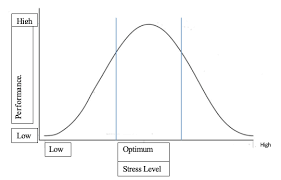
What is the Yerkes-Dodson Curve?
How does the type of arousal matter?
Yerkes-Dodson Curve - Inverted U shape relationship btw performance & arousal
Moderate arousal improves memory
Low & high arousal impair memory
Type of arousal
Low arousal
Invisible gorilla
High arousal
High stress can impair memory
Loftus et al. (1987) conducted important research. What did they do? What did they find? Why is it important?
Examined the presence of a weapon
Participants viewed a series of slides at a “Taco Time” restaurant
Measured eye movement while viewing the slides
Location & duration of eye fixation
Control Group: saw a man go to the cashier & pay
Weapon Group: A man pulls a gun on the cashier
Results:
Eye fixation & duration: The presence of a gun increases looking time & location
Gun draws out attention
Follow-up study - shown same slides as first experiment
15 min later, given a MCT
then, given a 12 person line up to ID the person from the crime
Results:
memory & line-up ID were worse when a weapon was present
What is the weapon focus effect? What causes it?
People tend to focus more on the weapon relative to a mundane object
Why?
unexpected or unusual object
Pulls attention from other aspects of the event (including the perpetrator)
Highly stressful event
Morgan et al. (2014) conducted important research. What did they do? What did they find? Why is it important?
Researched the influence of stress of ID accuracy
Method
50 military personnel undergoing POW training
1 day after leaving training, participants viewed a 15 person line-up to ID interrogator
Conditions
High stress - physically confronted
Low stress
Results
High stress = more errors, fewer correct ID
vise versa for low stress
What is the social contagion effect?
Others’ memory can “infect” ours
produces false memories
Principe et al. (2006) conducted important research. What did they do? What did they find? Why is it important?
Examined the social contagion effect
Method
Preschoolers saw a magic show & during it, the magician failed to pull a rabbit out from his hat
Intervening interview
Suggestive interview - planted info… “What did the rabbit eat when he got loose in your school?”
Neutral interview
Final interview: did you see a rabbit with your own eyes?
Groups
Overheard - overheard rumor of rabbit loose at school from adults
Classmate - overheard rumor from classmates
Control - didn’t overhear any rumor
Witness - saw a live rabbit running loose
Results
neutral interview
high rate of errors for classmates & overheard groups
suggestive interview
even HIGHER rates of errors
More false memories when influenced by others’ memories
What is the misinformation effect?
Distorts memory for the original event
retroactive interference
Btw the witness event → recall of event
Loftus et al (1978) conducted important research. What did they do, what did they find, & why is it important?
Researched post-event encoding - could they make the participants see a yield sign that wasn’t there?
Method
Students were shown a series of slides of a car at a stop sign & the car later hit a pedestrian
Completed a questionnaire about what they had witnessed. Critical question:
Consistent info: Did another car pass the car while it was at the STOP SIGN
Inconsistent info: did another car pass the car while it was at the YIELD SIGN
20 minutes later, given a pair of slide photos & told to ID which they had previously seen
Results
Those given inconsistent info falsely remembered & picked the photo with the yield sign
Loftus & Palmer (1974) conducted important research. What did they do, what did they find, & why is it important?
Researched suggestive questioning
Method
Watched videos of a traffic accident
Completed a questionnaire about the accident they just saw, including a critical question focused on the speed of the vehicles
“How fast were the cars going when they ______ each other”
smashed/collied/bumped/hit/contacted
Results
Memory for higher speeds when using more violent words (smashed/collided)
Follow-up experiment
Participants retested 1 week later
Asked if they saw any broken glass
Higher rate of false memories of broken glass when more “violent” verbs were used
Wade et al. (2002) conducted important research. What did they do, what did they find, & why is it important?
Tested false memories of personal memories
Participants were shown 4 pics from childhood events
3 were real; 1 was fake (photoshopped)
By the 3rd interview, participants said they remembered the event that never happened & added details to the story
What are the 4 possible outcomes of a lineup identification? Which ones are possible when the perpetrator is present? Which is correct when the perpetrator is absent?
Correct ID (hit)
Incorrect ID (false alarm - picking anyone other than the actual perpetrator)
ID failure (person isn’t there) - these 3 are for when they are present
Correct rejection (rejecting lineup correctly) - correct when perpetrator is absent
Perfect & Harris (2003) conducted important research. What did they do, what did they find, & why is it important? What is unconscious transference? What is the own-age bias & what causes it?
How does confirmatory feedback influence eyewitness identification?
What is a sequential lineup? What is a simultaneous lineup? How do they relate to correct & mistaken ID?
Sequential - one pic/person @ a time → make a yes/no decision
Simultaneous - see all b4 making a decision
Wells (1984) conducted important research. What did they do, what did they find, & why is it important?
What is semantic memory?
What is a category? What is a concept? What is an instance/exemplar? What is a feature?
How do we classify novel objects? What are the theories of concept formation? For each, know what you would compare the new object to to make a classification decision
What is the classical view? What are limitations of it?
What is the typicality effect?
Rosch & Mervis (1975) conducted research. What did they do, what did they find, & why is it important?
What is the prototype approach? What is abstraction? What is a prototype? How does it handle typicality effects? What are limitations of the prototype approach?
What is family resemblance?
What makes prototypes special?
Know the structure of categories & examples for each (superordinate, basic, subordinate). What are basic-level categories special (see book)
Posner et al (1967) conducted important research. What did they do, what did they find, & why is it important?
What is the exemplar approach? What are the limitations?
Know examples of when we might use an exemplar approach vs. a prototype approach
What are network models of semantic memory? What are nodes? What is spreading activation?
Collins & Quillian (1969) conducted important research. What did they do, what did they find, & why is it important?
What is parallel distributed processing? What are connection weights? How are connection weights influenced by frequency of pairing items together?
Know the evidence for network models
What is a lexical decision task?
Bargh et al (1996) conducted important research. What did they do, what did they find, & why is it important?
What is a script? What is a schema? Know examples of each.
How do schemes & scripts influence cognition
Brewer & Treyens (1981) conducted important research. What did they do, what did they find, & why is it important?
What is memory integration? How is it related to stereotyping? What is the implicit association test & why is it used? How do people perform on congruent vs. incongruent trials
What is boundary extension & how do schemas influence this?
What is the pragmatic approach to memory? How does this differ from the constructive approach?

