phys 2001 exam 2 mc
 Call Kai
 Learn
Learn Practice Test
 Spaced Repetition
 Match
Match Flashcards
 Knowt Play
1/26

There's no tags or description
Looks like no tags are added yet.
Name | Mastery | Learn | Test | Matching | Spaced | Call with Kai |
|---|
No analytics yet
Send a link to your students to track their progress
27 Terms
two objects collide and stick together. what type of collision is this?
perfectly inelastic
which of these masses would be moving the fastest if all four have the same momentum?
a. 10kg b. 4kg c. 2kg d. 1kg
d. 1kg
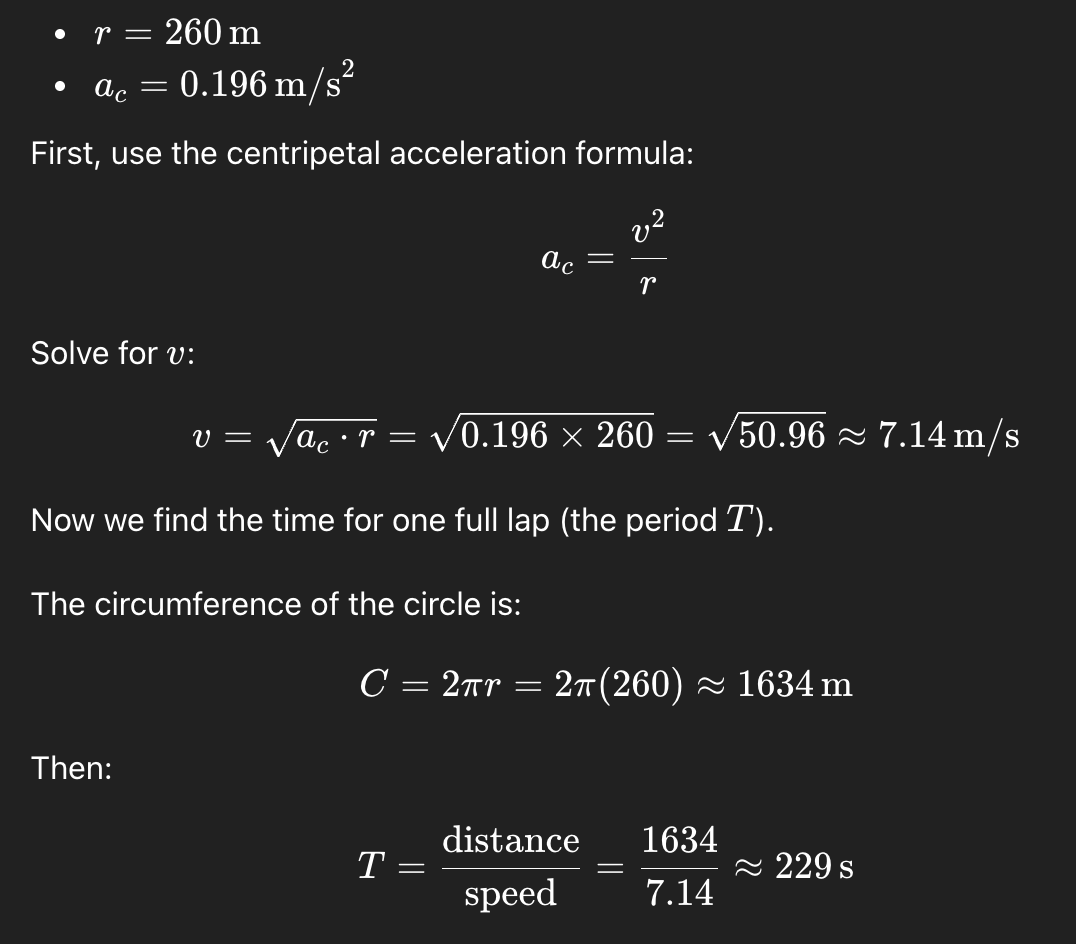
a 10,000kg blimp flies in a circular path at a constant altitude and speed. the circular path has radius, r=e 260m, and the centripetal acceleration is 0.196m/s². what is the time for one full lap around the circle?
229 s
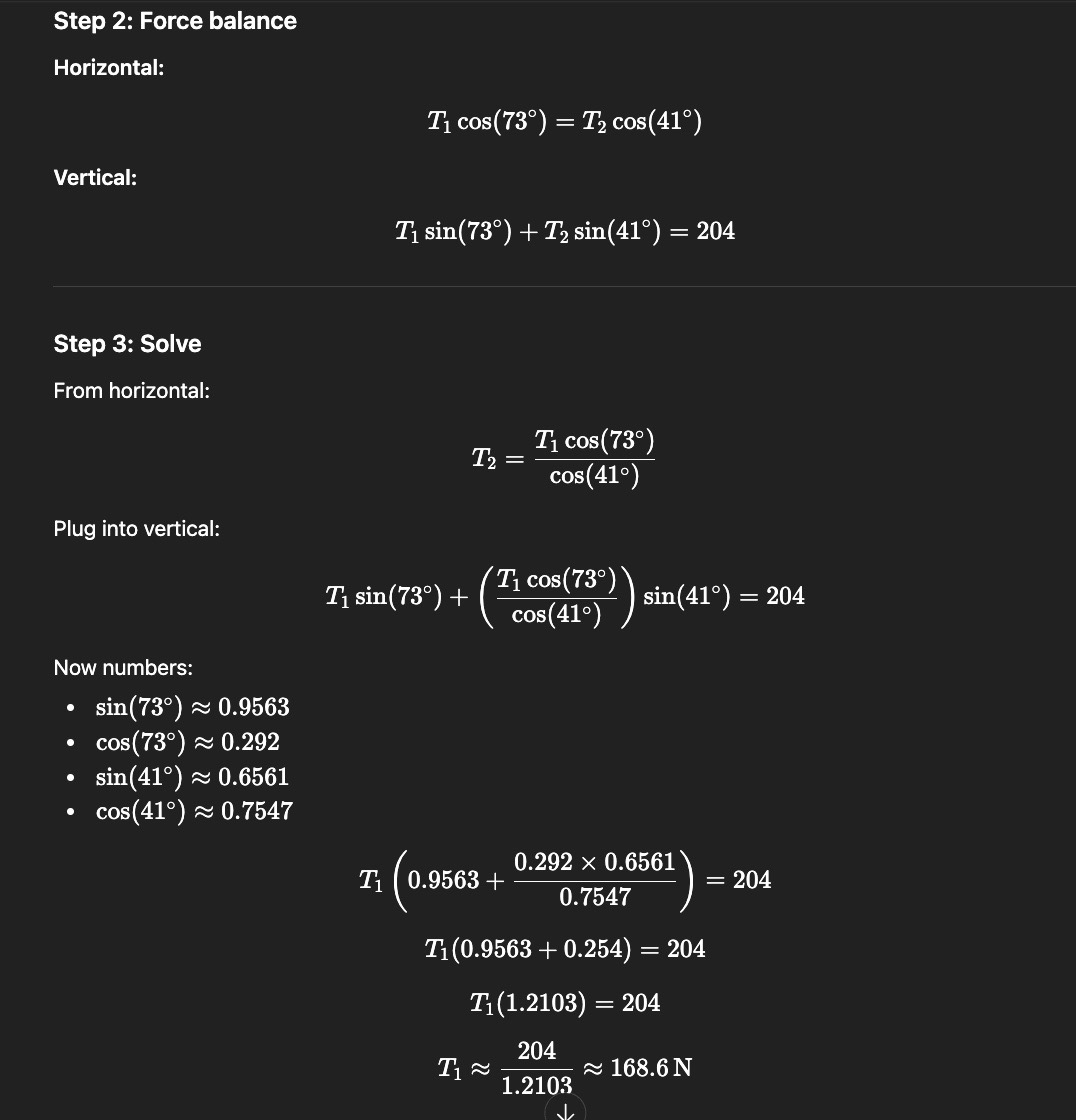
a sign of mass, ms = 20.8kg hangs from three ropes. angle 1=73.0 degrees and angle 2 = 41.0 degrees. (ropes 1 and 2 are not perpendicular) what is the magnitude of the tension in the left rope (T1)?
168 N
Block B of mass 1.5kg accelerates downward at a rate of 3.0m/s². blocks a and b are connected by a massless string that does not stretch. there is no friction between block a and the level table. the pulley is massless and friction-free. assume there is no air drag. what is the tension in the string?
mg - T = ma
(1.5)(9.8) - T = (1.5)(3.0)
T = 14.7 - 4.5 =
10.2 N
a. a collision conserves momentum only if it is elastic. true or false?
a. false
b. a collision conserves kinetic energy only if it is elastic
b. true
c. if two objects collide and one is permanently bent or crushed, the collision is elastic
c. false
d. the impulse is the force divided by the time interval over which the force is applied
d. false
e. an astronaut is floating in space and throws a baseball. after throwing the ball, the momentum of the astronaut plus the baseball increases
p = mv would cause a negative momentum for the astronaut
e. false
f. doubling an object’s velocity doubles its kinetic energy
f. false
g. doubling an object’s height doubles its gravitational potential energy
g. true
h. if there are no non-conservative forces, total energy remains the same
h. true
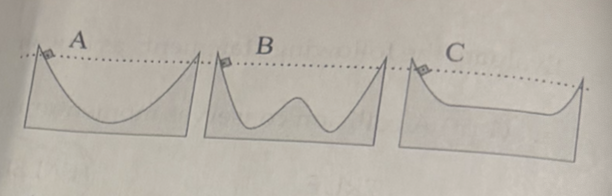
consider the same block moving on three frictionless ramps without air resistance. after being released the block will slide down from the left to the right. for which ramp will the block reach the highest maximum height on the right?
same for all ramps
an engine does 400J of useful work to bring a 10kg vehicle up to some speed from rest. what is the final speed of the vehicle?
400 = ½ 10 x v²
8.9 m/s
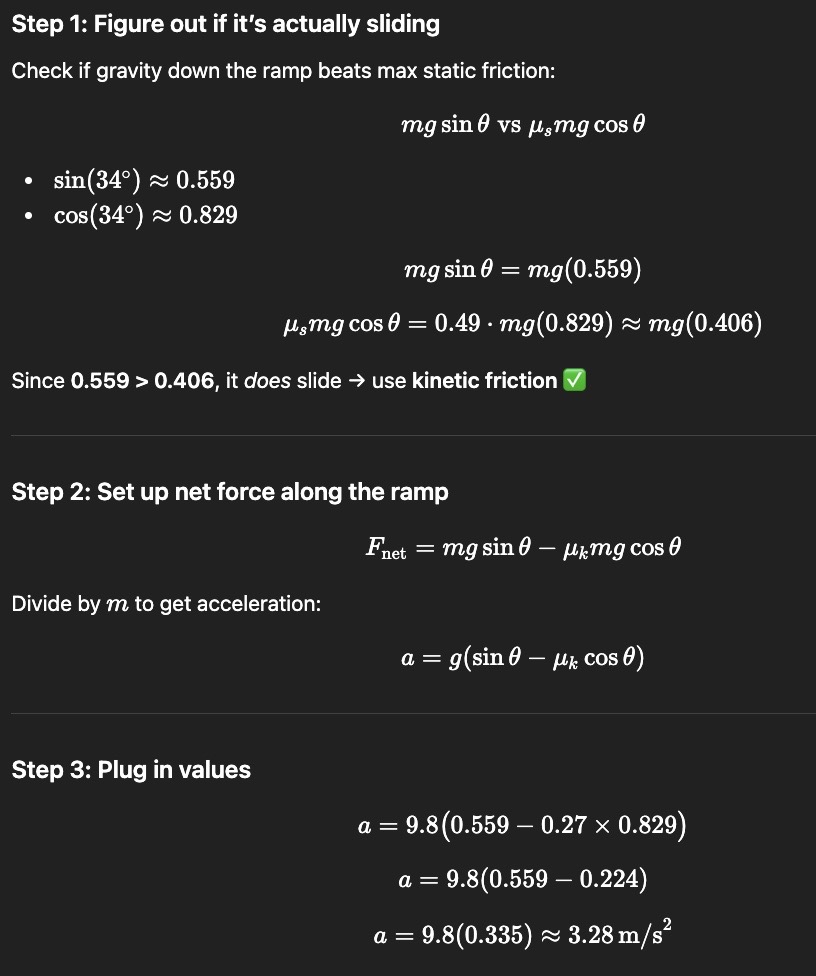
a 35kg crate slides down an incline at an angle 34 degrees below the horizontal. the coefficient of kinetic friction between care and ramp is 0.27; their coefficient of static friction is 0.49. what is the acceleration of the crate along the ramp?
3.29 m/s/s
which of the following statements about forces and acceleration is false?
a. if two objects are in contact, the force that the first exerts on the second is of the same magnitude as the force that the second exerts on the first
b. if two objects are in contact, their accelerations are always equal
c. if an object follows a curved path, the acceleration vector has a non-zero component parallel to the velocity vector
d. if an object is speeding up or slowing down, the acceleration vector has a non-zero component parallel to the velocity vector
b
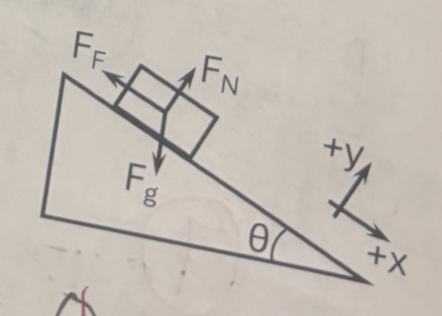
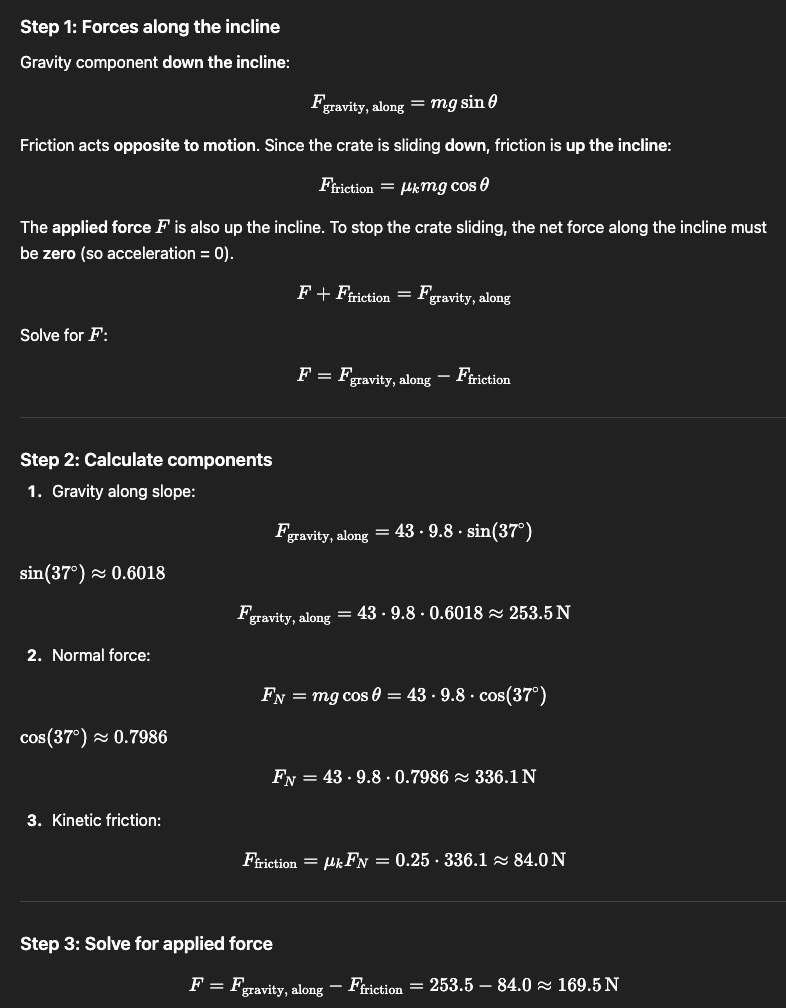
a 43kg crate slides down an incline at an angle 37 degrees below horizontal. the coefficient of kinetic friction between the crate and the ramp is 0.25; their coefficient of static friction is 0.47. another force (not shown) is applied parallel to the slope. what is the minimum magnitude of that force, so that the crate will eventually stop sliding?
169 N
a trench mortar (muzzle at ground level) fires at an angle, θ=62 degrees, above the horizontal, with a velocity of 195m/s. pretend that air resistance is negligible. what is the horizontal component of the ball’s initial velocity?
v0x=v0cosθ
cos(62) = 0.4695
v0x=195⋅0.4695
91.6 m/s
a trench mortar (muzzle at ground level) fires at an angle, θ=62 degrees, above the horizontal, with a velocity of 195m/s. pretend that air resistance is negligible. what is the vertical component of the ball’s initial velocity?
v0y=v0sinθ
sin(62∘)≈0.8829
v0y=195⋅0.8829
172 m/s
a massive, frictionless cylindrical pulley (a disk) is mounted in the middle of a large room with its axle horizontal. it has a mass of 8.50kg and a radius of 0.260 m. the pulley is originally at rest. you grab a massless, unstretchable rope wrapped multiple times around the pulley, and pull with a constant force of 9.40 N in line with the rope. you pull the rope a distance of 4.40 m, starting with no slack in the rope. what is the angular displacement of the pulley caused by pulling on the rope?
s=R⋅θ
4.40 = 0.260⋅θ
16.9 rad
a meter-stick, which has a length of 100 cm, hangs from two strings as shown. the left-hand string is attached at the left end of the meter-stick (0.0 cm mark) and has a tension, Tt. The right-hand string is attached to the mter-stick at the 7.80 cm mark and has a tension, Tr. an object of mass 0.560kg is hanging from the meterstick at the 37.0 cm mark. the meterstick has a mass of 0.210 kg that is uniformly distributed. use the attachment of the left string as the axis of rotation. what is the magnitude and direction of the torque due to the hanging object?
xobject=37.0cm=0.370m
F=mg=0.560⋅9.8≈5.49N
τ=r⋅F=0.370⋅5.49
2.03 Nm CW
an object that was dropped hits the ground at a speed of 5.0 m/s. from how high was the object dropped? (ignore air resistance)
v²=u²+2gh
5.0²=0²+2⋅9.8⋅h
25=19.6⋅h
1.28 m
two carts collide and bounce off each other. cart A is 3.0 kg and cart B is 5.0 kg. before the collision, cart A is moving to the right at 1.0 m/s and cart B is moving to the left at 2.0 m/s. after the collision, cart A is moving to the left at 1.0 m/s. what is the velocity for cart B after the collision?
mAvA,i+mBvB,i=mAvA,f+mBvB,f (momentum conservation equation)
(3.0)(+1.0)+(5.0)(−2.0)=(3.0)(−1.0)+(5.0)vB,f
left: 3.0−10.0=−7.0
right: −3.0+5.0vB,f
equation: −7.0 = −3.0+5.0vB,f
-4.0/5.0
0.8m/s to the left
a 500 kg car is driving on an unbanked, flat, level test track in a circle of radius 1,000 m moving at a speed of 50 m/s. what must be the centripetal force (generated by friction between the track and the tires) to make this happen?
Fc = m x V² / r
Fc = 500 × 50² / 1000
Fc = ?
1,250 N
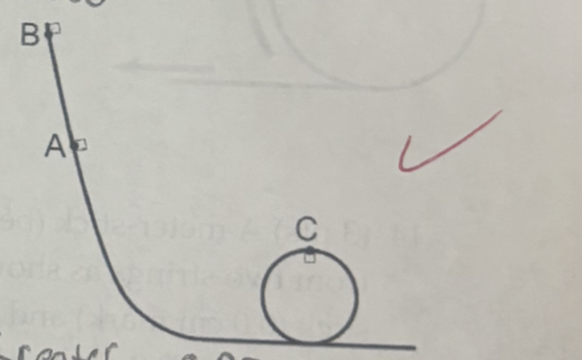
consider the block in the picture. first, the block is released from point A, it slides down the frictionless ramp, and through the loop. next, the block is released from point B and follows the same path. fill in the blank in the following statement: when the block is released from point B, the normal force on the block at point C is _______ the normal force on the block at point C when the block was released from point A
greater than
an object starts at rest and undergoes an average angular acceleration of 3.5 rad/s² for 20 seconds. final angular speed?
ω=θ/t
3.5 = ω / 20 sec
70.0 rad/s

