[coasts] coastal landforms & management
 Call Kai
 Learn
Learn Practice Test
 Spaced Repetition
 Match
Match Flashcards
 Knowt Play
1/48

Earn XP
Description and Tags
[ BBC Bitesize 'Coastal Management ⇢ Coast' page 1 ] [ BBC Bitesize 'Costal Management ⇢ Coastal Landscapes' page 2 ] + geography school book
Name | Mastery | Learn | Test | Matching | Spaced | Call with Kai |
|---|
No analytics yet
Send a link to your students to track their progress
49 Terms
Coast
The part of the land adjoining or near the sea
Erosional Landforms:
headland
bay
cave
arch
stack
stump
Headland
A high area of land that extends out into the sea, near a bay.
Bay
A low-lying inlet of land on the coast by a headland.
Formation of a Bay and Headland:
bands of soft rock (clay and sand) by a coast erode quickly, forming bays
hard rock (chalk) resists erosion, creating headlands
Caves
Recess in a cliff where waves have enlarged a crack in the rock face.
Arches
A natural rock formation often created by two sea caves eroding backwards towards each other until the back walls disappear.
Stack
A pillar of rock left standing in the sea when the top of an arch has collapsed.
Stump
The remains of a stack which the sea has eroded away.
Explain how the geology of the Holderness Coast affects the erosional landform.
average annual rate of erosion = 2m per year
soft rock (clay) eroded to form a bay (Bridlington Bay)
hard rock (chalk) resists erosion, forming a headland (Flamborough Head)
Explain how the climate will affect the geomorphic processes that take place at Holderness Coast.
strong prevailing wind from the south to the west
this transports and deposits sediment along the coast (longshore drift)
more erosion and weathering
1st Stage of Forming a Stump
Cracks are formed in the headland through the erosional processes of hydraulic action and abrasion.
2nd Stage of Forming a Stump
As the waves continue to grind away at the crack, it begins to open up to form a cave.
3rd Stage of Forming a Stump
The cave becomes larger and eventually breaks through the headland to form an arch.
4th Stage of Forming a Stump
The base of the arch continually becomes wider through further erosion, until its roof becomes too heavy and collapses into the sea, leaving a stack.
5th Stage of Forming a Stump
The stack is undercut at the base until it collapses to form a stump.
Depositional Landforms:
beaches
spits
Beach
Gently sloping land by a shore, which is formed from eroded material transported and deposited by the sea. For this to occur, waves must have limited energy, so beaches often form in sheltered areas like bays.
Types of Beaches:
sandy beaches → located in shallow bays with low-energy waves; tend to be gentle-sloping
pebble/shingle beaches → form near eroding cliffs with high-energy waves; tend to be steeper
Transportation
The movement of eroded material from one place to another.
Spit
A stretch of beach at one end of a coastline caused by waves depositing material.
Formation of Spits:
when the coastline ends and the process of longshore drift continues, sediment is deposited off the coastline
a long thin ridge of material is deposited; this is the spit
a hooked end can form if there is a change in wind direction
waves cannot get past a spit, therefore the water behind a spit is very sheltered; silts are deposited here to form salt marshes or mud flats
Conditions Affecting the Formation of a Spit:
speed of longshore drift
amount of sediment available
Berm
Ridges on the beach left as a mark of the tide.
Deposition
When material is dropped due to a decrease of energy.
Solution
Type of Erosion - chemicals in the water dissolves soluble material from the rocks.
Abrasion
Type of Erosion - rocks and other loose materials chisel the cliff, acting like sandpaper and causing the cliff/surface to crack further.
Attrition
Type of Erosion - rocks smashing together causing them to break into smaller pieces of rock.
Hydraulic Action
Air getting trapped in the cracks of cliffs, weakening and breaking down the cliff.
Mitigate
To make something less severe or serious
Hard Engineering
Involves building artificial structures which try to control natural processes, usually expensive infrastructure.
Soft Engineering
Involves a more sustainable and normal approach to managing the coast.
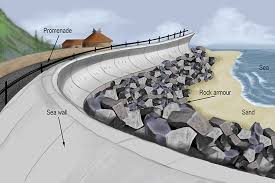
Sea Walls (Hard Engineering)
Structures separating land and water areas - protecting the land on the coast from the crashing waves.
Disadvantages of Sea Walls
very expensive
can look ugly
Groynes (Hard Engineering)
A wooden barrier built at right angles to the beach, preventing longshore drift.
Disadvantages of Groynes
may create problems elsewhere because they starve other beaches of sediment
need to be maintained
Longshore Drift
Movement of material along beaches by waves (backwash + swash).
Swash
When a wave reaches the shore, the water that rushes up the beach.
Backwash
The water that flows back towards the sea.
Rip Rap/Rock Armour (Hard Engineering)
Large boulders piled up on the beach, absorbing the energy of the waves that crash upon it.
Disadvantages of Rip Rap/Rock Armour
large/powerful waves can move or undermine the boulders
can look ugly.
Beach Replenishment (Soft Engineering)
Unwanted, extra sediment (dredged from the sea) is dumped onto the beach to widen and increase the depth of the beach, meaning waves won't have enough energy to erode the cliffs.
Disadvantages of Beach Replenishment
doesn't last very long
can alter ecosystems
time-consuming
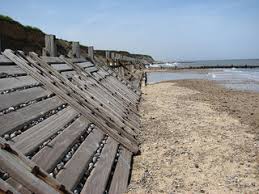
Revetments (Hard Engineering)
A wooden or concrete, slopping structure placed at the foot of the cliff to reflect and damage the impact of the waves.
Disadvantages of Revetments
expensive to build
big visual impact
need to be maintained
Gabions (Hard Engineering)
Wire, cages filled with small rocks and stone/pebbles placed at the bottom of the cliffs.
Disadvantages of Gabions
unattractive
cages rust within 5-10 years.
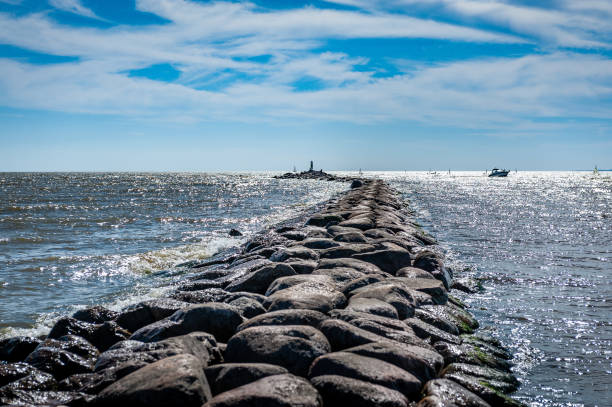
Breakwaters (Hard Engineering)
Offshore structures built from stone parallel to the coastline; help absorb the energy of breaking waves.
Disadvantages of Breakwaters
disrupts the natural flow of sediments along the coast
Explore top notes

