Chemistry topic 4: chemical changes
 Studied by 0 people
 Call Kai
 Learn
Learn Practice Test
 Spaced Repetition
 Match
Match Flashcards
 Knowt Play
1/20

There's no tags or description
Looks like no tags are added yet.
Name | Mastery | Learn | Test | Matching | Spaced | Call with Kai |
|---|
No analytics yet
Send a link to your students to track their progress
21 Terms
reactivity series
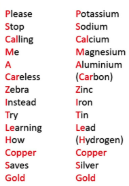
extracting metal methods
-most metals are reactive and as oxygen is abundant in our atmosphere metals are commonly found in metal oxide form as they have oxidised
-more reactive metal displaces a less reactive metal from a compound
-can be used to obtain metals from their ores by displacing with a more reactive, less valuable metal or carbon.
Smelting-iron is extracted from iron oxide + carbon →iron + carbon dioxide in a blast furnace
phytomining- using plants to extract copper, copper ions in soil absorbed by plant, plant is burnt causing copper ions to react with oxide ions from air, ash containing copper oxide is reacted with sulphuric acid and filtered creating a solution of copper sulphate, electrolysis then separates
bioleaching- using living organisms, uses certain types of bacteria to produce a solution called leachate leaving them with a metal ore so the solution contains a compound of that metal, electrolysis then separates
metal carbonates + acid
salt + carbon dioxide + water
oxidation and reduction (referring to atoms, ions, molecules)
Oxidation
Is
Loss
Reduction
Is
Gain
(of electrons)
neutralisation- making salts
acid + alkali → salt + water
acid
pH(conc. of H+ ions) less than 7
alkali
pH(conc. of OH- ions)more than 7
what x higher conc of H+ ions does pH3 have than pH4
10x
what x higher conc of OH- ions does pH11 have than pH9
100x
strong vs weak acids
-a strong acid dissociates/ionises more completely when in a solution
-a weak acid only partially ionises when in a solution
-the pH of an acid depends both on its strength and conc. so two acids, one strong and one weak had the same concentration the weaker acid would have a lower pH
titration
-use a burette to measure what volume of acid/alkali is needed to neutralise, to allow us to calculate an unknown concentration.
-an indicator(phenolphthalein which turns from pink to colourless) is used to detect when the alkali/acid has neutralised
electrolysis of metals
-electrolysis involves passing an electrical current through a substance to cause oxidation and reduction at the two electrodes: anode(+) and cathode(-)
-this can only happen if the ions are free to move to the electrode the are attracted to so for an ionic compound it must be molten or in solution.
-it can be used to obtain pure metals from a compound/ore
what substance is added to aluminium oxide and why (electrolysis)
cryolite
-it lowers the melting point of aluminium oxide making the extraction process cheaper
electrolysis of solutions
-the dissolved ions are free to move in the mixture
-the more reactive cation(+ ion) remains in solution while the less reactive one is reduced at the cathode if the metal is more reactive than hydrogen then hydrogen gas is formed from H+ ions in water
-halide(group 7) ions are always oxidised at the anode forming the halogen gas, if the anion isnt a halide the oxygen is oxidised instead and O2 gas is produced.
half equation
-represent reactions at electrodes
e.g reduction: (Pb2+) + 2e- → Pb
oxidation: (2Br-) → Br2 + 2e-
metal + water
metal hydroxide + hydrogen
metal + acid
salt + hydrogen
charge of ammonium
(NH4)+
charge of nitrate
(NO3)-
charge of sulfate
(SO4)2-
charge of carbonate
(CO3)2-
 Note
Note  Flashcards (31)