ADDITIONAL: SPRINGS
 Studied by 3 people
 Call Kai
 Learn
Learn Practice Test
 Spaced Repetition
 Match
Match Flashcards
 Knowt Play
1/14

There's no tags or description
Looks like no tags are added yet.
Name | Mastery | Learn | Test | Matching | Spaced | Call with Kai |
|---|
No analytics yet
Send a link to your students to track their progress
15 Terms
Springs
IS DEFINED AS AN ELASTIC BODY, WHOSE FUNCTION IS TO DISTORT WHEN LOADED AND TO RECOVER ITS ORIGINAL SHAPE WHEN THE LOAD IS REMOVED.
USES OF SPRINGS
cushion/absorb/control energy
apply forces
control motion by maintaining contact
measure forces
store energy
Helical Springs
Wire coiled in the form of a helix and is intended for compressive or tensile loads. Corss-section of the wirte may be circular, square or rectangular
Closely Coiled
Spring is coiled so close that the plane containing each turn is nearly at right angles to the axis of the helix and the wire is subjected to torsion. Helix angle is usually less than 10 degrees.
Open Coiled
there is a gap between the two consecutive turns, as a result of which the helix angle is large
Inactive Coils
part of the coil which is in contact with the seat and does not contribute to spring action.
Active Turns
turns which impart spring action
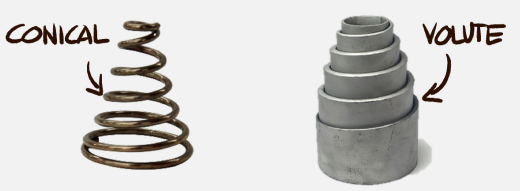
Conical / Volute Springs
Special applications where a telecopsing (spring with a spring rate that increases with the load is desired)
Helical and Sprial Type
Two Types of Torsional Springs
Helical Type
used only in applications where the load tends to wing up the spring and are used in various electrical mechanisms.
Spiral Type
is used where the load tends to increase the number of coils and when made of flat strip are used in watches and clocks.
Laminted / Leaf Springs
consist of a number of flat plates of varying lengths held together by means of clamps and bolts
Dics / Belleville Springs
Consist of a number of conical discs held together against slipping by a central bolt or tube. These springs are used in applications where high spring rates and compact spring units are required.
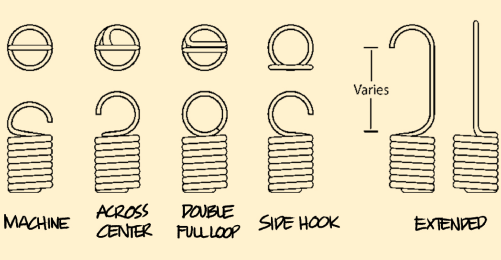
End Connection of Tension Springs
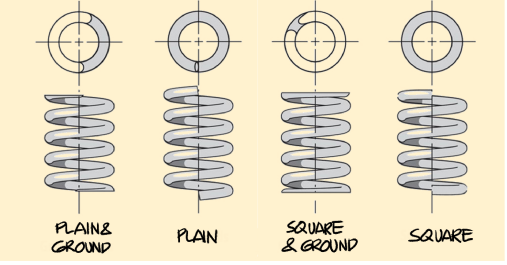
End Connection of Compression Springs
 Note
Note  Flashcards (131)