2 - Ventilator Graphics and Alarms
 Studied by 0 people
 Call Kai
 Learn
Learn Practice Test
 Spaced Repetition
 Match
Match Flashcards
 Knowt Play
1/56

Earn XP
Description and Tags
Name | Mastery | Learn | Test | Matching | Spaced | Call with Kai |
|---|
No analytics yet
Send a link to your students to track their progress
57 Terms
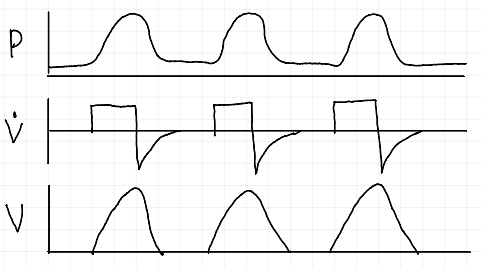
normal pressure, flow, and volume scalars for mechanical ventilation
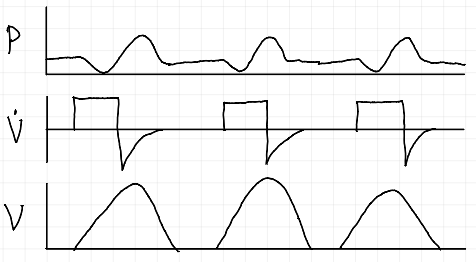
normal pressure, flow, and volume scalars for spontaneous breathing
positive end-expiratory pressure (PEEP)
pressure at end of expiration that keeps alveoli open
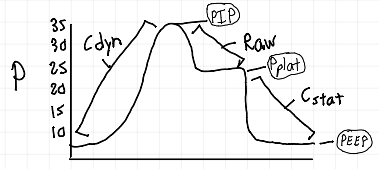
peak inspiratory pressure (PIP)
pressure at end of inspiration

plateau pressure (Pplat)
pressure in the alveoli after inspiration
can be seen on MV after inspiratory hold
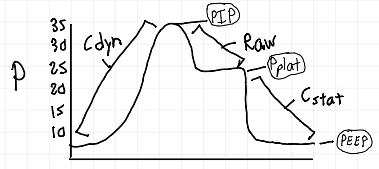
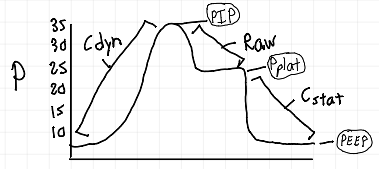
dynamic compliance (Cdyn)
pressure needed to overcome compliance in the lungs with airway resistance
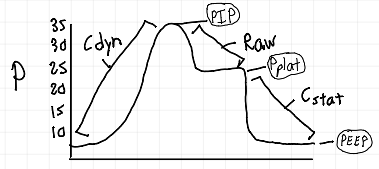
static compliance (Cstat)
pressure needed to overcome compliance in the lungs without airway resistance
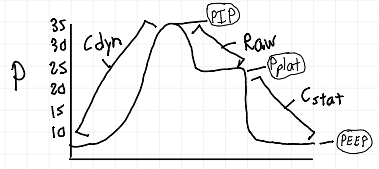
airway resistance (Raw)
pressure needed to overcome resistance in the airways
normal range of Cstat
40-100 mL/cmH2O
normal range of Raw
< 10 cmH2O/L/sec
formula for Cstat
\frac{V_{T}}{P_{plat}-PEEP}
formula for Cdyn
\frac{V_{T}}{PIP-PEEP}
formula for Raw
\frac{PIP-P_{plat}}{\cdot V}
(.V = L/sec)
mean airway pressure (MAP)
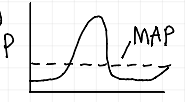
formula for MAP
\left(PIP-PEEP\right)\left(\frac{T_{i}}{T_{tot}}\right)+PEEP
how to increase MAP
add inspiratory pause
increase i-time
increase PEEP
decrease flow
increase RR
pressure waveform
autocycling
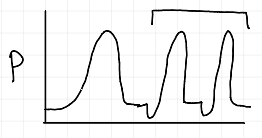
how to fix autocycling
fix leak
lower sensitivity
pressure waveform
auto-PEEP
seen with expiratory hold
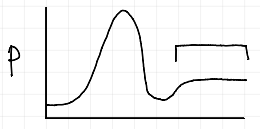
causes of auto-PEEP
obstruction
dynamic hyperinflation (caused by RT due to RR or i-time)
pressure waveform
leak
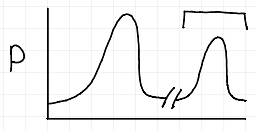
causes of leaks
hole in mask/tube
valve fails to close properly
square flow waveform
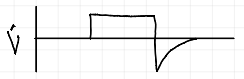
sinusoidal flow waveform
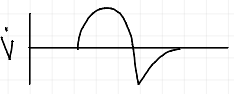
decelerating ramp flow waveform
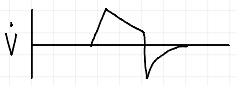
square flow waveform
characteristics
↓i-time (↑e-time)
↑PIP
↓MAP
sinusoidal flow waveform
characteristics
↑i-time (↓e-time)
↓PIP
↑MAP
most comfortable
decelerating ramp flow waveform
characteristics
↑i-time (↓e-time)
↓PIP
↑MAP
best ventilation distribution
flow waveform
auto-PEEP

flow waveform
bronchodilator response
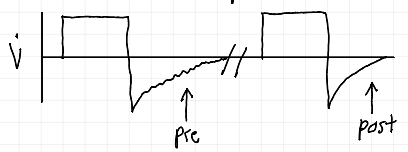
flow waveform
insufficient flow
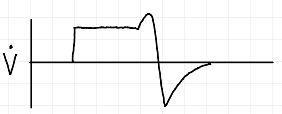
normal range for flow
30-60 L/min
volume waveform
normal
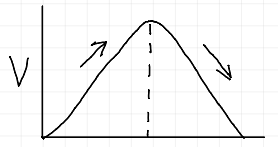
volume waveform
leak

volume waveform
obstruction
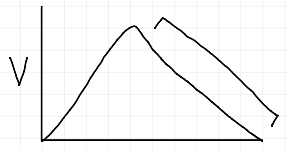
volume waveform
forced exhalation
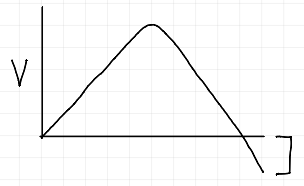
pressure-volume loop
normal
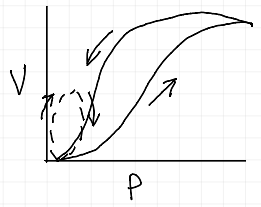
pressure-volume loop
overcompliance
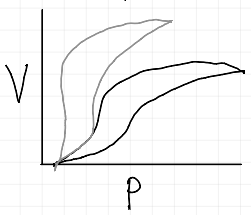
pressure-volume loop
noncompliance / decreased compliance
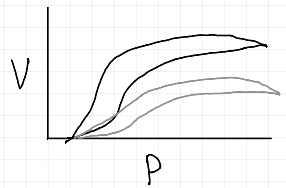
causes of decreased compliance
lungs
atelectasis
pulmonary edema
ARDS
thorax
pneumothorax
burns
(kypho)scoliosis
pressure-volume loop
trigger sensitivity

pressure-volume loop
increased work of breathing (spontaneous only)
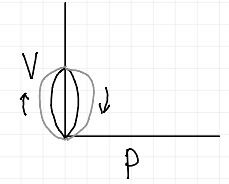
pressure-volume loop
leak

pressure-volume loop
insufficient flow
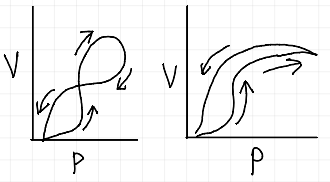
flow-volume loop
normal
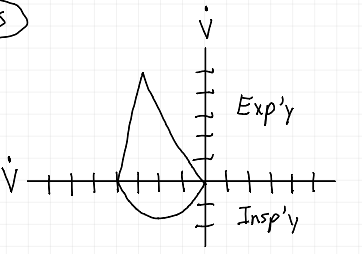
flow-volume loop
obstruction
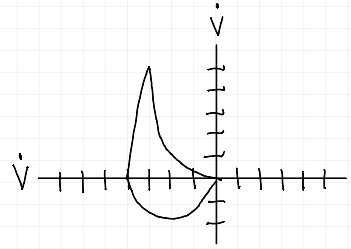
flow-volume loop
restriction (not seen on MV)
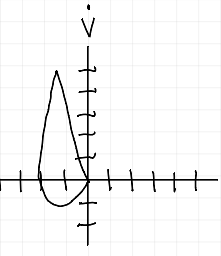
flow-volume loop
auto-PEEP

flow-volume loop
leak
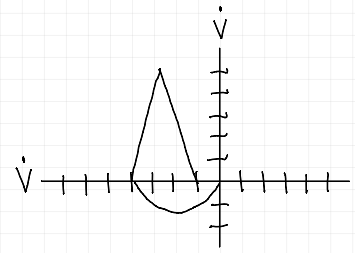
flow-volume loop
water/secretions

high pressure alarms
MV
10 above PIP as long as Pplat < 30 and PIP is not > 10 above Pplat
CPAP
N/A (watch vent settings!)
low pressure alarms
low inspiratory pressure (LIP)
3-5 below PIP
low PEEP
2-3 below set PEEP
high VT/VE alarm
20% over set volume
low VT/VE alarm
20% below set volume
I:E alarm
ratio inversion
high RR alarm
10 above average combined rate (set + spontaneous)
do not go above 35 b/min
FiO2 alarm
± 5%
 Note
Note  Flashcards (94)