LING100 Semantics
 Studied by 0 people
 Call Kai
 Learn
Learn Practice Test
 Spaced Repetition
 Match
Match Flashcards
 Knowt Play
1/41

There's no tags or description
Looks like no tags are added yet.
Name | Mastery | Learn | Test | Matching | Spaced | Call with Kai |
|---|
No analytics yet
Send a link to your students to track their progress
42 Terms
SEMANTICS
_________: the study of meaning, the link between what we say and the real world. However, meaning isn’t really a separate component of language; instead, it intersects with all aspects of language:
o Meaning and sound
o Meaning between words
o Meaning between phrases and sentences
o Meaning and context
Meaning and culture
Meaning & Sound
Phonology is inherently linked to semantics, because phonemes are meaningful sounds:
/pɪn/ vs. /bɪn/
Phonesthemes
_______: A sound or sound sequence that suggests a certain meaning, but is not a morpheme (compare the English plural morpheme –s which is a morpheme)
Gr. phone ‘sound’ + aisthema ‘perception’ + -eme ‘meaning’
mumble, grumble, murmer, mutter, muted (speaking quietly)
Sound Symbolism
______: the habitual association between certain sounds and certain elements of meaning.
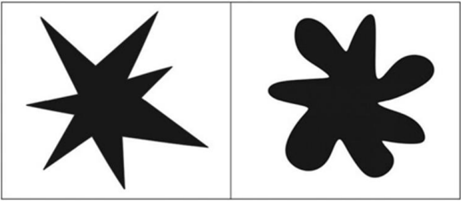
the narrow front vowel [i] (as opposed to open vowels like [a] and [ɔ]) tends to be associated with small size (as in English little, mini and teeny-weeny as opposed to large, grand and vast); the words small and big being untypical) and proximity to the speaker (this as opposed to that).
Kiki-Bouba Effect
LEXICON
______: a repository of semantic knowledge; a language’s word inventory, something like a vocabulary list, or a mental dictionary
LEXEME
______: entry in the lexicon, which includes the uninflected form of a word plus any inflected forms
LEXICAL FIELD
______: a domain or subject that relates a set of words to each other
HOMONYMY
________: two words that have different unrelated meanings but the same sound or written form (usually listed as separate entries in a dictionary)
Homophones and homographs
band: a group of musicians
band: a thin, flat piece of material that is put around something else
spring: the season following winter
spring: a piece of coiled metal
Homophones but not homographs
two: 2
too: also
Homographs but not homophones
tear: a drop of liquid from the eye
tear: a hole in a piece of material
Homophones
______: two words that sound the same
two, too, to
Homographs
______: two words that are written the same
tear, tear
POLYSEMY
________: a single word has two or more related meanings (usually listed under same entry in dictionary)
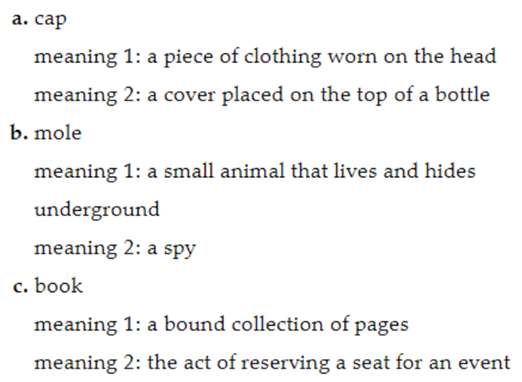
The problem with polysemy
Criteria of “relatedness” may include both speakers’ intuitions and historical development of the words (compare the different etymologies for the word mole). However, over time, a word may lose its similarity to other polysemous meanings, and speakers are rarely aware of the etymology of the words they use.
Are two meanings still considered _______________ if speakers don’t consider them to be related
SYONYMY
two words have (almost) the same meaning, usually sane meaning different connotations
happy and content; smart and intelligent
Words have a core meaning (denotation). But words also have connotations, which are emotional, stylistic, or social meanings.
DENOTATION
________: the strict dictionary meaning of a word
CONNOTATION
________: the emotional and imaginative association surrounding a word
ANTONYMY
______: : two words have opposite meanings
Binary antonyms
_______: the negative of one guarantees the positive of the other (‘either one or the other’)
dead/alive
off/on
possible/impossible
Gradable antonyms
_______: the negative of one does not necessitate the positive of the other (there are other possibilities in the set)
hot/cold
blue-eyed/brown-eyed
big/small
Reverse antonymy
_______: denotes opposite spatial movement or changes in an action
Climb/fall
Enter/leave
Tie/untie
Converse antonymy
_______: denotes different perspective of the same action or relationship
Buy/sell
In front/behind
Parent/child
HYPONYMY
_______: relation of inclusion
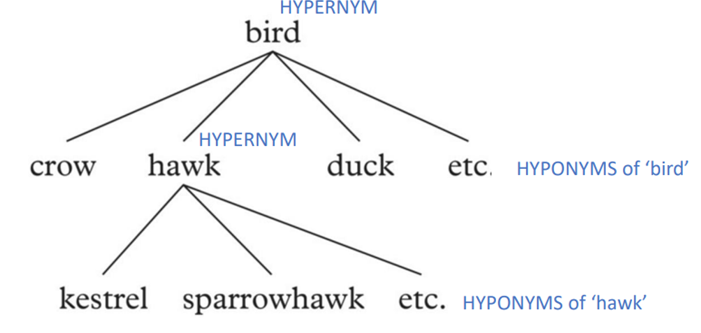
HYPERNYM
_______: the superordinate or general term that specific words fall under
HYPONYM
_______: a subtype of the hypernym
PROTOTYPE
_______: central example
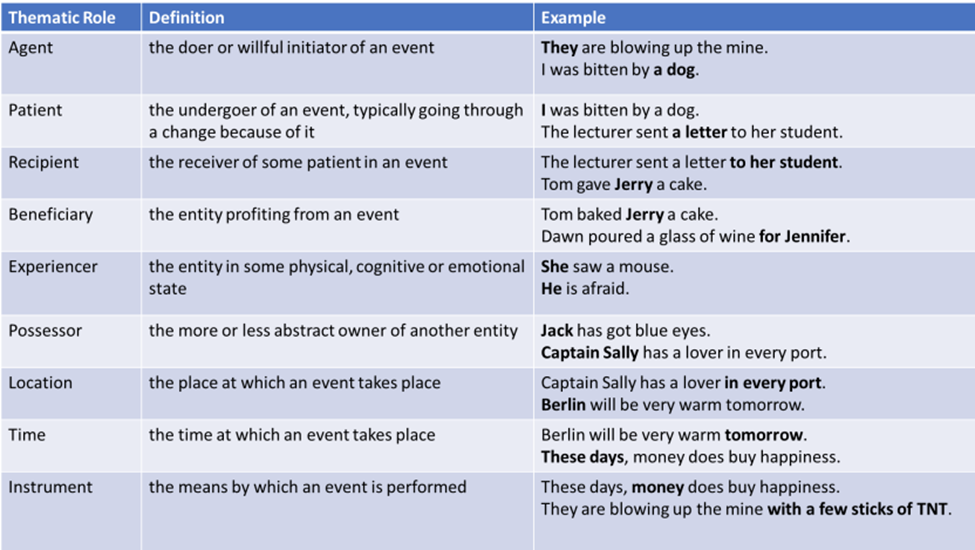
Semantic/Thematic Roles
_______: characterize the meaning of verbs (as requiring a particular type of argument).
Pragmatics
The study of language use in context
The speakers intentions and beliefs, and not the grammatical form of words spoken
The deeper meaning of what is said
Speaker and listener are in an ongoing negotiation of meaning
Semiotics
The study of signs
Speech Act/Illocutionary Act Theory
All utterances involved action of some kind, and all are _______. This is the speaker’s intention, or the act behind the utterance.
Sometimes the act matches the sentence type (explicit) and sometimes it doesn’t (implicit)
Explicit
Clause type and speech act match
Implicit
Clause type and speech act do not match
Declarative
Statement
There was an eclipse yesterday.
Interrogative
Question
Did you see the eclipse?
Imperative
Command
Don’t stare at the sun!
Performative Verbs
The utterance performs an action, can take the adverb hereby
I “promise to” take a taxi home
I “declare” this meeting open
Can be Felicitous (actually perform the action) and infelicitous (do not)
Felicity Conditions (Austin’s Speech Act Theory)
There must be an accepted conventional procedure having a certain conventional effect
The particular persons and circumstances must be appropriate
The procedure must be executed by all the participants correctly and completely.
Sincerity Clause
An act insincerely performed may be called an abuse of a speech act
I bet you a million dollars
I apologize
Nonverbal Cues
70% of the meaning of an oral conversation,
Punctuation helps but emojis do even more
Punctuation, ALL CAPS, and beat gestures can represent emphasis
Semiotics
The study of signs
Sign
Something that stands for something else
Icon
Resembles its referent, shows exact meaning
Index
Associated with its reference
Symbol
Related to its referent only by convention (words are __________)
 Note
Note  Flashcards (131)