Motivation Comps Review: Key Psychology Terms & Definitions
 Call Kai
 Learn
Learn Practice Test
 Spaced Repetition
 Match
Match Flashcards
 Knowt Play
1/52

There's no tags or description
Looks like no tags are added yet.
Name | Mastery | Learn | Test | Matching | Spaced | Call with Kai |
|---|
No analytics yet
Send a link to your students to track their progress
53 Terms
Scientific management era (Taylor)
-Emphasis on mechanization: organization as a machine
-About production, not employee satisfaction
-design workplace to increase efficiency
-don't really care about employees
-break down jobs into simpler parts
Contingency management era (McGregor)
Theory X and Theory Y management styles become apparent when the manager is under stress
Theory X managers
Managers believe that people dislike work and will avoid it whenever possible; treat employees with rigid control
Theory Y managers
-Takes a more humanistic and developmental orientation, emphasizing not only the inherent goodness, capacity, and potential of employees but also their readiness to develop those inherent characteristics
-Managers usually assume that workers will accept responsibility provided they can satisfy personal need and organizational goals at the same time
Human relations era
-Main lesson: paying attention to employees increases satisfaction and productivity
-Even if you do not make the changes they are asking for, they appreciate being able to talk to management about grievances
-Hawthorne studies
Motivation
Psychological process that forms the intensity and duration of people's behaviors that is caused by internal and external cues
Drive Induction
-like a positive feedback system; output accelerates the system
-behavior increases the behavior (once you start a behavior it becomes harder to stop)
-examples: learning, love, psychological growth
Drive reduction and homeostasis
-like a negative feedback system; output slows the system (most needs work on a negative feedback system)
- drive--> behavior
-dealing with an uncomfortable state that leads to a behavior so you can remove that uncomfortable state-->There is some kind of deficiency that leads you to behave a certain way that then reduces the drive
-deficit of water (feeling thirsty) leads to drinking water until you've satisfied the need (once you are no longer thirsty)
What is a need? How are needs motivating?
Need: a state where you perform a behavior to reduce or induce something (can be biological or physical)
Needs are motivating in the sense that you are performing a behavior to achieve a desired outcome or eliminate an undesirable outcome
Herzberg's Motivation-Hygiene Theory
the idea that satisfaction and dissatisfaction are separate and distinct dimensions
Growth Maintenance Model
2 types of satisfaction and dissatisfaction (growth satisfaction---growth dissatisfaction & maintenance satisfaction---maintenance dissatisfaction
Motivator Factors (Herzberg)
Long-term satisfaction; growth; drive induction
Hygiene Factors (Herzberg)
Short-term satisfaction; based on pain avoidance (drive reduction)
How to manage motivators
-enrich jobs (give people the option to learn, develop, and take on responsibility)
-allow self-direction
-treat people like adults
-attitudes will follow behavior
-divorce rewards and interesting work
Criticisms and Misinterpretation of Herzberg's Motivation Theory
-Professor's theory
-limited sample
-interpersonal relations can lead to growth
-self-serving attribution bias
Planning fallacy
Single best predictor of when something will get done is the deadline and NOT people's estimates of when they think it will get done
job satisfaction measures
-Job Diagnostic Survey (JDS)
-Job Description Index (JDI)
-Minnesota Satisfaction Questionnaire (MSQ)
Money cannot make you happy. Why?
Hygiene factor:
-No psychological growth
-Short-term feeling when you have it
Escalating 0 point:
-Never will be too rich / satisfied with possessions
Equity Theory of Motivation
The equity theory of motivation is the idea that what an individual receives for their work has a direct effect on their motivation. An individual will generally aim to create a balance between what they give to the organization compared to what they get in return.
Self-regulation (Baumeister)
The idea that anytime you have to watch and control your own behavior is effortful but he argues we have a limited capacity to self-regulate
Mastery and status orientations
Mastery:
-Intrinsic
-Doing something for a genuine desire of learning, improving, growing
-Can accept constructive criticism
Status
-Extrinsic
-Doing something b/c you want to look better than everyone else
-Self-handicapping
Job enlargement
-doing a variety of tasks at the same difficulty level
-job rotation
-doing different jobs instead of just one
Ingredients of a good job
-direct feedback from the work itself
-direct communications authority
-personal accountability
-self-scheduling
-control over resources
-client relationships
-tangible product
-continous learning
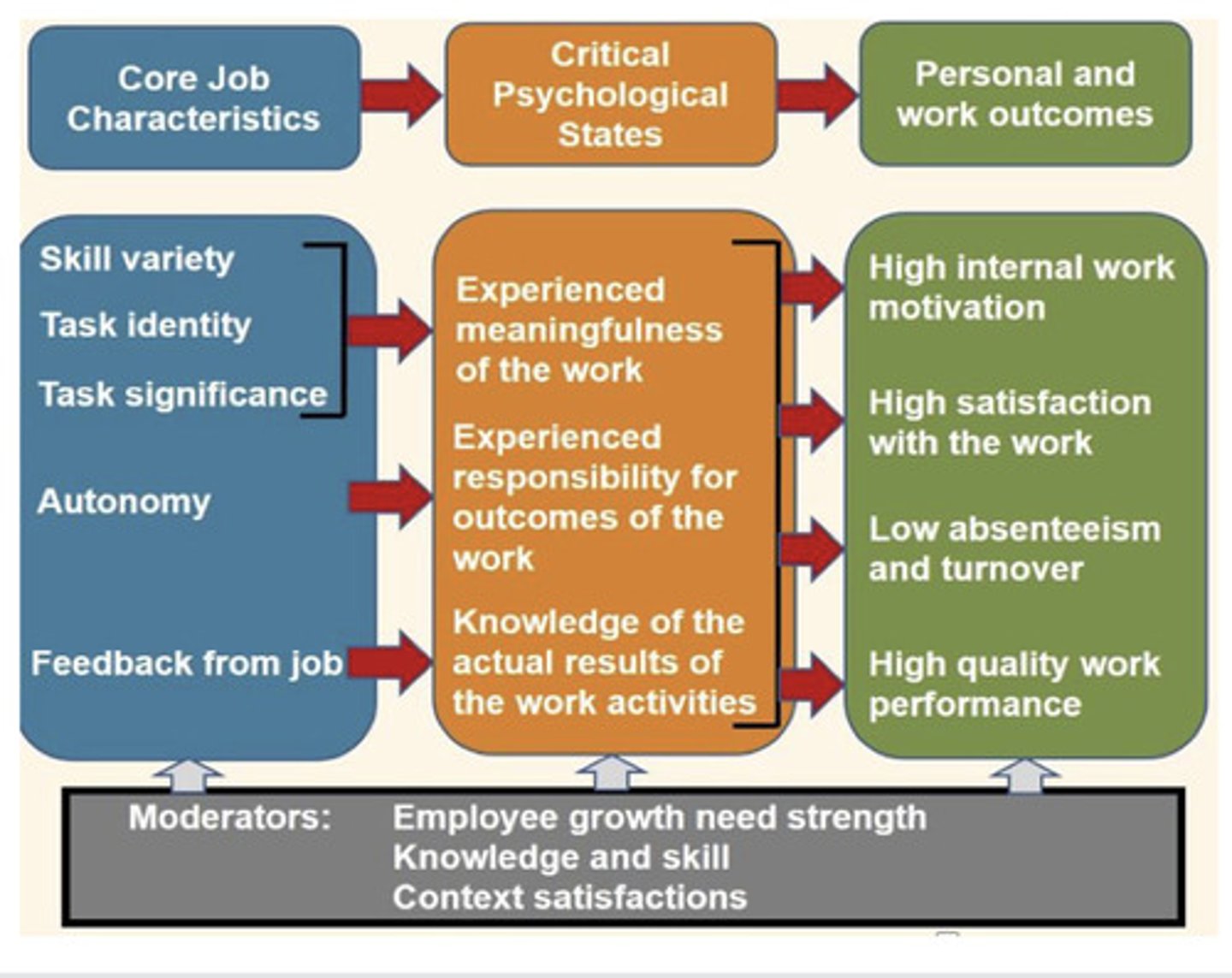
Job characteristics model (Hackman and Oldham)
Core Job Characteristics-->
Critical Psychological States-->
Outcomes
Berlyne's Theory
2 parts: hedonic tone (physiological pleasure) and arousal (physiological)
Inverted U
-In the middle you find the highest levels of pleasure and arousal
-Low levels of arousal, low levels of pleasure= boredom
-High levels of arousal, low levels of pleasure= anxiety
we seek moderate arousal
Job Enrichment
A process that is characterized by adding dimensions to existing jobs to make them more motivating
How to enrich a job
-Feedback from work
-Learning
-You are producing something that you know you have done well (or not)
-Autonomy
-Self-scheduling
-Direct Communication
-Skill variety
-Task variety
Activation-Arousal Theory
-Optimizing arousal to reduce boredom
-Earliest theory of job enrichment
Weiner's attributional model of motivation
Motivation = Expectancy*Value
(higher score = greater motivation)
Expectancy: Can I do this thing if I try?
Value: Do I like doing this thing?
Attributions:why did i perform as well as I did? (ability, effort, difficulty, luck)
self-serving attribution bias
Take credit for success (effort, ability); Blame environment for failure (task difficulty, luck)
VIE Theory
M= EIV
Expectancy: Can I do it?
Instrumentality: If I do it, what will happen?
Value: how much do I like the outcome?
Theory of planned behavior (Fishbein and Ajzen)
Mot = f(attitudes [towards the bx]., subjective norms, perceived behavioral control, past behavior)
What are some things you can do to increase motivation and productivity amongst employees?
Pay attention to your employees, make jobs more interesting, don't focus on money to motivate employees, give employees autonomy, set SMART goals, target desired behaviors, use reinforcers, create a learning environment, emphasize psychological growth, and reiterate organizational values
Movement vs. Motivation
Motivation: when you want to do something for yourself; intrinsic
Movement: extrinsic
Rewards that wreck intrinsic motivation
- expected rewards
- salient rewards
- non-performance based rewards
What effect does competition have on feelings of competence and self-determination?
competition can undermine competence, but not self-determination
Deci and Ryan's Self-Determination Theory
competence, self-determination, and relatedness
Competence (Deci and Ryan)
The extent to which a person feels capable of producing desired outcomes and preventing undesired events
Self-determination (Deci and Ryan)
the desire to be the origin of one's own behavior; autonomy
Organismic integration theory
4 types/levels of extrinsic motivation:
1. external regulation (do the activity because I simply want the reward for performing the activity)
2. introjected regulation (i do the activity because I feel guilt, worry, or shame if I don't)
3. identified regulation (even though it's not fun, i should do this because it's good for me)
4. integrated regulation (it's who i am--even if i don't like the activity for its own sake)
Phenomenology of flow
-Narrow focus of concentration on activity
-Sense of relaxation and energy
-Sense of personal control
-In control of the performance. Feels like its not out of control
-Low self-consciousness
-You don't think about yourself while you do the activity. Your focus is on the activity
-Compression of time
The metric of time changes (time flies by; the passage of time has to do with progress of activity, not on the clock)
Characteristics of activities that produce flow
- moderately challenging (difficulty matches skill)
-clear goals (working towards some end or goal)
-provide competence feedback (feedback comes from the activity itself, not from another person)
Attitude
an evaluation of a person, place, thing, or idea
attitude object
anything you have an attitude towards
ABC model of attitudes
affective, behavioral, cognitive
Lawler's model
happiness is determined by what we receive and what we expected
Amount received - amount expected
Schater-Singer Theory
the idea that emotion has two components: a bodily state of arousal and a cognitive label that specifies the emotion; words determine emotion
Schater and Singer's Paradigm
Emotional experience is a combination of arousal and label
misattribution of arousal
the process whereby people make mistaken inferences about what is causing them to feel the way they do
perceived organizational support
the extent to which an organization supports its members
assumptions of cognitive models of motivation
people are rational,
they look at outcomes,
they do whats in best interest and avoid whats not, the process of motivation, dont explain habitual bx, course of bx is thinking about cost/benefits of bxs
Decisions guide bx
Decision making models
Efficacy Theory (Bandura)
motivation is a function of efficacy
Work Motivation
a set of energetic forces that originates both within and beyond the person to initiate behavior and to determine its form, direction, intensity, and duration

