English Content and Analysis for Praxis Exam Preparation
 Studied by 0 people
 Call Kai
 Learn
Learn Practice Test
 Spaced Repetition
 Match
Match Flashcards
 Knowt Play
1/165

There's no tags or description
Looks like no tags are added yet.
Name | Mastery | Learn | Test | Matching | Spaced | Call with Kai |
|---|
No analytics yet
Send a link to your students to track their progress
166 Terms
Fiction
A genre of literature that involves imaginary events and characters.
Sonnet
A 14 line poem; written in iambic pentameter.
Poetry
Structured language to express emotions, usage of rhythm.
Fantasy
A genre that includes magical elements, supernatural beings, and imaginary worlds.
Biography
Background, achievements, and major events of a person's life.
Memoir
A single experience and reflection, written by oneself.
Gothic
A genre characterized by supernatural elements, isolation, and a mysterious atmosphere.
Epic
A long narrative poem detailing heroic deeds and events significant to a culture.
Themes
Central ideas explored in a literary work, such as love, beauty, and nature.
Imagery and symbolism
Use of descriptive language to create vivid images and represent ideas.
Heroic Protagonist
A main character who exhibits heroic qualities and faces significant challenges.
In media res
A narrative technique where a story begins in the middle of the action rather than at the start.
Moral lessons
Messages or teachings that convey ethical principles.
Expository
A type of writing that explains, informs, or presents information in a clear and straightforward manner.
Parallel structure
The repetition of a chosen grammatical form within a sentence to create balance and rhythm.
Diction
The choice of words and style of expression that an author uses in writing.
Soliloquy
Speech in a play where a character speaks their thoughts aloud, often when alone.
Metafiction
A form of fiction that self-consciously addresses the devices of fiction.
Dramatic irony
A situation in literature where the audience knows something that the characters do not.
Situational irony
When the actual outcome is different from what was expected by both the characters and the audience.
Kennings
Metaphorical compound word or phrase used in Old English and Norse poetry.
Frame narrative
A story within a story, where an outer narrative provides the context for the main, inner story.
Realism
Literary movement focused on representing everyday life and society as it is.
Satire
Genre of writing that uses humor, irony, and exaggeration to criticize or mock.
Individualism
Theme that focuses on the moral worth of the individual, emphasizing personal independence.
Naturalism
Literary movement that depicts human beings as subject to natural forces beyond their control.
Disillusionment
Theme reflecting the loss of faith or trust in something once believed to be true.
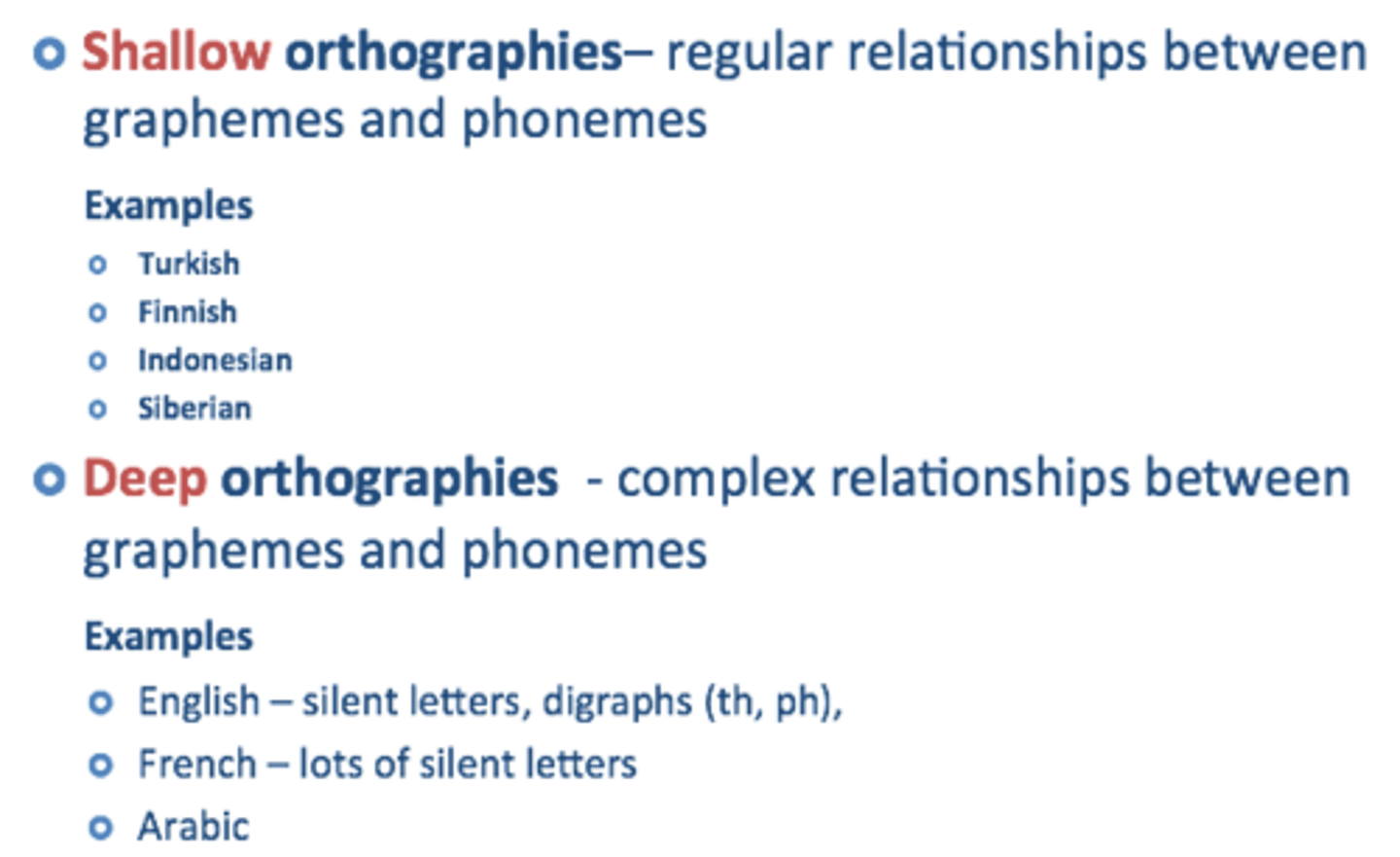
Orthography
Conventional spelling system of a language, including rules for letter patterns.
Literary devices
Techniques used by writers to convey meaning, such as metaphor and simile.
Techniques for understanding texts
Methods used to help understand and retain information from texts.
Writing strategies
Methods used to plan, structure, and refine writing, including brainstorming, outlining, drafting, and revising.
Figurative language
Language that goes beyond the literal meaning of words to create vivid images or express complex ideas, such as through metaphors or similes.
Old English
Era from 450-1066.
Middle English
Era from 1066-1500.
Renaissance
Era from 1500-1660.
Reformation
Era from 1660-1785.
Romantic
Era from 1785-1830.
Victorian
Era from 1830-1901.
Modernism
Era from 1901-1945.
Post-Modernism
Era from 1945-present.
Themes
Heroism, Fate, Religious Conflict, Chivalry, Courtly Love, Social Satire, Deconstruction, Irony, Meta-narrative, skepticism, Alienation, Fragmentation, Identity crisis, disillusionment, Morality, social reform, industrialization, Gender roles.
Historical Context
Industrial Revolution, French Revolution, Norman Conquest, feudalism, rise of the church, Rebirth of classical ideas, global exploration, British Empire expansion, Victorian morality, Anglo-Saxon period, oral tradition, Viking invasions, World Wars, changing gender roles, technological advances, Cold War, post-war recovery, rise of consumerism, Protestant Reformation, rise of Protestantism, Enlightenment.
Major Works
Beowulf, The Wanderer, Hamlet, Paradise Lost, Utopia (STM), Gulliver's Travels (Swift), The Waste Land by T.S. Eliot, Ulysses by James Joyce, Frankenstein by Mary Shelley, Lyrical Ballads by Wordsworth & Coleridge, Great Expectations by Charles Dickens, Jane Eyre by Charlotte Brontë, Slaughterhouse-Five by Kurt Vonnegut, Beloved by Toni Morrison, 1984, The Canterbury Tales by Geoffrey Chaucer, Sir Gawain and the Green Knight, KING ARTHUR.
Sonnet
Typically iambic pentameter, 14 lines, often in Shakespearean or Petrarchan rhyme schemes.
Iambic
Unstressed-stressed (da-DUM), common in English poetry, especially in sonnets and blank verse.
Trochaic
Stressed-unstressed (DA-dum), opposite of iambic, often found in traditional songs or chants.
Anapestic
Unstressed-unstressed-stressed, used in lighter or fast-paced poetry, such as limericks.
Dactylic
Stressed-unstressed-unstressed, often used in classical epic poetry.
Haiku
No specific rhythm, 3 lines following a 5-7-5 syllable pattern, often focusing on nature.
Literary Movement
Old English, Middle English, Renaissance, Reformation, Neoclassical, Romanticism, Victorian, Realism, Modernism.
Major Authors
Anonymous, Cynewulf, Geoffrey Chaucer, Sir Thomas Malory, William Shakespeare, Edmund Spenser, Thomas More, John Milton, John Bunyan, Alexander Pope, Jonathan Swift, Mary Shelley, William Wordsworth, Jane Austen, Charlotte Brontë, Charles Dickens, Emily Brontë, Gustave Flaubert, Leo Tolstoy, T.S. Eliot, James Joyce, Virginia Woolf.
Postmodernism
A literary movement characterized by a departure from traditional narrative techniques and a focus on fragmented narratives, unreliable narrators, and metafiction.
Compound sentence
A sentence that contains at least two independent clauses joined by a coordinating conjunction or semicolon.
Verb number
The form of a verb that shows whether it is singular or plural to agree with the subject.
Gerund
A verb form ending in -ing that functions as a noun in a sentence.
Diction
The choice of words and style of expression in writing or speech.
Modifier
A word, phrase, or clause that adds detail or qualifies a word in a sentence, often adjectives or adverbs.
Subject-verb agreement
The rule that the verb must agree in number (singular/plural) with the subject of the sentence.
Indirect object
The recipient of the direct object, answering 'to whom' or 'for whom' something is done.
Direct object
The noun or pronoun that directly receives the action of the verb.
Auxiliary verb
A verb used with a main verb to form tenses, moods, or voices.
Lexical verb
The main verb in a sentence that carries meaning (not an auxiliary or helping verb).
Subject complement
A word or phrase (usually a noun, pronoun, or adjective) that follows a linking verb and describes or renames the subject.
Modal verb
Auxiliary verbs that express necessity, possibility, permission, or ability (e.g., can, may, must).
Vernacular language
The language spoken by the ordinary people in a particular country or region, often contrasted with formal or literary language.
Comprehension Strategies
Techniques used to improve understanding of texts.
Reading Strategies
Methods to enhance reading skills and engagement.
Summarization
Students summarize what they've read to reinforce understanding.
Questioning
Encourage students to ask questions about the text to enhance engagement.
Graphic Organizers
Mind maps, Venn diagrams, or storyboards to visualize information.
Think-Pair-Share
Discussing with a partner to clarify understanding.
Reciprocal Teaching
Students take turns teaching each other and asking questions.
Previewing
Skimming the text to get an overview before reading in detail.
Annotating
Taking notes in the margins or highlighting key points while reading.
Active Reading
Engaging with the text through questioning, visualizing, and predicting.
Cloze Procedure
Completing a text with missing words to focus on context.
Shared Reading
Reading together in a group to promote discussion and understanding.
Prewriting
Brainstorming ideas and organizing thoughts before drafting.
Peer Review
Students review each other's work to provide feedback and suggestions.
Writing Workshops
Structured sessions where students draft, revise, and share their work.
Writing Prompts
Specific prompts to inspire creativity and focus writing efforts.
Modeling
Demonstrating writing techniques through examples and guided practice.
Literary Elements and Devices
Symbolism, metaphor, irony, tone, mood, imagery, etc.
Genres
Poetry, drama, novel, short story, non-fiction, and their conventions.
Critical Approaches to Literature
Formalism, feminism, post-colonialism, historical criticism, etc.
Major Literary Periods and Movements
Old English, Middle English, Renaissance, Romanticism, Victorian, Modernism, Postmodernism.
World and Multicultural Literature
Important works from non-Western cultures and minority voices.
Grammar and Syntax
Subject-verb agreement, parallel structure, sentence types, modifiers, etc.
Vocabulary Development
Word roots, prefixes, and suffixes; context clues.
Semantics and Pragmatics
Understanding meaning in language and context.
Language Acquisition and Development
How people learn language; stages of language development.
Dialect and Vernacular
Regional language differences, slang, and code-switching.
Writing Process
Prewriting, drafting, revising, editing, and publishing.
Rhetorical Strategies
Argumentation, persuasion, cause and effect, comparison and contrast, etc.
Genres of Writing
Expository, descriptive, narrative, persuasive, and analytical writing.
Textual Evidence
Identifying main ideas, themes, and supporting details in a passage.
Inference and Analysis
Drawing conclusions, interpreting figurative language, understanding point of view.
Text Structure
Recognizing organizational patterns such as chronological, cause-effect, problem-solution.
Differentiated Instruction
Tailoring teaching strategies to meet individual student needs.
Formative and Summative Assessment
Using assessments to guide instruction and measure student progress.
Explore top notes
 Note
Note Explore top flashcards
 Flashcards (52)