Cognition Exam2
 Call Kai
 Learn
Learn Practice Test
 Spaced Repetition
 Match
Match Flashcards
 Knowt Play
1/146

There's no tags or description
Looks like no tags are added yet.
Name | Mastery | Learn | Test | Matching | Spaced | Call with Kai |
|---|
No analytics yet
Send a link to your students to track their progress
147 Terms
Memory
processes involved in retaining, retrieving, and using info about stimuli, images, events, ideas, and skills after the original information in no longer present
active when past experiences influences
Atkinson & Shiffrin
1986, memory model
input → sensory mem → short term mem → ← long term mem
attended to advances to sensory, rehearsal keeps in STM
Short Term Memory
5-7 items, 15-20 seconds
Rehearsal
control process that holds info in short term mem
Sensory Mem
initial stage, seconds - fractions of a second, holds all incoming
quick info decay, Sperling
Long Term Mem
large amt of info for years → decades
Control Processes
active, controlled by the person
rehearsal
strategies to make stim more memorable
strategies of attention - focusing on a specific stimuli
Iconic Memory Storage
brief sensory mem of things we see
persistence of vision - retention of perception of light, films
Echoic Mem
brief sens mem of things we hear, persistence of sound
Sperling
1960, iconic mem, capacity and duration of sensory memory with light
flash letters on screen - report letters seen
tone for row played after letters - report ~82% of letters in that row
delayed tone → dramatic performance decrease
Short Term Mem Storage
new info from sensory + info from LTM
Peterson & Peterson, Miller, Luck & Vogel, Ericson
Peterson and Peterson
1959, STM duration
3 letters, 3 digit #, given letters to recite after counting down by threes from the #
18 sec recall, decay
Digit Span
how many digits a person can remember, 3-9
Miller 1956 magic # 7+-2
Luck & Vogel
1997, change detection, 4 items in STM
100ms show screen, 900ms delay, 200ms screen again
Chunking
small units can be combined into larger meaningful units
by association, story mnemonics
Ericson et al.
Ericson et al.
1980, chunking can be trained
student participant, memorize and recite digits by creating meaningful units, SF
Alvarez & Cavanugh
2004, STM by amt of info not number of items
Luck & Vogel replication with addition
colored squares > chinese char > random polygons > shaded cubes
Working Memory
lim cap sys for temp storage and manip of infor for complex tasks like comprehension, learning, and reasoning
phonological loop + central executive + visuospatial sketch pad
Baddeley and Hitch 1974
Phonological Loop
verbal and auditory info
phonological similarity effect, word length effect, articulatory suppression
Phonological Similarity effect
letters or words that sound sim are confused
Word Length Effect
mem of word lists are better for short words
rehearsing long words and producing them takes longer, slows reading speed
Articulatory Suppression
speaking prevents rehearsal of items to be remembered
reduces mem span, elim word length effect
reduces phonological stim effect for reading words
disrupts subvocalization ability
Visuospatial Sketch Pad
creation of visual image in the mind in the absence of a physical visual stim
Shepard & Metcler - 1971, mental rotation task, more rotation → longer time to id, linear results
Central Executive
attention controller. divide, focus, and switch attention
controls suppression of irrelevant info, preservation
Preservation
repeatedly performing the same action or thought even if it is not achieving the desired goal
Episodic Buffer
backup storage, communicates with LTM and WM
holds info longer with greater capacity than phonological loop or visuospatial sketch pad
binds info from storages together
Working Memory and Brain Damage
prefrontal cortex
Funashashi, Stokes
Prefrontal Cortex
processes incoming visual and auditory info
sustained attention, rehearsal, goals
Funashashi et al.
1989, single cell recordings from monkey prefrontal cortex during delayed response task
info retained until neurons stop firing
Stokes
2015, working memory function
STM from neural network changes, activity - silent WM
synaptic = no firing, connections btwn neurons are strengthened
active = info to be remembered causes neurons to fire
Parietal Lobe
sustained attention
Temporal Lobe
LTM, perception
Reverberating Signals
memory throughout the brain
parietal, temporal, prefrontal cortex
Vogel
2005, WM > STM
EEG, ERP data, show simple or complex stim
high performers better at ignoring distractors, lower ERP responses
LTM
works closely with RM, storage stretches back for as long as one can remember
inaccessible vs. forgotten
past events and knowledge
Serial Position Curve
give list of words in certain order, abil to remember them
primacy effect - better at remembering beginning words, rehearsal
recency effect = better at remembering the last words, 30s delay elims (STM)
Testing Memory
recognition = abil to ID if stim was prev experienced
recall = abil to recount detailed info with presence of complete cue
free recall - no external cues
cue recall - given external cues but not the recalled
Proactive Interference
stim for Wickens et al, 1976
grouped - fruits vs professions
dec in mem when prev learned info interferes w learning new info
Release from Proactive Interference
elim or reduce performance dec caused by the proactive interference
Memory In the Brain
Hippocampus = episodic mem, recent LTM, STM → LTM transfer
Back of Temporal Lobe = semantic mem
Parietal Lobe = STM
Cerebellum = procedural mem
HM
no hippocampus, anterograde amnesia
STM remained - 2 minutes
no episodic em, intact semantic mem
KF
damaged parietal lobe, STM impaired
encephalitis damage, impaired semantic, intact episodic
Double Dissociation
HM and KF, opposite memory issues, Rangarath & D’Esposito - STM and LTM interdependent, hippocampus maintains for short delays
Episodic Memory
mental time travel, person experience, self knowing, remembering is reliving
recollection
Semantic Memory
general knowledge, facts, knowing
familiarity
Episodic & Semantic Interaction
can lose episodic → semantic (fade away) over time
enhance semantic with associated episodic
autobiographical - spec experience
personal semantic mem - personal experience attached
Prospective Memory
remember and perform actions planned for later
constructive episodic simulation hypothesis from this
Constructive Episodic Simulation Hypothesis
episodic mem extracted and recombined to create sims of future events
adaptive fxn sim to mind wandering, anticipates future needs and guides behavior
great overlap btwn past and future picturing in brain
Long Term Memory
explicit - stored, conscious/declarative
episodic - personal events
semantic - facts, knowledge
implicit - non conscious, nondeclarative, learning from experience wo conscious memory
procedural memory
priming
conditioning
Procedural Mem
skill, mem for actions, no mem of where/when knowledge was learned, perform wo conscious awareness of how
still exists in those without LTM
Priming
change in response to stim caused by prev presentation of the same or sim stimulus
blue vs red followed by pond - RT difference
mere exposure, propaganda effects
Mere Exposure Effect
subconscious inc in liking for familiar items due to repeated exposure
Propaganda Effect
people are more likely to rate statements read or heard before as being true
Conditioning
Classical - HM responded to
Operant - behav rear through reinforcement of diminish/disappear through punishment, shape behav
Encoding
acquiring info and transforming it into mem
Retrieval
transferring of LTM info → WM
Maintenance Rehearsal
Rep of stim that maintains info but does not transfer it to LTM
Elaborative Rehearsal
using meanings and connections to help transfer info to LTM
Levels of Processing Theory
Craik & Tulvig 1975
mem depends on how info in encoded. shallow processing and deep processing
Shallow Processing
little attention to meaning, focus on physical features, perceptual
surface, poor memory of
Deep Processing
closer attention to meaning, better mem
makes more associations
Encoding Factors
visual imagery
self reference effect
generation effect
organizing to be remembered info
relating words to survival value
retrieval practice
Visual Imagery
generate mental image to visually connect words, up 50%
paired associate learning procedure (5 sec show word pairs, then remember them)
the easier words are to image the easier they are to remember
Self Reference Effect
mem is better when you relate a word to yourself, 18%
Leshikar, study averages, questions about words that are associated with their traits
better memory for yes’s than no’s
Generation Effect
mem better when one generates the material rather than read it, 28%
Slameka & Grof, word pairs, king-ca___
Organizing to be remembered info
categories can serve as a retrieval cue, 40-50%
Bower - concept map or random
preventing organization hurts memory - Bransford & Johnson 1972
saw picture of written scenario before/after/never the reading
before did better
Relating Words to Survival Value
Nairne - rate words for foreign grasslands/moving somewhere/pleasantness, best mem for foreign grasslands
remember better if good for survival
Retrieval Practice
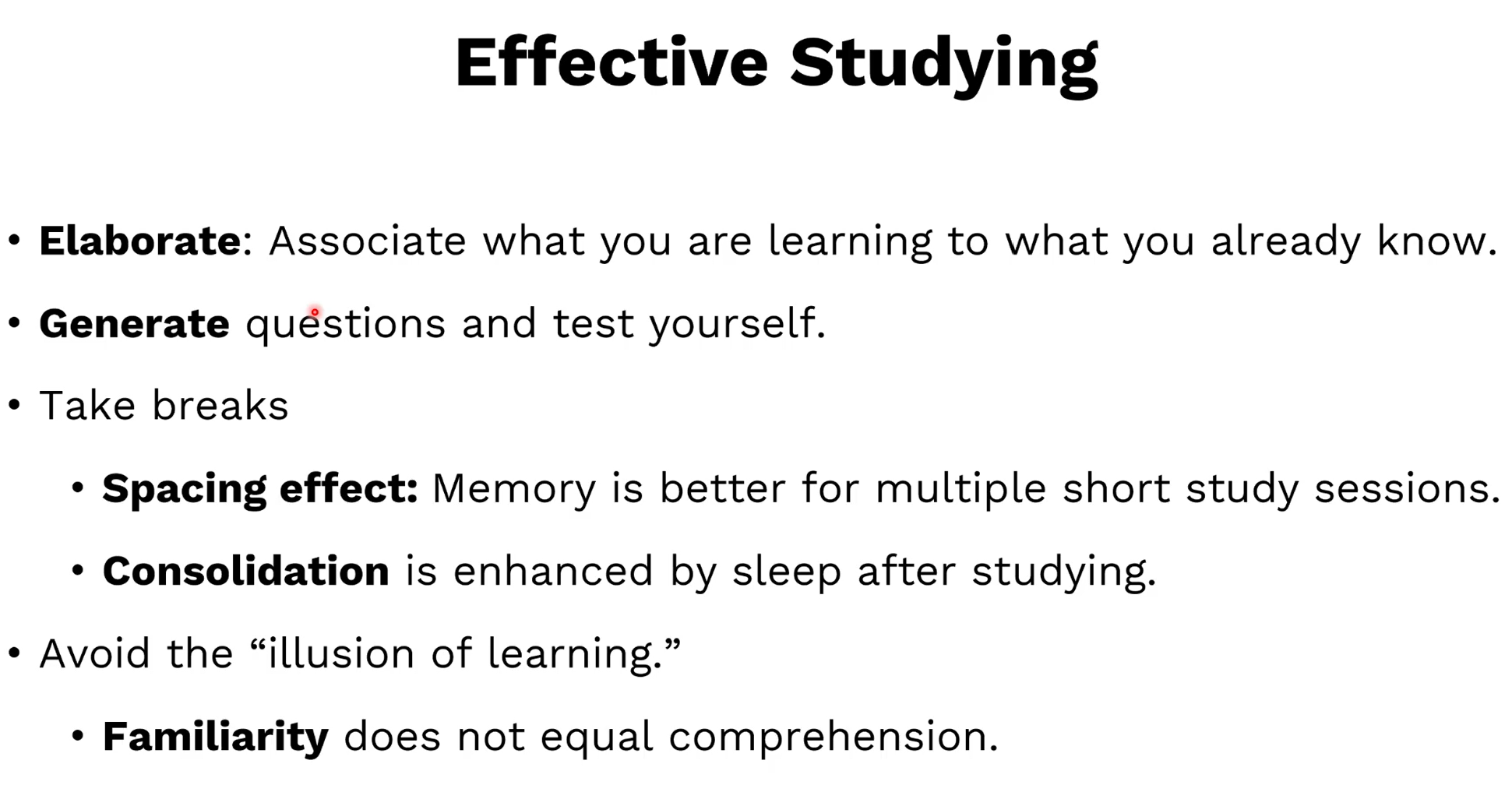
prev testing effect, 20%
active recall of info strengthens long term learning relative to rrestudying
Karpicke & Roediger, restudying only stronger at short retention intervals
Effective Studying
Cued Recall
aids recall, most effective when created by the person using them, 45%
Context Dependent Learning
encoding specificity
learn info together with context, good for mood and location and physiological
Baddeley 1975 diving, land or underwater, did better on test in matching condition (word lists)
Miles and Hardham - exercise or rest
Moris et al.
1977, transfer - appropriate processing
mem task results are better if processing used during encoding is the same as retrieval
rhyming vs meaning
Consolidation
new mem from fragile state → more perm state
small delay → up consolidation → inc mem, Miller and Pilzecker
synaptic and systems
Synaptic Consolidation
rapid, at synapse, short breaks
Hebb 1948 - neural record of experience, synapse physiological changes w learning and memory
long term potentiation
Systems consolidation
gradual reoganization of neural circuits, no longer retrieve from hippocampus when complete
contributes to mvmt of mem out of hippocampus in to cortical
takes weeks to years
Long Term Potentiation
enhanced firing of neurons after repeated stimuli → structural changes
up NT release and reception, enhanced responsivity
opposite is long term depression
Reactivation
replaying encoded mem to reinforce and stabilize them for long term storage
Retrograde Amnesia
loss of mem for events prior to trauma
Graded Amnesia
mem for recent events is more fragile than for remote events
Multiple Trace Consolidation Model
hippocampus activates during retrieval of recent and remote memories not only at the beginning of consolidation
fMRI - multiple trace Viskontas et al. 09, picture pair learning
. know (semantic) = less hippocampus reliance, moving info for remote mem is contained in prefrontal cortex and posterior hippocampus
Consolidation & Sleep
enhanced during sleep (Gais 06)
sleeping stops interference from envi stim
some mem consolidated better than others - when expected to remember (Wilhelm 2011), valued/preferred/emotional
stage 2 sleep spindles, non REM sleep
Anisomycin
inhibits P synth to prevent changes at the synapse responsible for formulating new memories
Nadar et al. 2000, prevented mem when injected before, after, or during mem reactivation
Hupbach 07
can overwrite - new list to remember - to make participants do worse at saying the first list by mem disruption
temporal context model - alternate explanation, association of 2 lists → interference
PTSD Reconsolidation
severe emotional responses to traumatic mem, can be helped with reconsolidation
Brunet et al. 2008: react to traumatic mem, propranolol (block amygdala stress receivers), later reactivation has a lower stress response
Brain is not a Camera
inattentional and change blindness, reconsolidation, mem is constructed of what happened, what happened after, and associated general knowledge
Greenberg and Rubin 2003
Objective and Autobiographical Memory
damage to visual region → cannot recog obj, lose AM
visual images are cues for AM mem encoding and retrieval
Cabeza et al.
2004, AB mem
view photos participant took and that others took
more hippocampus and prefrontal cortex activation for own photos
Remembered Well
significant events - marriage, childbirth
highly emotional events - weapon focus
transition points starting college, dif route to work
Mem Over Lifetime
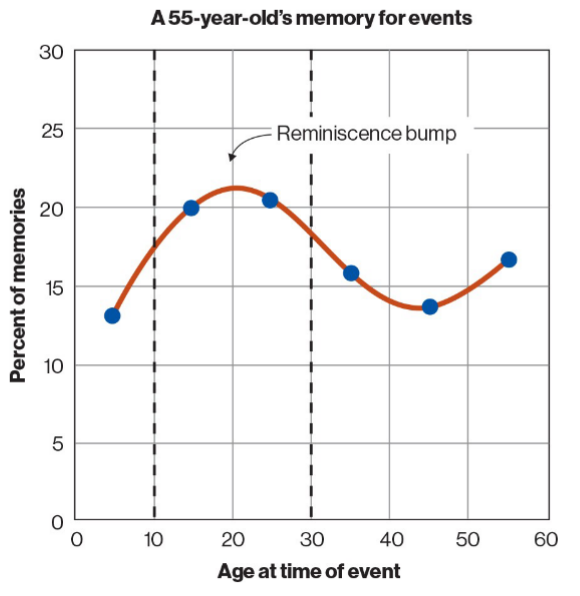
mem high for “prime time” and recent events
reminiscence bump, positivity bias
Reminiscence Bump Causes
Self Image Hypothesis
Cognitive Hypothesis
Cultural Life Script Hypothesis
Youth Bias
Self Image Hypothesis
mem enhanced for events that occur as a person’s identity and self image is being formed
many transitions in adolescence and young adulthood and identity is built then
Cognitive Hypothesis
encoding better during periods of rapid change followed by stability
immigrants have shifted bump to time of immigration
Cultural Life Script Hypothesis
each person has personal life story and knowledge of culturally expected events
easier to recall events when they fit cultural expectations/script
Youth Bias
most notable public events to be perceived to occur when someone is young
from asking people to pick age of most important life event for theoretical human
Exceptional Events - Emotion
emotions improve mem, become greater with time - may enhance consolidation
positive emotion enhances peripheral details
negative emotion enhances central details
Flashbulb Memories
mem for circumstances around shocking highly charged emotional events
vivid, very detailed (highly emotional), not photographic
repeated recall changes the mems - Neissen and Harasch, Talarico and Rubin
Source Monitoring
peripheral details, where and when a mem came from
narrative rehearsal hypoth, source mem = process of determing mem origin
source monitoring error = misidentify source of mem
Narrative Rehearsal Hypothesis
repeated viewing/hearing of an event
rehearsal → mem errors
Cryptomnesia
unconscious plagiarism of anothers work due to lack of recognition of its original source
forgotten mem resurfaced as a novel thought
Music, Odor, AM
nostalgia (mem that involves a sentimental affection for the past) evoked by music
music enhances AM, more vivid and detailed mems than face cues
Proust effect - smell triggers vivid and emotional mems