Renaissance / Age of Exploration
 Call Kai
 Learn
Learn Practice Test
 Spaced Repetition
 Match
Match Flashcards
 Knowt Play
1/21

Earn XP
Name | Mastery | Learn | Test | Matching | Spaced | Call with Kai |
|---|
No analytics yet
Send a link to your students to track their progress
22 Terms
Individualism
emphasizes the moral worth of the individual
Secularism
belief in separation of religion from civic affairs and government
Humanism inspired by Greek & Roman ideas
the idea rational thought is superior to unquestioning faith
Civic humanism
application of humanism to civil service
Petrarch
father of humanism
rediscovered ancient texts
emphasised individual emotional experience
Machiavelli
Wrote “The Prince” - advice to rulers
machiavellian
“The end justifies the means”
Role of women in the Renaissance
Limited but growing social opportunities
Notable Women: Isabella d’Este, Laura Cereta
Minor challenges to trad. gender roles
Printing press (Gutenberg)
Johannes Gutenberg invented the first mechanized movable-type printing press in Europe around 1440 in Mainz, Germany.
Revolutionized information dissemination by enabling the mass production of books, drastically reducing costs and increasing literacy rates.
Renaissance vs Middle Ages Art
Secular Geometric Humanism:
-Mathematic perspective
-Realism
-Humanism
-Reflecting Greek and Roman mythological references
Focus - scientific naturalism: Close observation of the natural world
Fall of Constantinople
The most important motive for the age of exploration - 1453
the capture of the capital of the Byzantine Empire by the Ottoman Empire.
Gold, Glory, God
The idea that led the first voyages of Expansion (esp. in Spain)
Prince Henry the Navigator
age of discovery
in Portugal
Never sailed anywhere
Started the school for navigation
Columbian Exchange
the widespread transfer of plants, animals, and diseases between the New World (the Americas) in the Western Hemisphere, and the Old World
Disease
Europeans brought diseases which affected the natives
Population decline (Indigenous peoples)
Disease and murder
Agricultural exchange (new foods)
American crops such as maize, potatoes, tomatoes, tobacco, cassava, sweet potatoes, and chili peppers became important crops around the world.
Encomienda system
Encomienda was a royal grant of authority to conquistadors to demand labor services from indigenous people in Spanish colonies. The system was a means of encouraging colonization without the Spanish Crown having to shoulder the entire expense of the colonial expedition. Spanish-born at the top
Conquistadors
Spanish and Portuguese military adventurers who explored, traded with, and colonized parts of the Americas, Africa, Asia, and Oceania during the 16th century, serving as the vanguard of the Spanish and Portuguese empires. The term, meaning "conqueror,"
Las Casas & Sepúlveda Debate
Valladolid debate (1550-1551)
Las Casas believed that the view of indigenous free men in natural order; stance on war: unjust
Sepulveda believed that the exploitation was necessary for suppressing their crimes
Transatlantic Slave Trade
Institution of slavery not as moral failing, but as an economic necessity required to fuel profitability of American plantation
terrible middle passage conditions
fuelled the growth of western countries but decreased such growth in Africa
Forced migration
involuntary or coerced movement of individuals or groups away from their home or home region due to factors beyond their control.
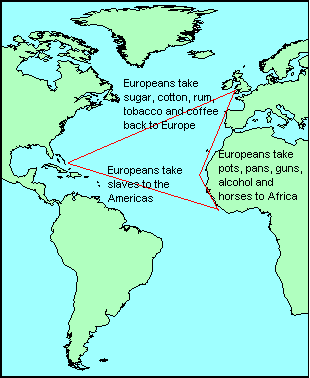
Triangular Trade
leg 1: manufactured goods
leg 2: enslaved africans/middle passage
leg 3: raw materials