superpowers
 Studied by 0 people
 Call with Kai
 Learn
Learn Practice Test
 Spaced Repetition
 Match
Match Flashcards
 Knowt Play
1/64

There's no tags or description
Looks like no tags are added yet.
Name | Mastery | Learn | Test | Matching | Spaced | Call with Kai |
|---|
No study sessions yet.
65 Terms
superpower definition
a nation with the ability to project its influence anywhere in the world and be a dominant global force
hyperpower
an unchallenged superpower that is dominant in all aspects of power (cultural, economic, political, military)
blue water navy compared to green water navy
blue water navy - one that is deployed in open ocean
green water navy - one that is deployed in littoral waters (close to shore)
diplomacy
negotiation and decision making that takes place between nations
emerging superpowers
nations with significant influence that is growing e.g. china, Russia, India
regional superpowers
have strong influence within their region but are less powerful outside e.g. Nigeria, Australia
pillars of superpowers 1. economic power
high GDP and levels of trade, including control over trade
home to many TNCs
powerful currency (euros, dollars)
determine economic policies (G20, Trade blocs)
military power
high spending, large amounts of hardware and personnel, including nuclear weapons
could command global military control
unparalleled intelligence networks
not just about size but about standard of technology e.g USA has good tech
demographic factors
significant percentage of global population
attracts skilled migrants an other workers
access to natural resources
able to export and control the supply of valuable commodities e.g oil or be able to secure the resources it needs
multiple resources make a country less dependant on others
physical size and geographical position
a location that helps it command influence
a larger country may have more resources
not landlocked
friendly neighbours to avoid conflict
cultural influence
long standing tradition and rich cultural history or ways of life is voluntarily enjoyed by many around the world e.g. music fashion film dance and food
transmission of ideology USA = capitalism and liberalism
Hard and Soft power
hard = military presence. military action or threat of it. alliances e.g NATO. diplomatic threats to use force if negotiation fails. economic sanctions
economic = favouring certain trade partners. trade blocs + alliances. giving allies economic and technical help. using aid to influence policy
soft = culture and ideology. media promoting particular messages. values and ideology of some nations is seen as appealing. exporting culture through film and tv
Mackinders geo-strategic location theory
there is a heartland extending from Eastern Europe to Russia with a pivot in the centre
whoever controlled this area would be a superpower
USA tried to hide/contain this ideology to prevent Russia
this heartland has 50% of world’s resources]
is now outdated due to the rise of soft power.
smart power
a combination of hard and soft mechanisms to get their own way. this is necessary because war and conflict often do not go as planned and fails to achieve the aims and soft power alone may not persuade especially if culture and ideology are very different.
sharp power
the power of manipulation, such as attempts to interfere in other countries democratic elections or manipulate views on social media. this type is increasingly important.
stats for China, USA, UK
china
total GDP - 18.7 trillion 2nd
total population - 1.4 billion 2nd
total military spending - 235 billion 2nd
number of nuclear warheads - 600 3rd
number of global Fortune 500 companies - 128 2nd
USA
total GDP - 29.2 trillion 1st
total population - 340 million 3rd
total military spending - 986 billion 1st
number of nuclear warheads - 5177 2nd
number of global Fortune 500 companies - 139 1st
UK
total GDP - 5.7 trillion 6th
total population - 68.2 million 21st
total military spending - 81.1 billion 5th
number of nuclear warheads - 225 5th
number of global Fortune 500 companies - 17 6th
how is China allowing more tourism
visa optimisation - expanding visa free access
flight resumption - increasing international flights
payment flexibility - introducing diverse payment options to cater to international tourists
customs efficiency - smoother entry to the country
global campaigns - launching international marketing campaigns
acculturation
a process of cultural change that takes place when two different cultures meet and interact. it includes the transfer of a dominant culutre’s ideas onto a subordinate culture.
types of polarity
unipolar - one superpower. good because a single superpower can dominate the world and act as the police but bad because it is impossible to police the whole world.
bipolar - two superpowers. good because smaller blocs are easier to control but bad because a breakdown in diplomacy could lead to global conflict
multipolar - multiple superpowers. good because no single country is powerful enough to dominate the world and international cooperation is necessary but bad because if countries don’t want to share power this could lead to conflict and numerous trade blocs competing is complex.
colonialism definition
direct control exerted over territories conquered by mainly European powers in the period of 1600-1900
European empires and superpowers, particularly the British empire, shaped the world during this time
from the 1600s-1800s the world was considered multipolar. by 1950 the major superpower is the British Empire. this time is considered unipolar then 1910-1945 the world was considered multipolar
success of colonialism
railway lines were built throughout colonies and were used to transport goods and military forces quickly between places
education for all colonial states was improved as schools were set up. this has led to increased international migration to fill skills shortages in other countries after ww2
the English and other European languages were spread across the world, which allowed colonies to participate in global businesses and become hubs for outsourcing services today
negatives of colonialism
the majority of crops grown in colonies were bought by the colonising empire at extremely low prices. this left farmers with little profit to invest in their own futures
man colonies did not have their own governments which lead to rebellions and strong protests for independence
discriminating policies were established to segregate British and European migrants from the original population. these polices remained in some countries until recent years
reasons why colony collapsed
after ww1 and ww2 many colonial powers were left bankrupt as they had to spend so much on war efforts that they could no longer afford to control or maintain their colonies
after ww1 and ww2, colonial powers focused mainly on rebuilding their home countries and so they focused less on the colonies
anti-colonial movements and sentiment gained popularity both in colonies themselves as well as the empires that owned them. this increased the demand for independence and forced colonial powers out
between ww1 and ww2
by 1910 the British empire was at its height but as Germany was expanding, Russia was revived and Japan was rapidly industrialising it led to a geopolitically complex multipolar world
the world after colonialism
after ww2 the British empire, USA, and USSR
however war had left Britain bankrupt and indebted to USA. many independence movements had meant the British empire has lost many colonies
while Britain continued to have an empire until 1997 it no longer had global dominance. world was then bipolar
Rostow’s modernisation theory
breaks down economic development of a country into a series of five simple steps or stages of growth leading on from each other in linear order
traditional society - a country’s economy is based on primary industry, gathering and exporting raw materials for income. there is little technology, meaning traditional cultures, religions, and values still exist
preconditions for take off - increase in demand for a country’s raw materials, increasing GDP due to higher exports. this allows for more money to be spent on building infrastructure projects and leads to increased FDI and a push towards secondary industry
take off - rapid push towards industrialisation, furthering the growth of secondary industry leading to higher employment and higher GDP
drive to maturity - higher GDP and economic growth as well as higher tax revenue which allows for greater investment and improvement in quality of life. tertiary industry starts to grow
high mass consumption - final stage where countries have high disposable income and free market guides decisions
evaluation
eurocentric
IMF and world bank followed these steps for LICs but it led to little economic growth
Frank’s dependency theory
wanted to explain why newly independent nations were still underdeveloped
these countries were part of a global periphery to the developed global core. the periphery provides for the core by exporting raw material, cheap labour, outsourcing manufacturing, new markets.
this allows superpowers to gain economic wealth by exploiting poorer nations as well as preventing future powers
evaluation
assumes world is static and countries are stuck in state of underdevelopment
Wallerstein’s world systems theory
core regions drive the world economy
the core was the first industrial areas that were financed by wealthy farming sector
western core now owns and consumes 75% of global goods and services. however this core is shifting to Asia as China and India are emerging
peripheral areas are the other extreme as they are distant from the core and lacking capital, they rely on core regions to exploit their raw materials. this is likely the result from colonialism
western areas assumed control over areas rich in resources within Africa and Asia and Latin America. core regions process and manufacture these resources and added value
cores remain dominant because they own production lines and this maintains the development gap
BRICs
the G7 was a group of the most influential countries: USA, Canada, UK, Japan, Germany, France and Italy
Russia joined in 1990s to make it G8 but in 2014 was expelled due to illegal annexation of Crimea
while the G7 still has global influence its share of global GDP in 1980s to 28% today
the G20 is a wider group of the 20 largest economies
the G20 represents 85% of global GDP
within the group Brazil, Russia, India and China formed the BRICs which are emerging economies.
Brazil
considered a regional power as it is the largest country and economy in South America. however globally it has little influence
represents half of South America’s GDP set to be 5th largest economy by 2050, abundant resources and self-sufficient in food and energy
military is insignificant with smallest budget in BRICs
reliant on primary sector and the exporting of raw materials
lacks economic infrastructure
politically less stable and corrupt which decreases FDI
Russia
not as powerful as USSR was
despite Econo,ic, political, and demographic challenges it still has one of the most powerful militaries
very skilled workforce with high education levels
wealth of natural resources
worlds largest country by landmass
politically isolated with economic sanctions
weak economy with lower GDP than Italy
demographically shrinking due to poor health and low life expectancy due to recent war
corruption with economic elite dominating the economy and politics
India
one of the two big emerging economies but still has a long way to being fully developed there is a large and growing middle class but much of the country is still in poverty
has the largest population of £1.4 billion which means there are more workers to boost economy
worlds largest democracy with over 600 million voters
strong IT and services sector due to large English speaking population
20% still live in poverty
Bollywood produces the most films but has little global reach which limits soft power
largest emitter of co2 and has severe air pollution and other environmental problems
weak rupee
China
considered by many to be the next superpower
2nd largest economy with strong manufacturing base
high population of 1.4 billion - lots of workers
largest military, strong hard power
strong centrally planned government
strong FDI, highly skilled workers
large deposits of coal, iron, oil and gas
ageing population due to one child policy
welfare quite weak despite communism
social + political instability in future due to ageing population
FDI is decreasing and Trump’s tariff war.
world economic forum
meets annually in Davos Switzerland
people who go are CEOs of TNCs, government leaders and celebrities
promotes public-private cooperation in aims to improve the state of the world. helps resolve disputes and promotes global thinking. discusses issues of corruption
TNCs receive benefits from government policies such as low taxation
sometimes voter instincts conflict with WEF for example when UK voted to leave the EU
World Bank
Bretton Woods 1944
first loan went to France for post-war reconstruction
focuses on the effects of natural disasters and humanitarian emergencies and to help capitalism function
the world bank financed projects that were either environmentally damaging or so costly that countries were unable to pay back loans resulting in debt
USA holds 16.5% of votes, 40% of total votes go to 8 of the largest contributions
IMF
Bretone Woods 1944
original aim was to stabilise global currencies after the 1950s depression and devastation of ww2
originally was 44 countries, now is 189
individual voting rights are proportional to the amounts that they have invested
mostly reflects western countries interests because they were contributing the most and therefore had the most voting power
WTO
Bretton Woods 1944
Aims to achieve free global trade by negotiating free-trade agreements and ensuring members follow rules. free trade means there is no tariffs placed on exports or imports
currently focused on poverty reduction by removing farm subsidies in developing countries to stimulate efficient production
cheaper imports undercut local farmers who are forced out of business
the value of trade has increased rapidly from 2.1 in 1800 to 4427.6 in 2014
world police
refers to a group of countries in the UN Security Council who are the primary global mechanism for maintaining international peace and security
they can enforce global laws through sanctions or military action
the USA has intervened in many areas of the world but mostly in Central America for example the 1989-1990 invasion of Panama in Eastern Europe. for example the 1994-1995 Bosnian War and the Middle East. for example the 2003-2011 Iran War
the USA has intervened so much in order ti maintain their superpower status and have control over other countries
Iran’s Nuclear programme
western countries have long concerns about Iran being nuclear armed and destabilising an already unstable Middle East
USA first applied sanctions in 1995
UN sanctions began in 2006 and included an arms embargo and asset freeze
EU sanctions began in 2007
sanctions were placed on their oil exports in 2012
Iran was forced to end its nuclear weapons programme in 2015 as their economic situation deteriorated due to its denied oil exports
Bosnian war 1992-1995
resulted from post Cold War breakup of Yugoslavia
toxic mix of ethnic, religious and nationalist divisions led to a war involving genocide, mass rape and numerous other war crimes
UN resolution led t a NATO enforced no fly zone
UN peacekeeper tried to establish safe zones unsuccessfully
UN-sanctioned naval blockade in Adriatic Sea
eventually NATO air strikes forced an end to conflict
Haiti Earthquake 2010
7.0 magnitude destroyed 20% of buildings in the capital city of Port-Au-Prince and created a Humanitarian crisis
within 6 days the UN and US military:
US air force restored air traffic control to allow relief flights
US coastguard began relief flights
aircraft carrier from US brought rescue assist, food and water
1600 US marines provided aid and technical help
Ebola epidemic 2013
outbreak in west Africa and had no cure, vaccine and is easily transmitted in insanitary conditions. Has a mortality rate of 50-70%.
initial response was slow
in Sierra Leone the UK committed £450 million, 1500 troops and 150 NHS personnel
work of NGOs and WHO was crucial and so was aid from countries like USA in Liberia and France in Guinea
by 2016 the epidemic was over and 113,000 people died
economic alliances
interdependence between nations is further strengthened by economic alliances
those who have free trade agreements also have military alliances e.g. NAFTA, EFTA, ASEAN
economic alliances included free import/export taxes and tariffs.
global emissions patterns
China - over 30% of global emissions due to:
industrialisation
high growth
dependance on fossil fuels
low grade coal
US - over 13.5% of global co2 due to:
manufacturing base
transport due to people commonly taking flights
lack of investment in the rest of the world
still extracting and burning fossil fuels
the rise of China’s middle class
china has developed very quickly over a short period of time
the size of the m/c has grown from just 3% in 2000 to over half in 2018
GNI per capita has grown ten-fold
however most are still part of the lower middle class (68%)
spending habits of the middle class
Chinese m/c has begun to behave similarly to its counterparts across the world in terms of consumption of goods and services
an increase to disposable income has led to an increase in the sale of passenger vehicles (24.7 million in 2017)
internet perception rates have sky-rocketed from 1.8% to 54%. however these rates are still much higher in city areas
rapid growth of e-commerce market which is now the largest in the world.
educational opportunities
increase to tourism
debt patterns have changed because people are now spending more and dipping into savings
rising house prices has put increased financial pressure on China’s m/c. 2/3 of debt was attributed to housing.
consequences of growing m/c
environmental stresses due to higher energy use, urban sprawl, elevated levels of air pollution
this has prompted action from China’s government to invest in renewable energy and a pledge to be carbon neutral by 2026
dietary preferences have also shifted. a rise in animal protein consumption among the m/c has led to increased agricultural production and placed considerable strain on the environment.
the new sedentary lifestyle has led to increased chronic and non-communicable diseases
from 2000 to 2018 health care expenditure rose to $893.5 billion
ageing population is affecting the dependancy ratio
growing burden to alleviate the burden of rising health care costs
wage increases to broaden the social safety net
pattern of development and demand
as countries develop their demand for resources grows to fuel their growing economies. people want a high quality of life and consumer products as they move into the m/c
iron ore in China
china gets iron ore from Australia. 25 tonnes are transported per train and cargo ships. chinas demand for resources took up 90% of sea tariffs. rio pinto owns 2.4km long trains.
has led to degradation of land. used for steel production. to construct cities and bridge projects due to high economic development.
china makes 33% of the world’s steel. china is now largest producer and consumer of steel.
food
cereal consumption increased by 364%
meat increased by 99%
fruit and nuts by 98%
coffee and tea by 71%
fossil fuels
in 2007 china national petroleum corporation became the main shareholder of petrokazakhstan, a purchase which included a 1000km oil pipeline into China. China uses 39% of world consumption
minerals
invested in subsaharan Africa to supply iron ore or copper
water
china has average renewable freshwater resources of 2000 tonnes per capita however water resources are not evenly distributed
70% of China’s water resources goes to farming
20% to coal industry
Beijing total consumption exceeded supply by 70% in 2012
climate change conferences
1987 Montreal protocol - aimed to stop use of CFOs and Halons which were both damaging to ozone
1999 Kyoto Protocol - aimed to reduce greenhouse gas emissions
2015 The Paris Agreement - highest number of states participating however key emitters like USA have withdrawn
level of commitment to reduce co2
USA
under Obama renewable energy and lowered emissions were advocated but Trump disputes evidence for climate change. pulled out China
China
Agreed to work towards an emissions peak in 2030 but only started committing in 2016
Russia
agreed to reduce co2 emissions by 30% below 1990 but in 2015 they were 35% below 1990
EU
forefront of climate initiatives and grants to encourage renewable energy
cut energy consumption by 12% by 2010 and 20% in 2020
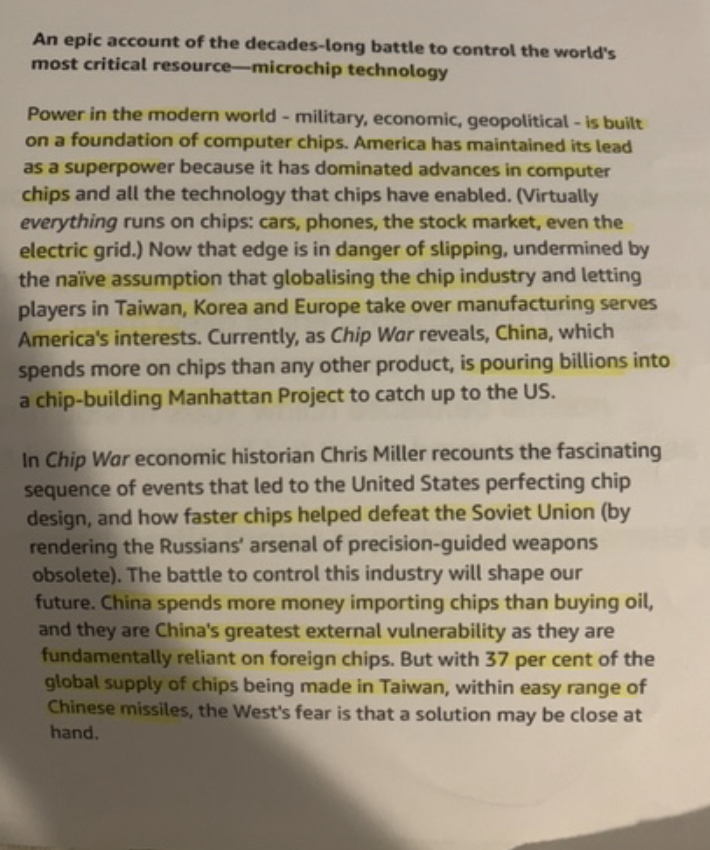
Taiwan tension
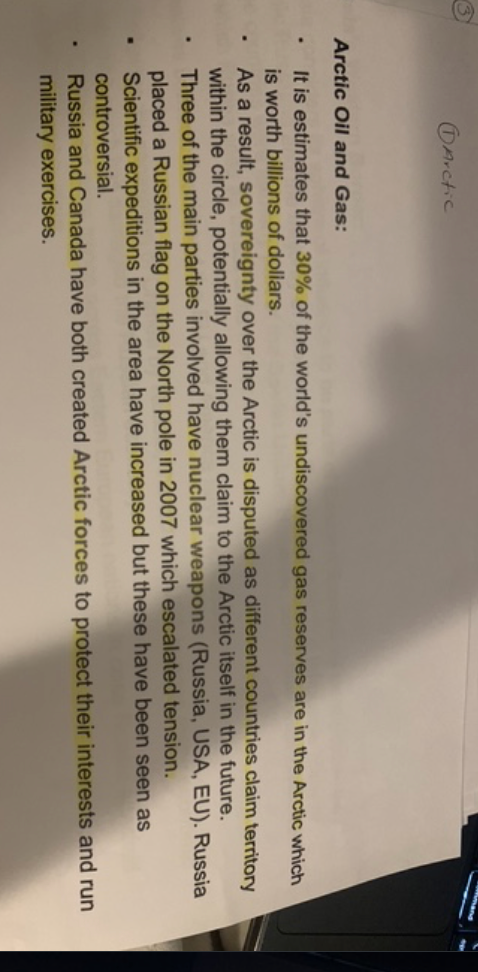
Arctic tension
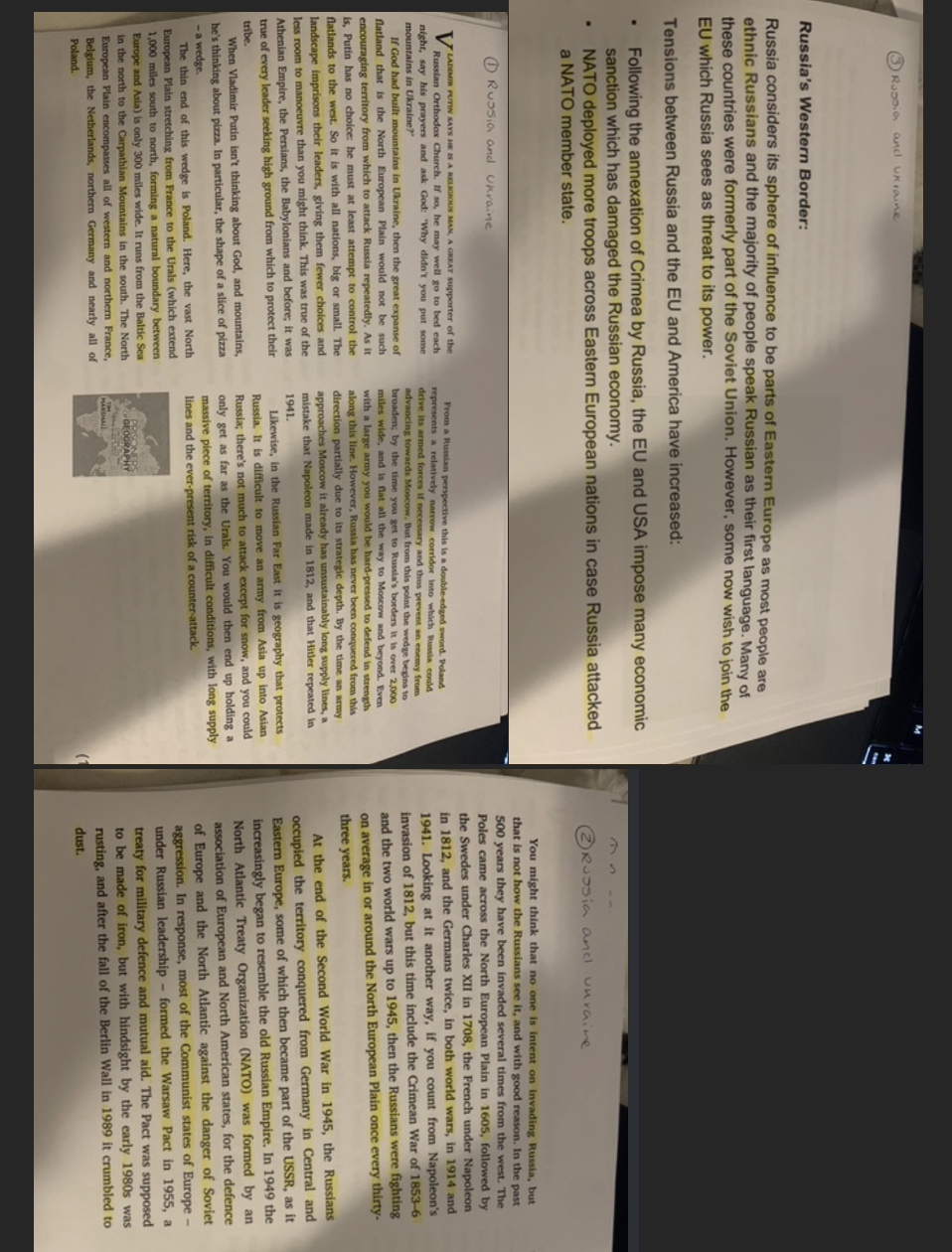
Russia and Ukraine
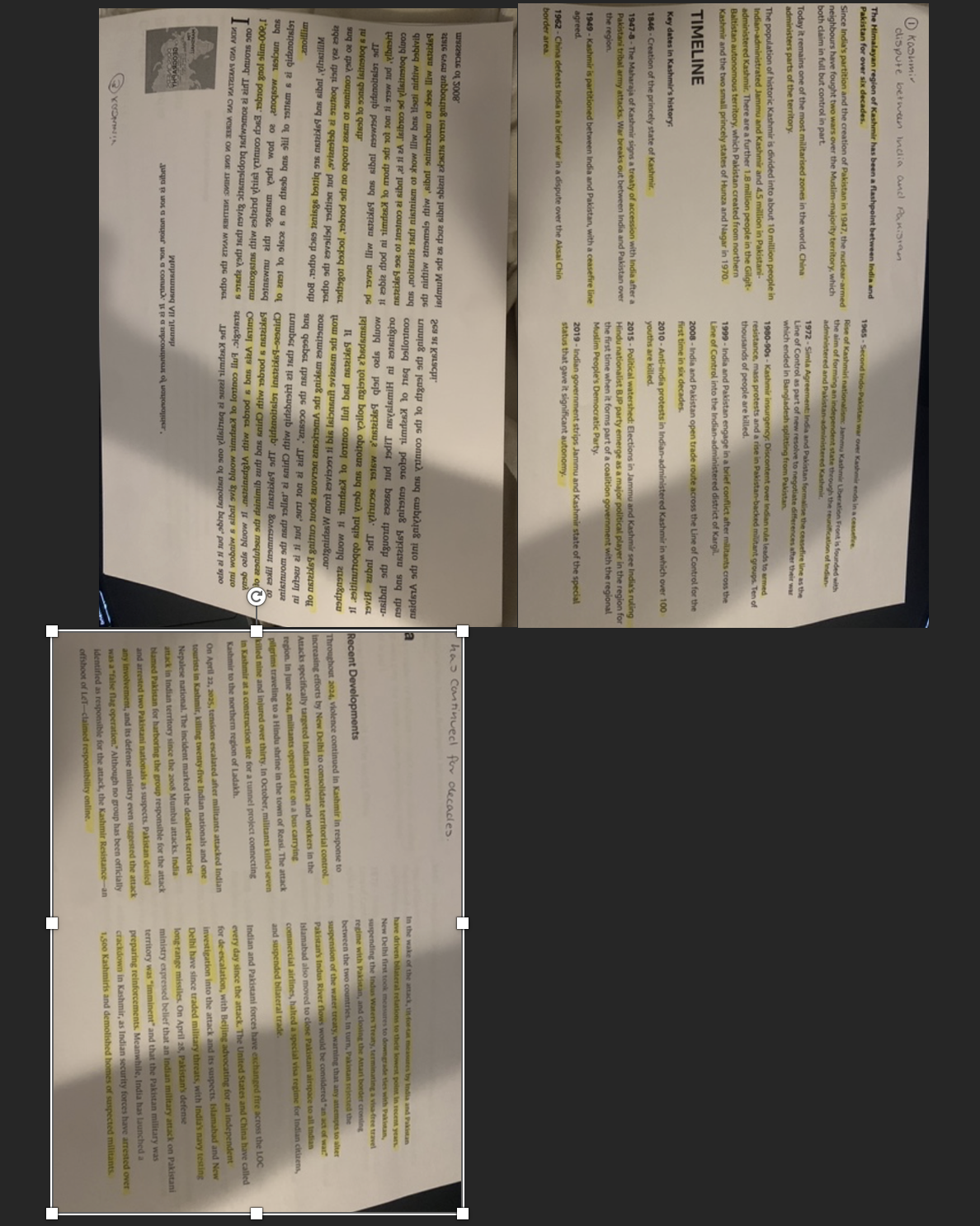
Kashmir
China and Africa
china want to expand their sphere of influence and this has created problems for the areas they are seeking
Belt + Road initiative - started in 2013. connecting Asia to Europe on the old Silk Road - Belt. the road is the Marco Polo maritime road which is the sea route that connects trade to rest of the world e.g. Africa, Australia. includes major infrastructure developments
china has seen its position in the global economy grow rapidly from 2000-today
china has experienced between 5-15% GDP growth a year or 1400% total from 2000-2024
there fore china’s trade links have grown too
Chinese imports from Africa are mostly mineral products (79%) and metals (10%)
Chinese exports to Africa are mostly machinery/electrical (29%) and textiles (18%) and transport (14%)
by 2015 China had become Africa’s largest trading partner which has led to US$60billion in FDI to boost developments
trained 40,000 personnel
environmental impacts like leaking oil from boats, pollution, land degradation, carbon footprint, timber exports, open cast mining
reasons for conflict
youth - high rates of unemployment
religion - divisions between Shia Iran and Sunni Iraq. tensions caused by Islamist uprisings
oil and gas - past conflicts resulted in economic damage to oil installations. western interests are defending oil reserves in Saudi Arabia
governance - conflict between USA who support Israel and the muslim Middle East in opposition to the separation of Israel Palestine. the Taliban in Afghanistan
resources - Israel need/rely on water from other countries like Turkey
history - Cold War, Afghanistan hiding Islamist militant groups responsible for 9/11, invasion of Iraq
Middle East - Cold War explained
proxy warfare between Saudi Arabia and Iran
oil in Saudi Arabia discovered in 1939 led to alliance with the USA but Iran was effected by other conflict/invasions
Iranian revolution in 1979 began tension with Saudi Arabia
Iran was carrying out projects to take charge of Middle East countries
Iran helped Iraq to fight Saudi Arabia
Mecca and Medina located in Saudi Arabia
usa invaded iraq in 2003
Arab spring fight for democracy
Afghanistan
considered the graveyard of empires as it was a buffer between British India and the Russian Empires
communist government tried to bring controversial reforms e.g. universal education
the soviet-afghan war was a deadly disaster lasting a decade. USA provided arms to Mujahideen as part of proxy battle in Cold War
a 1978 communist coup led to political upheaval which led to a civil war
with the collapse of the USSR, the afghan government could not keep fighting the Mujahideen which went on to become the Taliban
alternative superpower futures
US hegemony - Us dominance, economic and military alliances continue in a unipolar world. China faces an economic crisis, similar to Japan’s in the early 1990s, and ceases to grow rapidly
regional mosaic - emerging powers continue to grow while the EU and USA decline in relative terms, creating a multi-polar world of broadly equal powers with regional but not global influence
new Cold War - china rises to become equal to the USA and many nations align themselves with one or the other, creating a bipolar world
Asian century - economic, social and political problems reduce the power of the EU and USA; economic and political power shifts to the emerging powers in Asia, led by China
 Note
Note  Flashcards (86)