Neurological System
 Studied by 15 people
 Call Kai
 Learn
Learn Practice Test
 Spaced Repetition
 Match
Match Flashcards
 Knowt Play
1/3

There's no tags or description
Looks like no tags are added yet.
Name | Mastery | Learn | Test | Matching | Spaced | Call with Kai |
|---|
No study sessions yet.
4 Terms
Cerebellar Function
Balance Tests:
Romberg Test: patient stands with eyes closed and balances on one foot for 5 seconds - negative Romberg test, patient maintains posture without swaying.
Gait: have patient walk normally, eyes closed, heel-to-toe, and heel-to-toe backwards - gait is smooth, rhythmic, and coordinated.
Coordination and Skill Movements:
Rapid Alternating Movements: flip hands on thighs, increase speed - rapid alternating movements are smooth and coordinated.
Finger-to-Finger: patient touch each finger with thumb and back.
Finger-to-Nose: patient touch your finger then their nose / arms out wide and eyes closed: touch nose with alternating hands - finger-to-finger/nose test accurate and coordinated.
Heel-to-Shin: run heel of foot up and down opposite shin - heel-to-shin test smooth and accurate.
Sensory System
Spinothalamic Tract:
Pain: use disposable pin and have patient point and say sharp or dull - pain sensation intact and symmetric.
Light Touch: use cotton wisp and have patient point - light touch sensation intact and symmetric.
Posterior Column Tract:
Vibration: Strike tuning fork and place on big toe/bony joints, ask when does it stop - vibration sense intact.
Position: Raise toe/finger up or down and ask them to identify it - position sense intact.
Tactile Discrimination:
Stereognosis: place familiar object in hand and ask to identify - stereognosis intact.
Graphesthesia: draw number on palm and ask to identify - graphestesia intact.
Two-Point Discrimination: use paperclip to deetermine minimal distance they perceive two points - two-point discrimination within normal limits.
Extinction: touch both sides of body simultaneously - no extinction, patient feels bilateral stimuli.
Point Location: patient pointing to where they were touched (will happen during other tests) - point location intact.
Neurological Recheck
LOC: assess orientation (person/place/time) and speech - patient is alert and oriented x3, speech is clear and unbroken.
Motor Function: have patient squeeze both hands, have patient push their foot down (gas pedal) while resisting with your hand - motor function intact and streng is equal bilaterally.
Pupillary Response: shine light in each eye - pupils equal, round, and reactive to light.
Vital Signs: assess BP, HR, RR, T, SpO2.
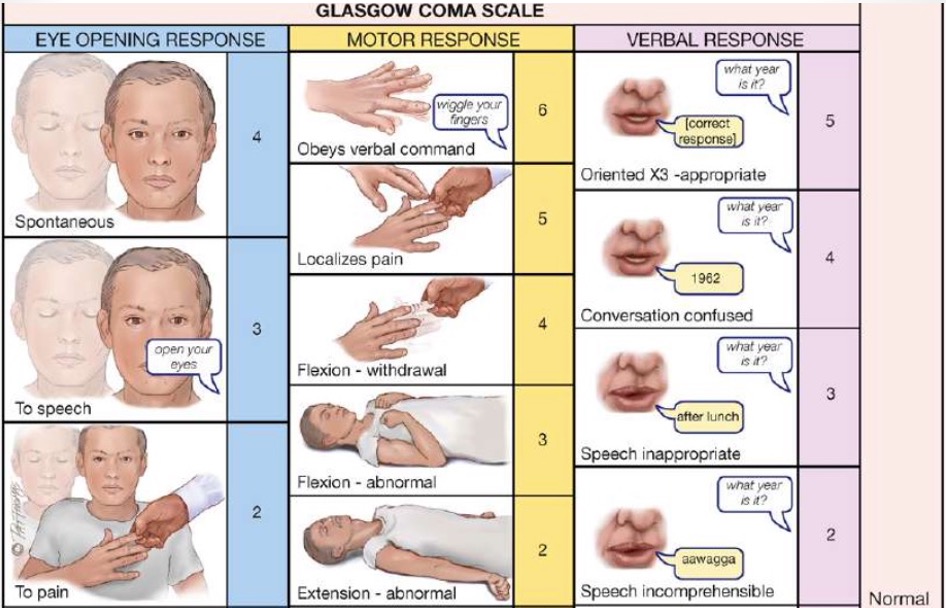
Glasgow Coma Scale (GCS): score out of 15 - GCS 15/15.
BLANK
 Note
Note  Flashcards (20)