EARTH SCIENCE FINALS
 Studied by 0 people
 Call Kai
 Learn
Learn Practice Test
 Spaced Repetition
 Match
Match Flashcards
 Knowt Play
1/64

There's no tags or description
Looks like no tags are added yet.
Name | Mastery | Learn | Test | Matching | Spaced |
|---|
No study sessions yet.
65 Terms
Virginia’s Blue Ridge Mountains were once among the tallest in the world, similar in altitude to the Himalayas of today. This would still be the case if not for the process of
Weathering
When the Atlantic Ocean opened during the middle Mesozoic era around 144 million years ago, the differences between the species living on opposite shores gradually _____________. The greater the distance, the _____________ the number of characteristics in common. Plate activity resulting in continental drift forced diversification of life.
increased; smaller
Crustal plate movement occurs because the earth's mantle flows in connection currents as a result of uneven heating inside the mantle. The heat causes the mantle rock to become less dense and rise towards the surface. As the rock moves towards the surface, it cools and becomes denser, causing it to sink back down towards the core. This process occurs because of the energy generated by _________________ within the Earth.
radioactive decay of elements
Destructive waves erode the coastline in a number of ways. Identify the term that describes when acids contained in sea water dissolves some types of rock such as chalk or limestone.
Solution
When sunlight reaches the Earth’s surface, the world’s oceans absorb some of this energy and store it as heat. This heat is initially absorbed at the surface, but some of it eventually spreads to deeper waters. Currents also move this heat around the world. Water has a much higher heat capacity than air, meaning the oceans can absorb larger amounts of heat energy with only a slight increase in temperature compared to the solid parts of the Earth system. The total amount of heat stored by the oceans is called ocean heat content, and measurements of water temperature reflect the amount of heat in the water at a particular time and location. Ocean temperature plays an important role in the Earth’s climate system. Explain how this slow but consistent rise in the ocean heat content seen above will influence Earth's climate.
Ocean heat content influences the ocean surface temperature. Heat from ocean surface waters provides the energy for storms and thereby influences weather patterns on Earth.
A model of carbon cycling through the geosphere and atmosphere is shown here. Which reservoir of carbon is quickly being mobilized as carbon in the atmosphere?
Oil and gas reserves are being combusted and released as carbon dioxide.
Land degradation is a major issue worldwide and poses a threat to the sustainability of agriculture and economic development of many third world countries. Which statement best describes the major cause of land degradation in these countries?
water erosion caused by rain and runoff in semi-arid regions
Why is recycling aluminum cans beneficial?
Recycling reduces the need to mine more aluminum and helps conserve this mineral.
Without the sun, life on earth would not exist. There would be no warmth, no plants, no animals, no night and day. To power itself, the sun is constantly generating a nuclear reaction in its core, in which hydrogen nuclei are combined to form helium. This process is known as __________.
Fusion
____________ is the variety of life on Earth, on both the species and genetic levels.
Biodiversity
Look at the conditions below. inside stars matter to energy high temperatures strong gravitational attraction The conditions listed above would be just right for several things to occur. Which is NOT one of those things?
Nuclear fission
Which evidence supports the theory that tectonic activity was high around 250 million years ago?
Atlantic rifting begins as tectonic plates move apart forming a deeper Atlantic basin during the late Permian.
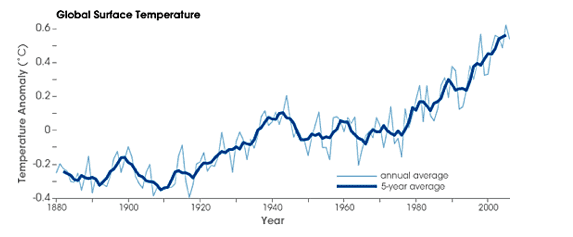
Temperature anomaly is defined as the deviation of the global mean surface temperature from that for the base period. In this case, the base period is the mean global temperature for 1914-1918 (above) and 2014-2018 (below). Since the turn of the 20th century, the average global surface temperature has risen about 2 degrees Fahrenheit. This warming has been driven, in large part, by increased emissions into the atmosphere of carbon dioxide and other greenhouse gases caused by human activities. Warming trends are strongest in the Arctic region, where 2018 saw the continued loss of sea ice as well as mass loss from the Greenland and Antarctic ice sheets. Which is NOT a way this warming trend will impact global climate?
decreased likelihood of future El Nino events.
Ocean acidification impacts ocean species to varying degrees. While most of the impacts are negative when considering ocean acidification, there can be positive impacts as well. Which of these COULD be a POSITIVE impact of ocean acidification?
Photosynthetic algae and seagrasses may benefit from higher CO2 conditions in the ocean for increased photosynthesis.
A section of farm land is shown above. The most likely use for the trees shown bordering the crop field would be
wind breaks to prevent soil erosion.
Different regions have access to different renewable or nonrenewable natural resources such as freshwater, fossil fuels, fertile soil, or timber based on their geographic location and past geologic processes. Access contributes to a place’s economic development, political relationships, and culture. For example, the Great Plains region of the U.S. is known for its abundance of fertile soil and adequate water supply and, as a result of the availability of these resources, its main industry is agriculture. What about the rest of the U.S.? What is/are the limiting resource(s) that prevents the southwestern states from becoming agricultural states? Responses
Poor soil, lack of water
Johannes Kepler (1571 – 1630) published a number of astronomical papers with detailed descriptions of the motions of the planets in three laws we still use today. Kepler's 1st Law: The path of each planet around the sun is an ellipse with the sun at one focus. Kepler's 2nd Law states: As a planet moves in its orbit, a line from the sun to the planet sweeps out equal areas in equal times. And finally, the 3rd Law: The ratio of the squares of the periods of any two planets revolving around the sun is equal to the ratio of the cubes of their average distance from the sun. Consider the model depicting orbital motion. Each colored wedge represents the same time interval. According to this, what conclusions can you draw about the movement of any planet? Select ALL that can apply.
An orbiting body travels faster as it gets closer to the central massive body.
Planets follow an elliptical orbit, meaning that the planet to Sun distance is constantly changing.
In August 2016, researchers found what appear to be fossilised microbes dating back 3.7 billion years. These fossils do not approach the age of Earth, which is estimated to be 4.5 billion years old. Much of what scientists know about the early Earth come from several sources. Choose ALL that apply.
-Meteorites that date from the beginning of the solar system.
-Lunar rocks, which represent the early days of the Earth-Moon system and date back 4.5 billion years.
-Zircon crystals, the oldest materials found on Earth, which show that the age of the earliest crust at 4.4 billion years old.
Over the last ninety years, scientists have added to the body of evidence supporting the Big Bang Theory: that the universe expanded from a single point and continues to expand. What astronomical evidence may be cited to support this theory? Choose ALL that apply.
-Dr. Edwin Hubble studied many spiral nebulae and discovered that the nebulae are moving away from the Milky Way at a rapid pace.
-The concept of nucleosynthesis allows astronomers to measure the ratios of hydrogen, helium and other trace elements. They match what they expected to find if the entire Universe was once a really big star.
-Cepheids are a special type of variable star with very stable and predictable brightness variations. Using the Hubble telescope, cepheids can be used as a measure for the scale of the Universe and the distance between objects.
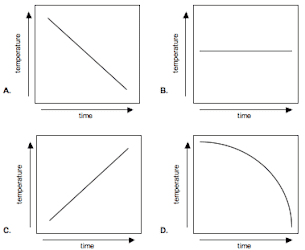
The rain forests of the world trap a large amount of carbon dioxide, a greenhouse gas. Every year, however, more rain forest is cut down and burned, releasing huge amounts of carbon dioxide. Which graph BEST shows the likely effect on climate?
C
In 1910, President Taft created Glacier National Park. This is an area of greater than one million acres. In 1910, an estimated 150 glaciers were present in the national park. Within the recent five years, that number has decreased to fewer than thirty glaciers remaining. What would be a climate impact of these melting glaciers?
Precipitation levels could increase, as there is more liquid water and water vapor due to rising global temperatures and melting glaciers.
Climate prediction is similar to numerical weather prediction, but the forecasts are for longer periods. Special numerical models are used to alter trace atmospheric gases (carbon dioxide and methane, for example), sea ice and glacier cover, changes in incoming solar radiation, and a host of other indicators. According to the 2018 Arctic Report Card, the Arctic is now warming at more than twice the rate of the global average temperature. This enhanced warming is known as Arctic Amplification, and it is caused by several feedback loops, including less snow and ice cover, warmer oceans releasing heat into the atmosphere, and increasing winter cloudiness. Trace the occurrences that result from increased Arctic temperatures to less snow and ice cover.
increased Arctic temperatures - less snow and ice cover - less solar radiation reflected, more absorbed - average temperatures continue to rise.
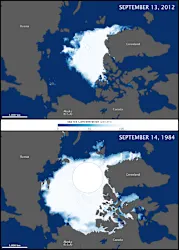
Arctic sea ice grows through the winter each year and melts through the summer, typically reaching its minimum extent sometime in September. The extent can vary considerably from year to year, sometimes above the long-term average and sometimes below. Extent is defined as the total area in which the ice concentration is at least 15 percent. What can be inferred about the two images?
Arctic ice has melted due to greenhouse gases concentration and soot deposited onto the ice.
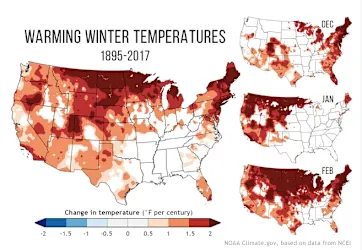
I. Increased rainfall II. Drop in annual snowfall III. Fewer days with below-freezing lows IV. Shorter winter season, earlier spring The large map at left shows average temperature change during winter (December-February) from 1895-2017. The smaller column of maps at right shows individual monthly averages over the same time period. If we take into consideration the data collected for more than a century, what prediction could we make about the future climate in the US? Choose all that apply.
I, II, III, IV
It is projected that an increase in carbon dioxide levels in the atmosphere will MOST LIKELY lead to
higher-than-average sea levels.
On Earth, human activities are causing global warming. Over the last century, the burning of fossil fuels in the forms of coal and oil has increased the concentration of atmospheric carbon dioxide. To a smaller extent, clearing land for agriculture, industry, and other human activities have increased concentrations of greenhouse gases. Review the data in the chart and predict three likely results of global warming. (choose 3)
-The oceans will warm and partially melt glaciers and other ice, increasing sea level.
-Warmer conditions will probably lead to more evaporation and precipitation overall.
-Higher temperatures and shifting climate patterns may alter the makeup of ecological communities.
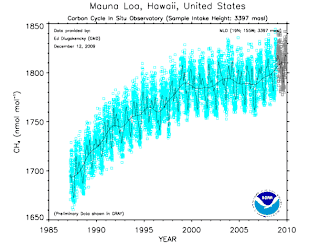
The graph illustrates the trend in methane levels in the atmosphere over the course of the twenty-five years. One of the impacts of global warming trends due to climate change is the melting of permafrost. This exposes organic material that has been covered in ice for hundreds and possibly thousands of years. This organic material will begin to decay, releasing more methane into the atmosphere. According to this model, what phenomenon is occurring and what trend will develop?
Average global temperatures will continue to grow warmer, as the methane levels generate a positive feedback loop.
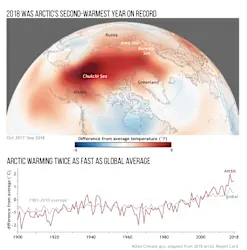
Climate prediction is similar to weather prediction, but the forecasts are for longer periods. Special numerical models are used to track atmospheric gases, sea ice and glacier cover, changes in incoming solar radiation, and a host of other indicators. According to the 2018 Arctic Report Card, the Arctic is now warming at more than twice the rate of the global average temperature. This enhanced warming is known as Arctic Amplification, and it is caused by several feedback loops. Why are temperatures warming faster in the Arctic than the rest of the world? Choose ALL the events that contribute to Arctic amplification.
-Less solar radiation is reflected.
-Losing sea ice reduces the Earth’s albedo.
-Open ocean surfaces absorb more solar radiation
Due to anthropogenic sources, CO2 is increasing the acidity of the oceans. All of the following are negative consequences of ocean acidification EXCEPT:
Lobsters grow thicker shells that make them more resistant to predators in increasing ocean acidification.
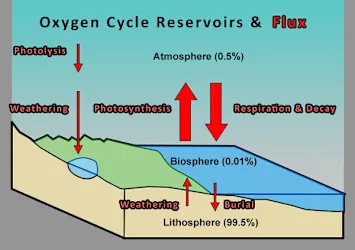
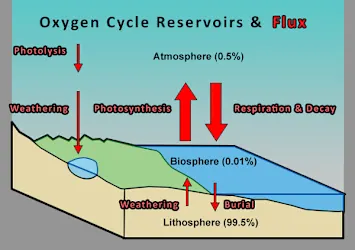
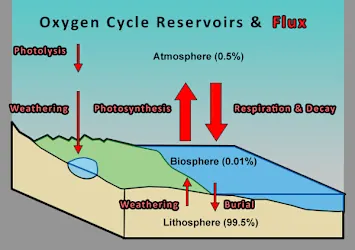
The model represents the oxygen cycle on Earth. If widespread habitat destruction and urbanization continues, how might we expect this model to change, as represented by flux?
Both the biosphere and atmosphere levels of oxygen would decrease.
The team reviewed the historical record of severe freeze impacts on the Florida citrus industry. Using pre-1900 and present-day land cover data, they created a series of paired comparisons of the modeled weather at the time of three damaging freezes: December 26, 1983, December 25, 1989, and January 19, 1997. According to their model results, the southward creep of the winter freeze line appeared to be the direct result of moving the farms farther south. The model indicated that areas where wetlands had been converted to agriculture experienced nighttime temperatures that were as much as 2 degrees Celsius colder than they would have been in the past. Two degrees can be the difference between a light freeze and devastating one. In all three cases, not only were the temperatures colder in the converted areas, but they stayed below zero for longer periods. Their research shows that the land itself exerts a primary influence on the climate we experience. And it is human interaction with that land that is impacting local climate change. The researchers concluded that newly developed agricultural lands in southern Florida experienced nighttime temperatures that were as much as 2 degrees Celsius colder than they would have been in the past on undeveloped land. How did the scientists reach this conclusion?
The team reviewed the historical record of severe freeze impacts on the Florida citrus industry. They then created a series of paired comparisons of the modeled weather at the time of three damaging freezes.
Scientists have noted a decline in the number of mushroom species dating back to the early 1900s. Annual crops of edible mushrooms in France and Germany have declined since 1950. One hypothesis explaining the decline is that edible fungi are being overharvested. Global warming and air pollution have also been considered as part of the problem. Researchers have also determined that the amount of edible fungi harvested tripled from 1900 to 1950. This last piece of evidence bolsters which hypothesis?
Overharvesting may be the reason for the decline in fungi.
According to the graphs, by what factor will the ocean's acidity change from 2005 to 2100?
1.6
In a local lake, the black bass was over fished one year. The following year, there was a industrial pollution incident that killed off another large portion of the black bass. This led to the demise of black bass in this lake. As a result of human activities, what happen to the other fish species in the lake after the demise of the black bass?
numbers increased when competition decreased
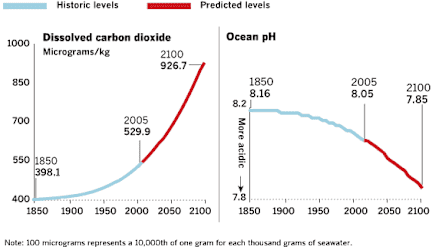
Human activity has had a significant impact on the carbon cycle. Although we think of carbon emissions having an impact on the atmosphere, carbon emissions also impact Earth's oceans. The combustion of fossil fuels and land use changes have increased the flux of CO2 into the atmosphere. As noted in the graphs, the increases of CO2 in the atmosphere results in some of the excess being stored in the ocean, causing the pH of the ocean to decrease. Review the choices and check each one that describes an effect of ocean acidification.
-Oceanic and coastal food webs will be disrupted.
-There is a great risk to human societies that rely on fishing as a source of food and income.
-Marine calcifying organisms will not be able to form shells and skeletons, and existing shells become vulnerable to dissolution.
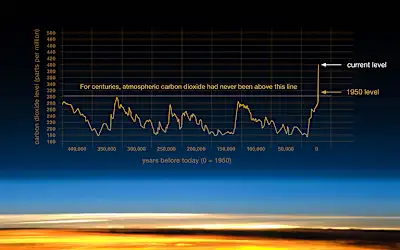
The Earth's climate has changed throughout history. In the last 650,000 years there have been seven cycles of glacial advance and retreat, most of which are attributed to very small variations in Earth’s orbit that change the amount of solar energy our planet receives. The current warming trend is of particular significance because most of it is extremely likely to be the result of recent human activity and is proceeding at a rate that is unprecedented over decades to millennia. Human (anthropogenic) impact on the environment includes changes to biophysical environments and ecosystems, biodiversity, and natural resources caused directly or indirectly by humans. Which of these human impacts most likely caused the greatest change in atmospheric CO2 levels, leading to increased global warming and climate change?
Overconsumption of resources
As human population has grown globally, so has the increased dependence on agriculture for food. Agricultural practices have had a significant impact on the environment. The environmental impact of agriculture involves a variety of factors from the soil, to water, the air, animal and soil diversity, plants, and the food itself. Which of these agricultural practices has most likely had the least adverse affect on the environment?
regulation of the introduction of invasive species
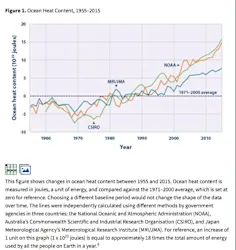
Increasing greenhouse gas concentrations are trapping more energy from the sun. Because changes in ocean systems occur over centuries, the oceans have not yet warmed as much as the atmosphere, even though they have absorbed more than 90% of the Earth’s extra heat since 1955. If not for the large heat-storage capacity of the oceans, the atmosphere would warm more rapidly. The total amount of heat stored by the oceans is called ocean heat content and measurements of water temperature reflect the amount of heat in the water at a particular time and location. Because Earth's systems are intertwined, the increase in the ocean heat content results in changes in other systems. Predict which is not an outcome of a rising ocean heat content?
The annual death rate is higher for deaths in which heat was reported as a contributing factor, including the interaction of heat and cardiovascular disease.
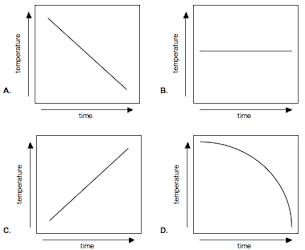
The effect of carbon dioxide on the atmospheric temperature is BEST shown by graph
C
Acid rain includes HNO3 and what other chemical?
H2SO4
Which natural disaster actually increases biodiversity over the long term?
Fire
Most organisms benefit from trees because they produce what as a result of photosynthesis? Responses
Oxygen
Which continent experiences the most problems with access to clean, safe water?
Africa
Most water is used for irrigation and crop. What is one way to help conserve water in relation to agriculture?
Better irrigation techniques
About 80% of waste water in undeveloped nations ends up in
Local rivers and lakes
Which of these events has led to the largest changes in worldwide sea levels?
Glaciation
Peat is accumulated dead and decaying organic matter, often found in high quantities in bogs and wetlands. These areas are being affected by climate change, as levels of evaporation are increasing. The evaporation of water exposes additional peat, which then further decomposes. The release of methane occurs from this decomposition, which is released into the atmosphere. What type of feedback is being exemplified by this global system?
This is a positive feedback loop, as stored carbon is converted to methane, which acts as a greenhouse gas, trapping more heat and increasing more global temperatures.
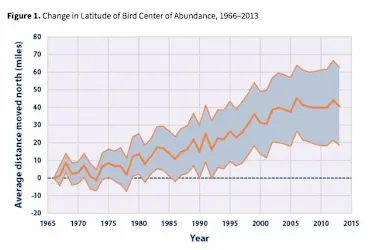
Changes in climate influence ecosystems by altering animal behavior and ranges. Birds are a particularly good indicator of environmental change for several reasons: they are easy to count, each species has adapted to a certain habitat type, food source, and temperature range, and scientists believe that If a change in behavior or range occurs across a range of bird types, it suggests that a common external factor might be the cause. The graphic model illustrates the annual change in latitude of bird center of abundance for 305 bird species in North America from 1966 to 2013. The center of abundance is a point on the map that represents the middle of each species’ distribution. If a whole population of birds were to shift generally northward, one would see the center of abundance shift northward as well. Consider the data recorded and displayed above. Construct a correlation between the data you see here and climate in North America.
The trend in the center of abundance moving northward can be related to rising average winter temperatures in North America.
In a typical system without human influence, as the surface of the Earth warms, it will emit greater amounts of infrared radiation back into space. This is a phenomenon known as Planck feedback. In the absence of anthropogenic influence, this system would be classified as what?
This is a negative feedback loop, as the warming of the Earth's surface causes greater infrared radiation to be emitted into space, which decreases the greenhouse effect.
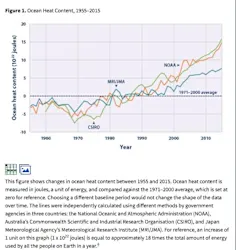
When sunlight reaches the Earth’s surface, the world’s oceans absorb some of this energy and store it as heat. This heat is initially absorbed at the surface, but some of it eventually spreads to deeper waters. Currents also move this heat around the world. Water has a much higher heat capacity than air, meaning the oceans can absorb larger amounts of heat energy with only a slight increase in temperature compared to the solid parts of the Earth system. The total amount of heat stored by the oceans is called ocean heat content, and measurements of water temperature reflect the amount of heat in the water at a particular time and location. Ocean temperature plays an important role in the Earth’s climate system. Explain how this slow but consistent rise in the ocean heat content seen above will influence Earth's climate.
Ocean heat content influences the ocean surface temperature. Heat from ocean surface waters provides the energy for storms and thereby influences weather patterns on Earth.
Water vapor is classified as a greenhouse gas, with an even greater ability to convert outgoing infrared radiation into thermal energy. However, water vapor cycles quickly through the hydrologic cycle, so it is not ranked as high on the list of concerning molecules leading to global climate change. Since global temperatures are increasing, this will result in more water vapor in the atmosphere. Since water vapor and carbon dioxide levels are both increasing, what would this phenomenon be classified as?
This is a positive feedback loop, as more water vapor will lead to increasing temperatures, which will cause higher evaporation rates.
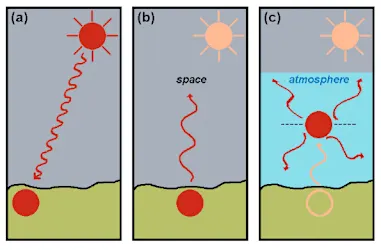
A balance between incoming and outgoing radiation produces a stable climate. Lack of a balance between incoming and outgoing radiation results in a net loss or gain of radiant energy to the system. This energy imbalance is expressed as climate change. Explain the steps in this system of energy input and output? Responses
Solar radiation reaching the Earth system and being absorbed, thermal radiation emitted by the Earth system.
Climate change is a cyclical event in the history of the Earth. In recent years, increased greenhouse gases in the atmosphere have accelerated the rate of climate change across the globe. Different areas may be impacted with different effects. Predict the effect on the Arctic tundra biome as greenhouse emissions increase.
Increased greenhouse gases will increase the overall average temperature of the region, resulting in the melting of the polar ice. This will decrease the access that humans have to navigate the area.
Changes sea level by 100 meters Exposure of continental shelf Changes in continental shelf composition Mass extinctions of species in certain areas Changes in water cycle Changes in landscape Changes in topsoil characteristics These periodic changes on Earth are a result of the five major _________________ that have occurred throughout Earth's history. Responses
Ice ages
Volcanic eruptions, changes in Earth's orbit, meteorite impact, and even the combustion of fossil fuels ALL contribute directly or indirectly to climate change by Responses
changing the amount of solar radiation that reaches Earth.
Which pollutant would probably NOT DIRECTLY harm most plants, despite having a negative impact on human populations and the environment?
carbon dioxide from automobile exhaust
The process of respiration is essential in the oxygen/carbon dioxide cycle. Respiration removes ______ from the atmosphere and produces and releases ______ to the atmosphere. Responses
oxygen, carbon dioxide
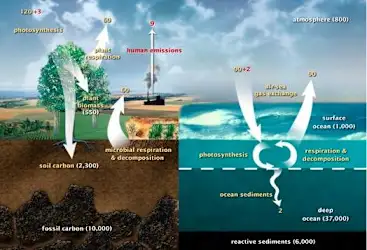
Reactive sediments deep in the oceans are circulated and brought to the surface when deep, cold ocean water rises to the surface. In this instance, the water warms and some of the dissolved CO2 from these sediments is released back to the atmosphere. What is this process called?
Upwelling
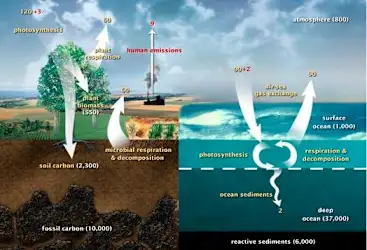
Carbon dioxide. We read about the excess of carbon dioxide in our atmosphere and how it may be influencing our climate. But the oceans currently absorb about a third of human-created CO2 emissions, about 22 million tons a day. The oceans have always been a CO2 storehouse as the illustration shows. But this huge influx of CO2 is changing the oceans. What is one change that would would expect to happen?
Adding CO2 creates carbonic acid, lowering the ocean pH.
Solar energy is utilized to convert inorganic carbon, in the form of carbon dioxide, into organic carbon compounds, such as glucose. This is part of the carbon cycle on Earth; a cycle which demonstrates the law of conservation of mass. What process is responsible for inititating this cycle? Responses
Photosynthesis
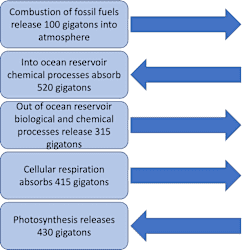
Among all Michigan tree species, the jack pine is uniquely adapted to exist and reproduce on the hottest and driest sites in Michigan. It thrives on dune sand and on the sandy glacial plains. It is called a fire species because wildfires sweep through jack pine stands, killing the trees and preparing the ground for a new stand, as well as releasing seeds from its cones. Once in a while, lightning would start a fire that would be fanned into a raging fire leaving everything behind it blackened and burned. The destruction was only temporary. Soon the jack pine seeds would fall to the ground, and, in a few weeks, the area would be green with new growth. This process was repeated every 30 to 100 years, and the jack pine continued to dominate these fire prone areas. How did the periodic jack pine wild fires impact the inputs and outputs of the carbon cycle according to this model?
The jack pine fires cause a temporary drop in both photosynthesis and respiration.
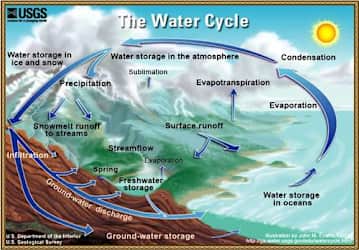
There is much interdependence among the biogeochemical cycles on Earth. Explain how warmer ocean water involved in these cycles. Responses
Atmospheric carbon dioxide, a greenhouse gas, would cause rising ocean temperatures, which will cause an increase in evaporation. The added water vapor would further increase climate change.
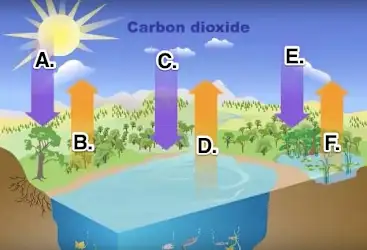
The Great Lakes ecosystem contains various types of habitats: forests, marshes, wetlands, and dune communities. These communities allow for more than 3,500 species of plants and animals to inhabit the basin. The many varieties of mammals, amphibians, reptiles, birds, and fish make the Great Lakes basin a unique and complicated ecosystem. The northern parts of the Great Lakes region are home to dense coniferous and northern hardwood forests, while largely grasslands and prairies cover the southern areas of the region. The marshes, wetlands, and dune communities are located near and along the many lake shores. Yet the Great Lakes ecosystem is in a state of change. Climatologists have determined that the climate of the Great Lakes basin will increase by 2 to 4 degrees Celsius. Warmer air temperatures affect lake levels by reducing runoff and increasing evaporation from the lake surface. Studies have shown that the predicted increase in air temperature will drop lake levels by half a meter to two meters Consider the predictions of climatologists. How will the model of the carbon cycle inputs and outputs change if they are correct?
Warmer temperatures may cause an initial increase in photosynthesis as well as cellular respiration until a point is reached where the temperatures are too hot. During this initial time, the arrows will remain reciprocal, but may enlarge.
The process of photosynthesis is essential in the oxygen/carbon dioxide cycle. Photosynthesis removes ______ from the atmosphere and produces and releases ______ into the atmosphere.
carbon dioxide, oxygen
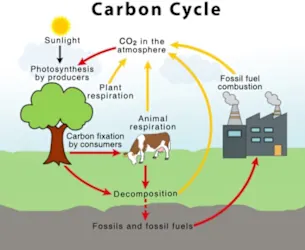
What two processes fuel the carbon cycle?
cellular respiration and photosynthesis
 Note
Note  Flashcards (21)