ISP 205 Exam 4 pt. 2
 Studied by 0 people
 Call Kai
 Learn
Learn Practice Test
 Spaced Repetition
 Match
Match Flashcards
 Knowt Play
1/51

Earn XP
Description and Tags
Astronomy Visions of the Universe chapter 15, 16, 17, 18.
Name | Mastery | Learn | Test | Matching | Spaced | Call with Kai |
|---|
No analytics yet
Send a link to your students to track their progress
52 Terms
For distant objects, how do astronomers measure speeds?
They use spectra of those objects to measure the wavelengths of emission lines
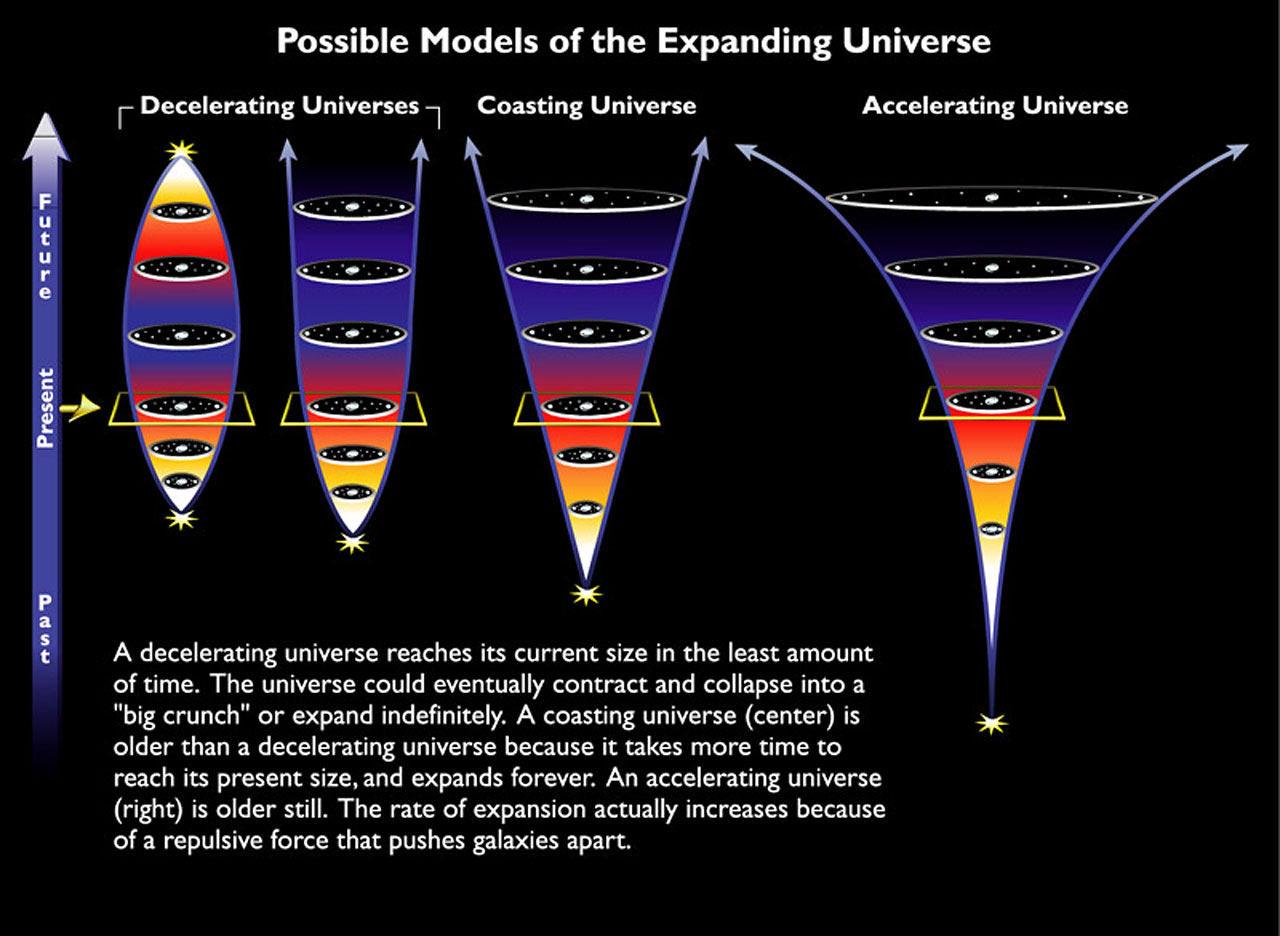
Which of the universe expansion models on the graphic implies the oldest universe?
The accelerating universe
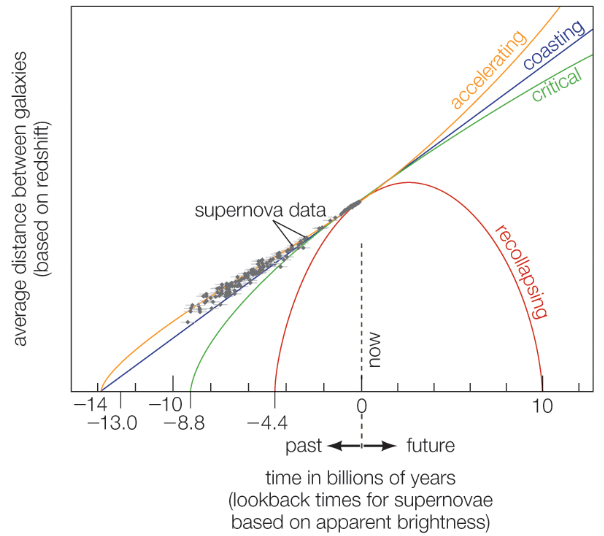
Which of the models best represents the supernova data?
The accelerating model
Which universe has the highest matter density?
Recollapsing universe
Which universe has little to matter density?
Coasting Universe
Which universe(s) has significant amounts of matter?
Critical and recollapsing Universe
Which Universe is the Youngest?
Recollapsing
Which Universe is the Oldest?
Accelerating universe
Which universe is expanding faster "now"?
all of these universes are expanding at the same rate today
what force prevents you from falling through your chair, the ground in a plunge to the center of the Earth
electromagnetic force
What keeps the Moon circling the Earth
force of gravity
What force affects neutrinos (in addition to gravity)
Weak nuclear force
What holds an atomic nucleus together
Strong nuclear force
What major event of the universe happened first?
Three fundamental forces became the four fundamental forces we have today – early universe, fractions of a second after the Big Bang.
What major event of the universe happened last?
Stars formed
What major event of the universe happened before stars formed?
Stable NEUTRAL hydrogen atoms form and persist for the first time, allowing the cosmic background radiation to stream freely through the universe.
What observation supports the Big Bang Theory?
High helium/hydrogen abundance of primordial gas and a relic radiation background that is the same in any direction we look.
Which black hole has the bigger mass M?
The one with the faster stars, but the same orbital radius (R).
Measuring the peak brightness of white dwarf supernovae light curves as standard candles
Used for distant galaxies.
Radar-bouncing light off solid surfaces
Used for planets and nearby objects
Measuring brightness and periods of Cepheid variables is used for:
Nearby galaxies and star clusters
Annual parallax angle measurement
Used for nearby stars
Lots of cold gas and dust
Spiral/disk galaxies
All of its stars are orbiting in random orientations and random directions; very little organization
Elliptical/spheroidal galaxies
Significant recent star formation
Spiral/disk galaxies
Most like the Milky Way galaxy
Spiral/disk galaxies
Most of the galaxies in the center of a cluster of galaxies
Elliptical/spheroidal galaxies
Which hypothetical universe is older, all other things about the universes being the same?
the one expanding slower
Youngest hypothetical universe
Hubble constant = 24 km/sec/million light years
Oldest hypothetical universe
Hubble constant = 20 km/sec/million light years
A protogalactic cloud most likely to form disk spiral galaxies would have what features?
low gas density, so they form stars gradually, far from other protogalaxy clouds with lots of rotation
If the Hubble Constant is 40 km/sec/million light years, what is the distance in light years of a galaxy that is moving away at 40,000 km/sec?
1000 million light years
Examples of observed evidence of a supermassive black hole in the center of the Milky Way.
The Event Horizon Telescope observed a dark circle surrounded by radio light, indicating a black hole in the Milky Way center.
Stars are orbiting a position in the center of the Milky Way at a rapid rate, but there is no star or other visible-light object at that position.
If the age of the universe is 13 billion years and the light travel distance from a distant galaxy to Earth is 9 billion light years, then what is the maximum possible age for that galaxy as we can observe it?
4 billion years
What was an observationally-based clue that the solar system was not in the center of the Milky Way Galaxy?
There are more globular clusters in the direction of the actual center of the Milky Way than in the opposite direction.
Stars are observed with:
Visible-light telescope
Hot, 10 million K halo gas is observed with:
X-ray telescope
Very cold, dense molecular gas (carbon monoxide) is observed with:
Radio Telescope
Cold, dusty gas is found in the Milky Way:
Disk
Ionized gas surrounding very blue main-sequence stars is found in the Milky Way:
Disk
Spiral arms are found in the Milk ways:
Disk
Only old stars with little to no recent star formation are found in the Milky Way:
Halo
Recently formed stars are found in the Milky Way:
Disk
Why can't we use UV telescopes to study the center of the Milky Way?
Dusty gas scatters blue light more than red light
Orbits in random directions, circling the center of the Milky Way, but confined to a few thousand light years of the center of the Milky Way.
Bulge
Spiral arms
Prominent, curved structures of gas, dust, and young stars that extend outward from the center of a spiral galaxy
Elliptical galaxies
Galaxy with a smooth, ellipsoidal or spherical shape that are primarily composed of old, red stars with very little gas, dust, or star formation
Spiral galaxies
disk-shaped galaxy with bright, swirling arms of young stars, gas, and dust rotating around a central bulge of older stars
Irregular Galaxy
Galaxy with no distinct spiral arms or central bulge, giving it a chaotic and amorphous appearance
Where are the oldest stars located in the Milky Way?
Halo
Where are the youngest stars located in the Milky Way
The spiral arms and the galactic disk
Doppler shift
The change in frequency of a wave due to the relative motion between its source and an observer
 Note
Note  Flashcards (94)