Astrophysics 13.2.1 - 13.2.5 (stars)
 Call Kai
 Learn
Learn Practice Test
 Spaced Repetition
 Match
Match Flashcards
 Knowt Play
1/33

There's no tags or description
Looks like no tags are added yet.
Name | Mastery | Learn | Test | Matching | Spaced | Call with Kai |
|---|
No analytics yet
Send a link to your students to track their progress
34 Terms
Factors of how bright a star appears in the night sky
Power output (Luminosity
How far away it is from us
Power output (Luminosity)
This means the total amount of energy emitted (in the form of EM radiation) - measured in watts
Intensity and how star emits radiation
A star doesn’t emit radiation in one direction but in all in an expanding sphere -Inner sphere will have a higher intensity per m² than the outer sphere
They produce every type of radiation but not in equal quantities
I = Power/Area -Area = 4πr²
Apparent magnitude
The brightness as viewed from earth
The more negative/Lower the value of apparent magnitude. the bright the object.
Hipparcos Scale
An apparent magnitude and logarithmic scale from 1 to 6 with 1 being brightest and 6 dimmest
As you go from 6 to 1 the brightness increases by 2.51 times each step
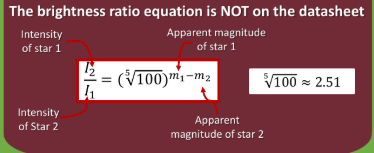
Equation to compare the brightness of two stars
Absolute magnitude
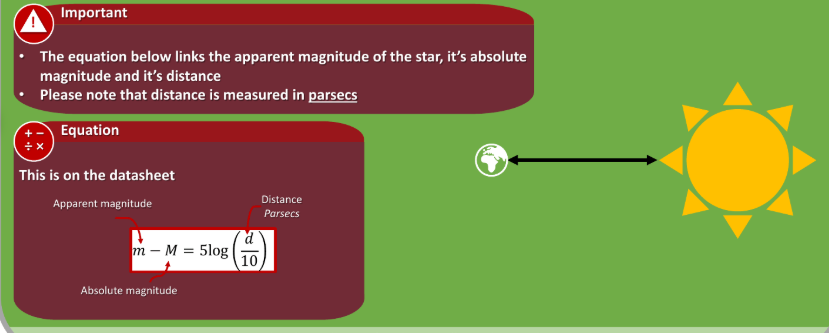
Based on how bright a star appears from 10 parsecs away (Nothing to do with distance with earth)
The more negative absolute magnitude is, the brighter the star
The equation that links absolute + apparent magnitude and distance
Type 1a supernovae
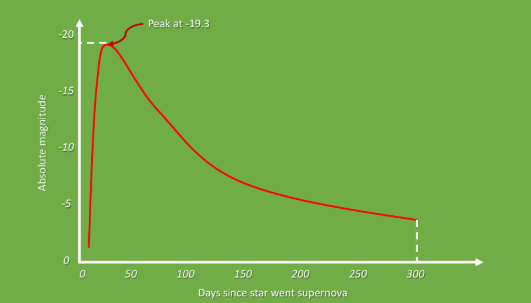
These supernovae are unique as when they explode and rapidly increase in brightness, they all have the same peak in absolute magnitude
This means combined with apparent magnitude from earth we can work out the distance to them
We call these' ‘standard candles’
Because supernovae are so bright it means we can see them from a very long way away
Allowing us to measure the distance to distant galaxies
Blackbody
An object which absorbs all types of electromagnetic radiation
Stars are therefore considered to be black bodies
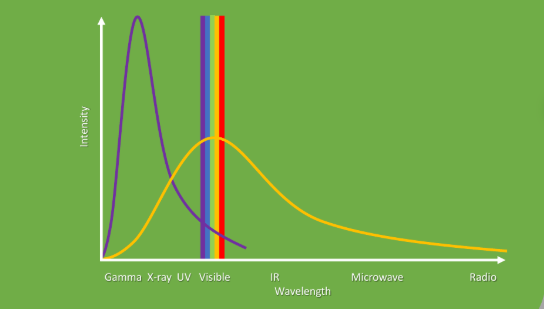
Blackbody radiation + It’s curve
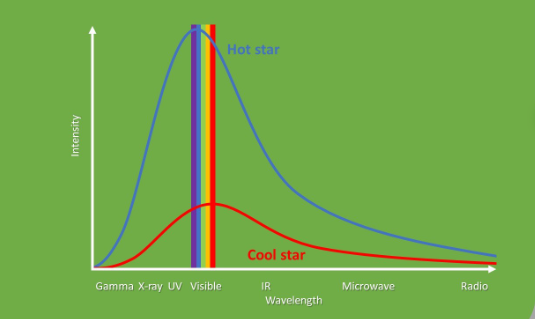
Every type of radiation (visible, radio, microwave etc)
Hotter stars produce more radiation than a cool star
They ‘peak’ at a shorter wavelength, meaning they appear bluer
Cooler stars ‘peak’ at longer wavelengths and they appear redder
Wein’s displacement law
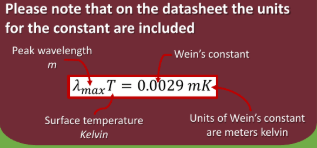
Wein’s displacement law represented on a graph with radiation types
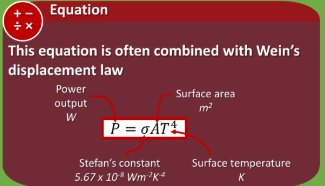
Factors of the power output of a star
Temperate of the star
Surface area of a star
Stefan’s power law
Area = 4πr²
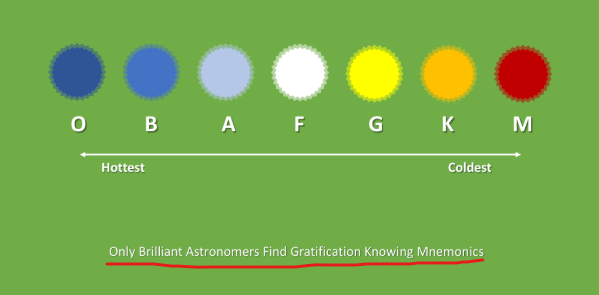
What factors determine how stars are grouped into 7 main classes?
Surface temperature (Which affects their colour) - Wein’s displacement law
Absorption spectra (Which is determined by what they are made of)
Classifying stars by absorption lines
Electrons in a gas will be able to absorb very specific energies (wavelengths) of photons) which are unique to a specific element
Stars are blackbodies which mean they produce all types of radiation - including a continuous spectrum in the visible section
But stars have an ‘atmosphere’ of cooler gases around them - these gasses in this absorb some of the photons produced
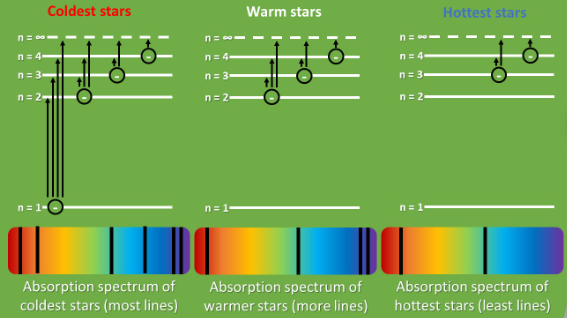
Absorption spectra is affected by temperature (hotter = more energy in electrons) - meaning they sit in higher and higher levels
Therefore there will be less photons that can be absorbed meaning there will be less absorption lines in a hotter star compared to a cooler star
Hydrogen balmer lines at n = 2 -There are no electrons in the ground state as the star is too hot
Balmer lines
The absorption lines created by electrons in hydrogen at level 2 only
There are no electrons in the ground state as the star is too hot
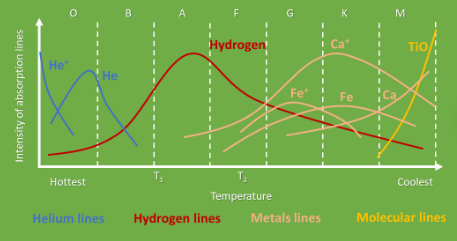
How different elements are visible depending on the temperature of the star
Hotter stars have very intense helium lines
Cooler stars will form heavy elements like metals
Coolest stars will even form molecules
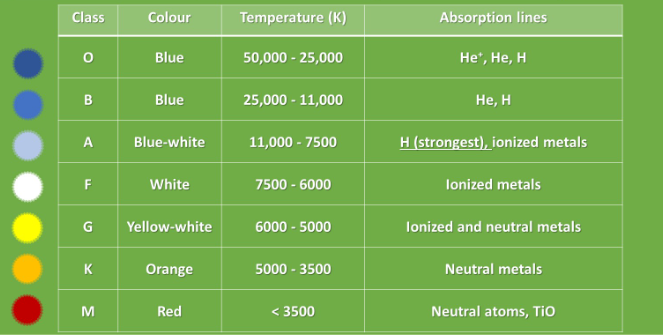
Spectral classes Table
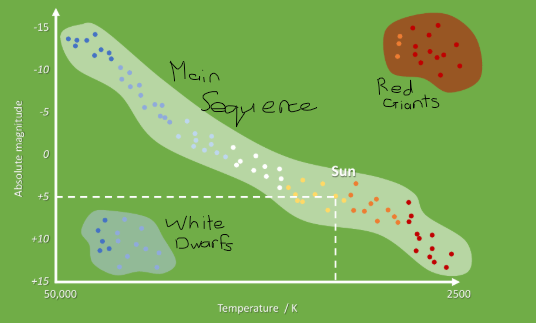
Hertzsprung-Russell diagram
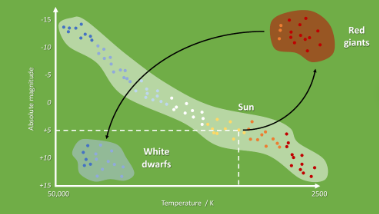
A graph of absolute magnitude vs temperature
Main sequence stars are in their long-lived stable phases when they are fusing hydrogen into helium -Ie. the sun (G class around 5700K, absolute magnitude of +5)
Red giants have large surface areas, large negative absolute magnitudes, very high power output but also very low surface temperature -Fusion reactions other than hydrogen to helium are occurring
White dwarfs have a tiny surface area, large positive absolute magnitude, low power output but also very high surface temperature -No fusion is occurring anymore -About the size of earth
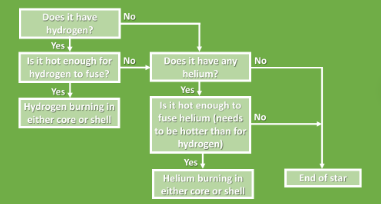
How fusion defines if a star is ‘alive’
A star is ‘alive’ when fusion is taking place
This depends on: -Do you have fuel for fusion (eg. hydrogen and helium) -Is it got enough anywhere in that star for that fuel to fuse
If conditions aren’t met fusion stops and star ‘dies’
Stellar evoluton steps
Stellar Nebula
Protostar
Main sequence star (core hydrogen burning)
Becoming a red giant
Shell hydrogen burning
Core helium burning
Shell helium burning
How electrons prevent further contraction
Planetary nebula and white dwarf
Stellar Nebula (Step 1)
Stars are born in clouds of dust + gas known as stellar nebula
Usually left from previous supernovae
Denser clumps contract (very slowly due to gravity)
Protostar (Step 2)
When these clumps get dense enough they form protostars
These continue to contract and heat up
When it reaches a few million degres hydrogen can fuse into helium
Main sequence star (core hydrogen burning - step 3)
Where the star spends most of it’s life
Pressure produced by the hydrogen fusion in the core balances out the gravitational collapse
Called Core hydrogen burning
Becoming a red giant (step 4)
When the hydrogen runs out nuclear fusion stops and so does pressure
The core contracts and heats up
Outer layers expand and cool
Star becomes a red giant
Shell hydrogen burning (step 5)
The material around the core still contains plenty of hydrogen (it just wasn’t hot enough before to fuse)
As the core contracts this heats a layer (shell) around the core, the shell gets hot enough to fuse hydrogen into hlium
Called Shell hydrogen burning
Core Helium burning (step 6)
The core continues to contract until it gets hot and dense enough to fuse helium into carbon and oxygen, known as Core helium buring
This releases a huge amount of energy which pushes the outer layers outwards
Shell helium burning (step 7)
Eventually the helium in the core runs and fusion stops
Once again the forces in the core are unbalanced causing it to contract again
This heats a layer (shell) around the core
This shell is now hot enough for the helium in it to fuse, called Shell helium burning
How electrons prevent further contraction (step 8)
In low mass stars the carbon-oxygen core won’t get hot enough for any further fusion
It contracts until it is about Earth size
At this point electrons exert enough pressure to stop it collapsing further
Planetary nebula and white dwarf (step 9)
As the core contracts the helium shell gets more and more unstable
The star pulsates and throws off outer layers into a planetary layer
Leaving behind a very hot, dense core (a white dwarf)
No more fusion is occuring
A flowchart that explains the location and type of fusion occuring
How a star like star will move around an HR diagram over its life
Explore top notes

Explore top flashcards
