PNS: ANS
 Studied by 0 people
 Call Kai
 Learn
Learn Practice Test
 Spaced Repetition
 Match
Match Flashcards
 Knowt Play
1/39

Earn XP
Description and Tags
Write the correct answer to each question.
Name | Mastery | Learn | Test | Matching | Spaced |
|---|
No study sessions yet.
40 Terms
What are the two components of the ANS?
The two components of the ANS are the sympathetic and parasympathetic nervous systems.
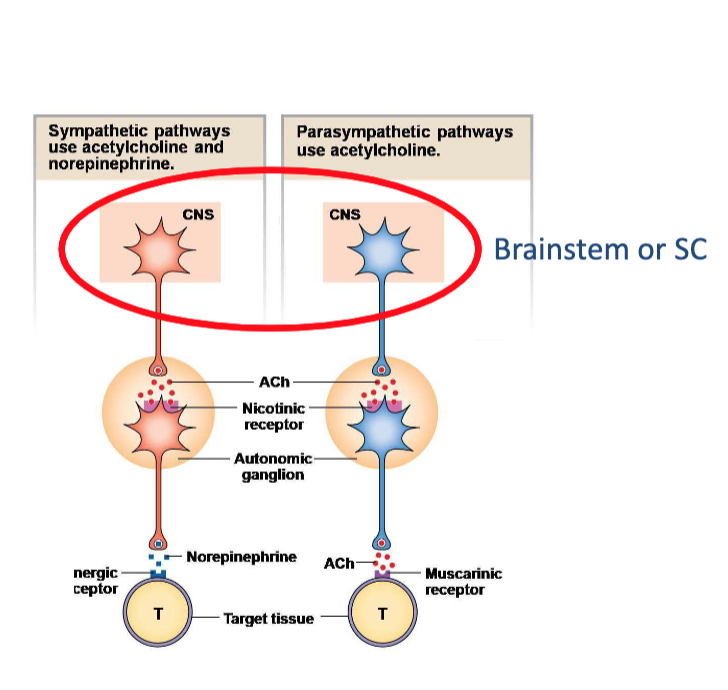
What are the types of cells circled on top in the image? Where are they located?
Preganglionic neurons; they are located in the CNS.
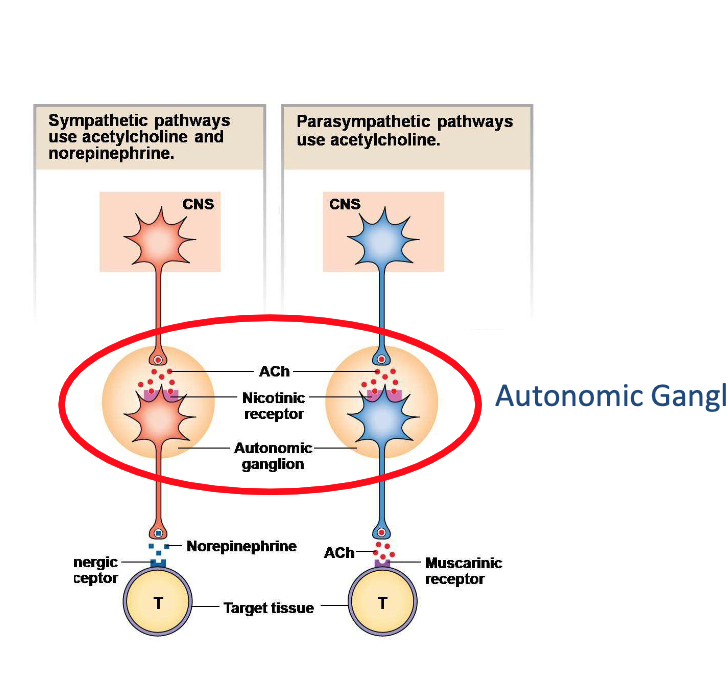
Where do the preganglionic axons project to?
They project to the autonomic ganglia between the CNS and the target tissues.
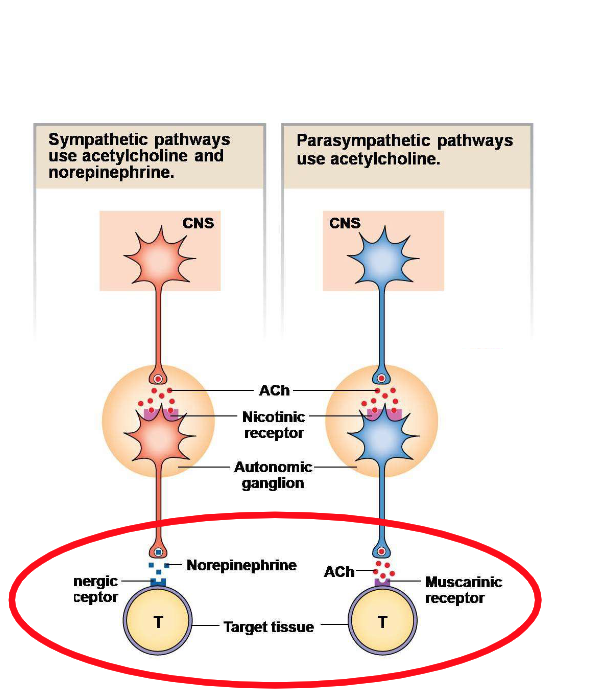
Postganglionic project to the…
target organs and tissues.
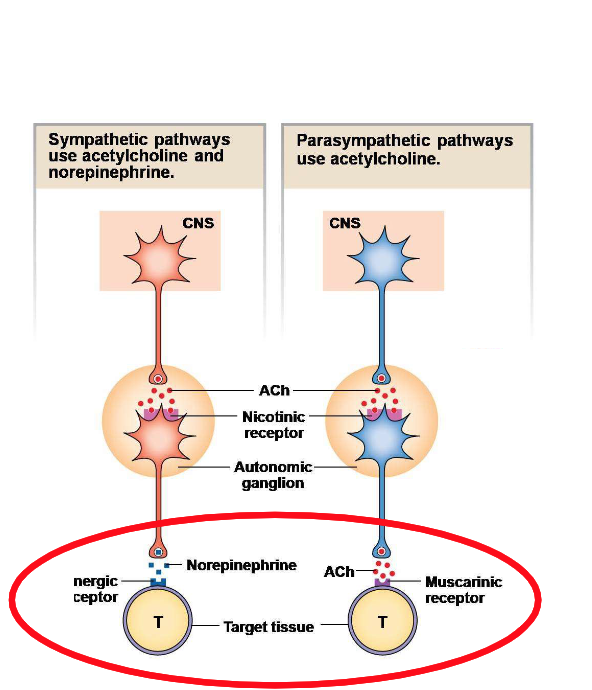
How is it that the postganglionic axons projecting to the target tissue are an act of divergence?
Divergence occurs when a single postganglionic neuron influences multiple target tissues, allowing for a widespread response throughout the body.
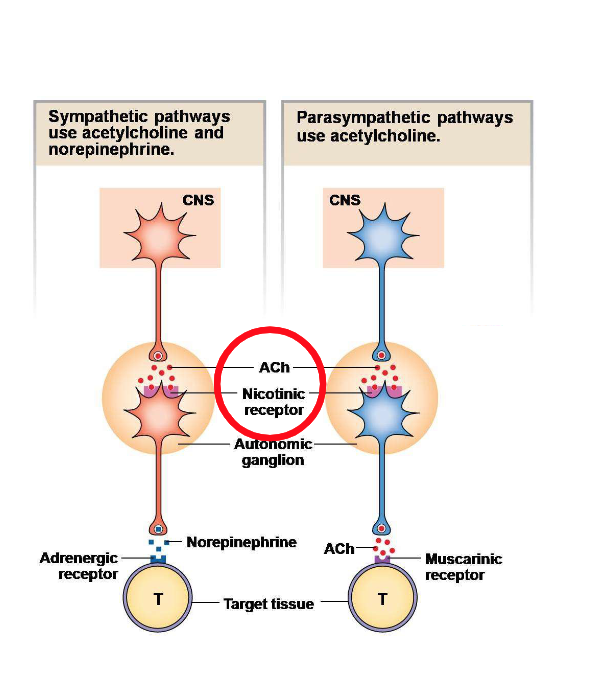
Both sympathetic and parasympathetic neurons release…
Acetylcholine onto nicotinic receptors.
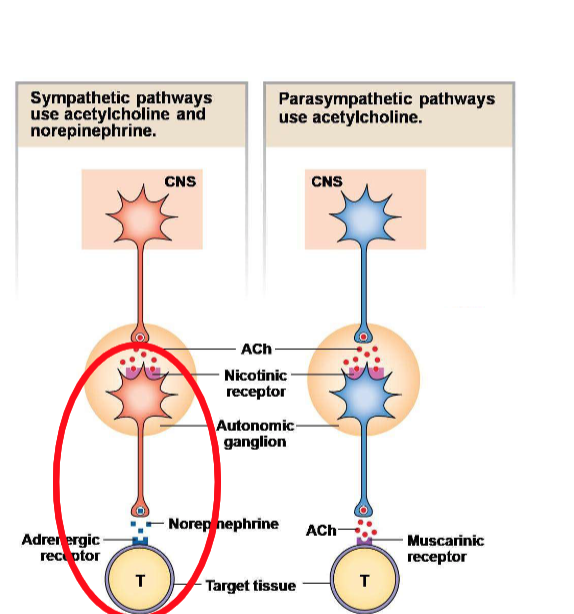
Most postganglionic sympathetic receptors secrete…
norepinephrine onto adrenergic receptors.
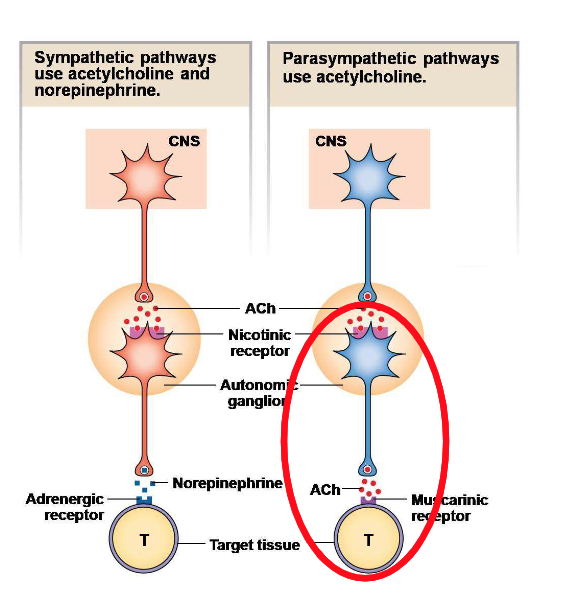
Most postganglionic parasympathetic receptors secrete…
acetylcholine onto muscarinic receptors.
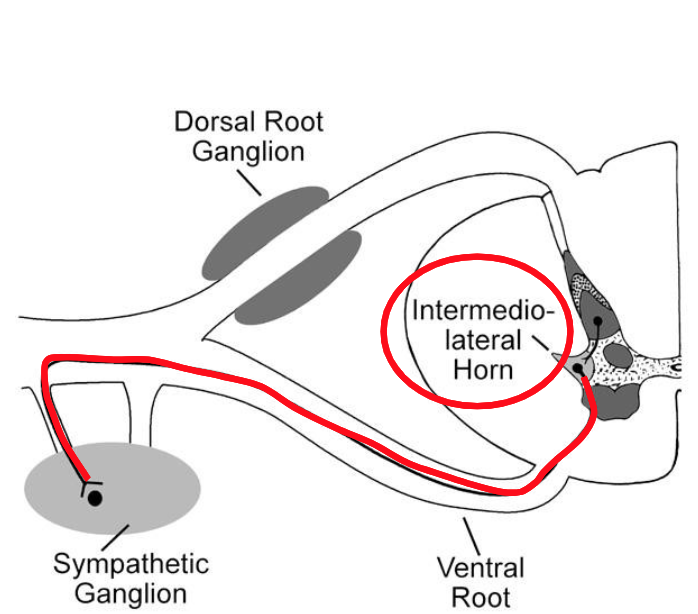
Explain the activity of the sympathetic efferents based on what’s happening in this image.
The preganglionic axon leaves the intermediolateral horn through the ventral root. The preganglionic axon then travels to the sympathetic ganglion.
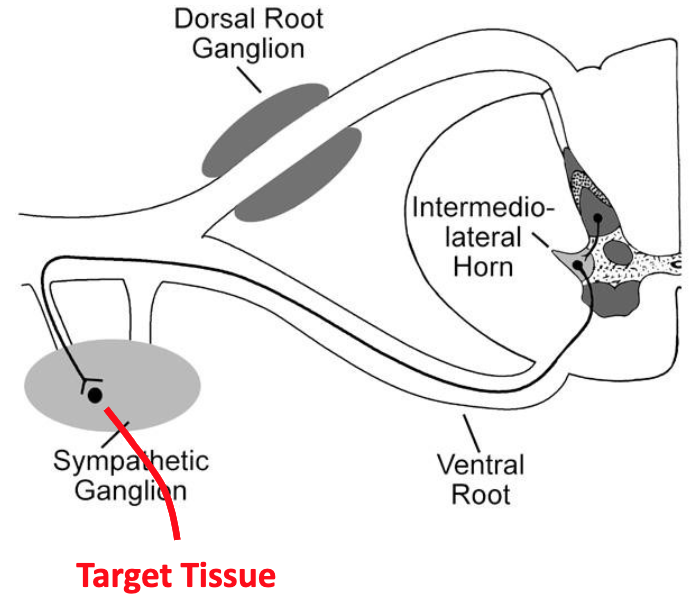
Explain the activity of the sympathetic efferents based on what’s happening in this image.
The preganglionic neuron synapses with the sympathetic ganglion, activating the postganglionic neuron. One preganglionic neuron can activate many other postganglionic neurons to activate many organs, such as the heart, sweat glands, blood vessels, etc.
List the activities of the sympathetic nervous system.
Increases heart rate, dilates pupils, inhibits digestion, and stimulates sweat production. It prepares the body for 'fight or flight' responses. Releases epinephrine and norepinephrine to enhance alertness and energy.
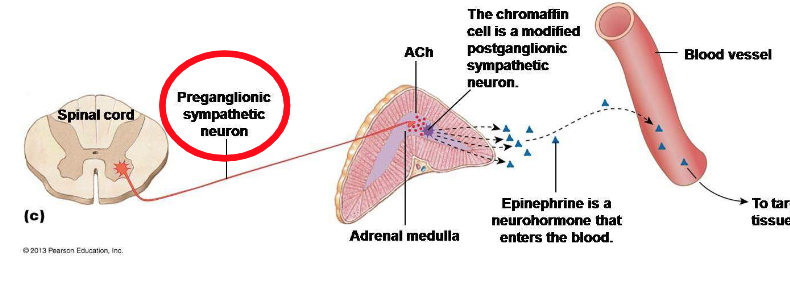
Explain the release of epinephrine from this image.
The preganglionic sympathetic neuron synapses with the postganglionic sympathetic neurons to release chromaffin in the adrenal medulla, so that epinephrine can be released into the bloodstream, enhancing the body's stress response.
Parasympathetic efferents originate from…
several cranial motor nuclei (3, 7, 9, 10) and in the intermediolateral part of the sacral cord.
Short postganglionic neurons in the parasympathetic system are…
embedded in the target tissue and will innervate the target tissue using local neurotransmitters such as acetylcholine.
List the activities of the parasympathetic nervous system.
The parasympathetic nervous system promotes rest-and-digest activities, including slowing the heart rate, stimulating digestion, conserving energy, and facilitating urination.
The Sympathetic nervous system and the parasympathetic nervous system both…
regulate homeostasis and are complementary rather than antagonistic.
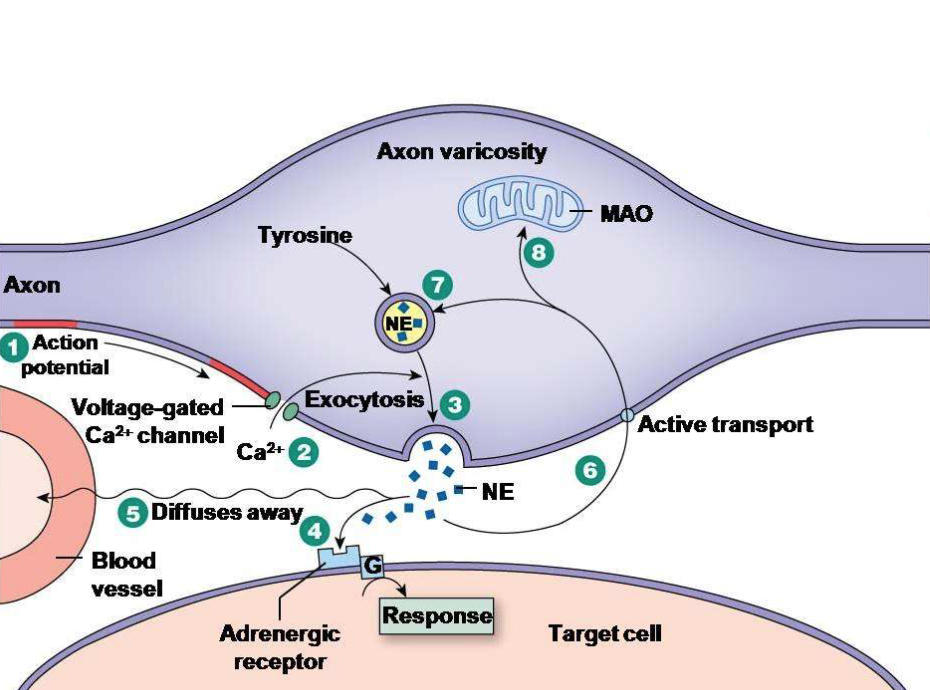
Explain the first step of how autonomic neurons target cells.
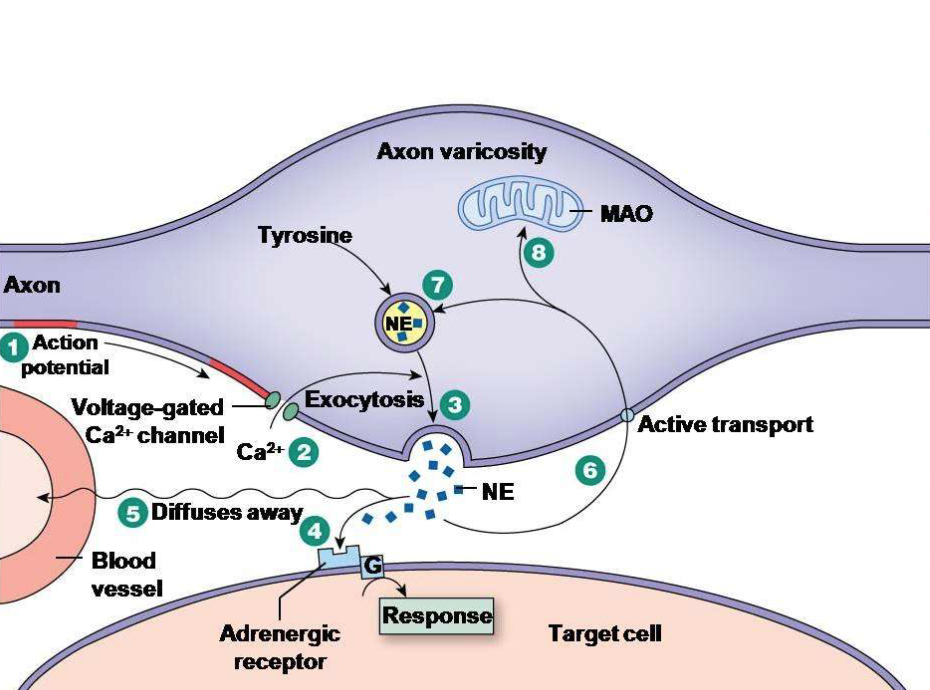
Action potential arrives at the axon varicosity.

Explain the second step of how autonomic neurons target cells.
Depolarization opens voltage-gated Ca2+ channels.
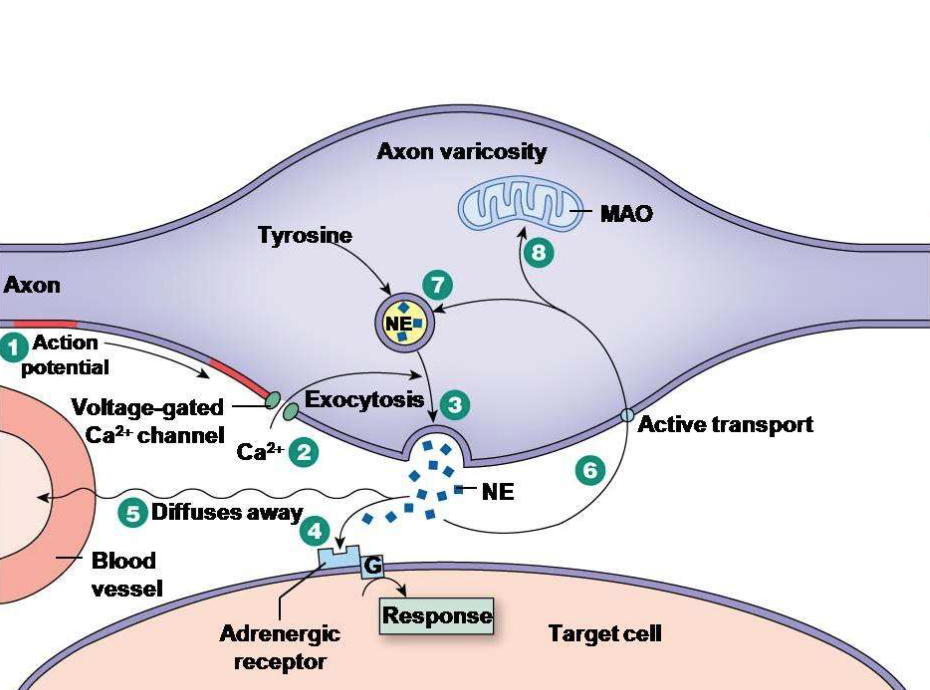
Explain the third step of how autonomic neurons target cells.
Ca2+ influx triggers neurotransmitter release.
Explain the fourth step of how autonomic neurons target cells.
Norepinephrine binds to adrenergic receptors on target cells.
Explain the fifth step of how autonomic neurons target cells.
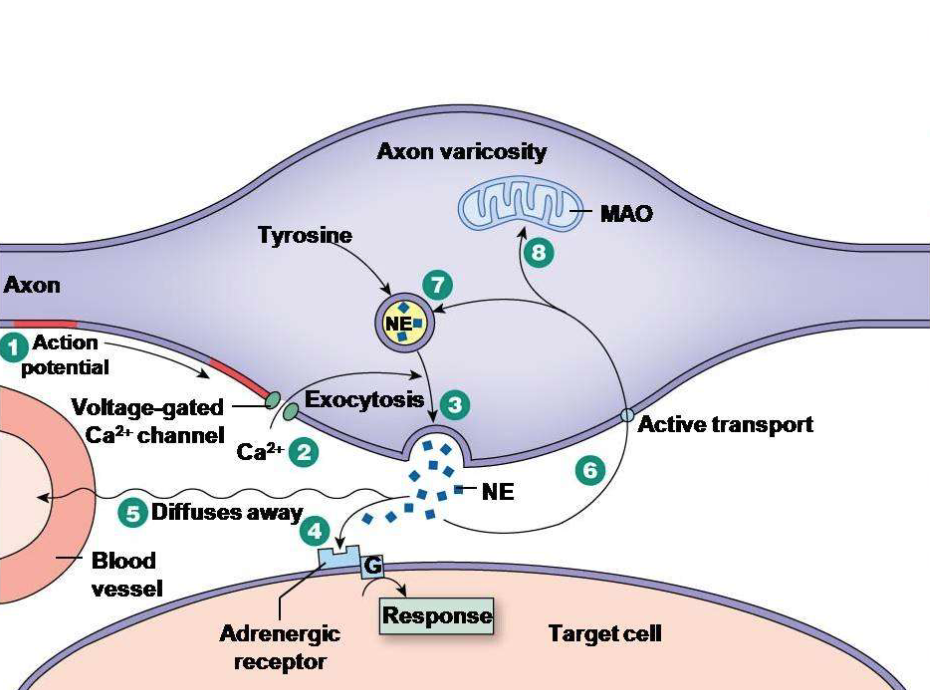
Receptor activation ceases when NE diffuses away from the synapse.
Explain the sixth step of how autonomic neurons target cells.
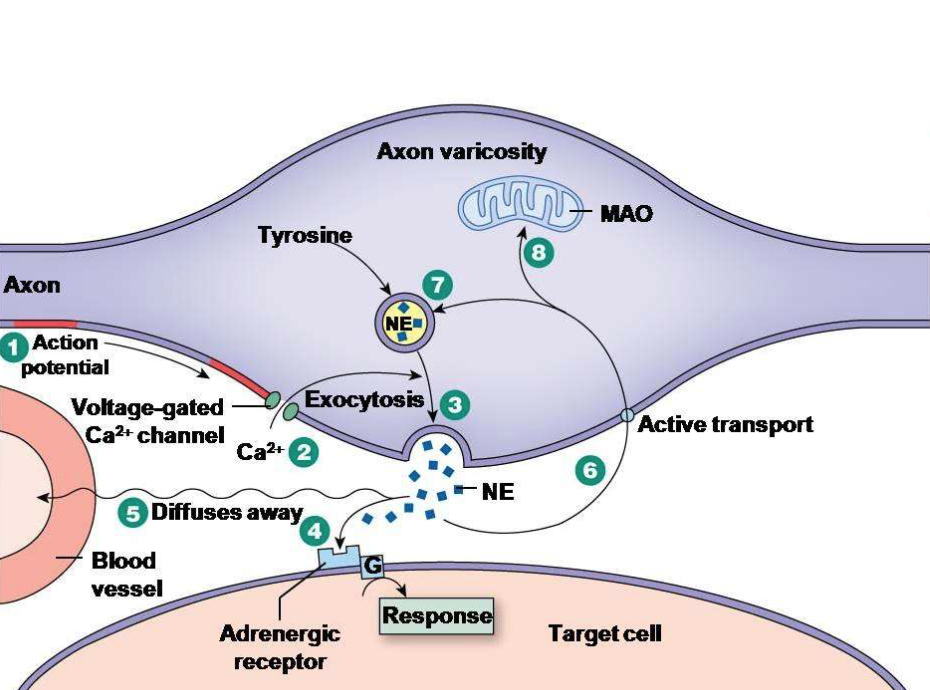
Norepinephrine is removed from the synapse.
Explain the seventh step of how autonomic neurons target cells.
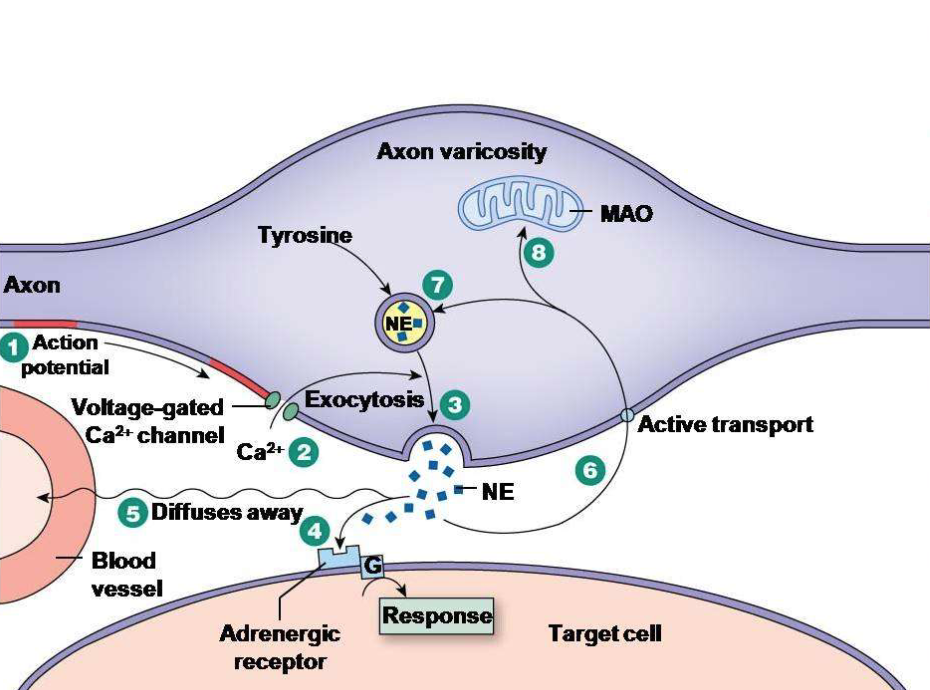
Norepinephrine can be taken back into the synaptic vesicles for re-release. Norepinephrine is broken down by monoamine oxidase.
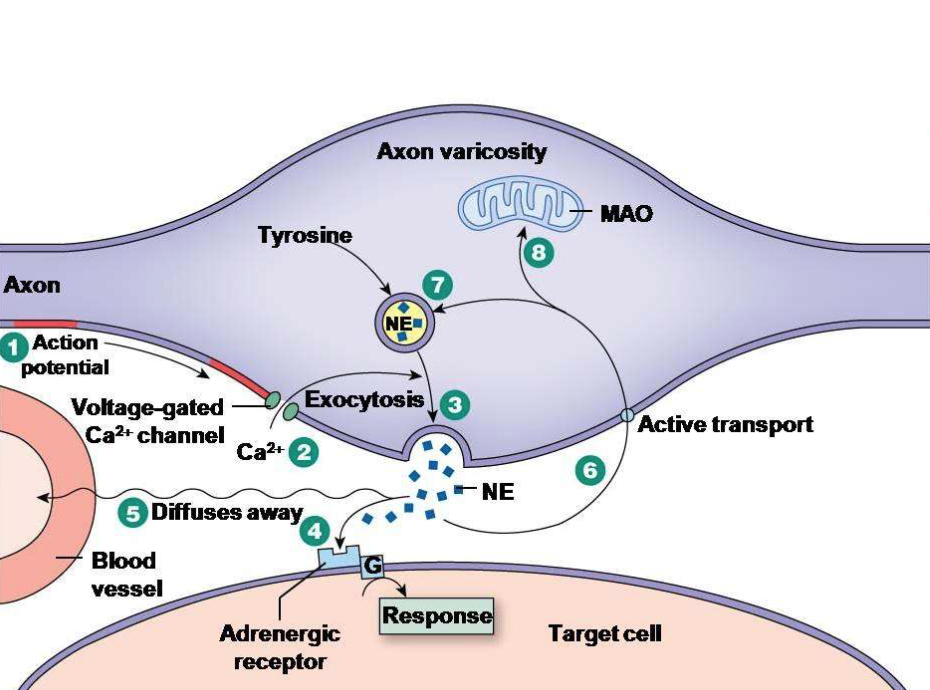
How do you treat depression?
You would have to increase the amount of norepinephrine available in the brain. MAO receptors are not specific for blocking actions of the brain’s norepinephrine. It also acts outside the brain, where the effects of norepinephrine and others will be increased.
Give an example of an autonomic reflex.
Smelling food automatically makes you salivate without thinking about it.
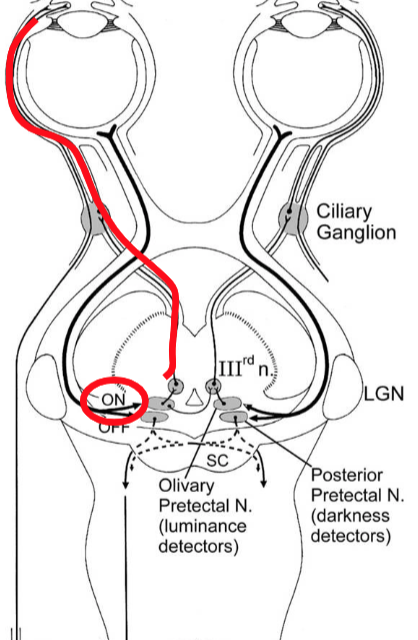
When the light is too bright…
the parasympathetic reflex constricts pupils through the 3rd cranial nerve to the ciliary ganglion and circular iris muscles.
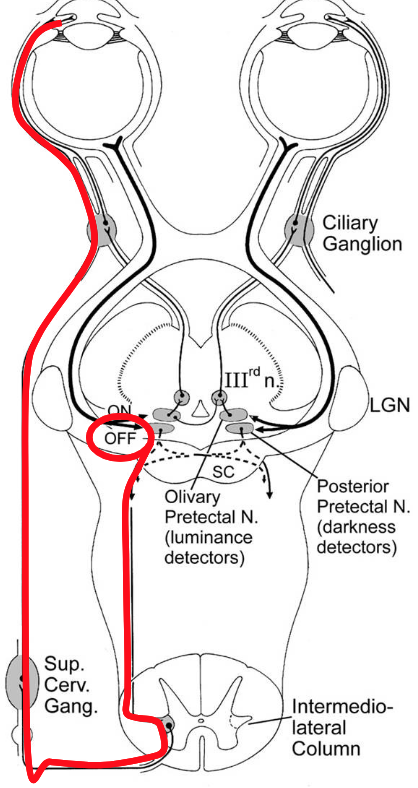
When the light is dim/dark…
the sympathetic reflex dilates pupils via the thoracic cord sympathetic chain to radial muscles.
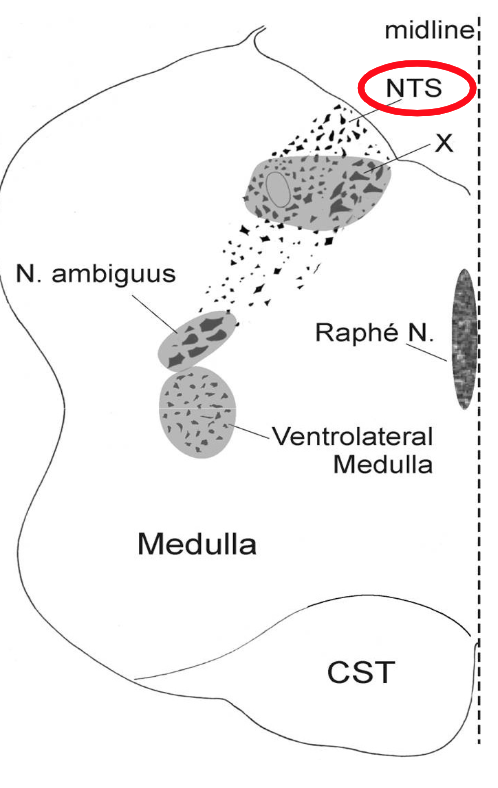
Where is the baroreflex located?
The baroreflex is located primarily in the cardiovascular centre and the ventrolateral medulla, beside the respiratory centre, where baroreceptors detect changes in blood pressure.
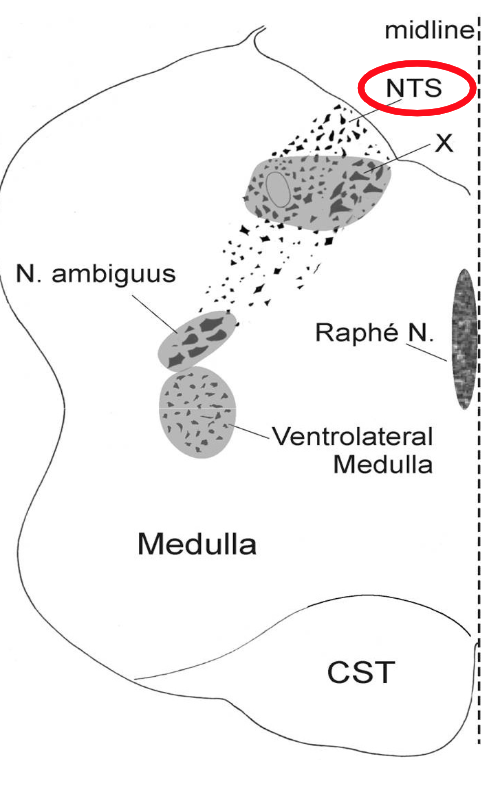
Why might some people pass out when they get up too quickly?
Their blood pressure drops. Blood pulls to the bottom because of gravity. Lack of blood in your head makes you dizzy.

NTS receives input from the baroreceptors. What happens if blood pressure is low?
There would be less NTS activity and the RVLM will be turned on, exciting sympathetic efferents.
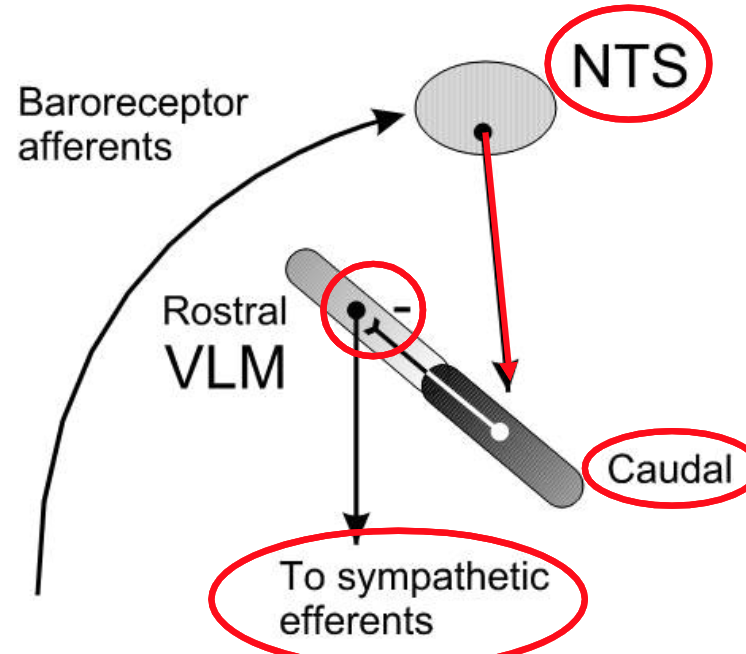
NTS receives input from the baroreceptors. What happens if blood pressure is high?
There would be increased NTS activity, leading to caudal inhibiting RVLM and decreased sympathetic output.
Give an example of a muscle sympathetic effect.
You tighten your blood vessel to increase your blood pressure when you get up.
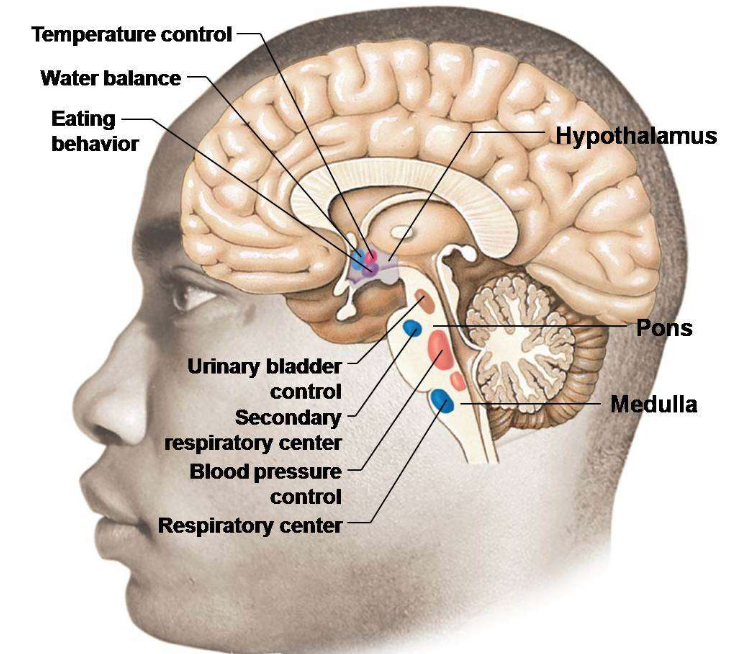
Name the three autonomic control centres and their function.
The three autonomic control centres are the hypothalamus (regulates homeostasis), the brainstem (controls basic autonomic functions like heart rate and respiration), and the spinal cord (mediates reflex autonomic functions).
The PAG is equivalent to the…
“premotor centre for autonomic behavioural programs”. For example, if you are fighting someone, this also includes your breathing rate, dilation of your pupils, blood pressure, and more.
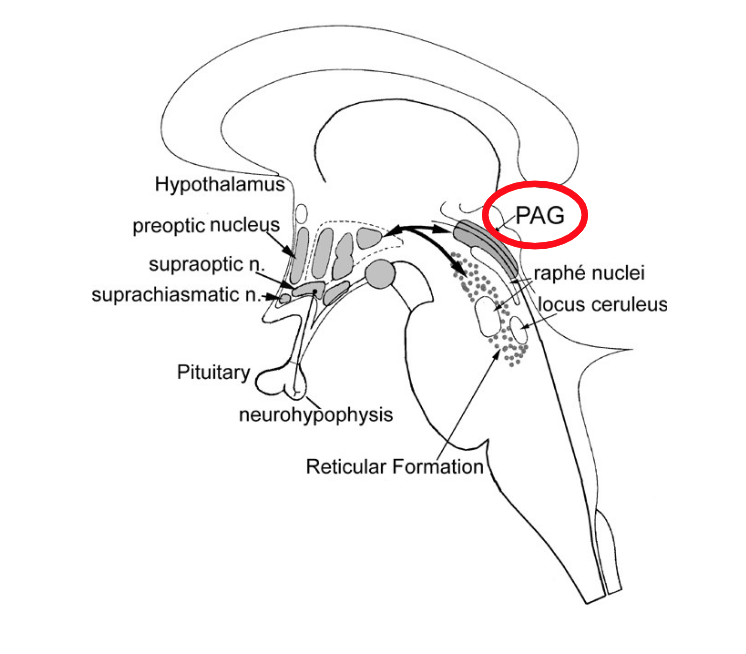
How is the PAG in control for all of the “fight (rage) responses?”
For example, the rage column projects to the cardiovascular and respiratory centres in the medulla to release serotonin in the spinal cord, depolarizing all the motoneurons and inhibiting pain transmission.
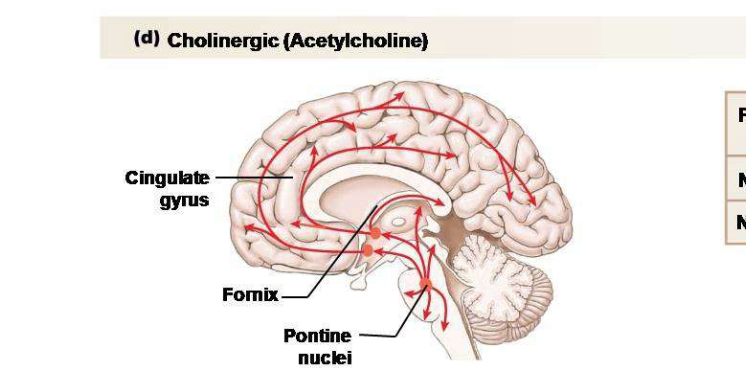
Explain the role of the acetylcholine neurotransmitter.
Sleep-wake cycle, arousal, learning, sensory info through thalamus.
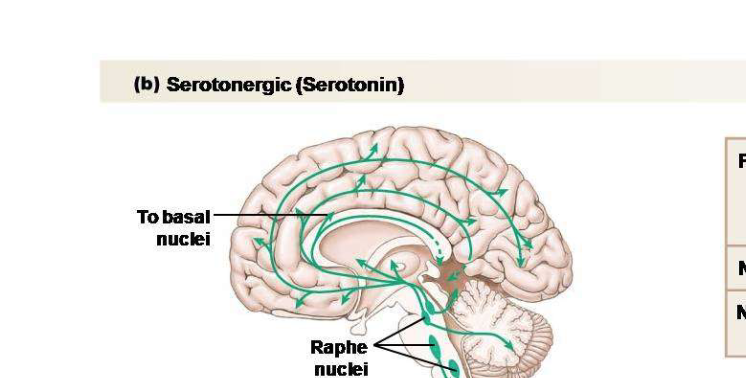
Explain the role of the serotonin neurotransmitter.
Regulating mood, emotional behaviours, aggression, and depression; involved in pain modulation and cognition.
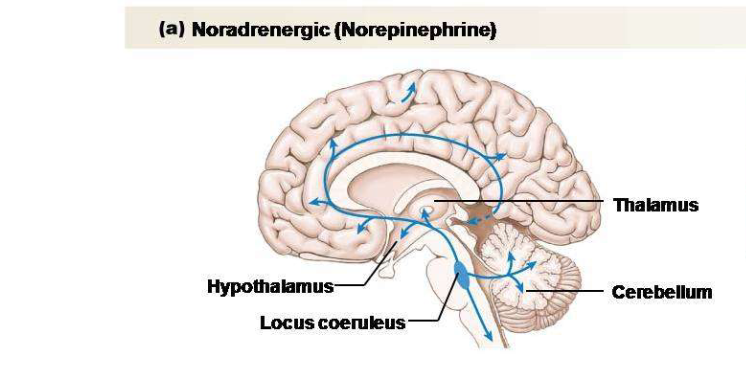
Explain the role of the norepinephrine neurotransmitter.
Regulating arousal, alertness, attention, and response to stress; involved in mood and anxiety disorders.
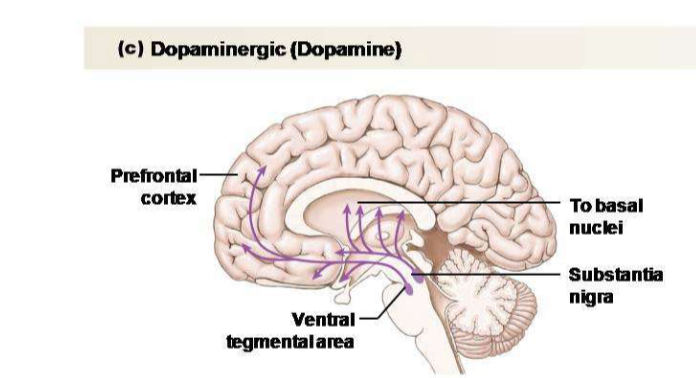
Explain the role of the dopamine neurotransmitter.
Involved in reward, motivation, pleasure, and motor control; plays a key role in mood and emotional regulation.
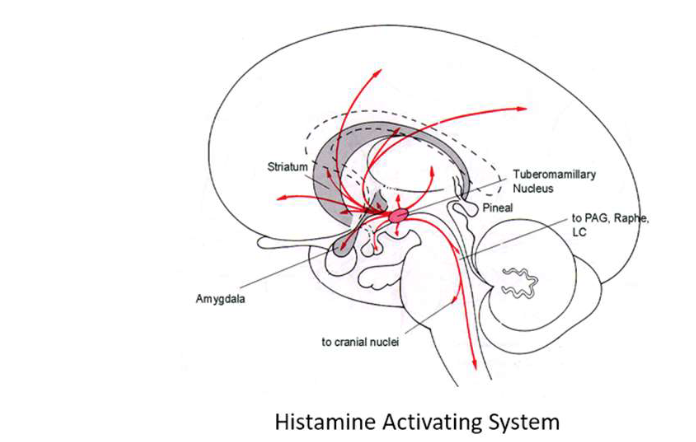
When turned on, histamines promote sleep and wake control. What do antihistamines do?
Antihistamines block the action of histamines, making you drowsy, thereby inhibiting the waking state.
 Note
Note  Flashcards (26)