Phonological Theories
 Call Kai
 Learn
Learn Practice Test
 Spaced Repetition
 Match
Match Flashcards
 Knowt Play
1/43

There's no tags or description
Looks like no tags are added yet.
Name | Mastery | Learn | Test | Matching | Spaced | Call with Kai |
|---|
No analytics yet
Send a link to your students to track their progress
44 Terms
linguistic research
Phonological theories are based on _______ _________
- spoke,
- transcribed and analyzed for patterns
Phonological theories are based on linguistics research
- Scientific study of language, specifically _____ language, looking at the speech sounds used in data sets
- Recordings are taken (in context, in isolation, in controlled environments) and _________ and ________ for _________
- Patterns like if a language has some manner classes, do they have other manner classes?
- Or if a child at this age has this sound here in English, does a child at the same age have that sound in another language?
structure and function, phonemic
Phonological theories attempt explain the _________ and ________ of a ________ system
- What exactly are the phonological rules of English
- Are there universal phonological rules of spoken language
services to children learning the phonemic system
Phonological theories attempt explain the structure and function of a phonemic system
Note the word “attempt”. None of these are perfect theories. New theories are being developed right now in linguistic departments across the world
When linguistics / phonologists can provide us better answers, the SLPs can provide better ________ to ________ _________ the ___________ __________
phonology
- language-specific phonemes and rules of use
___________ is the study of the system and patterns of phonemes in a language
- Determining ________-_________ _________ and _____ of ___ (structure and function)
1. Phonetic, phones
2. Phonemic, phoneme
There are two levels of study of speech sounds
1. ________ level (level of the ______) - in which the making of the sound is emphasized
2. ________ level (level of the _______) - in which the use of the sound in the lang is emphasized
- Form, function
Throughout the 1800s, 1900s, and 2000s, linguists/philosophers/psychologists have debated how to best explain these levels
- ____ (formal schools) versus ________ (functional schools)
Structuralism
___________ is the belief that sounds make up a string of speech that speakers combined to structure their meaning as listeners combined to construct interpretations.
Structural Linguistics
Structuralism:
___________ _________ is the idea that language is a system of contrast and equivalence. In it, language consists of strings of linguistic objects (words, phonemes, or morphemes) and these objects are define only through the fact that they contrast with other objects in the language system.
This is where we began to define a phoneme based on function in a language
correct, isolation, functional, communication
Structuralism:
Structuralism and Phonology - clinicially, this turned our focus from ______ articulation in _________ to __________ articulation in ____________
Distinctive Features
___________ _________ – the phonetic constituents that distinguish phonemes from each other
- I.e., The properties of the speech sound that help tell them apart
feature system, Sound Pattern of English (SPE)
Distinctive Features:
Various types of _______ _________ have been proposed. The most used was devised by Chomsky & Halle (1968). This was described in their book, The _____ _______ of ______ (___). Their system is still used today with some modifications
- articulatory and acoustic
- binary ( + or -)
- phonological
- universal, all languages
- distinct (phonemes), one
Characteristics of the Sound Pattern of English (SPE) Feature System:
- Features are derived from ____________ and ________ information
- Features are always ______ ( ___ or ___)
- The features are ____________, they don’t claim to cover every fine phonetic detail
- Features are _________, and can be used to describe sounds in ___ ________
- Sounds are considered ________ (________) if they differ by at least ___ of their features
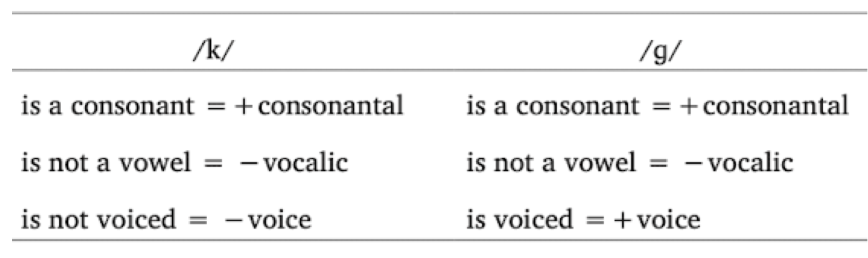
- Sonorant
- Consonantal
- Approximate
Sound Pattern of English (SPE) Major Class Features:
- [± ___________ ]
- [± ___________ ]
- [± ___________ ]
- unimpeded airflow, open
- impeded airflow, closed
Sound Pattern of English (SPE) Major Class Features:
[± sonorant]
- [+son] has _________ _______; ____ vocal tract = vowels, nasals, approximates
- [-son] has _______ _______; _______ vocal tract
- radical oral obstruction
- no radical obstruction
Sound Pattern of English (SPE) Major Class Features:
[± consonantal]
- [+cons] _______ ____ ___________ = plosives, fricatives, affricates, liquids, nasals
- [-cons] __ _______ ___________
- low degree
- high degree
Sound Pattern of English (SPE) Major Class Features:
[± approximate]
- [+app] sounds with ___ ______ of oral obstructions = vowel, liquids
- [-app] sounds with ____ ______ of oral obstruction
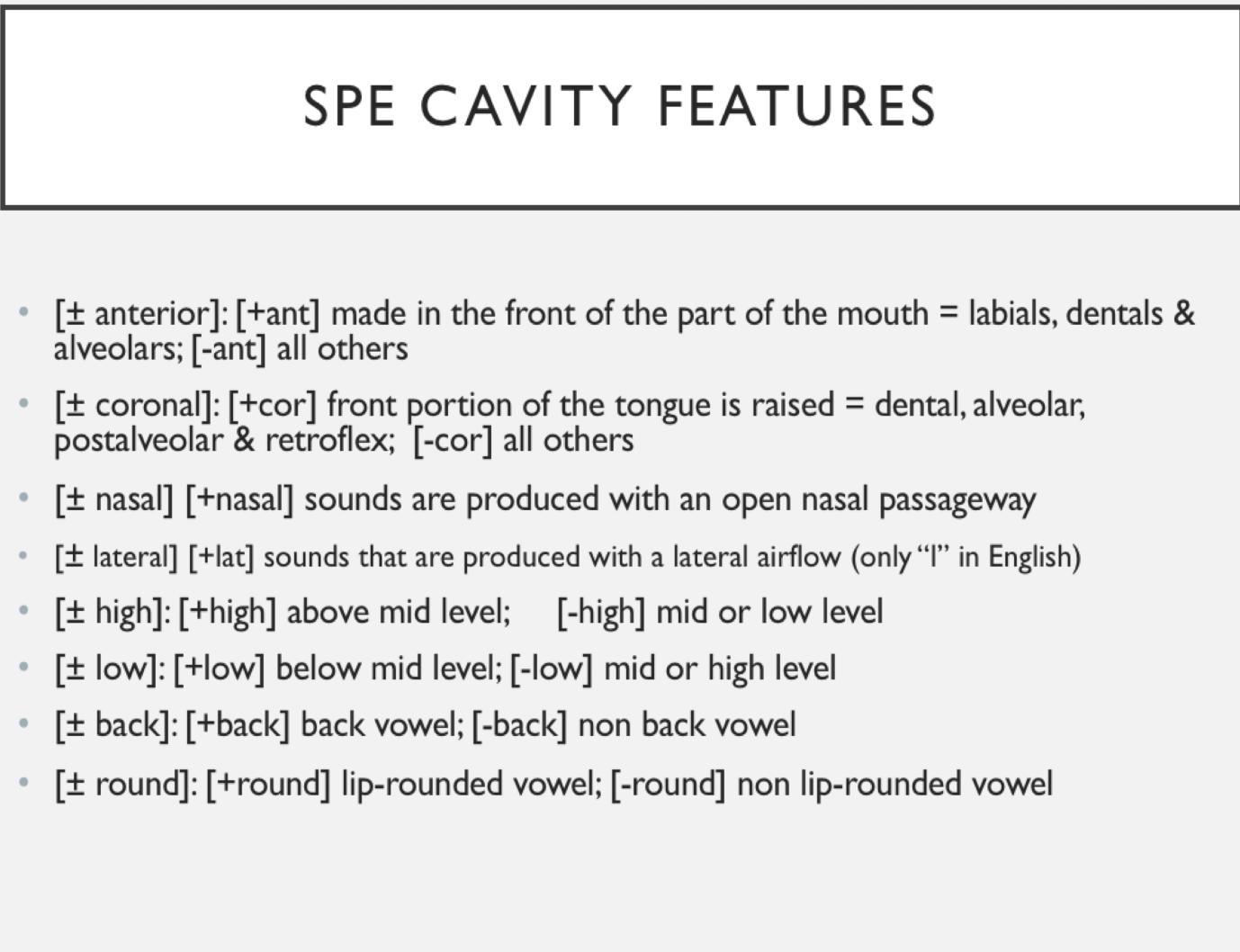
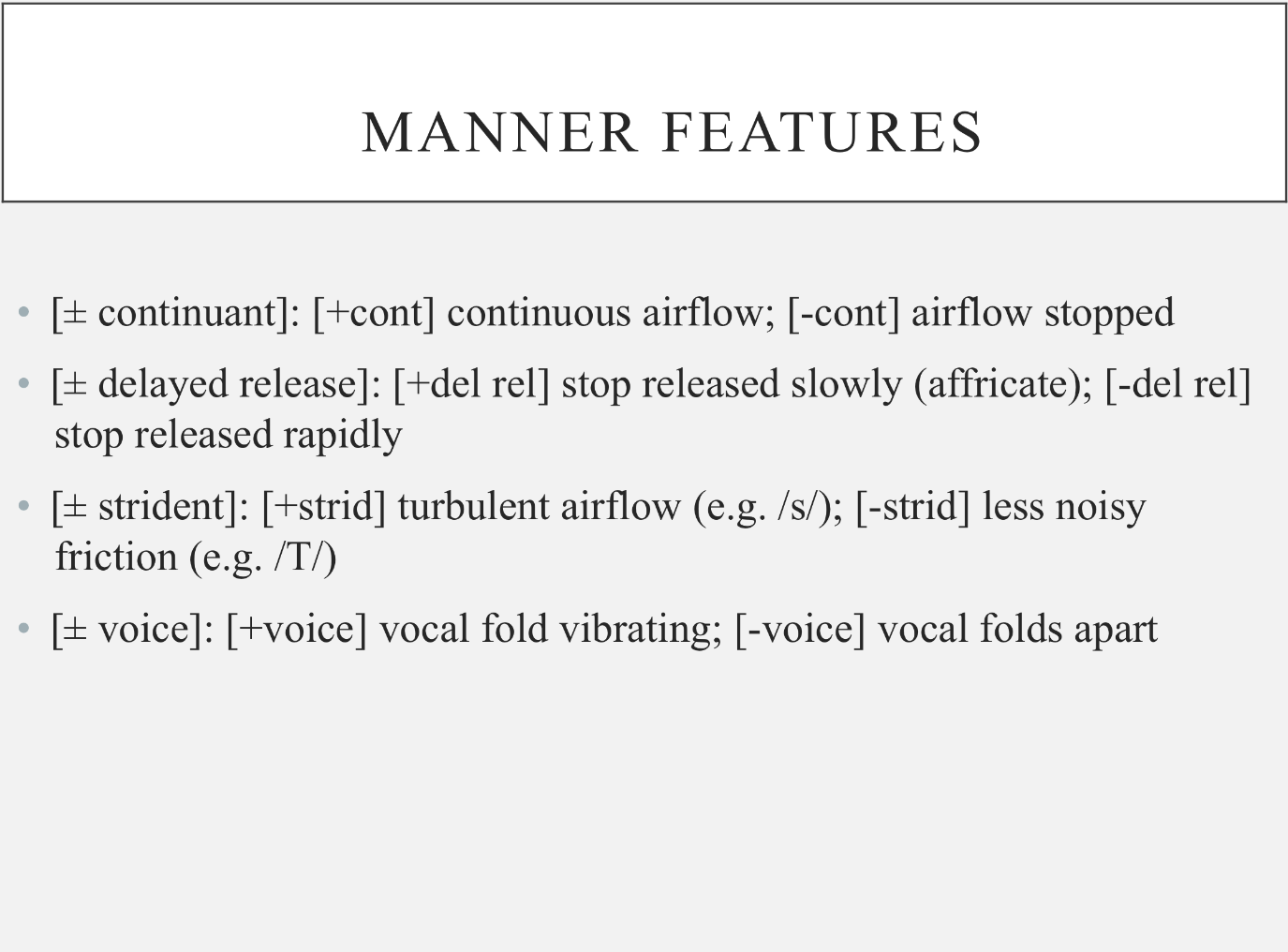
Counting Phoneme Errors
The following are typical phoneme errors in disorder speech:
/k/ —> [t]
/g/—> [d]
/ŋ/ —> [n]
These would result in a count of 3 phoneme errors '
Feature errors vs phoneme errors
However, if we examine those substitutions again, we see:
There is no change in the voicing
There is no change in the manner of articulation
There is only a change in the place of articulation
So, these aren’t 3 errors, but 1 feature error
- Minimal oppositional minimal pairs
- Maximal oppositional minimal pairs
Distinctive Features Clinically:
For treatment,
- _______ ____________ ______ ____ - targets are chosen based on insuring the least amount of distinctive feature differences
- _______ ____________ ______ ____ - targets are chosen based on insuring the most amount of distinctive feature differences
- naturalness, development
- "common errors", phonology
- Phonological processes
Natural Phonology
- The idea of ___________ is then applied to explain ___________
- That “_______ ______” are natural processes in the development of _________
- ____________ _________ – innate and universal easier ways of producing sounds, sound classes, or sound sequences
Stampe, Phonological Process
- simplify, pronunciations of classes of sounds
- mental
- phonological acquisition
Natural Phonology
______ defines a natural process as follows:
“A ____________ _________ is a mental operation that applies in speech to substitute for a class of sounds or sound sequences presenting a common difficulty to the speech capacity of the individual, an alternative class identical but lacking the difficult property.” 1971, p1.
- In other words, processes _________, phonetically, the _____________ of _______ of ______
- Note that he claims these are ______ processes
- He also claims that this accounts for similarities in ____________ ___________
- not all phonological patterns, definition of the process
- idiosyncratic, phonetically
- 'phonological rules'
Rules vs. Processes:
- Natural Phonology recognizes that ___ ___ ____________ ________ in a given language fit into the __________ of the _______
- Some patterns appear _____________ and cannot be explained ____________
- These patterns are accounted for by ‘____________ _____’ specific to a given language
- Phonological process in normal
- phonological rule in normal
Processes vs. Rules in English:
An example of a ____________ _________ in ______ English:
- Cluster reduction ‘next week’ /nEks wik/
An example of a ____________ _____ in ______ English:
- /k/ ➡️ /s/ in derivational morphology, ‘electric’, ‘electricity’
natural, innate
- explaining children learning their phonological system
Phonological Acquisition:
Natural Phonology claims that all possible _______ processes operate on children's speech at the outset. (I.e., the processes are deemed to ______)
- Phonological Acquisition is complicated. But it is best for _________ ________ _________ their ____________ ______.
- discarding all those processes not found in the adult form
- controversial
- rules have to be learned, processes unlearned
Phonological Acquisition:
- Natural Phonology claims that all possible natural processes operate on children’s speech at the outset (processes are deemed to be innate)
- ‘Learning’ the phonology of your native language, therefore, is a process of ____________ ___________________________________________________________
- This is a _____________ view. Other phonologists have criticized the claim that acquisition involves ‘unlearning’ processes rather than learning sounds
- Stampe says that the _____ have to be _______ and the _________ _________
commonly occurring processes
Processes effecting structural simplifications:
Weak syllable deletion
Final consonant deletion
reduplication
cluster reduction
Examples of Natural processes
Weak syllable deletion:
‘banana (nana)
‘umbrella’ (bwella)
‘Pajamas’ (james)
Final consonant deletion:
juice [du]
milk [mI]
Cluster reduction:
/s/ + plosive/nasal
‘stop’ [tAp] ‘snow’ [noU]
commonly occurring processes
Processes effecting systemic simplifications:
fronting (velar fronting)
stopping
gliding of liquids (liquid gliding)
Commonly occurring processes
Fronting:
Velars to alveolars: King [tIn], ‘goat’ [doUt], ‘cake’ [teIt]
Velars to palatals: ‘kite’ [caIt] (this does not involve loss of contrast)
Stopping:
• Of fricatives: ‘fish’ [pIt], ‘these’ [did]
• Of affricates: ‘jam’ [dQm], ‘cheese’ [did]
• Of liquids: ‘low’ [doU], ‘ray’ [deI]
Liquid Gliding:
• /l/ → [j]
• ‘light’ [jaIt]
• /r/ → [w]
• Hurry (huwwy)
- analyze clinical data
- acquisition, delayed pattern or deviant one
- therapy strategies
Clinical Use of Phonological Processes:
- We can _______ _________ ____ to organize it into the processes used
- We can use knowledge of ________ to determine whether processes show ________ _______ or a _______ ___.
- Knowledge of normal acquisition guides our choice of ________ _________
- A process rather than a single sound is the focus for therapy. Example: writing a goal for suppression of fronting
- sequentially
- bundled Distinctive Features
- equal in value
- segment level (not suprasegmental)
Linear Phonology
- Segments are arranged ________________
- Each segment contains sounds represented by _______ __________ ________
- All segments are _____ in _____
- Phonological rules apply only at the _______ _____ (___ ______________)
- hierarchical
- larger linguistic units
Nonlinear Phonologies
Linear Phonology
Linear Phonologies Do Not:
- Account for ___________ interactions
- Fail to recognize ______ __________ _____
_________ ___________ are needed to account for this
Nonlinear Phonology
_________ ___________ challenge the assumption that phoneme segments are independent, unorganized bundles of Distinctive Features
phoneme segments are independent, unorganized bundles of Distinctive Features
- Stress
- Intonation
- Prosody
- larger more complex
Nonlinear Phonology
Challenge the assumption that _________________________________________________________________________________________________________________________________
Nonlinear Phonologies Attempt to Account for: - ______
- _________
- _______
- Other ______ _____ _______ linguistic units
- feature geometry (hierarchical features)
- optimality theory (markedness/nontypical)
Nonlinear Phonology:
There a multiple "schools of thought" / focuses (I.e., there are the different types of Nonlinear Phonologies)
- Autosegmental (tonal focus)
- metrical (stress focus)
- _______ ________ (_____________ ________)
- __________ ______ (__________ / __________)
- stress
- Suprasegmental, segmental
sting, a hierarchy of features are considered
Nonlinear Phonology:
Theories of phonology that regard phoneme segments as being governed by the more complex linguistic dimensions (Like stress and suprasegmentals)
- The phoneme is less important than the ______
- That ______________ aspects (stress, rhythm, intonation) control the _________ (the phoneme)
Rather than bundles of distinctive features in a _____, a ________ of _________ are __________.
Optimality Theory
- Prince & Smolensky and McCarthy & Prince work beginning in the 1990s
__________ ______ is constraint-based – humans start with all possible ways of putting sounds together (mental representations of sounds/inputs). As languages/children develop, they are learning which constraints their language ranks as most important. From the rankings, we find “selected output” (which is actually said/surface forms).
- _____ & ________ and _______ & _____ ____ _________ in the _____
possible ways of putting sounds together
Optimality Theory:
Constraint-based – humans start with all ________ ____ of putting ______ ________ (mental representations of sounds/inputs). As languages/children develop, they are learning which constraints their language ranks as most important. From the rankings, we find “selected output” (which is actually said/surface forms)
1. Markednesss
2. Faithfulness
Optimality Theory:
1. __________ - require outputs to be unmarked (simplified structure version)
VS.
2. ____________ - require that inputs and outputs be the same (Opposition to markedness)
multiple phonological errors
- can do, isn't currently doing
- demoting their higher-ranking constraint to match conventional English constraints
Optimality Theory:
Clinically, this theory lets us explain how children with ________ ____________ ______ are understanding their language.
- Helps us focus on what the child ___ __ instead of what the child ____ _________ _____
- We take a speech sample, analyze for patterns, and then determine the rankings the child is giving to their constraints
- Then, we can help the child learn English constraint rankings by ________ their _______-_______ __________ to _____ ____________ _________ ___________
Sonority
________ - the relative loudness of a sound; relative to sounds of the same stress, length, and pitch
Sonority value difference
Sonority Theory:
- ________ _____ __________ – in complexity approach (see distinctive features above) this calculation helps rank clusters by subtracting the sonority rank of each individual sounds
- Thereby helping select targets. Clusters with least sonority difference are considered more complex
Conclusion:
- Phonological research is consistently helping us SLPs understand the speech process and the developmental process.
- Distinctive Features theory allow us to group sounds together based on sound characteristics, which allows us to analyze for patterns of breakdowns.
- Natural phonology therapy is used throughout the field of SLP to analyze developmental patterns of speech.
- Non-linear phonological theories are bringing us closer to understand how speech sounds are understood and organized in the mind of the speaker. They are helping linguistics describe the ontology of human language.
- Clinician to understand what is going through a child’s head cognitively

