Foundations of Biology Exam 2
 Studied by 6 people
 Call Kai
 Learn
Learn Practice Test
 Spaced Repetition
 Match
Match Flashcards
 Knowt Play
1/249

There's no tags or description
Looks like no tags are added yet.
Name | Mastery | Learn | Test | Matching | Spaced | Call with Kai |
|---|
No analytics yet
Send a link to your students to track their progress
250 Terms
How do cells divide
Four events must Occur:
Reproductive Signal
Replication
Segregation
Cytokinesis
Reproductive Signal
Step 1
To initiate cell division
Replication
Step 2
Of the Dna
Segregation
Step 3
Distribution of the DNA into two new cells
Cytokinesis
Step 4
Separation of the 2 new cells
Eukaryotic Cell Cycle
Distinct phases of the cell cycle, divided into Interphase and M phase (mitosis/cytokinesis)
Specific molecular signals trigger the transition from one phase to another
Interphase
DNA exists as long, threadlike chromatin
Begins after cytokinesis
Ends when mitosis starts
Divided into subphases: G1, S, and G2
M (mitosis) phase
Nuclear membrane dissolves
DNA condenses and divides
Cytoplasm divides
G1
each chromosome consists of one dsDNA molecule
S
DNA replication produces 2 identical dsDNA molecules (sister chromatids) for each chromosome
G2
Each chromosome consists of two associated dsDNA molecules (sister chromatids)
Mitosis Phases
Prophase/Prometaphase
Metaphase
Anaphase
Telophase
Cytokinesis
Prophase/ Prometaphase
compaction of replicated DNA into visible chromosomes: breakdown of nuclear envelope
Metaphase
Duplicated chromosomes line up in the middle of cell
Anaphase
sister chromatids separate and move to opposite sides of cell (now are daughter chromosomes)
Telophase
Decompaction and formation of new nuclear envelope around the two separated sets of daughter chromosomes
Cytokinesis
Division of cytoplasm (forms two cells)
In animal cells- a contractile ring of actin and myosin microfilaments pinches in the cell membrane
In plant cells- vesicles from the golgi apparatus appear along the plane of cell division and fuse to form a new cell membrane. contents of vesicles contribute to forming the new cell wall
Mitotic Spindle
Consists of Microtubles
Microtubules
function as the spindle fibers, which orient and move chromosomes in the dividing cell.
Microtubule Organizing Center (MTOC)
surrounded by high concentration of tubulin dimers
forms/ orients the mitotic spindle that will attach to and move the duplicated chromosomes during M-phase
Centrosome
MTOC of animal cells
consist of 2 centrioles (hollow tubes) formed by microtubules
doubling during S phase too: each will move to opposite ends of the nuclear envelope during G2-M Transition
positions determine the spindle orientation and plane of cell division
Plants
Have no centrosomes but have MTOCs
How is eukaryotic cell division controlled?
The eukaryotic cell cycle
transitions depend on activity of enzymes called Cdks= cyclin-dependent kinases
Cdk is active only when bound to its partner protein, cyclin
Cyclin
synthesized only at certain times in the cell cycle
Cdk activation occurs in the presence of cyclin
are unstable
Cyclin and Cdks
control the progression through the cell cycle
ensure that the cell is ready to move past crucial checkpoints
G1-S Cdk phosphorylates RB protein
Unphosphorylated (active) RB inhibits the cell cyle at restriction point: cell does not enter S phase
When RB is phosphorylated by G1-S cylicn-Cdk, RB is inactivated and no longer blocks the cell cucle
p16 inhibits RB phosphorylation
Types of Cell Division
Binary Fission & Mitosis
Meiosis
Binary Fission & Mitosis
DNA copied and a complete copy segregated to each daughter cell
products identical to the mother cell
division for somatic cells
Meiosis
DNA copied followed by 2 rounds of division and nuclear segregation
DNA content reduced by ½
Each Product is unique
division for gametes (sexual reproduction)
Sexual Reproduction
joining of gametes to produce a diploid phase of the life cycle, coupled with meiosis that reduces the chromosome number in the haploid phase
Meiosis specialized cell division
diploid mother cell (pairs of chromosomes) → haploid daughter cells (each with one of each kind of chromosome)
Diploid cell
has 2 complete sets of chromosomes
Pairs of chromosomes
2n
46 chromosomes
Sister chromatids
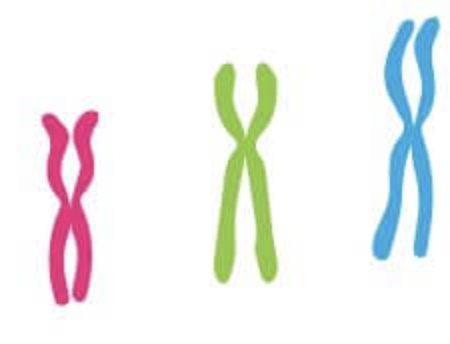
Haploid Cell
has a single set of chromosomes
has half the amount of a diploid cell
n
23 chromosomes
chromatids
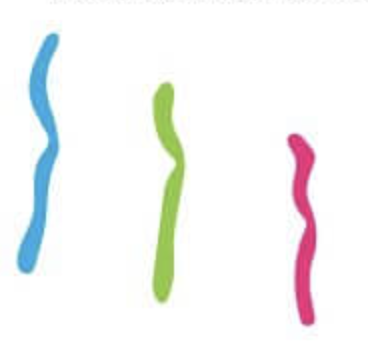
Homologs
One member of each pair of chromosomes inherited from each parent
Homologous chromosomes
appear the same and contain the same genes, except for sex chromosomes
Functions of Meiosis
Reduce chromosome number from diploid to haploid
ensure each haploid has a complete set of chromosomes
Generate diversity among the daughter cells
Key Features of Meiosis
2 nuclear divisions but DNA is replicated only once
Homologous chromosomes pair and exchange genetic information then segregate from each other in meiosis I
sister chromatids separated from each other in Meiosis II
Unique Events of Meiosis I
Duplicated homologous pairs come together and pair along their entire lengths
pairing occurs during prophase 1
the four chromatids of each homologous pair form a tetrad or bivalent
Synapsis
Pairing of homologous pairs of chromosomes during prophase 1
can lead to crossing over between non-sister chromatids
After Meiosis I
Homologous pairs separate
maternal and paternal centromeres of each pair segregate to opposite poles
cells at the end of Meiosis I are haploid, but each chromosome still contains 2 chromatids
Crossing over
can produce exchange between DNA molecules of each chromatid, contributing to genetic variation among gametes
Chiasmata
sites of exchange between non-sister chromatids
Events of Meiosis II
Duplicated cells at end of meiosis I are haploid, but each chromosome still consists of 2 chromatids
critical event: separation of the sister chromatids
sister chromatids segregate to opposite poles
Nondisjunction
Homologous pairs fail to separate at anaphase I or II
results in aneuploidy-chromosomes missing or present in access
Causes of Nondisjunction
aneuploidy is sometimes caused by lack of cohesions that hold the homologous pairs together. without cohesions the pairs separate randomly
failure to undergo crossing over
frequency of nondisjunction goes up as a female ages
Consequences of errors in meiosis
If both homologs go to the same pole and the resulting egg is fertilized
Trisomy 21→ down syndrome
Trisomy 18→ edwards syndrome
Fertilized egg that does not receive a copy of a particular chromosome will be monosomic
lethal in all situations except turner syndrome (having a single X chromosome)
Independent Assortment
haploid sets of chromosomes inherited from parents mixed by segregation of homologs during Meiosis I
Trisomic
3 chromosomes on 1 side
Monosomic
1 chromosome only and on 1 side
Mendel's laws
Law of Segregation
Law of Independent Assortment
Law of Segregation
Two alleles of a gene separate and are transmitted individually and equally to gametes
Gene
sequence within a DNA molecule and resides at a particular site on a chromosome (locus)
Law of Independent assortment
Alleles of different genes assort independently during gamete formation
Thomas Hunt Morgan
Established the drosophila melanogaster as a model for genetic studies
Discovered linkage
alleles of separate loci were transmitted together to offspring,
Linkage
alleles of separate loci are transmitted together to offspring
Frequency of crossing over between 2 linked genes
Proportional to the distance between them
Frequencies of recombinant gametes, and resulting offspring are greater for loci that are farther apart
recombinant frequency= # of recombinants/ # of total offspring
Max recom. frequency is 0.5
Heterozygotes
2 different alleles of a particular gene
Homozygotes
2 identical alleles of a particular gene
Absolute linkage
is rare
Linkage group
All of the loci on a chromosome form this
Genetic Maps
Recombinant frequencies can be used to make these
shows the arrangement of genes along a chromosome
Sex chromosome
the gene(s) with primary control of sexual development
Autosomes
Other chromosomes that are not sex chromosomes
Y chromosome
carries few genes
X chromosome
carries many genes involved in a variety of functions
Hemizygous
has 1 copy of a gene
Complete dominance
The allele defined as dominant completely masks the effect of the recessive allele
used to define dominant allele and recessive allele
Incomplete dominance
both alleles of a gene at a locus are partially expressed
results in an intermediate phenotype
Co-dominance
phenotypes of both alleles appear in the heterozygote
Epistasis
Phenotypic expression of one gene is influenced by genotype of another gene
Probability rules
two events occur together use multiplication
two events occur separately use addition
Single gene disorders
caused by a mutant allele of a single gene
results in a change in phenotype
rare in the general population
Examples of single gene disorders
recessive disorders
dominant disorders
recessive disorders
both alleles have to be mutant
examples of recessive disorders
albinism, cystic fibrosis, sickle cell anemia, muscular dystrophy
dominant disorders
one mutant allele is enough
examples of dominant disorders
huntington disease, achondroplasia
Mendelian traits
single gene, affecting discrete phenotypic differences
Quantitative phenotypic variations
height, weight, skin pigmentation, hypertension, type II diabetes, asthma
Frederick Griffith
physician trying to find a vaccine for pneumonia
Griffith’s study
found 2 strains of bacterium streptococcus pneumoniae
Characterized them as smooth (S) and rough (R)
Griffith’s findings
S strain was dangerous and the R strain was not
S strain had polysaccharide capsule around them while R strain did not
Avery et al
Did experiments to identify the transforming principle
Avery et al’s study
Treated S strain bacteria to selectively destroy different types of macromolecules
Avery et al’s findings
R strain was still transformed when S-RNA or S-Protein was destroyed but was not transformed if S-DNA was destroyed
Hershey and Chase (1952)
Used bacteriophage to explore what controlled inheritance, DNA or proteins
Hershey and Chase’s study
Grew cultures of virally infected bacteria with radioactive Phosphate or Sulfate
32PO4 or 35SO4
Hershey and Chase’s experiment
DNA contains lots of PO4 but no SO4, so if phage transferred PO4 to the bacteria, then DNA was hereditary particle
Opposite for protein
Hershey and Chase’s findings
DNA contained the information needed to make the next generation of phage
Chargaff’s rule
A+G=C+T
Rosalind Franklin
Suggested that DNA is spiral or helical molecule
Watson and Crick
combined all the knowledge of DNA to determine its structure
The double helical structure of DNA
antiparallel strands
polarity of the strands is determined by the sugar-phosphate bonds
Phosphate groups
connect to the 3’ C of one sugar and the 5’C of the next sugar
2 DNA chain ends differ
One is a free 5’ phosphate group (5’ end) and the other is a 3’ hydroxyl group (3’ end)
Base pairing
5’→3’ strand paired with the 3’←5’ strand
5’ paired with 3’ of other strand
Major and minor grooves
result of base pairing, phosphate backbones are closer together on one side of the double helix than the other
Major grooves
atoms available for hydrogen bonding with other molecule are more accessible here
A and T
Minor grooves
Have C and G
 Note
Note  Flashcards (31)