Topic 4 - Sensory Systems
0.0(0)
 Studied by 6 people
 Call Kai
 Learn
Learn Practice Test
 Spaced Repetition
 Match
Match Flashcards
 Knowt Play
Card Sorting
1/111

Earn XP
Description and Tags
Part 1 - Visual, Part 2 - vestibular, Part 3 - Somatosensory [touch, pain, temp, proprioception]e
Last updated 6:22 AM on 12/15/22
Name | Mastery | Learn | Test | Matching | Spaced | Call with Kai |
|---|
No analytics yet
Send a link to your students to track their progress
112 Terms
1
New cards
What are Ruffini Endings?
They are Large receptors in dermis layer
2
New cards
What do Ruffini Endings do?
Detect stretch and deformation
3
New cards
How big is Ruffini Endings receptive field
Large receptive field
4
New cards
Are Ruffini Endings Slow adapting?
YES
* react to sustained deformations
* react to sustained deformations
5
New cards
What are Merkel's Disks
Small receptors in epidermis, common in fingers
6
New cards
What do Merkel disk do?
Detect fine touch and pressure
7
New cards
How big are Merkel disk receptive field?
Small receptive field
8
New cards
Are Merkel disk slow adapting?
YES
* react to sustained deformations
* react to sustained deformations
9
New cards
What is Two-Point Discrimination?
Sensitivity to discriminate small points varies greatly across the body
it is more sensitive in important places
Can't distinguish two separate points when they are very close together, feels like one point
it is more sensitive in important places
Can't distinguish two separate points when they are very close together, feels like one point
10
New cards
How is Two-Point Discrimination Accomplished?
- Greater density of mechanoreceptors
- Smaller field size (Meissner corpuscles + Merkels disks)
- Greater brain tissue devoted to these areas
- Smaller field size (Meissner corpuscles + Merkels disks)
- Greater brain tissue devoted to these areas
11
New cards
What are Primary Afferent Axons?
Enter spinal cord at DORSAL root
Cell bodies lie in DORSAL root ganglion --> Pseudo-unipolar neruons
Cell bodies lie in DORSAL root ganglion --> Pseudo-unipolar neruons
12
New cards
What are the four types of Primary Afferent Axons?
A-alpha [Proprioceptors]
A-beta [touch/mechanoreceptors]
A-delta [pain, temp]
C axons [temp, pain]
A-beta [touch/mechanoreceptors]
A-delta [pain, temp]
C axons [temp, pain]
13
New cards
What are the various sizes of Primary Afferent Axons?
All A's are myelinated
- larger + myelination = faster
C's are NOT myelinated
- smaller and slower
- larger + myelination = faster
C's are NOT myelinated
- smaller and slower
14
New cards
What are the two A-Beta branches?
Directly ASCENDING the spinal cord to brain
SYNAPSES with second-order sensory neuron (for reflexes)
SYNAPSES with second-order sensory neuron (for reflexes)
15
New cards
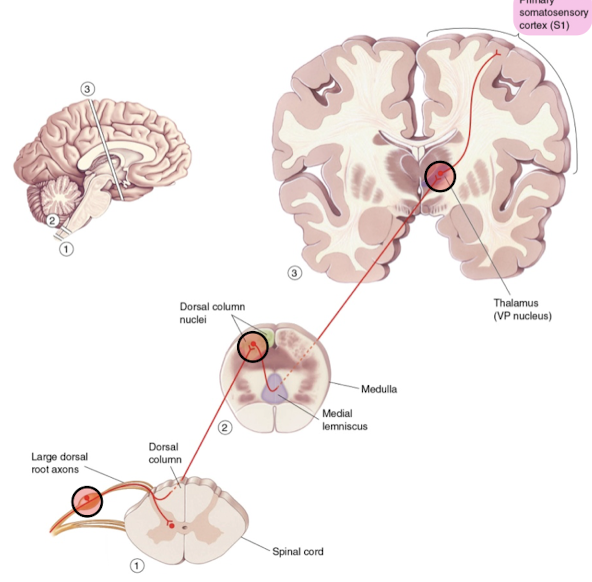
What is the Dorsal Column-Medial Lemniscal Pathway (DCML) pathway?
1. Ascending branch goes up the dorsal column
2. Synapse on the dorsal column nuclei in the medulla
3. Dorsal column nuclei axons decussate and ascend the medial lemniscus
4. Synapse in the VP nucleus of the thalamus
5. Neurons in the VP nucleus project to somatosensory cortex
2. Synapse on the dorsal column nuclei in the medulla
3. Dorsal column nuclei axons decussate and ascend the medial lemniscus
4. Synapse in the VP nucleus of the thalamus
5. Neurons in the VP nucleus project to somatosensory cortex
16
New cards
What type of information does the DCML pathway send?
Touch Information
17
New cards
How many neuron pathways and synapses points does the DCML have to reach S1?
3 neuron pathways
- 1st order, 2nd order, 3rd order
3 synapse points
- first to second, second to third, third to cortex
- 1st order, 2nd order, 3rd order
3 synapse points
- first to second, second to third, third to cortex
18
New cards
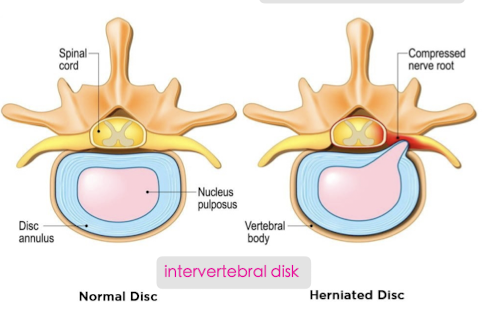
What is a Herniated Disc?
A slipped, ruptured, bulging disc
can compress a nerve root
can compress a nerve root
19
New cards
What are the Symptoms of Herniated Disc?
Pain - Back and Leg
Numbness or tingling
Weakness
Numbness or tingling
Weakness
20
New cards
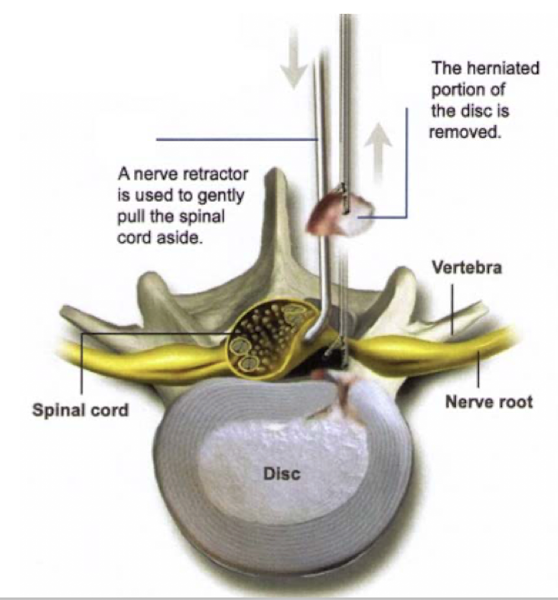
What is the treatment for Herniated Disc?
Rest, physical therapy, pain meds
Surgical - Discectomy/Microdiscectomy
Surgical - Discectomy/Microdiscectomy
21
New cards
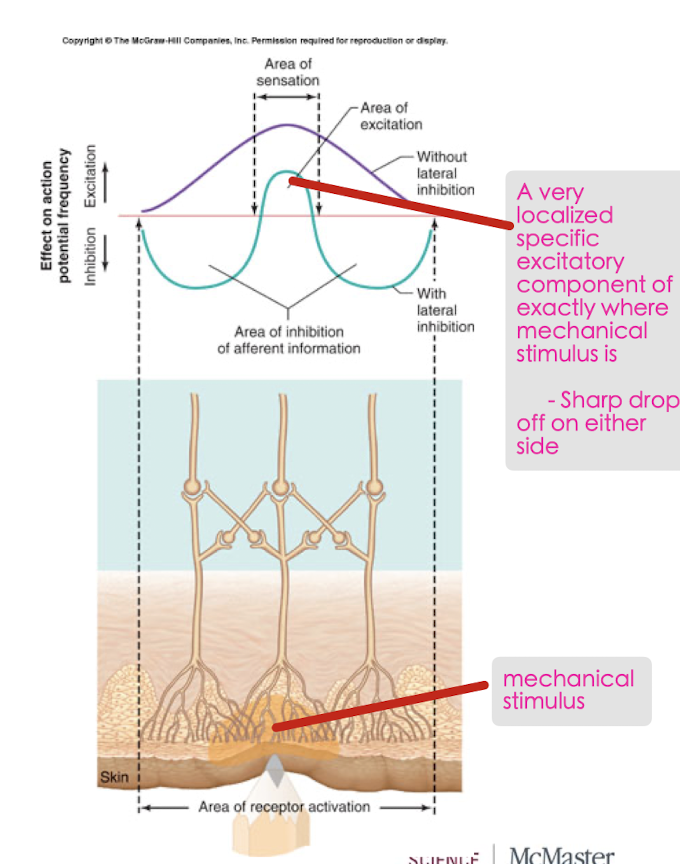
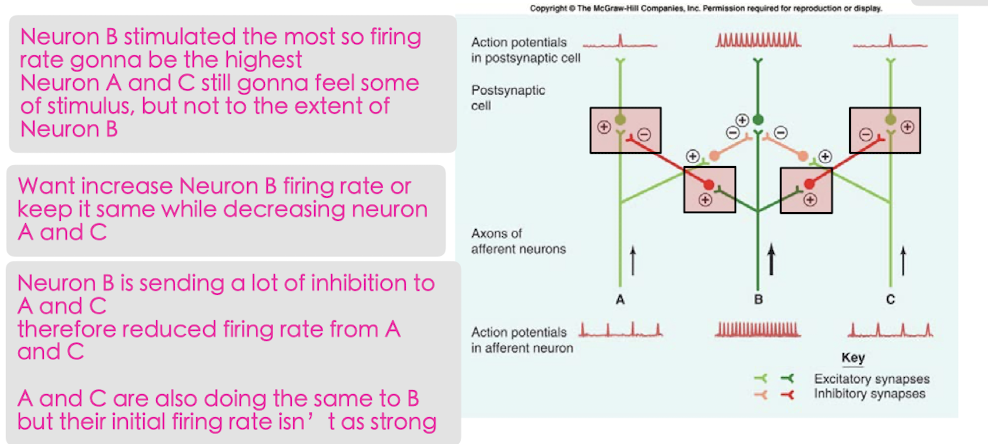
What is Lateral Inhibition?
^^Inhibit adjacent inputs to enhance tactile sensitivity^^
Increases contrast to __**allow for more precise/finer location of sensations**__
* minimize the firing rate of sensory information close to it but maximize the information that is precisely where is it happening
Increases contrast to __**allow for more precise/finer location of sensations**__
* minimize the firing rate of sensory information close to it but maximize the information that is precisely where is it happening
22
New cards
What is Sensory Gating?
It is ^^**Corticothalamic Feedback**^^ influences sensory processing
* cortex to thalamus
Cortex helps to filter irrelevant or repetitive information
__"feel what you want to feel"__
* cortex to thalamus
Cortex helps to filter irrelevant or repetitive information
__"feel what you want to feel"__
23
New cards
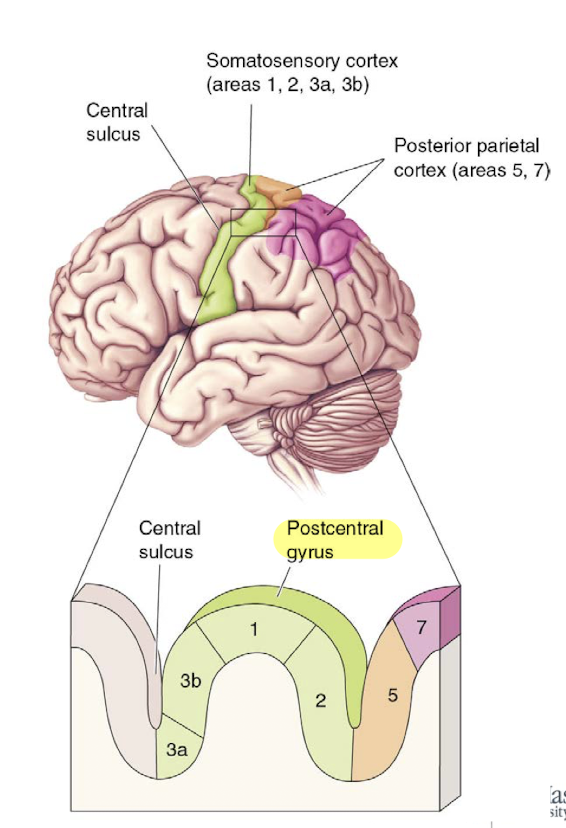
what is the Primary Somatosensory Cortex [3b]
Receives inputs from VP Nucleus
Highly responsive to somatosensory input
Damage impairs sensations
Electrical stimulus creates sensations
Highly responsive to somatosensory input
Damage impairs sensations
Electrical stimulus creates sensations
24
New cards
What is the Somatosensory 3a?
Dense thalamus input, but more body position
25
New cards
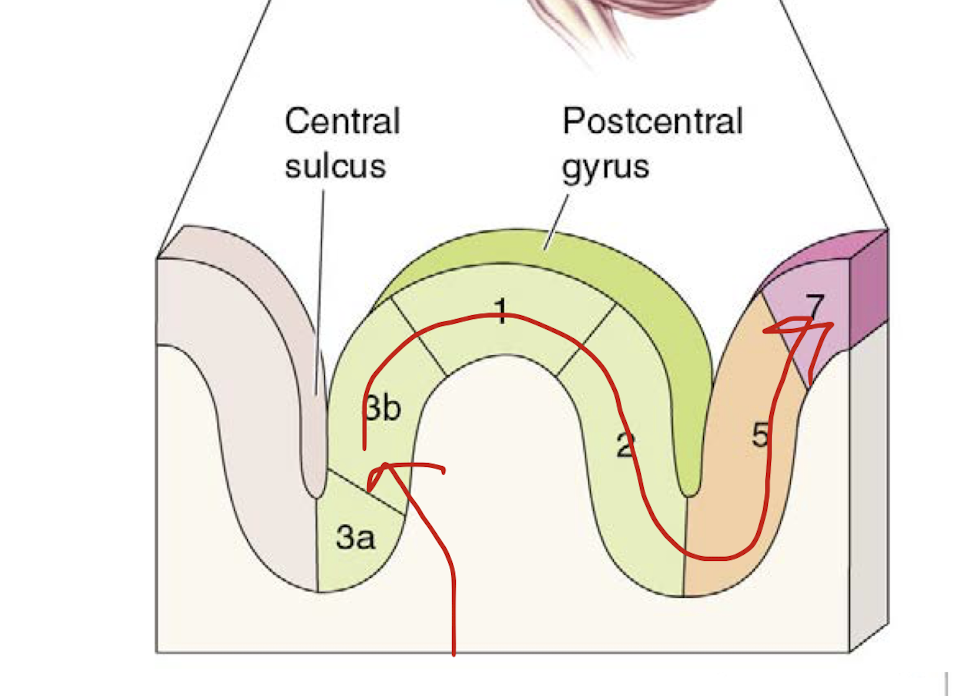
What is Somatosensory 1 & 2 ?
Receives infor from 3b
- trying to integrate things together
Generally related to texture, size, and shape
- starting to combine
- trying to integrate things together
Generally related to texture, size, and shape
- starting to combine
26
New cards
What is Posterior Parietal Cortex?
Allows for processing of basic sensory information and integration with other senses
27
New cards
What is the Posterior Parietal Cortex Area 5?
Sensory integration with planing and organizing of movement
28
New cards
what is the Posterior Parietal Cortex Area 7?
Sensory information for object recognition and spatial relationships
29
New cards
What is a Nociceptor?
A receptor of painful stimulus
30
New cards
What are Nociceptor activated by?
Activated by stimulus that may damage tissue
- strong mechanical stimulus, temp extremes, oxygen deprivation, chemicals: even substance released by damaged cells [lactic acid, histamine, etc]
- strong mechanical stimulus, temp extremes, oxygen deprivation, chemicals: even substance released by damaged cells [lactic acid, histamine, etc]
31
New cards
Does Nociception mean Pain?
NO
Nociception --> sensory process that provides the signals that MAY trigger pain
Pain -> sore, aching, throbbing sensations we "feel"
they can exist without each other
Nociception --> sensory process that provides the signals that MAY trigger pain
Pain -> sore, aching, throbbing sensations we "feel"
they can exist without each other
32
New cards
What are the types of Nociceptors?
Mechanical Nociceptors
Thermal Nociceptor
Chemical Nociceptor
Polymodal Nociceptor
Thermal Nociceptor
Chemical Nociceptor
Polymodal Nociceptor
33
New cards
What are Mechanical Nociceptors?
Respond to damage such as cutting, crushing, or pinching
34
New cards
What are Thermal Nociceptors?
Respond to extreme temperatures
35
New cards
What are Chemical Nociceptors?
Respond to histamine and other chemicals
36
New cards
What are Polymodal Nociceptors?
Respond to equally to all kinds of damaging stimuli
37
New cards
Characteristics of the Fast pain?
(nociceptor, fiber, pain, localization, tming)
(nociceptor, fiber, pain, localization, tming)
Nociceptor --> Mechanical and Thermal
Fiber --> Myelinated A-delta fibers
Pain --> Sharp, prickling sensations
Localization --> Easily localized
Timing --> Fast, occurs first
Fiber --> Myelinated A-delta fibers
Pain --> Sharp, prickling sensations
Localization --> Easily localized
Timing --> Fast, occurs first
38
New cards
Characteristics of Slow pain?
(nociceptor, fiber, pain, localization, tming)
(nociceptor, fiber, pain, localization, tming)
Nociceptor --> Polymodal
Fiber --> unmyelinated C fibers
Pain --> dull, aching, burning sensations
Localization --> poorly localized
Timing --> slow, occurs second and for longer time
Fiber --> unmyelinated C fibers
Pain --> dull, aching, burning sensations
Localization --> poorly localized
Timing --> slow, occurs second and for longer time
39
New cards
What information does the Spinothalamic tract carry to the brain?
Carries **nociceptive information** to the brain
40
New cards
Where are the Spinothalamic tract cell bodies located and where do axons enter?
Cell bodies located in dorsal root ganglion
Axons enter dorsal horn of spinal cord
Axons enter dorsal horn of spinal cord
41
New cards
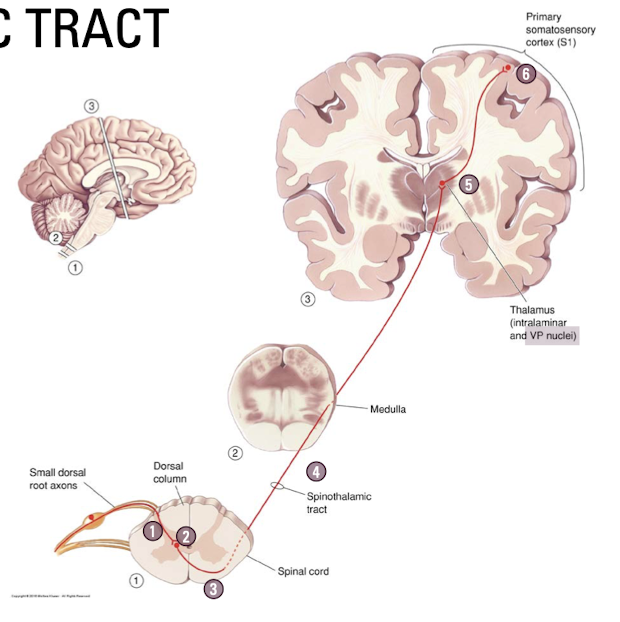
what is the Spinothalamic tract pathway?
1. Enter zone of Lissauer [ascend or descend slightly]
- travels up a bit then enters spinal cord; does not instantly synapse
2. Synpase in the substantia gelatinosa [in dorsal horn]
3. Second order neurons in the spinal cord immediately decussate
4. ascend to the brain in the ventrolateral lateral surface of spinal cord
5. synapse with VP nucleus in thalamus
6. information projected to somatosensory cortex
- travels up a bit then enters spinal cord; does not instantly synapse
2. Synpase in the substantia gelatinosa [in dorsal horn]
3. Second order neurons in the spinal cord immediately decussate
4. ascend to the brain in the ventrolateral lateral surface of spinal cord
5. synapse with VP nucleus in thalamus
6. information projected to somatosensory cortex
42
New cards
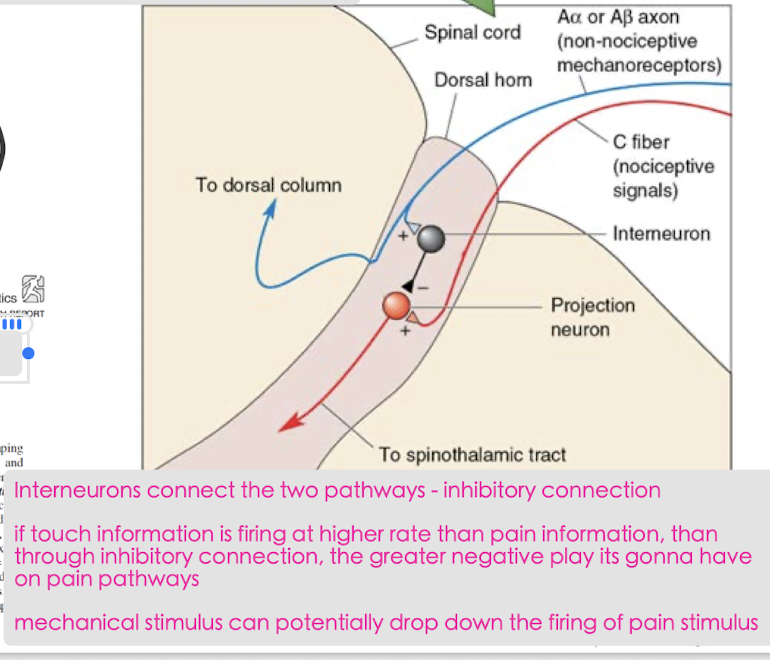
What is Afferent Pain Regulation?
Pain being reduced by the activity of mechanoreceptors
- mechanical information coming in can over ride pain information
- mechanical information coming in can over ride pain information
43
New cards
What is gate control theory of pain?
Neurons in the spinothalamic tract may be inhibited by A-alpha or A-beta sensory nerves (touch) in the dorsal horn of the spinal cord
44
New cards
What is decending regulation of pain?
Brain can do powerful things when it comes to controlling pain (strong emotion, stress etc.)
- brain is trying to minimize pain
- could be to major stress response
- brain is trying to minimize pain
- could be to major stress response
45
New cards
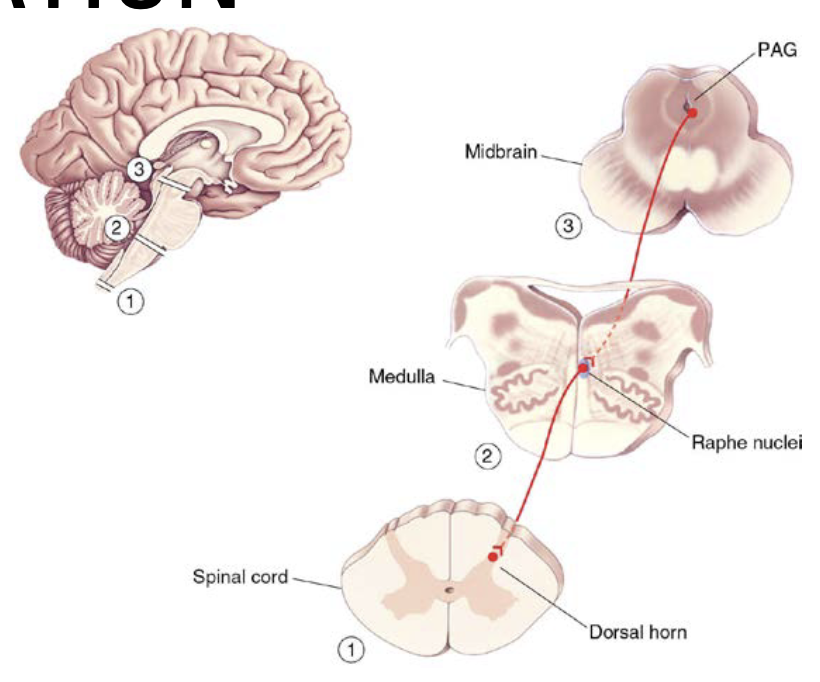
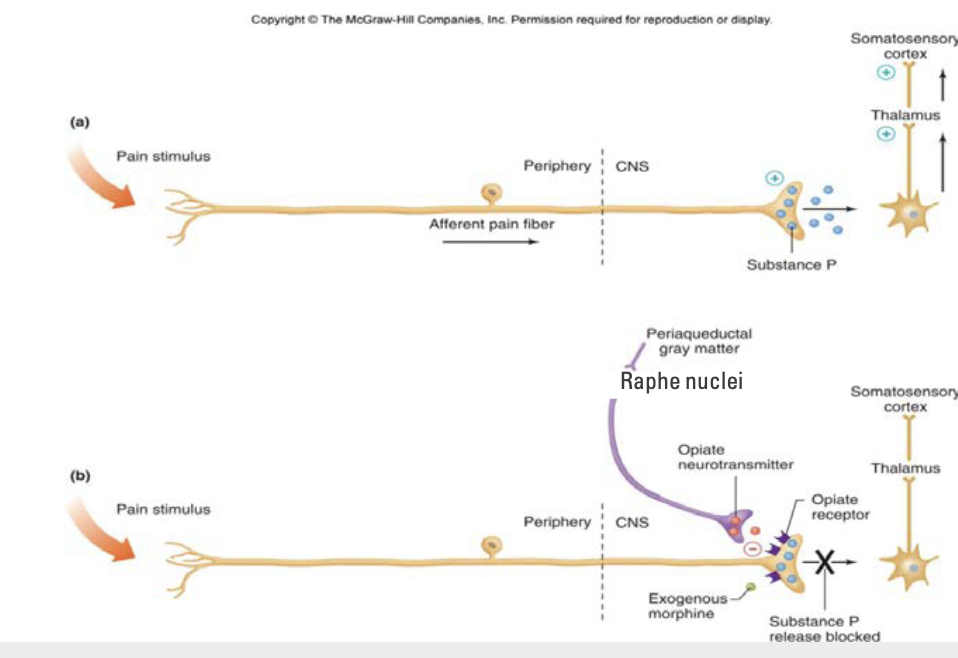
What is the Periaqueductal Gray Matter (PAG) Pathway?
1. Receives input from many areas in the cortex (often emotional)
2. Neurons descend to medulla (raphe nuclei)
3. Neurons descend to spinal cord to depress activity
** sends information down to spinal cord and synapses in dorsal horn**
2. Neurons descend to medulla (raphe nuclei)
3. Neurons descend to spinal cord to depress activity
** sends information down to spinal cord and synapses in dorsal horn**
46
New cards
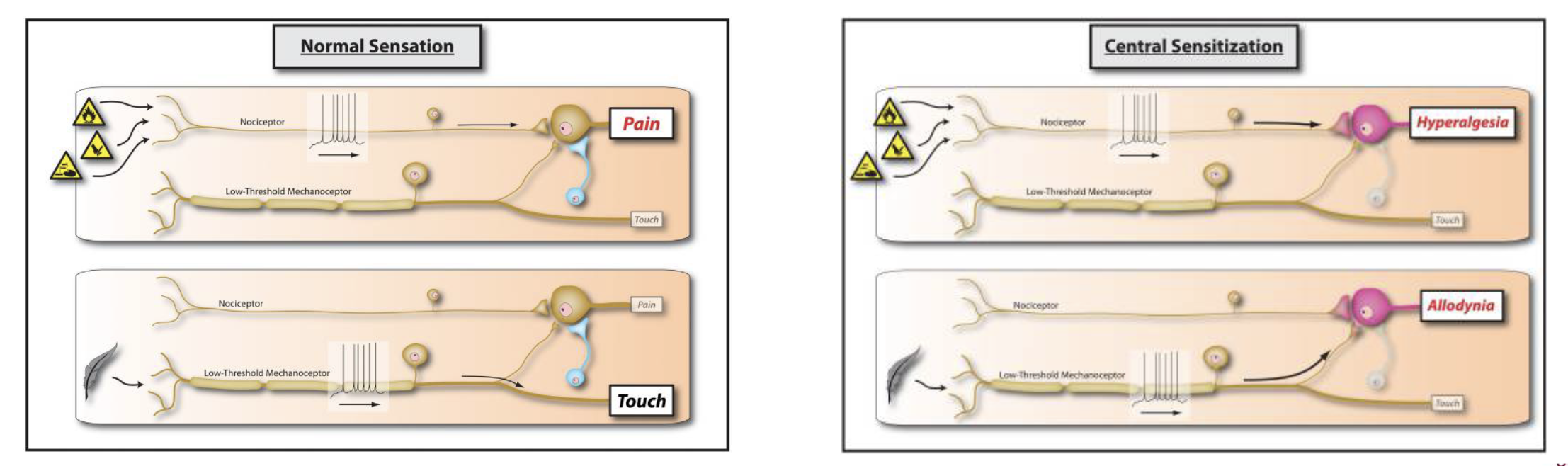
What is Hyperalgesia?
Reduction in the Pain threshold, increases sensitivity or spontaneous pain
47
New cards
What is Primary Hyperalgesia?
super-sensitivity within the damaged area
48
New cards
what is secondary Hyperalgesia?
super-sensitivity in the surrounding area
49
New cards
What is the primary change that occurs peripherally in Hyperalgesia?
Inflammation
- bodies attempt to eliminate injury and stimulate healing
A variety of neurotransmitters, peptides, lipids, etc, are released which can attach to receptors in/around injury to lower their threshold for activation
- bodies attempt to eliminate injury and stimulate healing
A variety of neurotransmitters, peptides, lipids, etc, are released which can attach to receptors in/around injury to lower their threshold for activation
50
New cards
How is Allodyina different from Hyperalgesia?
Alloydina is similar BUT pain response from stimuli that would normally NOT cause pain
51
New cards
What is Central Sensitization?
Amplification of neural signalling (e.g. nociceptive info) within the CNS that elicits pain hypersensitivity or even normal stimuli (allodyina)
\
**using pathways over and over causes them to become hypersensitive (chronic injuries/pain)**
\
**using pathways over and over causes them to become hypersensitive (chronic injuries/pain)**
52
New cards
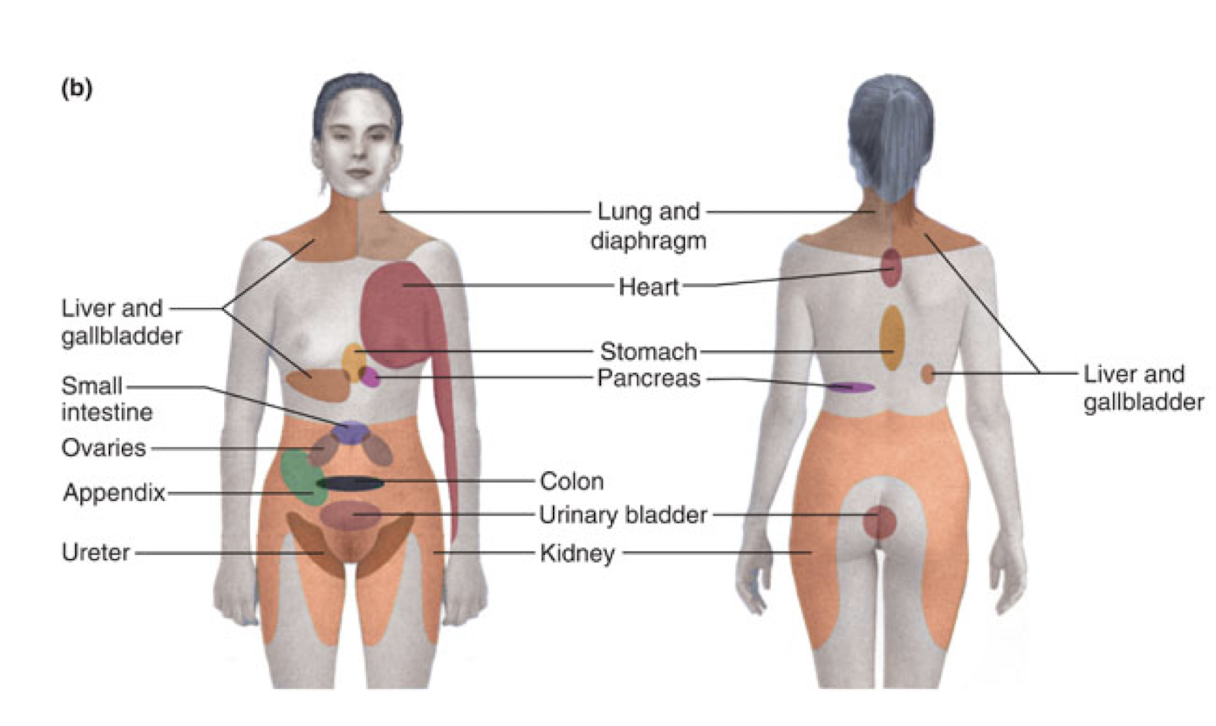
What is Referred Pain ?
^^**Cross-talk**^^ between sensory neurons
* convergence of visceral and somatic afferent neurons
ex. heart attack --> feel in left arm
* convergence of visceral and somatic afferent neurons
ex. heart attack --> feel in left arm
53
New cards
What are Thermoreceptors?
Varying sensitivities to hot and cold temps
- Hot temps = C Fibers
- Cold temps = A-delta + C fibers
Adapt to long durations of stimuli
Follow same pathways as Pain
- Hot temps = C Fibers
- Cold temps = A-delta + C fibers
Adapt to long durations of stimuli
Follow same pathways as Pain
54
New cards
What is Proprioception?
Our perception of the location and movement of our body
Allows us to control limb and joint position for optimal movement
Group 1 Neruons (from muscle) myelinated fibers
Allows us to control limb and joint position for optimal movement
Group 1 Neruons (from muscle) myelinated fibers
55
New cards
What are the two primary receptors for Proprioception?
Muscle spindle --> amount of stretch in a muscle
Golgi tendon organ --> amount of force
Golgi tendon organ --> amount of force
56
New cards
What is Conscious Proprioceptive information pathway?
Dorsal Column medial lemniscus pathway (DCML)
57
New cards
What is Unconscious Proprioceptive information pathway ?
Spinocerebellar tracts --> to cerebellum
Spinal interneurons --> Spinal reflexes
Spinal interneurons --> Spinal reflexes
58
New cards
Where is the Primary visual cortex located?
Broadman’s area 17
Occipital lobe → posterior parietal lobe
Occipital lobe → posterior parietal lobe
59
New cards
What is the Primary visual cortex?
first area of the cortex to receive visual information
60
New cards
What are the two main pathways of the primary visual cortex?
Dorsal stream + ventral stream
61
New cards
What is the Dorsal stream?
* object recognition W/ TOUCH
* Processing visual motion
* Processing visual motion
62
New cards
What type of visual motion does the Dorsal stream process?
\
* Navigation
* perceiving the direction and speed of objects
* Directing eye movement
* sense motion and quickly react
* motion perception
* interpretation of moving objects
* Navigation
* perceiving the direction and speed of objects
* Directing eye movement
* sense motion and quickly react
* motion perception
* interpretation of moving objects
63
New cards
What is the ventral stream?
Information passed toward the temporal lobe
Processing of vision other than motion
Relating more to object preception W/ VISION --> identifying objects
Processing of vision other than motion
Relating more to object preception W/ VISION --> identifying objects
64
New cards
What type of vision other than motion does the ventral stream process?
* Object perception + facial recognition
* not only recognize features but remember faces
* not only recognize features but remember faces
65
New cards
What is the Vestibular System?
* Balance, equilibrium, posture
* Based on motion of hair cells
* Humans = Vestibular Labyrinth
* Based on motion of hair cells
* Humans = Vestibular Labyrinth
66
New cards
What are the parts of the vestibular system?
* Otolith organs ---> acceleration and tilt
* Semicircular Canals ---> head rotation
* Use hair cells to detect changes
* Semicircular Canals ---> head rotation
* Use hair cells to detect changes
67
New cards
What do the Otolith organs measure?
Measures Acceleration and Tilt --> depend on direction they deflect
68
New cards
Parts of the otolith organs?
* Macula --> epithelium-filled pouch w/ hair cells
* Kinocilium --> tallest, most important cilia
* measures things in respect to how far
* Otoconia (ear stones) --> calcium carbonate crystals
* provide weight on top
* squish fluid as moves around
* Kinocilium --> tallest, most important cilia
* measures things in respect to how far
* Otoconia (ear stones) --> calcium carbonate crystals
* provide weight on top
* squish fluid as moves around
69
New cards
What is the Macular Orientation?
__**Array of hair cell orientation**__ within Otolith organs
\
Allows __**measures of all possible linear movements**__
* measure tilt in all directions
\
Allows __**measures of all possible linear movements**__
* measure tilt in all directions
70
New cards
What are the types of Macular Orientation?
* Saccular macula --> vertically oriented
* Utricular macula --> horizontally oriented
* Utricular macula --> horizontally oriented
71
New cards
What do the semicircular canal measure?
__**Measures head rotation**__ → angular acceleration
* three canals on each side → help sense all possible head rotation
Principle of inertia
Push-Pull activation of vestibular axons
prolonged dizziness will keep fluid in motion \[dizziness --> opposite direction\]
* three canals on each side → help sense all possible head rotation
Principle of inertia
Push-Pull activation of vestibular axons
prolonged dizziness will keep fluid in motion \[dizziness --> opposite direction\]
72
New cards
What are the parts of the semicircular canals?
* Crista ampullaris -->
* cupula \[bubble\] fill of cilia found within an ampulla \[bulge\]
\
* Endolymph
* reacts slowly to quick rotations which deflect the cupula + cilia
* as rotation occurs fluid will remain where it is or start moving crista in one direction
* cupula \[bubble\] fill of cilia found within an ampulla \[bulge\]
\
* Endolymph
* reacts slowly to quick rotations which deflect the cupula + cilia
* as rotation occurs fluid will remain where it is or start moving crista in one direction
73
New cards
What is the Central Vestibular Pathway?
\*\*Pathway of vestibular information and reflexes to control head, body, eye movement
1. Otolith organs + semocicular canals
2. Vestibulochochlear nerve \[VIII\] --> vestibular + cochlear nerve
* biopolar neurons
3. vestibular nuclei
* dorsolateral regions of medulla
* integrate with other information \[visual/motor\]
4. Send out information above and below
* cerebellum, VP of thalamus, extraocular motor neurons, limbs, neck, trunk
1. Otolith organs + semocicular canals
2. Vestibulochochlear nerve \[VIII\] --> vestibular + cochlear nerve
* biopolar neurons
3. vestibular nuclei
* dorsolateral regions of medulla
* integrate with other information \[visual/motor\]
4. Send out information above and below
* cerebellum, VP of thalamus, extraocular motor neurons, limbs, neck, trunk
74
New cards
Where does the Central Vestibular Pathways Sends info out to...
* cerebellum
* thalamus \[VP Nucleus\]
* Extraocular motor neurons
* Limbs
* Neck and Trunk
* thalamus \[VP Nucleus\]
* Extraocular motor neurons
* Limbs
* Neck and Trunk
75
New cards
The Cerebellum receives what type of information from the Central Vestibular Pathway?
Vestibular sensations needed for FINE MOVEMENTS, coordinating movement patterns
76
New cards
The Thalamus receives what type of information from the Central Vestibular Pathway?
* projects to post-central gyrus
* info received by the cortex maintains a representation of the body in space
* info received by the cortex maintains a representation of the body in space
77
New cards
The Extraculor motor neurons receives what type of information from the Central Vestibular Pathway?
* Reflexive eye movements
* Primary goal --> maintain gaze \[eye needs to know how head is moving so keep tract at what we are looking at\]
* Primary goal --> maintain gaze \[eye needs to know how head is moving so keep tract at what we are looking at\]
78
New cards
The Limbs receives what type of information from the Central Vestibular Pathway?
* reflective limbs movements
* primary goal --> keep body upright
* primary goal --> keep body upright
79
New cards
The Neck & Trunk receives what type of information from the Central Vestibular Pathway?
* reflexive neck/trunk movements
* primary goal --> keep head upright
* primary goal --> keep head upright
80
New cards
What is the function of the Vestibulo-Ocular reflex (VOR)
to fixate line of sight on visual target during head movement
81
New cards
What is the mechanism of the Vestibulo-Ocular reflex (VOR)
senses rotation of head, commands compensatory movement of eyes in opposite direction
82
New cards
Vestibular Connections - horizontal eye movements
* head rotate to left, eye rotate to right
* one semicircular canal will increase FR and one will decrease FR
* key is push and pull --> one inhibits, one excites
* job is to control extra ocular muscles
* eyes moving to right = muscles on right side of eyes need to contract, inhibit muscles on the left side
* Semicircular canals change FR to control ocular muscles
* Excitation and Inhibition cross over
* one semicircular canal will increase FR and one will decrease FR
* key is push and pull --> one inhibits, one excites
* job is to control extra ocular muscles
* eyes moving to right = muscles on right side of eyes need to contract, inhibit muscles on the left side
* Semicircular canals change FR to control ocular muscles
* Excitation and Inhibition cross over
83
New cards
What are the Vestibular Changes in the __**Otolith organs**__ with Age
* loss of cilia --> sensations and organs not as efficient
* alterations in otoconia (size and shape) --> crystal carbonate breakdown \[stone crumble\]
* alterations in otoconia (size and shape) --> crystal carbonate breakdown \[stone crumble\]
84
New cards
What are the Vestibular Changes in the __**Semicircular canals**__ with Age
* loss of cilia, to a greater extent than otolith organs
* greater impact in VOR
* greater impact in VOR
85
New cards
What are the Vestibular Changes in the __**Central changes**__ with Age
occurs around 60 years age
* vestibular nuclei --> slow loss of neurons
* Cerebellum --> slow loss or change in connectivity
\
Overall leads to a reduction in sensory info for controlling head, eyes, body and balance = increased fall risk
* vestibular nuclei --> slow loss of neurons
* Cerebellum --> slow loss or change in connectivity
\
Overall leads to a reduction in sensory info for controlling head, eyes, body and balance = increased fall risk
86
New cards
What is Benign Paroxysmal Positional Vertigo \[BPPV\]
* Benign = Harmless in long term
* Paroxysmal = sudden onset/recurrence of symptoms (
* Paroxysmal = sudden onset/recurrence of symptoms (
87
New cards
Causes of Benign Paroxysmal Positional Vertigo \[BPPV\]
* otoconia (ear stones) migrating into semicircular canals \[displaces in organs\]
* disrupting the cupula located in ampulla
* disrupting the cupula located in ampulla
88
New cards
Treatment of Benign Paroxysmal Positional Vertigo \[BPPV\]
* often resolves on own
* specific head manoeuvers can repositon debris out
* specific head manoeuvers can repositon debris out
89
New cards
Causes of Vestibular Neuronitis?
inflammation of vestibular nerve
90
New cards
Symptoms of Vestibular Neuronitis?
* vertigo for several days
* does NOT affect hearing
* does NOT affect hearing
91
New cards
Treatment of Vestibular Neuronitis?
* anti-nausea medication until inflammation reduces
* steroids to reduce inflammation
* physical therapy/activity can help the body compensate
* steroids to reduce inflammation
* physical therapy/activity can help the body compensate
92
New cards
Cause of Labyrinthitis?
* inflammation of entire inner ear due to infection
93
New cards
Symptoms of Labyrinthitis
* vertigo last for several days
* DOES affect hearing
* DOES affect hearing
94
New cards
Treatment of Labyrinthitis
* treat infection
* anti-nausea medication until inflammation reduces
* physical therapy/activity can help body compensate
* anti-nausea medication until inflammation reduces
* physical therapy/activity can help body compensate
95
New cards
Cause of Meniere's Disease
* excessive fluid up in inner ear
96
New cards
Symptoms of Meniere's Disease
* sudden episodes of --> tinnitus, hearing loss, vertigo
* each episode can last minutes to hours
* may occur in clusters, then subside for years
* each episode can last minutes to hours
* may occur in clusters, then subside for years
97
New cards
Treatment of Meniere's Disease
* no cure --> mange symptoms
* can lead to permanent hearing loss but rare
* can lead to permanent hearing loss but rare
98
New cards
What are Mechanoreceptors in Skin?
Somatosensory receptor
* Receptive to physical distortion
* Receptive to physical distortion
99
New cards
What are the 4 primary Mechanoreceptors in Skin
* Pacinian Corpuscles
* Mesissner's Corpuscles
* Ruffini endings
* Merkels Disk
* Mesissner's Corpuscles
* Ruffini endings
* Merkels Disk
100
New cards
What do Mechanoreceptors vary by?
* Receptive field (large vs small)
* Adaptation (rapid vs slow)
* Adaptation (rapid vs slow)
 Note
Note  Flashcards (22)