Chapter 54 - Behavioural Ecology
 Call Kai
 Learn
Learn Practice Test
 Spaced Repetition
 Match
Match Flashcards
 Knowt Play
1/45

There's no tags or description
Looks like no tags are added yet.
Name | Mastery | Learn | Test | Matching | Spaced | Call with Kai |
|---|
No analytics yet
Send a link to your students to track their progress
46 Terms
What can explain diverse behaviours
selection for individual survival and reproductive success
3 key questions for the evolution of foraging behaviour
where to forage
what to eat
when to search for pray
The optimal diet model
prey are ranked by benefit (usually energy) per unit of handling time
top ranked prey are never rejected
lower-ranked prey may be rejected in the presence of more valuable food available
ex. oystercatcher may choose medium-size mussels over large mussels because large mussels take too long to open
central place foraging
foraging from a central place (nest or a den when feeding offspring) to catch prey
prediction of central foraging theory
longer travel times are only worthwhile if you can bring back large more valuable prey
ex. ospreys flying further to forage bring back larger fish to the nest
When to forage and examples
many animals schedule foraging to avoid predators
ex. deer, mice, and kangaroo rats forage at night (nocturnally) to avoid daytime (diurnal) predators
but some predators like owls take advantage of nocturnal foraging prey
Mating behaviour and Mate choice
these behaviours include seeking or attracting mates, choosing among potential mates, competing for mates, and caring for offspring
2 types of Mating Systems
Monogamous and Polygamous
Monogamous Mating system
one male mates with one female
males and females usually have similar external
Polygamous Mating System
an individual of one sex mates with several individuals of the other sex
species in this system are usually sexually sexually dimorphic
males and females have different external morphologies
types of Polygamous Mating systems
Polyandry - one female mates with multiple males
ex. phalaropes, angler fish
Polygyny - one male mates with multiple females
ex. elephant seals, elk
Polygynandrous - both males and females have multiple partners
ex. red-winged blackbirds
Mating Systems and Parental Care
mating relationship between males and females varies from species to species
in many species, mating is promiscuous with no strong pair-bonds or lasting relationships
2 factors that affect the mating system and parental care
expensive offspring favour monogamy
certainty of paternity
How Expensive Offspring favour monogamy
favoured when offspring require much parental care (ex. altricial birds) and can’t care for themselves
males benefit by staying with their partner
since they can produce more offspring that can survive better
ex. in precocial birds where the young can feed themselves (like ducks and pheasants), males derive less benefit from staying with their partner
so they maximize reproductive success by searching for other mates
Importance of the Certainty of paternity
males can increase their reproductive success by:
helping a female to raise his offspring
searching for other mates
males gain no evolutionary benefit if another male is the genetic parent of the offspring
ex. male birds singing to attract mates are less likely to care for kids
how certainty of paternity affects parental care
certainty of paternity is lowest in species with internal fertilization
and vice versa
paternal care is more common in species with external fertilization like fish, amphibians, aquatc invertebrates
ex. giant waterbug and plainfin midshipman
Types of sexual selection
intersexual selection - members of one sex choose mates on the basis of certain traits such as plumage or colour
intrasexual selection - competition between members of the same sex for mates, often by fighting
Female choice
type of intersexual selection
where females drive sexual selection by choosing males with specific behaviours or features of anatomy
ex. female stalk-eyed flies choose males with long eyestalks
ornaments like long eyestalks or plumage of peacock often correlate with health and vitality
male competition
source of intrasexual selection that can reduce variation among males
favours the evolution of weaponry and large body size
agonistic behaviour
may happen in male competition
ritualized contest that determines which competitor gains access to a resource
types of midshipman males
Type 1 Males - more larger and vocalize when attracting females
Type 2 males don’t vocalize
weaponry (features) for fighting in salmon
chum salmon are sometimes called '“dog” salmon because they have canine teeth that develop when spawning
hooknose male in chinook salmon don’t feed on spawning grounds
canine teeth are for fighting with other males
genetic basis of behaviour
most behaviours have a genetic basis to some extent
true for all humans
the big 5 personality traits (extraversion, agreeableness, openness, conscientiousness, neuroticism) show a high degree of variability
some behavioural variation can be linked to variation in a single gene, but most are controlled by many genes (polygenic)
example of mating systems and genetic basis of behaviour
mating system in prairie vs. meadow voles
prairie voles are monogamous, which makes them unusual, while meadow voles are polygynous
difference in male behaviour can be traced to the gene receptor for a neuropeptide hormone (vasopressin)
vassopressin
and also oxytocin (which is closely related)
they are neuropeptides that play a key role in social attachment and affiliation including parental care and pair-bonding
influence of a single locus variation
differences at a single locus can sometimes have large effect on behaviour
ex. male prairie voles pair-bond, while male meadow voles don’t
level of a specific receptor for a neurotransmitter determines which behavioural pattern develops
Case Study - variation in Prey selection of Garter Snakes
natural diet of gartner snakes varies by population
coastal populations - mostly feed on banana slugs
inland populations - rarely eat banana slugs
studies show that these differences in diet are genetic
causes them to differ in ability to detect and respond to specific odor molecules of banana slugs
Monoamine Oxidase A gene (and how it affects behaviour)
codes for an enzyme that breaks down neurotransmitters norepinephrine and dopamine
single point mutation disables the gene that is located on X chromosome
males with the mutation (super rare) are cognitively impaired and prone to violence and sexual offences
gene affects fight or flight responses
can respond inappropriately to minor stressors
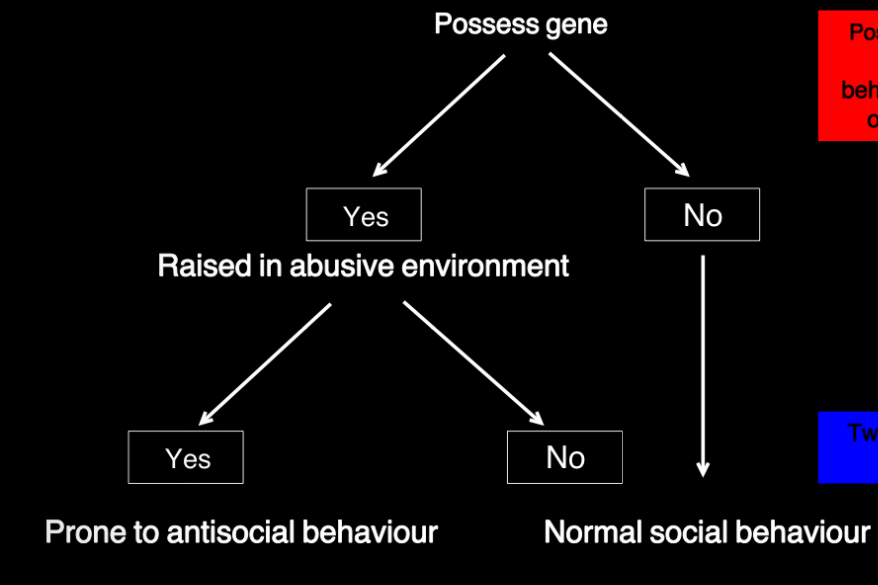
Warrior genes
variant of monoamine oxidase A gene
slow acting variant may result individuals being more prone to aggression / antisocial behaviour
effect is conditional on early environment - having the gene doesn’t guarantee the behaviour, it depends on early environment
individuals raised in abuse environments show antisocial behaviour
individuals raised in nurturing environments show normal behaviour
twin studies and behaviour
allow researchers to compare relative influences of genetics and environments on behaviour
monozygotic twins show more concordance (similarity) than dizygotic twins
suggest that genes are important
altruism
when animals may behave in ways that reduce their individual fitness but increase the fitness of others
ex. when under threat from a predator, Belding’s ground squirrel will alarm others, even if alarming others increases the chance that a killer is called towards him
William D. Hamilton
proposed Kin Selection and Hamilton’s Rule
Inclusive fitness
total effect an individual has on increasing number of its genes by producing offspring and helping close relatives produce offspring
helps explain altruistic behaviour
ex. workers (all females) in ants, bees, and wasps don’t reproduce
they assist close relatives to raise offspring
Concept of Relatedness
explains why the average relatedness of full siblings is ½
there is a 50% chance that you will share an identical copy of a gene you received from one of your parents
3 variables in altruistic acts
B - benefit to the receipient
C - cost to the altruist
r - coefficient of relatedness
fraction of genes that are shared on average
Hamilton’s rule
Natural selection favours altruism when
rB > C
Kin selection
an animal can increase its genetic representation in the next generation by helping close relatives (other than its own offspring) that share identical genes
favours Hamilton’s rule by enhancing reproductive success of relatives
Case Study - inclussive fitness in Belding’s groun squirrels
female belding’s ground squirrels are more likely to call alarm in the presence of a predator than males
alarm calling is dangerous since it attracts predators
but in a group, most of the females are closer related to each other than males are
kin selection benefit for calling is greater for females than males
Inclusive fitness in mole rats
Naked mole rats in a colony are closely related
non-reproductive individuals increase their inclusive fitness by helping the reproductive queen and kings (and close relatives) to pass their genes to the next generation
human behaviour
results from interactions between genes and environment
social and cultural institutions may provide the only feature where there is no continuum between humans and other animals
examples of adaptive human behaviours
possess a language instinct
acquire language automatically during an early critical period that lasts until around puberty
tongue pushing in newborns
during first months of life, infants push solid objects from mouth
this behaviour is adaptive because the digestive system is not yet ready for solid food
why do mothers gain weight during pregnancy
lactation is energetically expensive
mothers add weight during pregnancy to pay for cost of lactation
mothers of twins gain more weight than mothers of singletons
Incest avoidance
children raised together in the first 30 months of life usually show no sexual interest in one other
this is adaptive because it avoids harmful effects of inbreeding
each of us carry two recessive lethal genes on average
Traits for which genetic basis is known
alzheimer’s, aggression, dyslexia, extraversion, general intelligence, sexual orientation, memory, verbal ability, obsessive compulsive disorder, novelty-seeking behaviour, shizophrenia, spatial abiility
genes play a role in almost every behaviour, but no behaviour is 100% heritable
Parent-offspring conflict
concept that offspring should be more selfish than parents desire
since parents and offspring have shared but not identical genetic interests
parent-offspring conflict in humans
human pregnancy is an example
Preeclampsia - high blood pressure
gestational diabetes
both are due to embryonic genes manipulating mother to increase food supply to the fetus
both involve imprinted genes (due to the dad)

