Week 2 - Lecture PPT - Neuron Physiology Flashcards
 Studied by 0 people
 Call Kai
 Learn
Learn Practice Test
 Spaced Repetition
 Match
Match Flashcards
 Knowt Play
1/25

Earn XP
Description and Tags
Flashcards derived from the Neuron Physiology lecture notes, covering nervous system organization, resting and graded potentials, action potentials, refractory periods, conduction, and synaptic transmission.
Name | Mastery | Learn | Test | Matching | Spaced | Call with Kai |
|---|
No analytics yet
Send a link to your students to track their progress
26 Terms
How is the nervous system classified anatomically and functionally?
Anatomically: CNS vs PNS. Functionally: sensory vs motor, and somatic vs autonomic.
What are the two main types of nervous tissue cells?
Neurons (excitable, transmit signals) and neuroglia (support cells).
Which cells form myelin in the CNS and PNS?
Oligodendrocytes in CNS; Schwann cells in PNS.
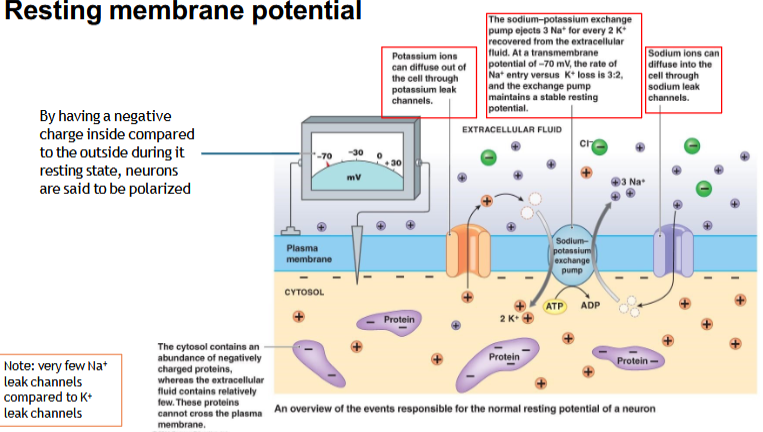
What is the typical resting membrane potential of a neuron?
–70 mV (inside negative compared to outside).
What factors contribute to the resting membrane potential?
K+ leak channels (main contributor), negatively charged proteins trapped inside, few Na+ leaks, and Na+/K+ pump.
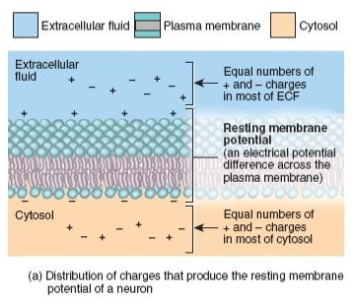
Why are neurons considered 'polarized'?
Because the inside of the membrane is negative compared to the outside.
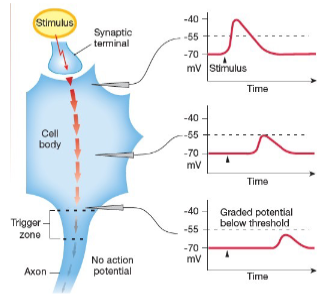
What causes graded potentials?
Opening of ligand-gated ion channels on dendrites.
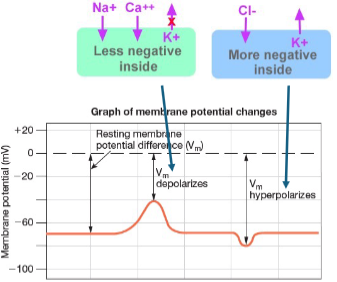
What is the difference between depolarizing and hyperpolarizing graded potentials?
Depolarizing potentials bring the membrane closer to threshold; hyperpolarizing potentials move it further from threshold.
Why do graded potentials usually not cause action potentials?
They lose strength as they travel and often don’t reach threshold.
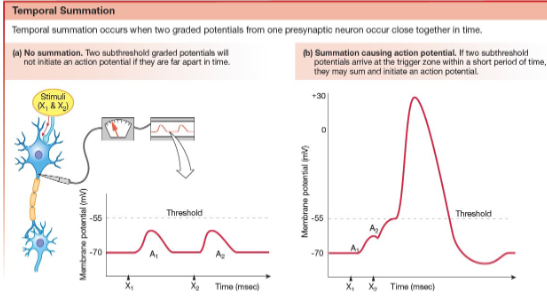
What is summation in neurons?
The combining of multiple graded potentials to reach threshold.
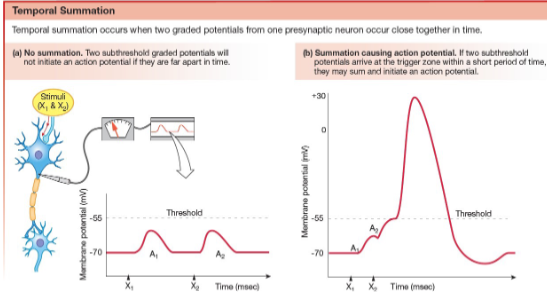
What are the two types of summation?
Temporal (rapid succession of signals) and spatial (inputs from different neurons).
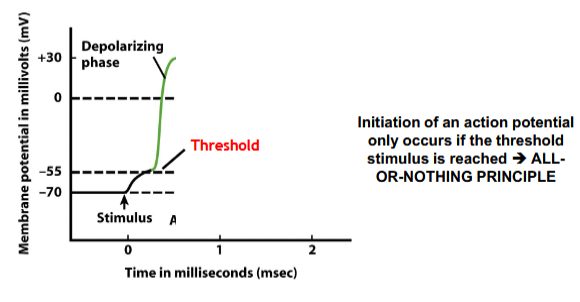
What is the threshold for an action potential in neurons?
About –55 mV.
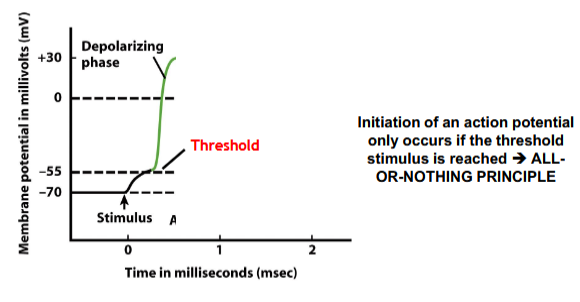
What is the all-or-nothing principle?
Once threshold is reached, an AP fires at full strength, regardless of stimulus size.
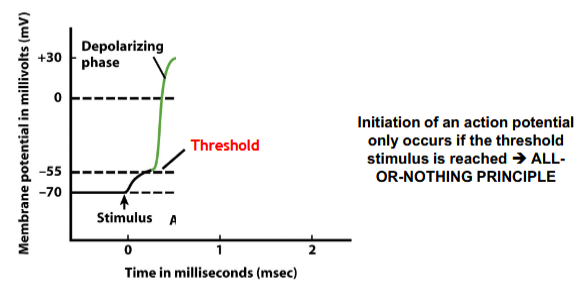
What are the main phases of an action potential?
Depolarization (Na+ influx) getting positive, repolarization (K+ efflux) getting negative again, hyperpolarization (super negative), return to resting membrane potential.
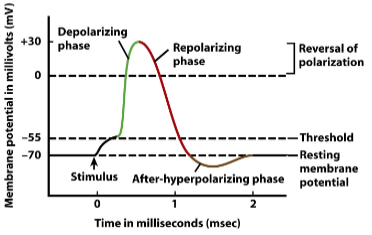
Do action potentials vary in amplitude?
No; they are always the same(all-or-nothing).
Why can action potentials travel long distances without weakening?
Because voltage-gated channels regenerate the signal along the axon.
What is the absolute refractory period?
Time when no new AP can fire (Na+ channels inactivated).
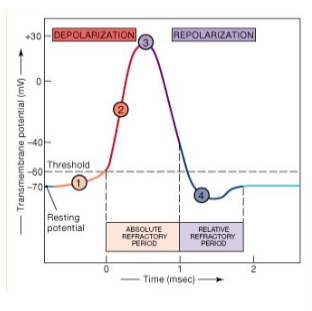
What is the relative refractory period?
Period when AP can fire, but only with a suprathreshold stimulus (Na+ reset but K+ still open).
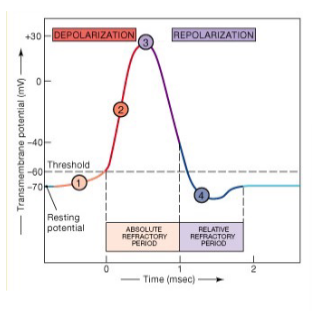
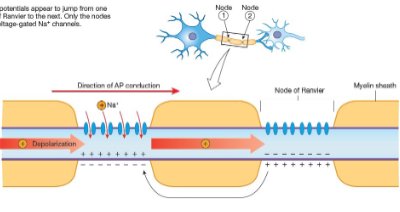
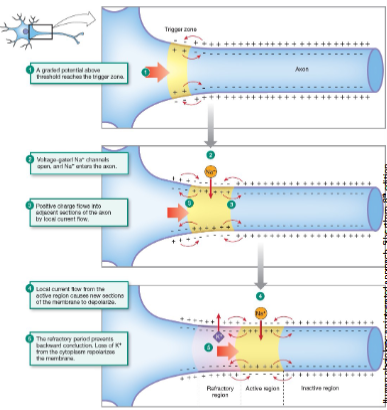
How is conduction different in unmyelinated vs myelinated axons (IMAGE)?
Unmyelinated (IMAGE) = continuous conduction; myelinated = saltatory conduction (AP jumps node to node, faster).
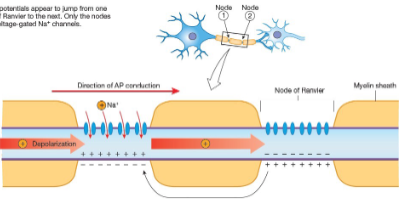
What is a clinical example of impaired conduction?
Multiple sclerosis (demyelination slows/stops conduction).
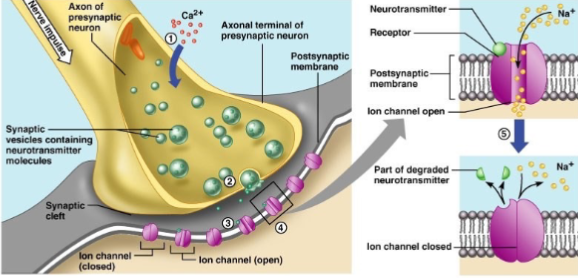
What are the components of a chemical synapse?
Presynaptic terminal, synaptic cleft, postsynaptic membrane.
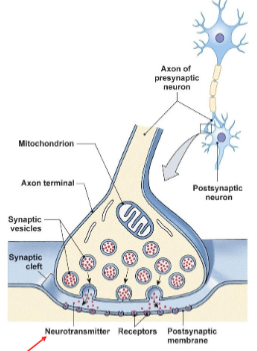
What ion triggers neurotransmitter release at the presynaptic terminal?
Calcium (Ca2+).
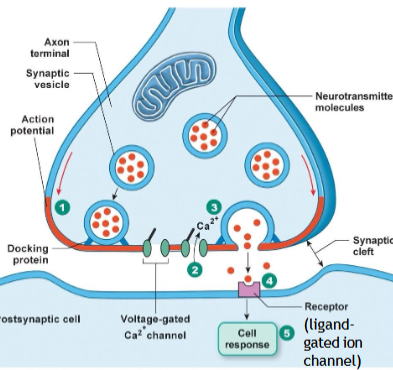
Give an example of an excitatory neurotransmitter and its effect.
Acetylcholine (ACh) → binds to Na+ channels → depolarization (EPSP).
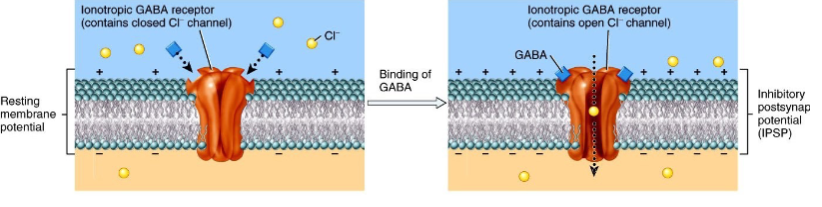
Give an example of an inhibitory neurotransmitter and its effect.
GABA → opens Cl- channels → hyperpolarization (IPSP).
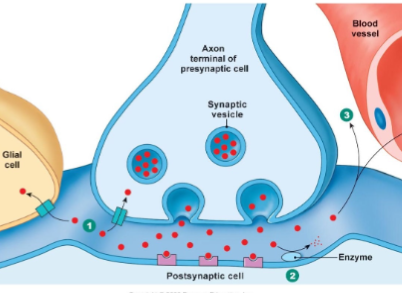
How is neurotransmitter action terminated?
Reuptake by presynaptic neuron, enzymatic degradation, or diffusion away.
What makes neurons unique in signal transmission?
They generate graded potentials (local), action potentials (long-distance), and communicate via synapses.
 Note
Note  Flashcards (106)