8.2.3 Gene Expression and Cancer
 Studied by 0 people
 Call Kai
 Learn
Learn Practice Test
 Spaced Repetition
 Match
Match Flashcards
 Knowt Play
1/10

There's no tags or description
Looks like no tags are added yet.
Name | Mastery | Learn | Test | Matching | Spaced | Call with Kai |
|---|
No analytics yet
Send a link to your students to track their progress
11 Terms
Describe how tumours and cancers form
mutations in DNA / genes controlling mitosis can lead to uncontrolled cell division
Tumour formed if this results in mass of abnormal cells
→ malignant tumour = cancerous, can spread by metastasis
Benign tumour = non-cancerous
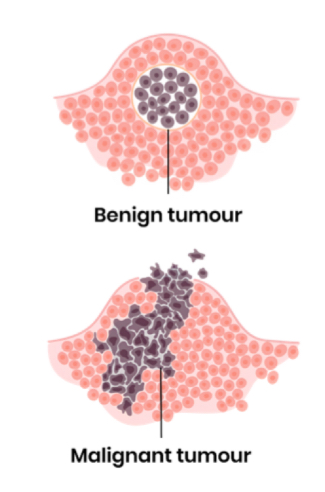
Compare the main characteristics of benign and malignant tumours
Benign tumours:
usually grow slowly (cells divide less often)
Cells are well differentiated / specialised
Cells have normal, regular nuclei
Well defined borders and often surrounded by a capsule so do not invade surrounding tissue
Do not spread by metastasis (as cell adhesion molecules stick together)
Can normally be removed by surgery and they rarely return
Malignant tumours:
usually grow faster (cells divide more often)
Cells become poorly differentiated / unspecialised
Cells have irregular, larger / darker nuclei
Poorly defined borders and not encapsulated so can invade surrounding tissues (due to lack of adhesion molecules)
Can normally be removed by surgery combined with radiotherapy / chemotherapy but they often return
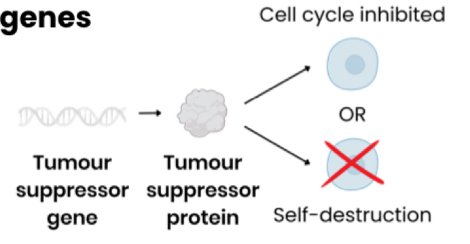
Describe the function of tumour suppressor genes
Code for proteins that:
inhibit / slow cells cycle (e.g. if DNA damage detected)
OR cause self-destruction (apoptosis) of potential tumour cells (e.g. if damaged DNA can’t be repaired)
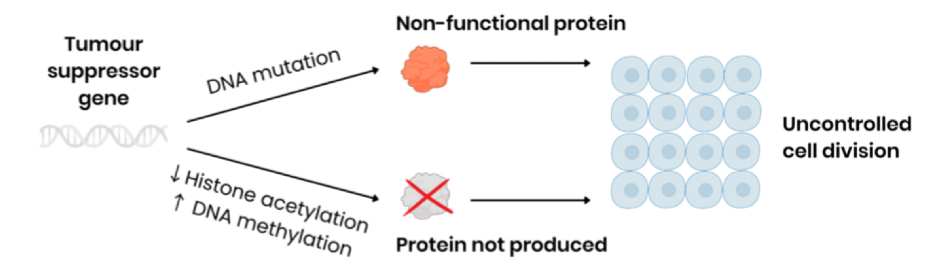
Explain the role of tumour suppressor genes in the development of tumours
mutation in DNA base sequence → production of non-functional protein
→ by leading to change in amino acid sequence which changes protein tertiary structure
Decreased histone acetylation OR increased DNA methylation → prevents production of protein
→ by preventing binding of RNA polymerase to promoter region, inhibiting transcription
Both lead to uncontrolled cell division (cell division cannot be slowed)
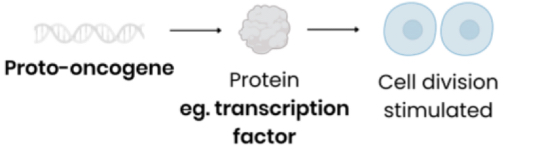
Describe the function of (proto-)oncogenes
Code for proteins that stimulate cell division (e.g. through involvement in signalling pathways that control cell responses to growth factors)
Explain the role of oncogenes in the development of tumours
(An oncogene is a mutated / abnormally expressed form of the corresponding proto-oncogene)
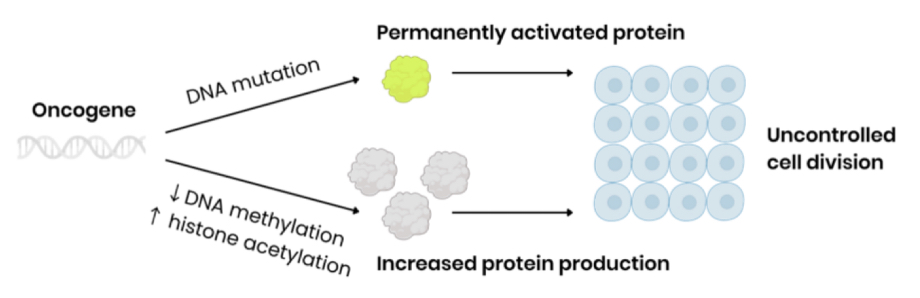
mutation in DNA base sequence → overproduction of protein OR permanently activated protein
→ by leading to change in amino acid sequence which changes protein tertiary structure
Decreased DNA methylation OR increased histone acetylation → increases production of protein
→ by stimulating binding of RNA polymerase to promoter region, stimulating transcription
Both lead to uncontrolled cell division (cell division is permanently stimulated)
Suggest why tumours require mutations in both alleles of a tumour suppressor gene but only one allele of an oncogene
one functional allele of tumour suppressor gene can produce enough protein to slow the cell cycle OR cause self-destruction of potential tumour cells → cell division is controlled
One mutated oncogene allele can produce enough protein to lead to rapid / uncontrolled cell division
Explain the relevance of epigenetics in cancer treatment
Drugs could reverse epigenetic changes that caused cancer, preventing uncontrolled cell division, for example:
increasing DNA methylation OR decreasing histone acetylation of oncogene
→ to inhibit transcription / expression
Decreasing DNA methylation OR increasing histone acetylation of tumour suppressor gene
→ to stimulate transcription / expression
Explain the role of increased oestrogen concentrations in the development of some (oestrogen receptor-positive) breast cancers
Some breast cancers cells have oestrogen receptors, which are inactive transcription factors
If oestrogen concentration is increased, more oestrogen binds to oestrogen receptors, forming more oestrogen-receptor complexes which are active transcription factors
These bind to promoter regions of genes that code for proteins stimulating cell division
This increases transcription / expression of these genes, increasing the rate of cell division
Suggest how drugs that have a similar structure to oestrogen help treat oestrogen receptor-positive breast cancers
drugs bind to oestrogen receptors (inactive transcription factors), preventing binding of oestrogen
So no / fewer transcription factors bind to promoter regions of genes that stimulate the cell cycle
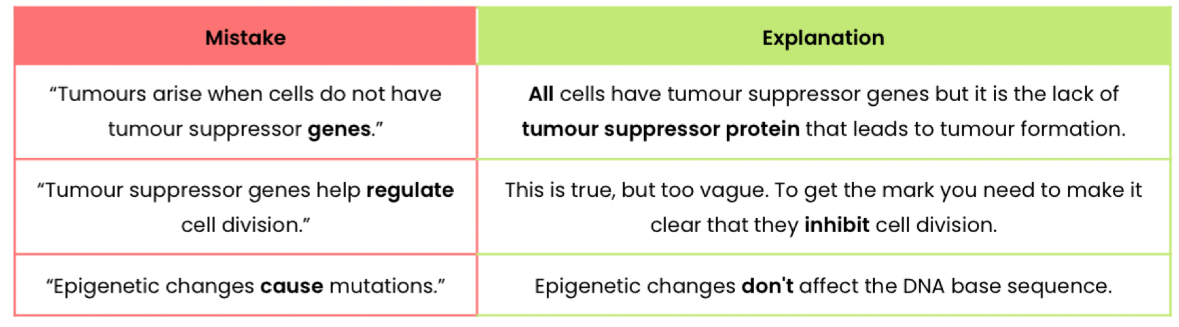
Exam insights: common mistakes
 Note
Note  Flashcards (31)