AP PYSCHOLOGY UNIT 3
 Studied by 26 people
 Call Kai
 Learn
Learn Practice Test
 Spaced Repetition
 Match
Match Flashcards
 Knowt Play
1/194

There's no tags or description
Looks like no tags are added yet.
Name | Mastery | Learn | Test | Matching | Spaced | Call with Kai |
|---|
No analytics yet
Send a link to your students to track their progress
195 Terms
Developmental Psychology
is concerned with chronological order of development and thematic issues in development across the lifespan.
Thematic Issues Developmental Psychologists Study
Nature (biological predispositions & heredity) vs. nurture (environment)
Continuity vs. stages (discontinuity)
Do the changes we experience occur very gradually or abruptly?
Stability vs. change
Teratogens
Potentially harmful agents that can produce birth defects or abnormalities. Many _______ cause damage only if they are present during a critical period in prenatal development.
Maternal Illness
HIV, herpes, gonorrhea, syphilis, rubella, and the Zika virus can be transmitted from the mother.
Mismanaged chronic conditions like diabetes or hypertension → complications like premature birth and low birth weight
Genetic Mutations
Example: Presence of an extra 21st chromosome causes Down syndrome
Hormonal Factors
Example: low maternal thyroid hormone levels → developmental delays
Environmental Factors
Examples: maternal nutrition, stress levels, and exposure to pollutants
Down Syndrom: Chromonsomal Abnormality
Prenatal screenings can detect _______ ____________ before birth. There is a positive correlation between a mother’s age and the likelihood of having a child with Down syndrome.
Fine and Gross Motor Coordination
Among the major physical and psychological milestones that define infancy and childhood. These physical skills develop as children mature, allowing children to develop critical skills needed to become more independent.
Fine Motor Skills
Ability to use small muscles in hands, wrists, and fingers to coordinate movements for tasks like eating, writing, and getting dressed
Gross Motor Skills
Ability to use large muscles to crawl, walk, throw, etc.
Infants
(from birth to 1 year) possess reflexes, like the rooting reflex, that indicate on-track physical and psychological milestone development.
Reflex
An innate, automatic response by the body that occurs when a stimulus in the environment is detected.
Rooting Reflex:
When the corner of a baby’s mouth is touched or stroked, the infant will turn their head and open their mouth. The reflex helps infants find food and latch onto a bottle or breast to feed.
Eleanor Gibson’s Visual Cliff Experiment
Research using the visual cliff apparatus demonstrates an early ability in infants to perceive depth and an innovative way to assess infant responses.
Findings:
Most infants (81%) refused to crawl to the deep side, even though they could touch it with their hands and feel that it was solid
They were upset and fearful when encouraged to crawl across the visual cliff
Evidence supported the hypothesis depth
Critical or Sensitive Periods
Research suggests that _______ __ __________ __________ in infancy and childhood have strong developmental effects, especially for skills such as language.
Imprinting
Some non-human animals will _____ on the first object they encounter as a means of survival. This attachment is innate and can’t be reversed.
occurs during the critical period of development and isn’t forgotten.
Growth Spurt and Puberty
the main physical and psychological milestones that occur in adolescence are the adolescent _______ ________ and _______, in which reproductive ability develops.
Puberty often begins ≈2 years after the beginning of the growth spurt.
Girls typically begin puberty around age 10, and boys typically begin around age 12.
Primary and Secondary Sex Characteristics
Adolescents develop ________ _____ ________ ______________ during puberty, such as menarche and spermarche.
Menarch
1st incidence of menstruation in a female, marking the beginning of puberty
Spermarche
a male’s first ejaculation of semen
Primary Sex Characteristics
Sex Organs involved in reproduction
Sperm production (Males)
Ovulation and Menstruation (Females)
Secondary Sex Characteristics
Sexual characteristics that develop during puberty that aren’t directly involved in reproduction
Growth of testes, broadening of shoulders, lowered voice, growth of facial hair, growth of pubic hair (Males)
Development of breasts and hips, growth of pubic hair
Adulthood
Spans most of the lifespan and is characterized by a general leveling off and then a varying decline in reproductive ability (i.e., menopause), mobility, flexibility, reaction time, and visual and auditory sensory acuity.
Vision: loss of elasticity in the lens, making it harder to focus
Hearing: may become harder to hear higher-frequency sounds
Crystallized intelligence increases, but fluid intelligence decreases.
Reaction time decreases due to decreased muscle mass, slower nervous system and cognitive processing
Risk Factors for Cogntive Decline
There are several risk factors for Alzheimer’s disease and other causes of dementia. Research suggests approximately 50% of Alzheimer’s disease cases may be related to these modifiable risk factors:
Type 2 diabetes
High blood pressure
Midlife obesity
Smoking
Depression
Little or no mental activity
Little or no physical exercise
Brain Health
Don’t smoke.
Exercise at a moderately high level of physical activity. Exercise facilitates oxygen and growth factors in the brain and helps modulate the brain’s immune responses.
Get routine medical care. Illnesses in your body affect your brain’s ability to optimally function.
Maintain excellent cardiovascular health (e.g., blood pressure, cholesterol levels). What’s good for the heart is good for the brain!
Build social support networks to reduce stress, challenge your brain and share the aging process with other people who are experiencing the same changes and joys of entering into the latter years of life.
Keep doing the activities that challenge you and you enjoy for as long as possible. Trying new activities may be a great way to challenge your brain to make new brain connections.
Maintain a healthy diet. Plan your meals around your vegetables and then fill in with other foods. Otherwise, as a general plan, eat a variety of foods as close to their natural state as possible.
Get enough sleep. As an adult, aim for 7-9 hours a night.
Jean Piaget
Worked with Alfred Binet in Paris on the first standardized intelligence test. Piaget soon found that he was more interested in children’s incorrect answers than their correct ones. He first noticed that children of the same age were producing the same kinds of wrong answers. But why? As he proceeded to question children about their misconceptions, he realized that young children aren’t simply less intelligent than older children; their thought processes are completely different.
According to Piaget, children develop schemas via continuous and discontinuous processes such as assimilation and accommodation.
Assimilation
A continuous process where children integrate new information into their existing schemas, reinforcing and expanding their understanding of the world without fundamentally altering their schema. For example, a child who knows what a dog is may assimilate new information by identifying different breeds of dogs as still belonging to the category of “dog.”
Accomodation
A discontinuous process where new experiences challenge existing schemas, requiring children to modify or create new schemas altogether. For example, if the child encounters a cat and initially calls it a “dog,” they must adjust their schema for animals to distinguish between dogs and cats, thereby refining their understanding and adapting to new information. Through these processes, schemas become more sophisticated, enabling children to think in increasingly complex ways.
Continuous Development
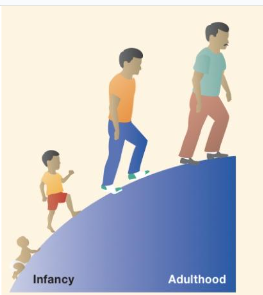

Key Question in Psychology
Does development occur as a continuous process or in distinct stages?
Two Types: Continous Development and Stage-Based Development
Piaget strongly advocated for a stage-based approach to understanding development
Sensorimotor Stage Age
Infancy Through Toddlerhood (Birth to 2)
Sensorimotor Stage
Experiencing the world through senses and actions
Sensorimotor Stage Phenomenon
Object Permanence
Preoperational Stage Age
Toddlerhood through early childhood (2-7)
Preoperational Stage
Representing things with words and images; using intuitive rather than logical thought
Preoperational Stage Phenomenon
Mental symbols
Pretend play
Egocentrism
Irreversibility
Animism
Begin to develop a theory of mind
Concrete Operational Stage Age
Early thorugh late childhood (7 to 11 or 12)
Concrete Operational Stage Definition
Understand the world in logical, realistic, and straightforward ways, but struggle to think systematically
Concrete Operational Stage Phenomenon
Develop conservation
Reversibility obtained
Formal Operational Stage Age
Late Childhood through adulthood (11-12 and beyond)
Formal Operational Stage
Piaget proposed that not all people achieve formal operational thinking
Formal Operational Stage Phenomenon
Gain the ability to think abstractly and hypothetically
Sensorimotor Stage of Cognitive Development
Infants primarily learn about the world through their senses (sight, touch, taste, etc.) and motor abilities (moving, grasping, etc).
Object Permanence
Knowledge of the continued existence of objects even when they are not directly perceived. Infants typically develop this cognitive skill around 8 months.
Peekaboo is a classic game that helps infants learn
Mental Symbols
Children start to use mental symbols, like words and images, to represent objects, people, and experiences. This symbolic thinking allows them to communicate ideas, recall past events, and imagine future possibilities, although their understanding is still very concrete.
Pretend Play
Imaginative play becomes a big part of the child’s life. Through activities like pretending to be a superhero or acting as a parent to a doll, children use their developing symbolic thinking to create scenarios that help them practice social roles and explore different aspects of reality.
Irreversibility
Preoperational children have difficulty understanding that some actions can be undone. They struggle with the concept of reversing processes, so if they see a toy taken apart, they may not understand that it can be put back together in the same way.
Animism
Tendency of young children to attribute human qualities or intentions to inanimate objects. For example, a child may think a stuffed animal is “sad” if left alone or think that the moon “follows” them.
Egocentrism
Difficulty of children to see perspectives other than their own. This egocentrism means that they may assume everyone else shares their viewpoint, beliefs, and experiences.
Does NOT mean selfish. But in developmental psychology, it refers to a child's inability to see things from others’ perspectives, not an unwillingness. It’s not a character flaw but rather a developmental stage, particularly prominent in young children.
Developing Theory of Mind:
Near the end of the preoperational stage, children start to understand that others have thoughts, feelings, and beliefs that may differ from their own. This development of a "theory of mind" allows them to grasp that others may have different intentions or viewpoints, though they’re still learning to fully appreciate those perspectives.
Piaget’s Conservation Tasks
The logical thinking ability that allows a person to determine that a certain quantity will remain the same despite adjustment of the container, shape, or apparent size
Alison Gopnik’s Goldfish and Brocolli Study
According to Piaget, children in the preoperational stage of cognitive development are egocentric. What does that mean?
They have a difficult understanding different perspectives and that other individuals may have different opinions; not to be confused with selfishness
Explain whether Alison Gopnik’s goldfish and broccoli study supports or refutes the idea that children are egocentric in the preoperational stage of cognitive development.
It refutes the idea that children are egocentric in the preoperational stage of cognitive development as they accept that the researcher preferred broccoli over crackers, contrary to their own beliefs, still handing the researcher her preferred choice (shows understanding of different perspectives). This was seen in 18-month-olds, who are presumably under the preoperational stage, under Piaget’s stages of cognitive development.
Criticisms of Piaget’s Theory
Piaget underestimated the cognitive ability of infants and young children.
Piaget underestimated the impact of the sociocultural context of cognitive development.
Lev Vygotsky’s Sociocultural Theory
This theory argued that people can attain higher levels of cognitive development through cooperative dialogues with more knowledgeable members of society such as adults and more expert peers. Stated that cognitive development is a socially mediated process.
Lev Vygotsjy’s Zone of Proximal Development
Challenges that are in Reach of that individual’s Intelligence

Scaffold Analogy
construction scaffolding provides temporary support, enabling workers to access higher areas and complete tasks they couldn’t reach on their own.
Similarly, in education, scaffolding offers support so students can tackle challenging tasks just beyond their independent abilities. Eventually the scaffolding is removed as the student becomes more competent.
cochlea
A message travels through the inner ear, where the ___ transduces sound vibrations into nerve impulses.
auditory cortex
Then the information moves to ___, the area responsible for comprehending spoken language in the temporal lobe.
Wernicke’s Area
Then the information moves to ___, the area responsible for comprehending spoken language in the temporal lobe.
Broca’s Area
The information then moves to ___, the area in the frontal lobe responsible for language production. These areas are in the brain’s ___ hemisphere.
Motor Cortex
That message then travels to the ___ located in the back of the frontal lobe, that signals your larynx and mouth to move and vocalize your response.
Phoenemes
the smallest units of sound in a language
Ex: the word “cat” comprises 3 phonemes: the sounds kuh, ah, and tuh
Morphemes
the smallest unit of meaning in a language
Ex: the word “cooked” consists of two morphemes: “cook” and “ed,” with the suffix “ed” indicating that the cooking took place in the past
Ex: the word “playing” consists of two morphemes: “play” and “ing”
Semantics
the study of meaning - how words, phrases, and sentences are interpreted
Ex: bank can mean a financial institution, the side of a river, or to rely or count of something
Ex: connotations like youthful v. childish
Syntax
set of rules for ordering words and phrases into sentences
Ex: nouns before verbs when making statements
Prelinguistic Stages
Birth to 2 months, 2-12 months (language development)
Cooing
Birth to 2 Months (Language Development)
2-12 months (language development)
babbling
babbling
meaningless, speechlike sounds
Linguistic Stages
around 12 months, 16 months, and 2-6 years of age (language development)
holophrastic stage
expressing a complete thought with 1 word like “up” for “pick me up” or “hungry” for “im hungry”
around 12 months (language development)
Holophratic Stage
telegraphic speech
2-3 word utterances like “me walk”
around 16 months (language development)
telegraphic speech
2-6 years of age ( language development )
add 6- 10 words per day
over extention
over-regularization
over-extension
using a word too broadly like calling all four-legged animals a “doggie”
over-regularization
regular grammatic patterns are applied to irregular verbs like “goed” instead of “went” or “breaked” instead of “broken”
controversial issue of language development
Children’s acquisition of language is a controversial issue in psychology.
Some psychologists argue that language is influenced primarily by nurture, and others argue that language development is primarily influenced by nature.
language development is primarily influenced by nurture
Learning, behaviorism, reinforcement and modeling are important in acquiring language
Behaviorists advocate this position, noting that children use words for which they’re reinforced and don’t use words for which they’re punished.
Case study: Genie
Genie had difficulty acquiring language after a childhood of abuse and isolation (positive and negative punishment).
language development is primarily influenced by nature
Innate factors, the language acquisition device, critical periods, maturation and genetics influence language acquisition.
Supporting evidence:
Critical or sensitive period
Universal sequence of language development
Children say many sentences that are never rewarded by parents (“I hate you, Mommy”) and toddlers engage in “crib speech,” talking to themselves when they’re alone in a room
Noam Chomsky stated that language is learned by exposure to language, but the ability to speak is hardwired. Humans are born with the innate ability to speak and the interaction with the environment allows that skill to emerge.
Language acquisition device: innate ability of the human brain to acquire language in childhood’s critical period
language acquisition device
innate ability of the human brain to acquire language in childhood’s critical period
ecological systems theory
explores how the social environment influences development. five systems in this theory: microsystem, mesosystem, ecosystem, microsystem, chronosystem
This theory underscores that development is not isolated but shaped by interactions within these interconnected systems. This model has been influential in fields like education, psychology, and social work for understanding how diverse influences contribute to individual growth.
microsystem
the immediate environment where a person has direct interactions, such as with family, friends, and work
mesosystem
the interactions between different microsystems
exosystem
the larger social system that doesn’t directly involve the person but still affects them indirectly like a parent’s workplace
macrosystem
broader cultural and societal factors, such as economic conditions, cultural beliefs, and political systems
chronosystem
incorporates the dimension of time, highlighting how changes over time, like life transitions (e.g., starting school), historical events, or shifts in societal values, affect development.
authoritattive parents
high control, high warmth (the best style of parenting)
authoritarian parents
high control, low warmth
permissive parents
high warmth, low control
uninvolved parents
low warmth, low control
characteristics of children of authoritative parents
Friendly
Cooperative
Self-reliant
Socially-
responsible
Do better in school & are more popular
characteristics of children of authoritarian parents
Moody
Unhappy
Fearful
Withdrawn
Not spontaneous
Irritable
More likely to cheat and deny responsibility & assign blame
characteristics of children of permissive parents
Relatively immature
Dependent
Often have tantrums
Tend to ask for help even when encountered with slight difficulties
characteristics of children of uninvolved parents
Immature
Impulsive
Aggressive
Less likely than any other children to form secure attachments
cultural difference
________ _____________ exist in the ways these parenting styles affect outcomes in caregivers and children. Cultural norms and values influence the way children and parents respond to different parenting styles. What works well in one cultural context may not have the same results in another.
For example, in Western cultures, authoritarian parenting often correlates with negative outcomes for children, such as lower self-esteem and higher levels of anxiety. However, in some Asian cultures, where respect for authority and family hierarchy is deeply valued, children raised by authoritarian parents may achieve high academic success and feel a strong sense of family loyalty.
attachment
the emotional bond between an infant or child and its caregiver. The type of attachment has far-reaching consequences for later development.
temperament
the basic foundation of personality, usually assumed to be biologically determined and present early in life, including such characteristics as energy level, emotional responsiveness, demeanor, mood, and willingness to explore.
 Note
Note  Flashcards (21)