Market Failure
 Studied by 0 people
 Call Kai
 Learn
Learn Practice Test
 Spaced Repetition
 Match
Match Flashcards
 Knowt Play
1/16

There's no tags or description
Looks like no tags are added yet.
Name | Mastery | Learn | Test | Matching | Spaced | Call with Kai |
|---|
No study sessions yet.
17 Terms
Definition
Inefficient allocation of resources (e.g. when too much/little of a good is being produced/consumed).
PS: equilibrium is not always socially desirable.
Marginal
for each additional unit
Positive/negative externalities
Benefits/costs to a 3rd party not part of a transaction.
(De)Merit goods
When consumption/production causes positive/negative externalities.
Demerit goods diagram & explanation
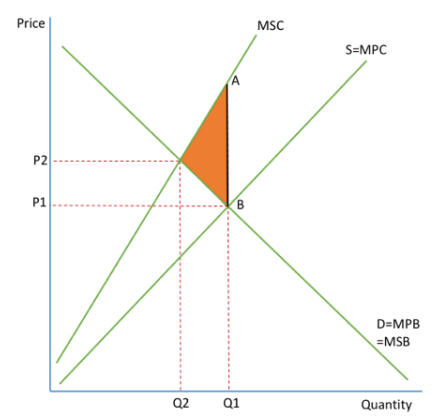
Q*: socially efficient allocation
Q1: free market allocation
MPC/MSC: marginal private/social cost
MPB/MSB: marginal social benefit
Demerit good = negative externalities = MSC > MPC = welfare loss (shown in triangle between Q* to Q1)
As there is no social benefit to demerit goods: MSB = MPB and is constant
Distance between A and B: the value of the external cost at output Q1
Merit goods diagram & explanation
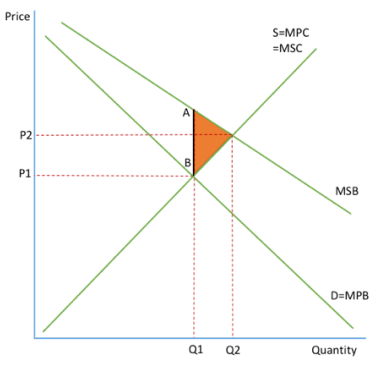
Merit good = positive externalities = MPB > MSB = welfare loss (shown in triangle between Q* to Q1)
As there is no social cost to merit goods: MSC = MPB and is constant
Distance between A and B: the value of the external benefit at output Q1
Solutions to demerit goods
Indirect taxes
Tradable pollution permits
Information Campaigns
Bans
Subsidising Healthier Alternatives
Minimum Price Schemes (decreases affordability)
Solutions to merit goods
Subsidies
Information campaigns
Maximum Prices (increases affordability)
Government Provision (100% Subsidy e.g. State Education)
Public goods (incl. examples)
When goods are:
Non-excludable (you can’t stop others from consuming the good if you have paid for it)
Non-rivalrous (your consumption of a good does not diminish the amount that is available for consumption for others)
Examples:
Street lights
Lighthouses
Military
Quasi (Semi)-Public goods e.g. parks/roads
Free rider problem
You can’t change an individual a price for the provision of a non-excludable good as someone else will gain the benefit from it without paying anything
Solution to public goods
Government provision: these have to be provided by the state
Why?: no rational consumer would pay for them due to non-excludability & non-rivalry
Producers don’t provide them as they aren’t sure of making a profit (provided by government instead)
Asymetric Information (incl. examples)
When buyer & seller have unequal information about the true market conditions.
This leads to a not truly reflective equilibrium price of the correct efficient allocation of resources
Examples:
A dentist prescribing non-essential work to customers to increase the dentist’s revenue.
A consumer lying about the amount of cigarettes they smoke on a life insurance questionnaire.
Solutions to Asymetric Information (incl. examples)
Regulation to prevent anyone exploiting their knowledge
Information campaigns by government to increase awareness amongst consumers/producers to prevent exploitation.
Examples:
Dentists lose their license if they prescribe non-essential treatment.
Unstable Commodity Markets
As agricultural markets depend on weather conditions/climate: very difficulty to determine supply.
Consequently: can supply fluctate radically =
Impacts on product price =
Impact of farmer incomes =
Disincentivise farmers to stay in market =
Vital agricultural products soar in price (due to fall in supply)
Solution to Unstable Commodity Markets
Buffer Stock Schemes: government buys up surplus stock in a good harvest year & stocks it & releases it again in bad harvest year.
Therefore: supply is constant & prices don’t fluctuate.
Labour Immobility (incl. examples)
When jobs are available and labour is searching for jobs but they can’t take up the vacanies due to immobility.
Geographical immobility:
Impractical commuting
Relocation not possible due to:
House price differentials, schooling, social life, partner’s job
Occupational immobility:
Unemployed don’t have right skills/qualifications needed for available jobs (structural unemployment).
Solutions to Labour Immobility
Geographical immobility:
Investment in:
Transport links
Subsidising housing
Increasing awareness of jobs available in different parts of the county
Occupational immobility:
Investment in:
Education
Training schemes
Apprenticeship programmes
Impact: allows workers to have wider skills & re-train to enter new profession easier
 Note
Note  Flashcards (20)