Biopsychology key definitions
0.0(0)
 Studied by 1 person
 Call Kai
 Learn
Learn Practice Test
 Spaced Repetition
 Match
Match Flashcards
 Knowt Play
Card Sorting
1/110

Earn XP
Description and Tags
Last updated 4:21 PM on 12/12/22
Name | Mastery | Learn | Test | Matching | Spaced | Call with Kai |
|---|
No analytics yet
Send a link to your students to track their progress
111 Terms
1
New cards
central nervous system (CNS)
brain and the spinal chord
2
New cards
peripheral nervous system (PNS)
somatic nervous system and autonomic nervous system
3
New cards
the spinal chord
acts as a relay between the brain and the body, it monitors and regulates processes such as breathing and digestion and contains relay neurons for quick reactions
4
New cards
the 4 main areas of the brain
cerebrum, cerebellum, diencephalon, brain stem
5
New cards
cerebrum
is in two halves and split into 4 main areas; frontal lobe for thought, occipital lobe for vision, ,motor cortex for movement, auditory cortex for speech
6
New cards
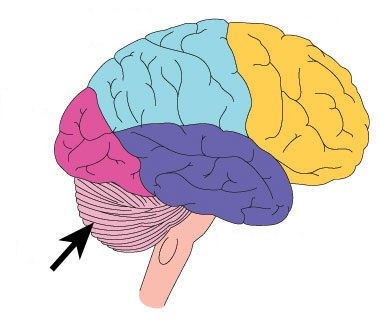
cerebellum
motor skills and balance
7
New cards
diencephalon
comprised of the thalamus - relay station sending nerve impulses for senses to the correct brain area, and the hypothalamus - responsible for memory, hunger and thought
8
New cards
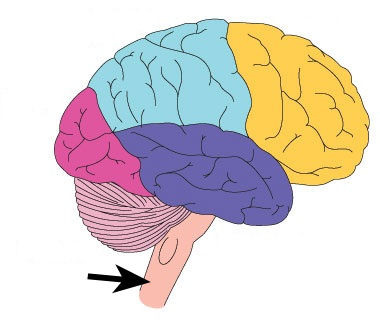
brain stem
regulates automatic functions e.g. breathing
9
New cards
autonomic nervous system
involuntary actions, comprised of the sympathetic division - excitatory; involved in fight or flight primarily and the parasympathetic division - inhibitory; relaxes the body
10
New cards
somatic nervous system
made up of 12 pairs of cranial nerves and 31 pairs of spinal nerves, sensory nerves relay messages to CNS and motor neurons from CNS to the body
11
New cards
sensory neurons
are found in receptors such as eyes and skin, and carry nerve impulses to the spinal chord and brain. when the nerve impulses reach the brain they are translated into 'sensations' such as vision and touch. however some stop at the spinal chord for quick reflex actions - long dendrites and short axons
12
New cards
motor neurons
found in the CNS and control muscle movements, when they are stimulated they release neurotransmitters that bind to receptors on muscles to trigger a response, which lead to movement - short dendrites and long actions
13
New cards
relay neurons
found between sensory input and motor output/response, are in the brain and spinal chord and allow sensory and motor neurons to communicate - short dendrites and short axons
14
New cards
sensory neuron diagram
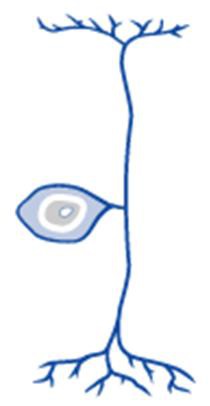
15
New cards
relay neuron diagram
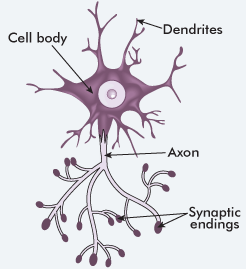
16
New cards
motor neuron
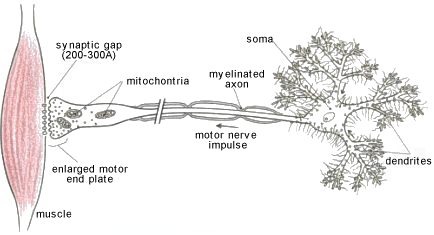
17
New cards
dendrites
receives messages from other cells
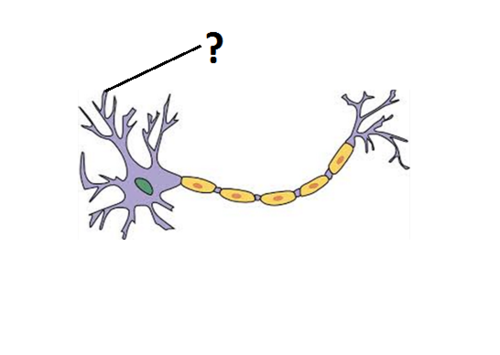
18
New cards
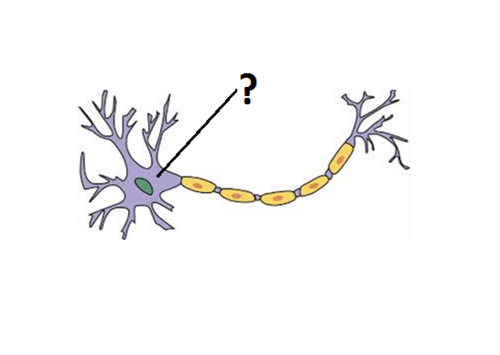
cell body
the cells life support centre
19
New cards
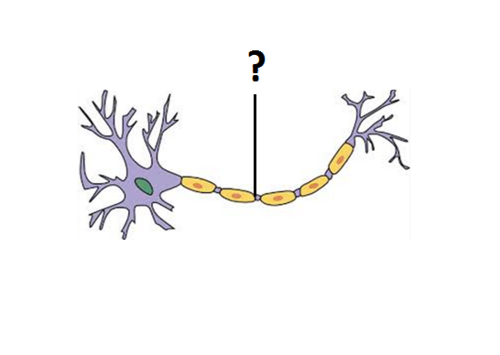
axon
passes messages away from the cell body to other neurons, muscles and glands
20
New cards
nerve impulses
electrical signal traveling down the axon (action potential)
21
New cards
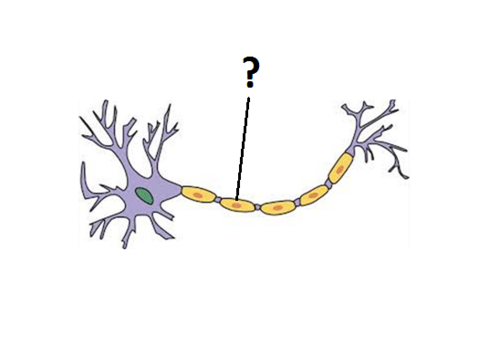
myelin sheath
covers the axon of some neurons and helps speed neural impulses, also insulates
22
New cards
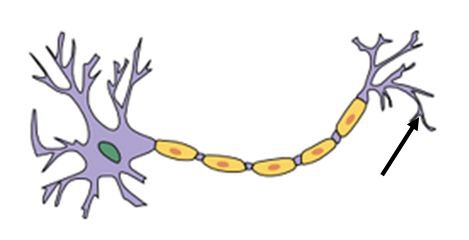
terminal branches of axon
forms junctions with other cells
23
New cards
synaptic transmission
the process by which neighbouring neuron communicate by sending chemical messages across the synapse
24
New cards
first stage of synaptic transmission
an action potential (electrical charge) travels down the pre-synaptic neurons axon
25
New cards
second stage of synaptic transmission
when the action potential reaches the terminal at the end of the neuron, vesicles release the neurotransmitters they control
26
New cards
third stage of synaptic transmission
neurotransmitters (chemical messages) travel out of the neuron, across the synapse gap into receptors on the dendrites of the receiving post-synaptic neuron
27
New cards
fourth stage of synaptic transmission
the chemical messages are converted back into an electrical impulse and the process of transmission begins again
28
New cards
reuptake of neurotransmitters
after the messages have been sent, any leftover neurotransmitters are recycled. process in the brain of the neuron to retrieve chemicals that were not retrieved by the next neuron
29
New cards
neurotransmitters in the synaptic gap
have a greater effect, the effect is lessened when the message has been received by the post-synaptic neuron and during reuptake when it is taken back into the vesicles of the pre-synaptic neuron
30
New cards
SSRI drugs and reuptake
work by inhibiting reuptake of serotonin by the pre-synaptic neuron. serotonin neurotransmitters stay in the synaptic gap for longer, having a greater effect. the persons mood would remain stable and regulated for longer
31
New cards
neurotransmitters
have either an excitatory or inhibitory effect on the neighbouring neuron
32
New cards
excitatory
increases positive charge inpost synaptic neuron (EPSP) that it sends the message to, this increases the chances of another action potential to fire and messages to continue to be transmitted e.g. adrenaline
33
New cards
inhibitory
increases negative charge in post-synaptic neuron (IPSP) that it sends the message to, this decreases the chances of another action potential occurring and messages slow down or stop being transmitted e.g. serotonin
34
New cards
the endocrine system
collection of glands that produces hormones that regulate metabolism, growth and development, tissue function, sexual function, reproduction, sleep and mood
35
New cards
hypothalamus
a collection of specialised cells that is located in the lower central part of the brain, it is the main link between the endocrine and nervous systems
36
New cards
the pituitary gland
the 'master gland', controls the release of hormones from all the other endocrine glands in the body
37
New cards
hormone negative feedback loop
hormones are secreted into the bloodstream and affect any cell in the body that has a receptor for that particular hormone, the hormones are detected and the hypothalamus responds by shutting down secretion from the pituitary gland
38
New cards
hormone
a chemical that circulate the bloodstream and carry messages to target cites throughout the body
39
New cards
fight or flight response
evolutionary survival mechanism
40
New cards
sympathetic stress response symptoms
increased heart rate, increased blood pressure, dilates pupils, slows digestion - acute
41
New cards
parasympathetic return to normal after stress symptoms
decrease heart rate, decreases blood pressure, consrticts pupils, returns to normal - rest and digest
42
New cards
acute stress
sympathomedullary pathway (SAM)
43
New cards
chronic stress
HPA
44
New cards
SAM pathway
hypothamus - autonomic nervous system - sympathetic branch - adrenal medulla - releases adrenaline and noradrenaline - activates fight or flight response
45
New cards
evaluate fight or flight response
Taylor et al (2000) says that females have a tend or befriend response to help protect themselves and young explained by high levels of oxytocin, not evolved to modern day stressors, Gray (1988) says there is a freeze response first
46
New cards
Frontal lobe
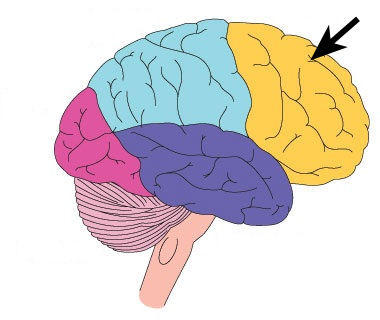
47
New cards
parietal lobe
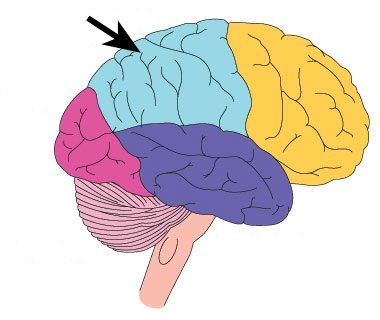
48
New cards
occipital lobe
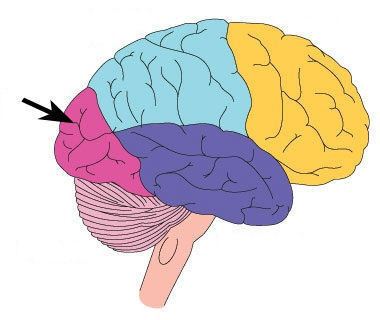
49
New cards
temporal lobe
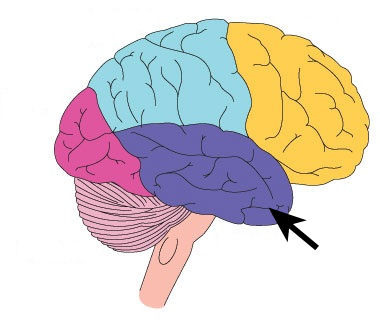
50
New cards
cerebellum location
51
New cards
brain stem location
52
New cards
localisation
the theory that specific areas of the brain are associated with particular physical and psychological functions
53
New cards
Broca's area
responsible for speech production in the left frontal hemisphere, based off case study of Tan, able to comprehend language but not to speak it
54
New cards
Wernicke's area
responsible for language comprehension in the left temporal lobe, can speak but unable to comprehend language
55
New cards
motor cortex
responsible for voluntary motor movements in the frontal lobe
56
New cards
somatosensory cortex
detects sensory events and produces sensations of touch, pressure, pain and temperature in the parietal lobe
57
New cards
visual centres
receives and processes visual information in the occipital lobe
58
New cards
auditory centres
receives acoustic information in the temporal lobes
59
New cards
evaluation of localisation
equipotentiality Lashley 1930 only motor and sensory functions localised, case studies support these areas when studying brain damage, gender (beta) bias
60
New cards
lateralisation
the dominance of one hemisphere of the brain for particular physical and psychological functions
61
New cards
hemispheric lateralisaion
each hemisphere has a specific function, left hemisphere is dominant in language and speech, right hemisphere excels in visual and motor tasks
62
New cards
corpus callosum
bundle of nerve fibres that connect the two hemispheres of the brain, this allows information received from one hemisphere to be sent to the other hemisphere - treatment for severe epilepsy involves cutting the corpus callosum creating split-brain patients
63
New cards
Sperry and Gazzaniga (1967)
quasi-experiment that studied split brain patients who had gone under hemispheric lateralisation for severe epilepsy
64
New cards
Sperry and Gazzaniga (1967) procedure
11 split brain patients, compared with control group, blindfolding one of pps eyes and asking them to fixate on a point, stimulus was projected on either the left or right side of the fixation for less than 1/10 of a second
65
New cards
Sperry and Gazzaniga (1967) findings
patients can verbalise an image shown to their right visual field, patients cannot verbalise an image shown to their left visual field but can draw it with their left hand, if a patient is shown two different images in their full visual field they will say they've seen the one in their right visual field but draw the image they've seen in the left
66
New cards
evaluation of lateralisation
increases neural processing capacity as only one hemisphere is needed for specific tasks leaving the other free, lateralisation of function doesn't stay the same throughout a lifetime
67
New cards
evaluation of split brain research
Gazzaniga (1998), early discoveries from split brain research have been disconformied by more recent discoveries, split brain procedure is rarely carried out so it is hard to find large samples for research
68
New cards
plasticity
the brains ability to change and adapt as a result of experience, plays an important role in brain development and behaviour
69
New cards
functional plasticity
the brains ability to move functions from a damaged area to other undamaged areas
70
New cards
structural plasticity
the brains ability to change its psychical structure as a result of learning
71
New cards
Boyke et al (2008)
found evidence of brain plasticity in 60 year olds, taught them a new skill of juggling and found an increase in grey matter in the visual cortex and when practice stopped these changes reversed
72
New cards
Maguire et al (2000)
studies london taxi drivers to discover whether changes to the brain could be detected as a result of their extensive navigational experience. MRI scanners showed that there was more grey matter in the brains of taxi drivers in the posterior hippocampus compared to a control group - functional plasticity
73
New cards
evaluation of Maguire et al (2000)
scientific, objective measurement (MRI), control group which shows significant difference, real world application, drivers weren't tested prior to becoming tai drivers so there could be an existing difference
74
New cards
neural unmasking Wall (1977)
'dormant synapses' exist but their function is blocked as neural input is too low. increased rate to these synapses as a result of a damage to the surrounding area can 'unmask' them
75
New cards
stem cells
stem cells transplanted directly into the brain could replace dead or dying cells. stem cells could secrete growth factors to rescue dying cells. stem cells could link an uninjured brain site with the damaged region
76
New cards
research support from animal studies
Tajiri et al (2013) assigned rats with brain damage to two groups, one group recieved stem cells and the other didnt. the stem cell group showed development of neuron-like cells in the area of injury
77
New cards
age differences in functional recovery
functional plasticity reduces with age however studies have suggested that adults can modify some abilities with retraining
78
New cards
post-mortem exams
after death the brain can be opened to look for abnormalities. can be used to establish a link between psychiatric disorders and underlying brain abnormalities
79
New cards
post-mortem exam evaluation
helped understand the cause of some disorders, very detailed of structure and neurochemistry. cant establish causal relationships
80
New cards
fMRI (functional magnetic rensonace imaging)
measues changes in brain activity while a person performs a task. measures changes in blood flow to particular areas of the brain
81
New cards
fMRI evaluation
spacital validity (between 1-2mm), non-invasive. low temporal validity (up to 4 sec delay), no direct measure of neural activity
82
New cards
EEG (electroencephalogram)
measures electrical activity in the brain resulting from the activity of brain cells. can be used to help diagnose brain disorders (e.g. epilepsy and alzheimers). 4 types of wave
83
New cards
alpha waves
when a person is awake but relaxed, rhymical
84
New cards
beta waves
when a person is physiologically aroused, low amplitude but fast, also found in REM sleep
85
New cards
theta and delta waves
occur during sleep. as a person moves fom light to deep sleep the occurance of alpha waves decreases and are replaced by lower frequency theta waves and then by delta waves
86
New cards
EEG evaluation
can be used as a diagnostic tool, high temporal resolution (1-10 ms). low spatial resolution
87
New cards
ERP (event-related potentials)
small voltage changes in the brain triggered by specific events or stimuli. waves occurring within the first 100 ms after stimulus presentation are 'sensory'. after the first 100 ms they are termed 'cognitive'
88
New cards
ERP evaluation
good temporal resolution (1-10 ms), non-invasive. low spatial resolution, enables determination of processing
89
New cards
circadian rhythms
any cycle which lasts around 24 hours such as the sleep-wake cycle
90
New cards
suprachiasmatic nuclei
the master circadian pacemaker found in the hypothalamus. neurons within the SCN spontaneously synchronise with each other so that their target neurons in sites elsewhere in the body receive correctly time-coordinated signals
91
New cards
the sleep-wake cycle
our strongest sleep drive usually occurs in two dips, 2-4am and 1-3pm. driven by exogenous zeitgebers such as light and social cues which controls the release of melatonin.
92
New cards
core body temperature
at its lowest at about 4:30am (36 degrees) and at its highest about 6pm (38 degrees). sleep occurs when the core temperature begins to drop and the body temperature begins to rise during the last hours of sleep, promoting a feeling of wakefulness in the morning.
93
New cards
hormone production
the production and release of melatonin from the pineal gland follows a circadian rhythm. by activating chemical receptors in the brain, melatonin encourages feelings of sleep, when its dark more melatonin is produced
94
New cards
Michel Siffre
spent long periods of time living underground with no access to zeitgebers to guide his rhythms. after 61 days underground in 1962 he resurfaced on the 17th of september believing it was august 20th. 6 months in a cave settled his circadian rhythm to just over 24 hours.
95
New cards
evaluation of circadian rhythms
individual differences - (Czeisler et al 1999) found that cycle length can vary from 13-65 hours,
research methodology - in most studies people are isolated from variables which may affect their cycles but are still exposed to artificial light, which research suggests can vary circadian rhythms
biological determinism
research methodology - in most studies people are isolated from variables which may affect their cycles but are still exposed to artificial light, which research suggests can vary circadian rhythms
biological determinism
96
New cards
endogenous pacemakers
anything whose origins are within the organism, most probably the product of inherited genetic mechanisms
97
New cards
the pineal gland
the SCN sends signals to the pineal gland, directing it to increase the production and secretion of the hormone melatonin at night and to decrease it as light levels increase - endogenous pacemaker
98
New cards
melatonin
induces sleep by inhibiting the brain mechanisms which promote wakefulness
99
New cards
exogenous zeitgebers
anything whose origins are outside the organism. environmental events that are responsible for entraining the biological clock of an organism
100
New cards
light
receptors in the SCN are sensitive to changes in light levels during the day and use this info to synchronise the activity of the body's organisms and glands. light resets the internal biological clock each day, keeping it on a 24 hour cycle.
 Note
Note  Flashcards (31)