Internal Environment - Introduction to International Business and Management
 Studied by 0 people
 Call with Kai
 Learn
Learn Practice Test
 Spaced Repetition
 Match
Match Flashcards
 Knowt Play
1/16

There's no tags or description
Looks like no tags are added yet.
Name | Mastery | Learn | Test | Matching | Spaced | Call with Kai |
|---|
No study sessions yet.
17 Terms
The Internal Environment
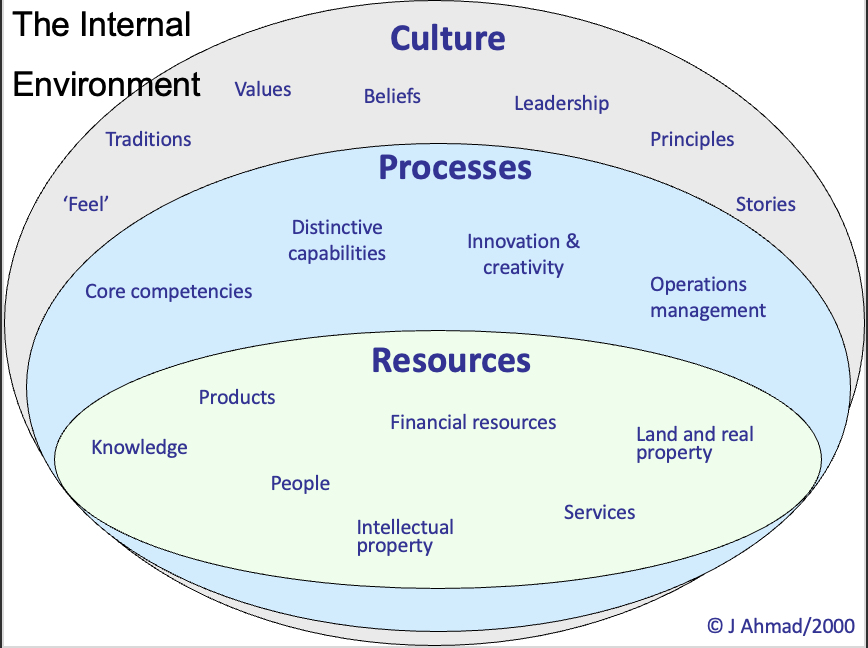
Analysis of the Internal Environment
Internal analysis is a process of identifying and evaluating an organizations specific characteristics
analyzing resources available in the business
analyzing competencies and capabilities (available and needed)
analyzing internal activities
analyzing financial performance
analyzing performance of functional areas - HR, marketing
conducting quality and service level reviews/audits
analyzing the range and appropriateness of products/services
Theories of Organization and Management
The Classical Approach: dates back to the early 20th century and looks at the work of Taylor, Fayol, Urwick and Brech
These theories look mainly at a ‘Scientific Management’ ‘Bureaucracy’ and structural approach
The Human Relation Approach: This approach emphasizes the importance of people in the work environment and the influence of social and psychological factors in shaping organizational behavior
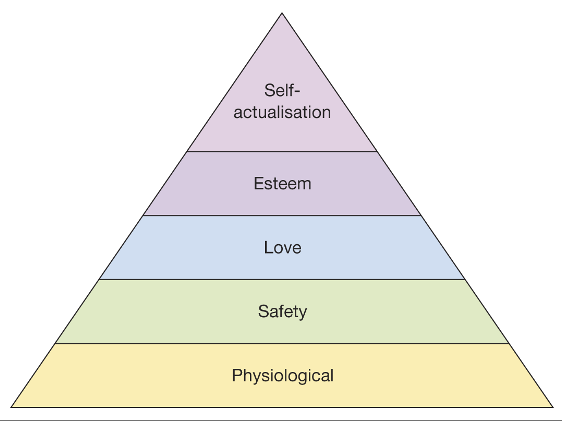
This takes into account hierarchy of needs: Maslows Hierarchy of Needs
Maslows Hierarchy of Needs
Physiological needs, these are the physical requirements for human survival.
Air, water, food
Safety and Security needs include:
Personal security, Financial security, Health and well-being, Safety needs against accidents/illness and their adverse impacts.
Social belonging: to be accepted and valued by others, Friendships, Intimacy, Family
Esteem: to be excepted, respected and loved by others. Involves self esteem and self respect.
Self-actualization: Realizing ones full potential
Theories of Organisation & Management
The Systems Approach: This uses ‘technology’ to manage departments, people, products and services.
Sub-system approach; looks at how an organisation uses the various parts of the organisation to function i.e. HR department, marketing, Production etc
Contingency approach. Is a management theory that uses the most appropriate style of management and is dependent on the situation. Not dependent on one ridged approach
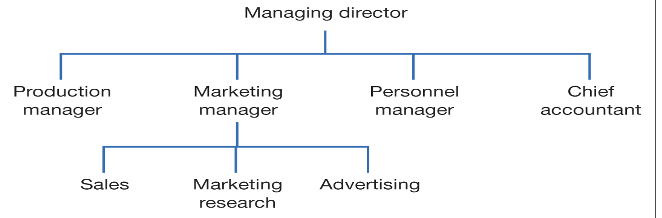
Functional Organisation
The functional approach to organisation is depicted in the figure below. In this structure activities are clustered together by common purpose and function.
Value Chain Analysis
Value Chain: describes the activities within an organisation that go to make up a product or service.
Value Chain Analysis: allows an organisation to establish the costs and value that derive from each of its value activities.
Activities in an Organization
Primary Activities: these are activities which are directly involved in the creation of a product or service.
Inbound logistics, operations, production
Support Activities: these are activities which ensure that the primary activities are carried out efficiently and effectively.
HRM, Innovation, Technology & Development , Marketing
Internal Audit
This is a through analysis of an organisations internal functional areas - (inc, operations, marketing, finance, R&D, management and I.T.) usually carried out by CEO’s Executives
Advantages
Fairly straight forward & can be tailored to fit any organisation
Provides a through analysis of the organisations important strategic capabilities
The main approach to identifying S&W
Resource-Based View of the Firm
Firms differ in fundamental ways because each firm possesses a unique “bundle” of resources - tangible and intangible assets and organizational capabilities to make use of those assets.
Three Basic Types of Resources
Tangible Assets
cash reserves
inventory
buildings
patent
equipment
Intangible Assets
reputation
brand names
leadership
culture
alliances
Organisational Capabilities
customer
service
innovation
NPD processes
flexibility
relationship mgt
Tangible Assets
Easiest to identify and often found on a firm’s balance sheet
Include physical and financial assets
Examples: Production facilities, raw materials, financial resources, real estate, computers
Intangible Assets
Cannot be seen or touched
Often very critical in creating competitive advantage
Examples: Brand names, company reputation, company morale, patents and trademarks, accumulated experience
Organizational Capabilities
Organizational Capabilities: is a process that determines how efficiently and effectively the organization transforms its inputs into outputs
Organizational Routines and Process: is a regular, predictable and sequential patterns of work activities
Dynamic Capabilities: the ability to rapidly address the changing environment- timely response and flexible product innovation
Core competencies: Does the organization share its capabilities and skills across the multiple product lines? Use left over's else where.
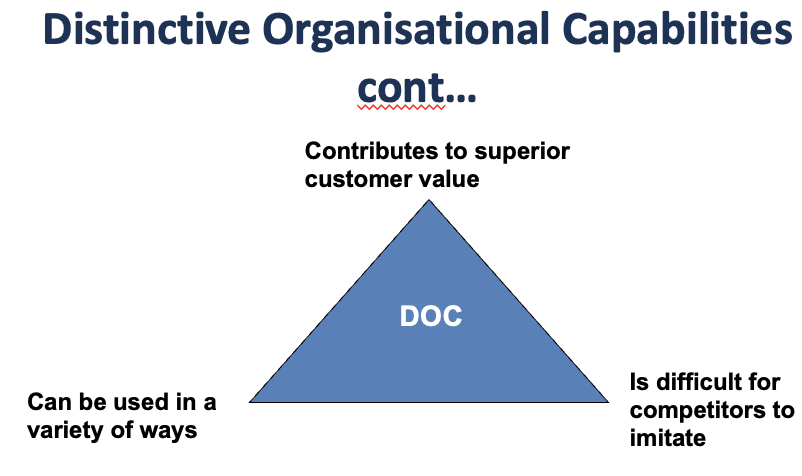
Distinctive Organizational Capabilities: this refers to the special and unique capabilities that distinguish the organization from its competitors.
What Makes a Resource Valuable?
Competitive superiority: Does the resource help fulfill a customer’s need better than those of firm’s competitors?
Resource Unavailability: Is the resource in short supply?
Inimitability: Is the resource easily copied or acquired?
Appropriability : How appropriate is the resource.
Durability: How rapidly will the resource depreciate? (Product life cylcle)
Substitutability: Are other alternatives available?
SWOT Analysis
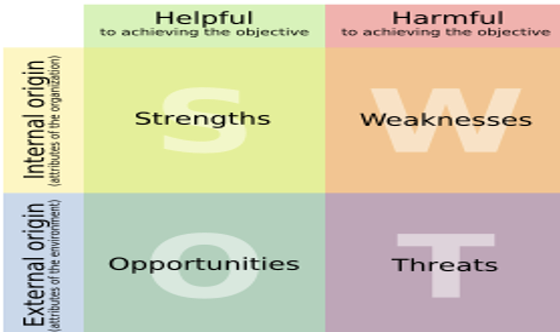
Once an internal analysis (internal audit) has been conducted a SWOT is required to analyse the S.W.O.T of an organization
Limitations of a SWOT Analysis
It is not an end to a process leading to a decision, but part of a process- A SWOT is not enough alone to conduct an analysis
Ambiguity- ‘S’ can be ‘W’ and weaknesses can be strengths
‘S’ & ‘W’ may not easily be translated into ‘O’ & ‘T’
 Note
Note  Flashcards (66)