PSY 2110 Behaviour and Attitudes Cartes | Quizlet
 Studied by 0 people
 Call Kai
 Learn
Learn Practice Test
 Spaced Repetition
 Match
Match Flashcards
 Knowt Play
1/61

There's no tags or description
Looks like no tags are added yet.
Name | Mastery | Learn | Test | Matching | Spaced | Call with Kai |
|---|
No analytics yet
Send a link to your students to track their progress
62 Terms
What is an attitude?
A favourable or unfavourable evaluative reaction toward something or someone, shown in beliefs, feelings, or intended behaviour.
Ex. Liking academia and believing studying is important
Are attitudes a good predictor of behaviour?
No
What are the ABCs of attitude?
Affect, Behaviour, Cognition
Ex. Feeling scared of spiders (affect), believing they are dangerous (cognition), avoiding them (behaviour).
When Attitudes DO Predict Behaviour?
-Social pressure is low and attitudes are measured indirectly
-Facial responses
-Implicit association test
What is the IAT?
A test measuring automatic associations between concepts.
Ex. Faster pairing of "good" with one group vs another may reveal implicit bias.
What is the principle of aggregation an what does it say about attitudes?
Attitudes predict behaviour better across many actions rather than a single act.
What are the issues with the IAT?
1. IAT Reliability Issues
Scores may change over time and lack consistency.
2. IAT Validity Issues
Debates exist about how well it predicts real-world behaviour.
3. Contextual Influences on IAT
Mood and environment can affect results.
4. Interpretation Concerns (IAT)
Results may oversimplify complex attitudes.
What is the Theory of Planned Behaviour?
Behaviour is predicted by intentions, which are shaped by attitudes, perceived social norms, and perceived behavioural control.
WHat are the three key factors of the theory of planned behaviour?
Attitudes, perceived social norms, perceived behaviour control
These three things shape intention.
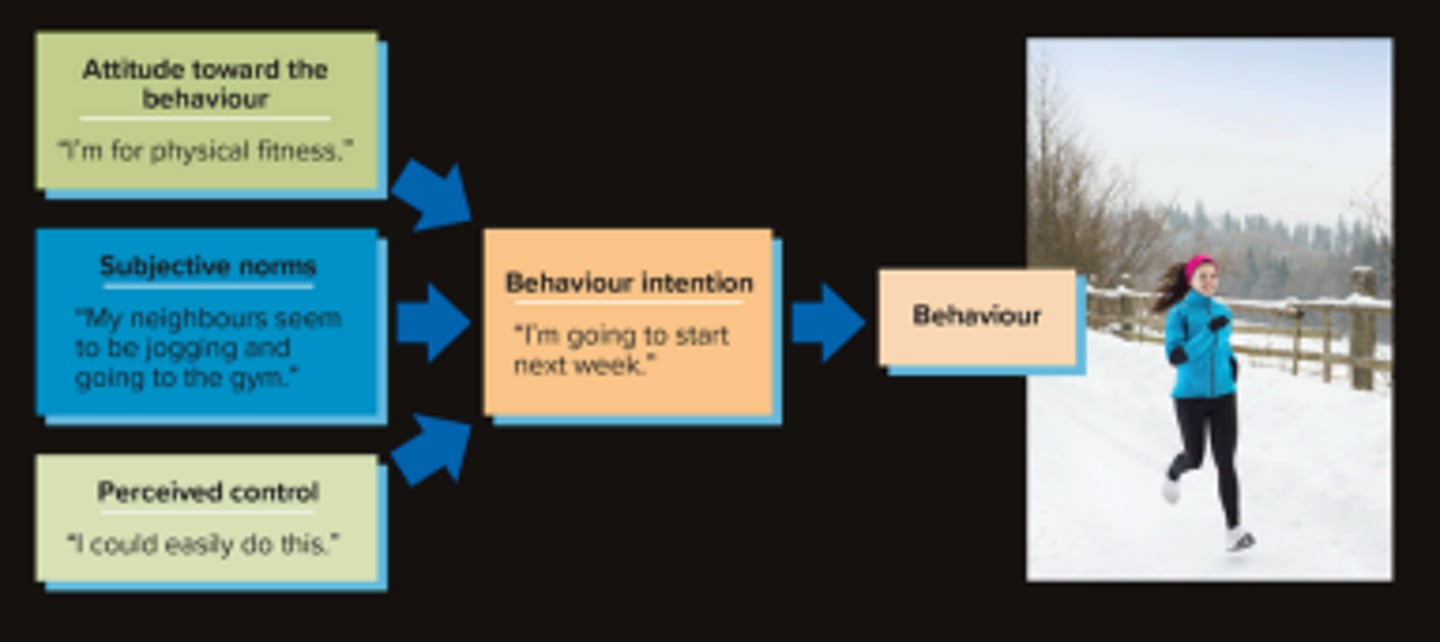
WHat are Perceived Social Norms?
Beliefs about whether important others approve of a behaviour.
Ex. Recycling because friends think it’s important.
WHat is Perceived behavioural control?
Belief about how easy or difficult performing a behaviour is.
Example: Thinking recycling is easy because bins are available.
How does behaviour shape beleifs?
Role playing
WHat is a social role?
Expected behaviours for people in certain positions.
Ex. Teacher is authorative and the student must listen
What are norms?
Shared expectations for behaviour in a role or situation.
Stanford Prison Experiment
Study showing how assigned roles (guard/prisoner) shaped behaviour and attitudes.
Gender Roles
Societal expectations for male vs female behaviour.
When does saying become believing?
We may come to believe statements we repeatedly say to please others.
What are the three main compliance and persuasion techniques?
1.Foot-in-the-door
2.Door-in-the-face
3.Low-ball technique
Foot-in-the-Door Phenomenon
Agreeing to a small request increases likelihood of agreeing to a larger one later.
Once we say yes, we want to stay consistent, so our attitudes will change to match our actions.
Door-in-the-face Technique
After refusing a large request, people are more likely to accept a smaller one.
Shows us how small actions can lead to a shift in beliefs or self-perception.
Low-balling Technique
Getting agreement, then increasing the cost.
It is a variation of FITDP. It works even when people are aware of a profit motive. It takes advantage of the psychological effects of making a commitment.
Ex. Hidden Fees
How can harming others lead people to change their attitudes? (Escalating commitment to immoral acts)
When people harm others they will shift their attitudes to justify their behaviour. This will reduce guilt and protect self image.
People can mentally distance themselves from the victim, or think of the victim as "less than" to make harmful actions feel more acceptable.
WHat is Escalation of commitment?
The tendency to keep investing resources into a failing decision or project, rather than abandoning it, due to prior investments and a desire to justify past choices or avoid admitting failure.
How does dehumanization support immoral behaviour?
Seeing victims as "less than human" makes continued harm feel easier
How can public conformity lead to private acceptance
Repeated public behaviour can eventually shape genuine private beliefs.
Ex. A routine act like singing "O Canada" can gradually build real patriotism.
What is impression management?
Trying to control how others see us.
We want to appear consistent.
Why do people engage in impression management?
To gain social, material, or psychological benefits.
How does wanting to appear consistent affect attitudes?
We may change our beliefs to match our past behaviour.
What is cognitive dissonance theory?
People experience mental discomfort (dissonance) when holding conflicting beliefs, values, or behaviors.
- Two conflicting thoughts, or behaviour doesn't match our attitudes.
What is selective exposure?
We expose ourselves to information that agrees with our existing beliefs.
Helps us maintain constant beliefs
It is like cognitive bias in relation to the CDT
What is insufficient justification?
It is a type of cognitive dissonance.
It occurs when our actions are not fully explained by external rewards or coercion.
Lacking a strong external reason, people create internal justification, such as convincing themselves they actually enjoyed a dull task.
Insufficient justification leads to
greater attitude change to resolve the cognitive dissonance
What is post-decision cognitive dissonance?
The discomfort we feel after choosing between two equally attractive (or unattractive) options because we still see the downsides of our choice and the positives of the rejected option.
Why does dissonance occur after making a decision?
Because we remember the good features of what we rejected and the bad features of what we chose, creating mental conflict.
How do people reduce post-decision dissonance? What is this called?
By upgrading the chosen option and downgrading the rejected option.
This is called the spreading of alternatives.
How does arousal affect cognitive dissonance?
If people think their arousal come from an external source (like caffeine or stress), they feel less dissonance and are less likely to change their attitudes.
What is misattribution of arousal in dissonance theory?
When people blame their discomfort on an outside factor instead of their conflicting beliefs/behavior.
Ex. "I feel anxious because I drank coffee," not "because I didn't study."
Why does misattributing arousal reduce attitude change?
Because people don't feel internal psychological conflict, so they don't need to justify their behavior by changing their beliefs.
What is self-perception theory? (Daryl Bem)
The idea that we figure out our attitudes by observing our own behavior, especially when our feelings are weak or unclear.
When does self-perception theory apply most strongly?
When attitudes are uncertain or weak, not when we already feel strongly.
How do we use behavior to infer attitudes?
We interpret our own actions the same way we would judge someone else’s.
Example: “I volunteer a lot, so I must be a caring person.”
How is self-perception different from cognitive dissonance?
Self-perception doesn't involve discomfort — it's just observation and inference.
What is intrinsic motivation?
Doing something because you genuinely enjoy it.
What is extrinsic motivation?
Doing something for an external reward or to avoid punishment.
What is the overjustification effect?
When giving external rewards for something people already enjoy reduces their intrinsic motivation.
Why do external rewards reduce intrinsic motivation?
Because people start attributing their behavior to the reward instead of enjoyment.
How does self-perception explain the overjustification effect?
People observe, "I'm doing this for money," so they conclude they don't truly like the activity.
What is self-affirmation theory?
The idea that when our self-image is threatened, we restore our sense of worth by focusing on another valued aspect of ourselves.
What is a self-image threat?
A situation where our actions conflict with our view of ourselves as good, moral, or competent.
How do people compensate after a self-image threat?
By affirming another part of their identity.
Does self-affirmation reduce dissonance?
Yes — by restoring self-worth, people feel less need to change their attitudes.
Self-perception vs. Cognitive Dissonance vs. Overjustification Effect:
Self-Perception: We infer our attitudes from our behaviour when they’re unclear.
Cognitive Dissonance: Dissonance causes discomfort, leading to attitude change.
Overjustification Effect: External rewards can reduce intrinsic motivation by shifting focus to the reward.
What is the core idea of Self-Perception Theory vs Cognitive Dissonance Theory?
Self-Perception: We infer our attitudes from our behaviour when they are unclear.
Cognitive Dissonance: Discomfort comes from inconsistency between attitudes and behaviour.
What is the key mechanism behind Self-Perception vs Cognitive Dissonance?
Self-Perception: Behaviour leads to attitude inference when prior attitudes are weak.
Cognitive Dissonance: Attitudes change to reduce psychological discomfort (dissonance).
How does the Overjustification Effect differ in Self-Perception vs Cognitive Dissonance?
Self-Perception: External rewards reduce intrinsic motivation by shifting focus to the reward.
Cognitive Dissonance: Rewards only reduce motivation if they create dissonance.
How does motivation change in Self-Perception vs Cognitive Dissonance?
Self-Perception: Motivation changes based on how we interpret the reason for our behaviour.
Cognitive Dissonance: Motivation changes as a result of resolving internal conflict (dissonance).
Attitudes might predict ____ behaviour, but not ____ behaviour
1. Intended
2. Real
Social roles and norms shape...
behaviours
The Foot in the Door Phenomenon is an example of :
when attitude changes because of behaviour
What is the Norm of Reciproxity?
If you do something nice, we expect to get something nice in return.
We have less cognitive dissonance if we attribute our discomfort to an
external source
Self-Presentation is
impression management
 Note
Note  Flashcards (33)