Organizational theory and behavior
 Call Kai
 Learn
Learn Practice Test
 Spaced Repetition
 Match
Match Flashcards
 Knowt Play
1/56

There's no tags or description
Looks like no tags are added yet.
Name | Mastery | Learn | Test | Matching | Spaced | Call with Kai |
|---|
No analytics yet
Send a link to your students to track their progress
57 Terms
What is an Organisation?
A coordinated social unit, composed of two or more people, that functions on a relatively continuous basis to achieve a common goal or set of goals.
manager
someone who achieves organizational goals by coordinating and supervising the work of others.
What is Organisational Behaviour (OB)?
field of study concerned with understanding behaviors and attitudes people exhibit in an organization
- A field of study that investigates the impact that individuals, groups, and structure have on behavior within organizations to improve organizational effectiveness.
focus of OB
It is an applied behavioral science that emphasizes employment-related concerns such as
- jobs, work, absenteeism, productivity, and management
levels of OB analysis
- Individual level: Focuses on individual differences, learning, perception, motivation, and personality.
- Group/Team level: Examines interaction, team dynamics, leadership, power, and conflict.
- Organizational level: Addresses structure, design, culture, and how the organization interacts with its environment.
Contributing Disciplines to OB
- Psychology: Contributes to understanding individual behavior, including learning, perception, personality, and motivation.
- Sociology: Enhances knowledge of group dynamics, formal organization theory, structure, and culture.
- Social Psychology: Focuses on the influence people have on one another and how to implement change.
micro levels of OB analysis
specific characteristics or things that cause an effect on behavior
individual level and group/team level
ex for individuals- financial, personality, motivators
macro levels of OB analysis
Broader scope that affects the organization as a whole
organizational level
ex- culture, value, structure
relationship between OB and management
- the relationship between organisational behaviour and management (planning organising coordinating controlling leading) all the resources in the organisation including people
While Organizational Theory explains how organizations are designed, Organizational Behavior explains how people behave within them, and Management integrates both to ensure efficiency, productivity, and employee satisfaction.
Classical Organisation Theory
Scientific Management (Frederick W. Taylor): focuses on maximising efficiency by applying scientific methods to analyse workflows. It implied finding the best way to do tasks to maximise productivity.
Administrative Theory (Henri Fayol): Focused on the process of management or managerial functions and general principles of administration.
Bureaucracy (Max Weber): hierarchy governed by clearly defined rules, impersonal relationships, and selection based on technical qualifications rather than "who you know."
Theory x and y(Dougls Mcgregor):behavioral theories that describe two contrasting views managers hold about employees
Bureaucracy (Max Weber):
Describes an organisation designed for maximum rationality, efficiency and stability.
characteristics:
Formal hierarchy structure- each level of business controls the level below it or controlled by the level above it
Formal rules and regulations- standardised rules to guide decisions and actions
Division of labour- work/tasks are broken into simple specialised tasks based on competence
Career oriented- workers are chosen based on expertise and skills not personal connections
Impersonality- rules apply to all in decisions are based on firms goals not personal relations or desires
Formal records- all actions, decisions and rules are written down
Scientific Management (Frederick W. Taylor):
focuses on maximising efficiency by applying scientific methods to analyse workflows. It implied finding the best way to do tasks to maximise productivity. Principles:
Science not rule of thumb- analysing work scientifically and not relying on habit or intuition
Scientific selection and training-select best workers who are specific strengths needed to do the job efficiently and train them
Cooperation- management and workers must cooperate to ensure work is being done but power dynamics still remain
Division of responsibility-managers handle planning design and supervision of workers twin ensure tasks are being completed
Neo-Classical and Modern Theories
Human Relations Movement (Elton Mayo): Originated from the Hawthorne Experiments, leading to the discovery of the Informal Organization—people interacting outside formal structures to meet personal needs.
Systems Approach: Views an organization as an Open System that interacts with its environment, taking in inputs (resources) and transforming them into outputs (goods/services) while receiving feedback.
Contingency Approach: Suggests there is no "one best way" to manage; the most appropriate action depends on the specific situation or circumstances
Personality
Set of psychological characteristics that influence behaviour and how you interact with society. It can be influenced with socialisation.
Perception
The process by which individuals organize and interpret information to give meaning to their environment
Use five senses to make perception and meaning of information
7 basic features of a managers job
1. Managing employee performance- supervising
2. Guiding subordinates - teaching and training
3. Representing one's staff-advocacy
4. Managing team performance-facilitation
5. Allocating resources- decision making
6. Coordinating independent group groups- collaboration
7. Monitoring business environment-scanning for adaptations
past and present challenges of managers
PAST:
power dynamics/superiority
hire skilled workers and reduce training costs
one way communication (top down)
centralized decision making
resistance to change
PRESENT:
develop workers and support teamwork
continuos training
two way comms
open to change
based on interpersonal skills
reasons for this change is due to changing workforce and customer expectations
importance of interpersonal skills
need for strong comms and leadership skills
improve workers morale, reducing work stress and lowers employee turnover
improve company performance
mintzberg managerial roles
interpersonal roles
informational role
decisional roles
Interpersonal Roles
Figurehead: Represents the organization at ceremonial duties.
Leader: Motivate and manage team members.
Liaison: Maintains a network of contacts outside the organization.
informational roles
1. Monitor: Collects information from the environment to understand the organization.
Disseminator: Shares necessary information within the organization.
Spokesperson: Represents the organization to the external environment.
Decisional Roles
1. Entrepreneur: Initiates and change and innovation.
Disturbance Handler: Manages conflicts and crises.
Resource Allocator: Decides where to allocate resources effectively.
Negotiator: Represents the organization in negotiations.
management skills
technical- apply specialized knowledge and expertise
human- ability to work well , understand, motivate others in groups and individually
conceptual- mental ability to analyze and diagnose complex situations and choose the best course of action
classic organizational theories
theory x and theory y- Douglas mcgregor
administrative theory/ management- henri fayol
max weber theory of bureaucracy
Scientific management theory- Frederick Taylor
theory x
authoritarian style of management
one way comms- top down
managers believe workers are lazy and unmotivated
believe they are only there for job security
mangers monitor workers closely
theory y
managers believe workers are motivated to work and enjoy working
managers expect creativity and innovation
managers retain workers by giving them stimulating work
administrative theory/managemtn by Henri fayol
how organization should be managed
division of work
break work into small tasks (done by skilled/qualified workers)
authority and responsibility
right to do something and be accountable
discipline- consequences for actions that affect everyone including managers
unity of command
one boss, limiting confusion of who to report to
subordination of individual interest
workers interprets dont matter
centralization and decentralization
decision making made by top level or by different branches in the business
remuneration
pay enough to keep you working there
scalar chain
clear chain of command
order
things done at right time and place
equity
equal rights for all workers
stability of personnel
ensure there is employee retention
initiative
allow workers to be creative in how to do something
unity of direction
all branches working toward the same goal
esprit de corps- team work
Values
Derived from socialisation. the core beliefs, principles, and standards that guide employee behavior, decision-making, and corporate culture
Example: right or wrong?, moral or immoral., good or bad
Terminal values
Something you achieve that makes you completely satisfied. You don't feel like anything is missing.
Achievement
Social status
Wisdom, peace, happiness, freedom
Beauty
Healthy working environment
Instrumental values
What gets you to those terminal values in terms of actions that you do?
Competency
Cleanliness
Courage
Self-control
Independence
Obedience
Politeness
Responsibility
Ambition
Creativity
Individual differences
Aspects of your personality that helps predict behaviour
Control of locus
an employee's belief regarding whether their work outcomes (successes or failures) result from their own actions (internal) or from external forces like luck, management, or fate
External control of locus
the belief that workplace outcomes—such as success, failure, promotions, or project results—are determined by external forces like luck, fate, powerful others, or the environment rather than one's own actions
Risk aversion
Not motivated
Stress stressed
Internal control of Lucas
the belief that one’s own actions, efforts, and abilities directly determine work outcomes, such as success, failure, promotions, or project results
Self motivated
Risk takers
Ambitious
Big five personality traits
Openness: Creativity, willingness to learn.
Conscientiousness: Reliability, responsibility, discipline
Extraversion: Sociability, energy, need for external stimulation
Agreeableness: Cooperation, friendliness.
Neuroticism: Emotional stability vs. anxiety.
Importance in Organizations:
Hiring: Matching roles to personality.
Teamwork: Balancing different personalities.
Leadership: Personality affects management style.
Machiavelli and personality theory (1532)
Ends justify the means
Do anything to achieve objectives even if it causes harm to others example- companies that are like monopoly
Narcissism characteristics
Self-centred
Controlling
Selfish
No accountability – otherisms, blame others
Organisation fit
Person family fit
Person job fit
Person group fit
Person supervisor fit
Person environment fit
Organisation fit
Person family fit
Are you in control of your emotions? Do you bring your home stress to work and your work stress?
refers to how well the demands of the organization allow the individual to fulfill their roles within their family.
Person job fit
it focuses on the match between a person’s Knowledge, Skills, and Abilities and the requirements of a specific task.
Person group fit
it’s about how your working style and interpersonal skills mesh with the group’s dynamics.
Person supervisor fit
relationship between an employee and their manager. Can manager and employee get along
Person environment fit
Intrinsic values- self motivated to achieve things
Do you enjoy the job?, personal targets.
Extrinsic values- tangible and external
Promotion rewards
Person organisation fit
Is the worker able to fit in and follow the culture of the organisation?
Job satisfaction
Positive or negative feelings workers have about their job. How much they like or dislike their job.
It is influenced by:
The Work Itself: Training, variety, and independence.
Social Context: Interaction with co-workers and supervisors.
Pay: Important for lower-level needs, but its influence diminishes once a comfortable living standard is reached.
recognition and career growth
work life balance
How can managers monitor and evaluate the job satisfaction of their workers?
Suggestion box
Survey/observation
interviews
Gossip/informal channels of communication
Single, probability, cluster
Discussions
How do you improve job satisfaction?
Increase salaries, fringe benefits, recognition, offer meaningful work and autonomy
Discrepancy theory
What you expected or thought you would achieve does not match the reality of the situation creating a discrepancy
Perception process
selection- receive stimulus
memory ,proximity, similarity, difference
organizing- processing stimulus
priority
Interpretation- assigning meaning
Theory of attribution
study of how people perceive and interpret the reasons behind success and failure
Three factors to consider:
Locus
Controllability
Stability
Halo effect
Bias were an initial positive or negative impression of a person causes you to assume other unrelated positive or negative traits
Example of positive:
Observer- known trait
Problem solver- assumed unrelated trait
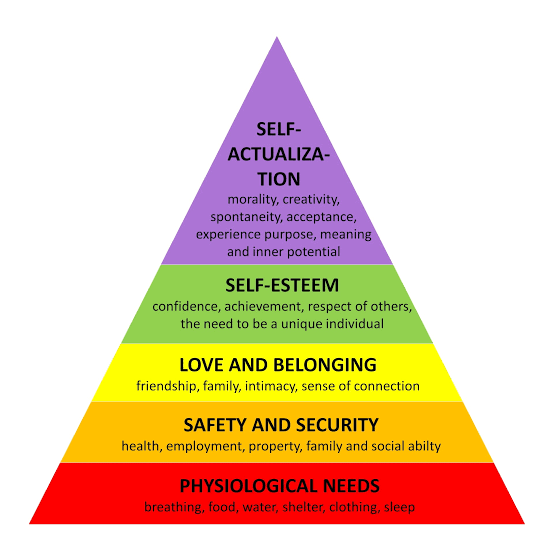
Maslow’s Hierarchy of Needs
Physiological Needs: Food, water, shelter.
Safety Needs: Security, stability, health.
Social Needs: Relationships, friendship, belonging.
Esteem Needs: Respect, recognition, achievement.
Self-Actualization: Fulfillment, personal growth, creativity.
open system
They take inputs (raw materials, information, human resources) from the environment, transform them through internal processes, and release outputs (products, services) back into the environment. They rely on constant feedback to survive.
characteristic:
boundaries are permeable meaning that they can be changed
Observe what is happening in the environment and adapt to it
Affected by outcomes-need profit
Many ways to do something
closed systems
Focuses only on internal needs fulfillment (ignores environment).
Boundaries are impermeable
Do not care for external environment
Affect affected by outcomes-need profit
Only have one way of doing something
expectancy theory
Workers are motivated when they believe their effort will lead to good performance and that this performance will result and rewards the value
Effort leads to performance
Performance leads to rewards
Value of the reward to the individual
Expectancy= performance
Instrumentality= reward
Value= outcomes
Herzberg theory
Divide workplace factors into hygiene and motivators
Hygiene factors- they don't motivate workers but can cause the satisfaction if they are inadequate. Extrinsic
ex: salary, working conditions, quality of supervisors job security
Motivators- increase jobs, satisfaction and motivation. Intrinsic.
ex: achievement, recognition, high salary, more responsibility, training personal growth
Equity theory
Workers compared their inputs(effort efforts/skill/experience) and rewards(pay and recognition) with those of others. If they perceive equity, they feel satisfied and motivated.
Equity/reward. vs effort of another in the same position/ reward