Phar 204 - Distribution
 Studied by 0 people
 Call with Kai
 Learn
Learn Practice Test
 Spaced Repetition
 Match
Match Flashcards
 Knowt Play
1/90

There's no tags or description
Looks like no tags are added yet.
Name | Mastery | Learn | Test | Matching | Spaced | Call with Kai |
|---|
No study sessions yet.
91 Terms
What is distribution
the movement of a drug from the bloodstream to tissues / site of action
Distribution is reversible / irreversible
reversible
drugs can re-enter the bloodstream for redistribution
What influences how drug is distributed throughout the body?
properties of the drug
characteristics of the body
Explain the mathematical model in the context of distribution
the body is divided into hypothetical compartments that connect to simplify how drugs move between them. This makes understanding drug distribution easier.
Blood is a complex mixture containing dissolved substances;
salt
glucose
drugs
plasma
cells
Plasma
the liquid part of the blood responsible for carrying everything including dissolved substances and blood proteins
Plasma contains water and plasma proteins, what are some examples of plasma proteins?
albumin 60%
globulin 30%
fibrinogen and prothrombin 4%
Red blood cells remain in blood vessels are are responsible for transporting…
O2 and CO2 bound to Hb
Can white blood cells enter and exit the bloodstream?
Yes
TRUE or FALSE
Platelets lack a nucleus
TRUE
they are cell fragments lacking a nucleus
What do drugs do when they are absorbed into the bloodstream?
bind to plasma proteins → can’t leave the bloodstream
unbound and uncharged → leave the bloodstream
unbound and ionized →leave the bloodstream
Plasma proteins bind drugs ….. (specifically / non-specifically)
non-specifically
The binding of plasma proteins to drugs is …. (reversible / irreversible)
reversible
unbound and uncharged drug molecules can leave the blood stream through
paracellular transport (squeeze between endothelial cells) or diffusion (through the cell)
unbound and ionized drug molecules can leave the bloodstream by
paracellular transport (only if small enough) and active transport (because ionized)
Drugs in plasma is a mixture of
bound drug and free drug
What is the major drug-binding protein and is synthesized in the liver
albumin
albumin has how many drug binding sites?
two main drug binding sites
Albumin has a high ability to bind a wide range of molecules with
high affinity
Albumin primarily binds to what type of drugs
acidic ( neg. charge / donate proton)
neutral
What proteins in plasma has concentration changes in response to inflammation, infection and injury?
alpha - 1 - acid glycoprotein
Alpha-1-acid glycoprotein binds a small range of molecules with a
high affinity
Alpha-1-acid glycoprotein primarily binds to what type of drugs
basic (pos. charge / accept proton)
neutral
Distribution is driven by a
dynamic equilibrium between bound and free drug
Explain the dynamic equilibrium in distribution
as free drug leaves vascular space, the equilibrium will readjust to replenish the free drug
A drug is known to be 98% albumin bound. Which patient most likely has higher free drug at the same total concentration?
A patient with low albumin levels
Once a drug leaves the bloodstream, it distributes into the
interstitial fluid until equilibrium is reached
meaning that the drug concentration in the interstitial fluid will be equal to the free drug concentration in plasma
What is the effect of active transport on the equilibrium when free drug continues to distribute from the interstitial fluid into the cells of the tissue
it could lead to higher drug concentrations in cells than outside of the cells (goes against the equilibrium)
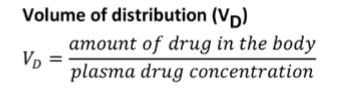
What is Vd (Volume of Distribution)
drug’s propensity to either stay in the plasma or distribute to tissues
Drugs that have high Vd will
leave the bloodstream and go into tissues
Drugs that have a low Vd will
stay in the bloodstream
Formula of Vd
Most drugs distribute by passive processes, but polar and ionized drugs depend on….to enter tissues
Uptake transporters → Solute Carrier (SLC) family proteins (facilitative transporters/active transporters)
What is redistribution
drugs move back from tissues to blood as drug plasma levels fall
Redistribution occurs primarily through what types of transport?
paracellular transport
passive transport
(across the endothelium)
As drugs leave the bloodstream and then are metabolized/excreted, the drug plasma concentration becomes ….. than the drug tissue concentration, so they have to distribute to the opposite direction
lower
Redistribution is important for eventual ….
removal of waste
Only what type of drug (free/bound) can redistribute back into bloodstream
free
Explain the whole process of distribution (bloodstream → endothelium → ISF → epithelial and tissue cells → tissue → epithelial and tissue cells → tissue → ISF → endothelium → bloodstream)
in bloodstream, drug binds and unbinds proteins until equilbrium is reached
free drug leaves bloodstream, pass through endothelium into ISF until equilibrium is reached
free drug pass from ISF through epithelia and tissue cells until equilbrium is reached
free drug leave tissues by passing through epithelia and tissue cells into ISF until equilibrium is reached
free drug re-enters blood stream when passing from ISF through endothelium until equilbrium is reached
A drug is 99% plasma protein-bound. Which statement best predicts its initial distribution into tissues?
it will distribute more slowly because only free drug can leave plasma
To be distributed, drugs need to be somewhat soluble in polar and non-polar environments, meaning that they need to have…
both hydrophilic and lipophilic properties
Why does a drug need to have some hydrophilic properties
to move through aqueous blood, ISF and intercellular fluid
Why does a drug need to have some lipophilic properties?
to cross the cell membranes
Lipophilic (hydrophobic) drugs are more likely to pass through lipid bilayer so they are more likely to
leave the bloodstream and distribute to tissues, so they have a higher Vd
lipophillic →higher Vd
Polar drugs are less likely to pass through lipid bilayers and therefore more likely to
stay in the bloodstream, so they have a lower Vd
hydrophilic → lower Vd
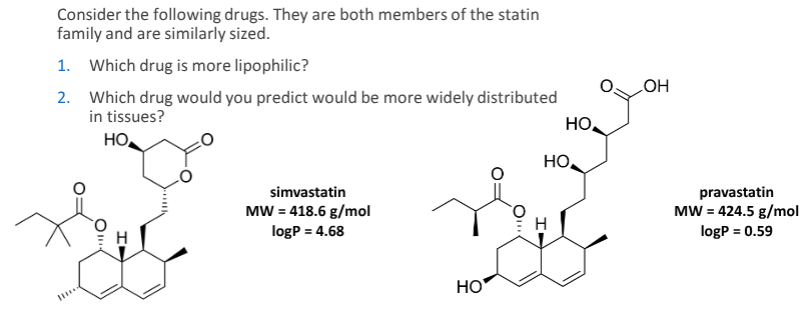
simvastatin
As the drug becomes more lipophillic, what’s the effect on protein binding in plasma
it increases protein binding in plasma (driven by hydrophobic interactions), the more bound they are, the less distribution
How can a lipophilic drug both have increased distribution due to being able to easily cross cell membranes and have decreased distribution due to increased plasma protein binding?
it’s complicated
drugs that are highly bound to plasma proteins have a longer duration of action but may also exhibit reduced volumes of distribution
Compare the distribution of big vs small drugs
small drugs are more likely to pass through endothelium, leave bloodstream, and distribute to tissues thus a higher Vd
big drugs are less likely to pass through endothelium, leave bloodstream, and distribute to tissues thus a lower Vd
Physiological properties that impact drug distribution are
blood flow and perfusion
protein binding
tissue type
biological barriers
What is perfusion?
Perfusion is the extent to which your body’s tissue and organs are supplied with blood vessels
Highly perfused tissues have a large amount of
vasculature, therefore a high amount of blood flow to the area
brain, heart, liver, kidneys, lungs
lower perfused tissues have very little
vasculature, therefore have a small amount of blood flow to the area
muscle, skin, fat, bone
Compare tissues with high and low perfusion in the context of receiving drugs
High perfusion → high blood flow → receive drugs more quickly
Low perfusion → low blood flow → receive drugs slowly
A patient is in shock and experiences strong vasoconstriction. Compared to a healthy patient, which tissue is most likely to receive even less early drug exposure?
A. Brain
B. Heart
C. Kidney
D. Skin
Skin
Is protein-bound drug pharmacologically active?
No. Bound drug is inactive
What is meant by a “circulating drug reservoir”?
Protein-bound drug remains in plasma and serves as a reserve
What happens as free drug is eliminated from the body? (causing depleting tissue and isf concentrations)
protein-bound drugs in plasma will dissociate to maintain plasma levels
this creates a plasma reservoir that buffers free drugs
What is the buffering effect of plasma protein binding
it creates a plasma reservoir that buffers free drug concentrationn
How does plasma protein binding affect volume of distribution (Vd)?
It doesn’t necessarily increase VD and often lowers apparent Vd
What is the overall clinical effect of plasma protein binding on drug action
prolonged duration of action
A drug is predicted to be 90% bound in a healthy individual. What potential impact(s) could occur for an individual with severely impaired liver activity who takes the same dose of the same drug
reduced albumin production could increase free fraction of the drug
free drug concentration could rise more than expected, increasing risk of toxicity
Can drugs bind to tissue components? If yes, what does that mean
Yes
it means that there is less free drug available to move through the body and interact with their targets
(some drugs have a strong affinity for a tissue component, depleting it from the bloodstream)
drugs can bind to tissue proteins and other macromolecules through
non-specific or specific interactions
As free drug concentrations decrease in the ISF, tissue-bound drug will be…
released to restore equilibrium
There are two types of tissue reservoirs;
fats reservoirs and bone reservoirs
Explain fats reservoir
lipophilic drugs are bound to fat tissue and get trapped, since fat as low blood flow, the drug uptake and release is slow (released slowly back to circulation), so there is a prolonged duration of action
(e.g cannabis)
Explain bone reservoirs
some drugs have high affinity for calcium crystals in bone mineral, and bind tightly to bone through ionic interactions
(e.g biphosphonates)
A patient with high body fat receives a lipophilic drug. Predict how the distribution of drug would compare to a patient with less body fat
More drug is trapped in fat, and less is in the bloodstream, so there is a higher Vd
it will have a higher Vd
Biological barriers act as a semipermeable membranes to
block interaction of foreign materials with cells beyond the barrier
Barriers limit the molecules that can pass through, forming / producing…
tight cell-cell junctions
efflux transporter proteins
The existence of biological barriers mean that
a drug may not be able to be distributed to certain areas of the body
Brain endothelium is very tightly packed, why?
to restrict any entry to the brain through paracellular transport
What additional barrier of cells wrap around the brain’s capillaries, and what does it do?
astrocytes
prevent influx of materials
What do efflux transporters at the BBB to
pump out foreign materials that manage to sneak in
BBB prevents distribution of many drugs to the brain
How do drugs distribute into the brain?
By satisfying the Lipinski rule of 5
What is the Lipinski rule of 5?
< 500 g/mol
log P < 5
< 5 H-bond donors
< 10 H-bond acceptors
uncharged at physiological pH
Example drugs: pain relievers, antidepressants, nicotine
Many drugs can still distribute into the brain through the BBB, how though?
active and receptor-mediated transport through binding to receptors on the brain’s epithelial cells
In order to get drugs through the BBB, we have to design drugs that
mimic the natural substrates for specific receptor proteins at the BBB
e.g: semaglutide
Another example of how drugs can still distribute into the brain through the BBB is through Adsorptive-mediated transport, what does that mean
the drug has a lipid nanoparticle-encapsulated drug adsorb to plasma membranes to support passage through cells
Explain the internasal route of administration
internasal delivery can allow some drugs to travel into the brain through olfactory nerves
e.g: naloxone
A drug meets Lipinsi’s Rule of 5 but still has low accumulation in brain tissue. What is the most likely reason?
the presence of efflux transporters pump the drug out of the brain
What is the Blood-Testes barrier (BTB)
barrier that separates developing sperm cells from the bloodstream
BTB is formed by
tight junctions between sertoli cells that prevent paracellular transport
Some drugs can make it through the BTB if they
satisfy Lipinski’s Rule of 5
transported via active transport mechanism
Does the BTB also have efflux transporters
Yes, their efflux transporters work to pump out the drugs
What does the Placenta Barrier do?
separates maternal and fetal circulation
What creates a large surface area for nutrient and waste exchange?
stem cells called cytotrophoblasts that fuse to make a synctiotrophoblast
Does the placenta barrier have a tight regulation like BBB?
No, it’s more lax
What type of drugs can easily diffuse through the placenta
small lipophilic drugs
drugs that are very large, ionized or have strong protein binding are less likely to pass through the placenta
So many physiological factors impact distribution, like
age
pregnancy
obesity
various disease states
diet
drug interactions
(see slide 49 of distribution lecture for more detail)
 Note
Note  Flashcards (23)