Lecture 8/9: Spay-Neuter I & II
 Call Kai
 Learn
Learn Practice Test
 Spaced Repetition
 Match
Match Flashcards
 Knowt Play
1/63

There's no tags or description
Looks like no tags are added yet.
Name | Mastery | Learn | Test | Matching | Spaced | Call with Kai |
|---|
No analytics yet
Send a link to your students to track their progress
64 Terms
What does neuter refer too?
• Ovariohysterectomy (OHE) – surgical removal of the ovaries & uterus
• Ovariectomy (OVE) – surgical removal of the ovaries
• Orchiectomy – surgical removal of the testicles
What is surgical removal of either the male or female sex organs (most commonly used interchangeably for orchiectomy)?
castration
What is a hysterotomy?
surgical incision into the uterus
What is excision of ovary or testis?
gonadectomy
Reproductive surgery encompasses a variety of techniques designed to:
• Alter the animal's ability to reproduce
• Aid parturition
• Treat or prevent disease of the reproductive organs
Reproductive and genital surgery are primarily performed to limit reproduction, but what are the other reasons?
• Relieve dystocia
• Prevent or treat tumors influenced by reproductive hormones (e.g., mammary tumors, testicular tumors, and perianal adenomas)
• Control certain diseases of the reproductive tract (e.g., pyometra, metritis, prostatitis, tumor, and prostatic abscessation)
• Help stabilize systemic disease (e.g., diabetes and epilepsy)
How is a PE performed on females before a repro procedure?
• Inspection and palpation of the: Abdomen, Vulva, Mammary glands
• Vaginal Exam – when discharge or enlargement present
• Visualize and digitally palpate vestibule and vagina (If patient is too small for vaginal exam, perform a rectal)
What do you inspect mammary glands for during a repro PE?
• Symmetry
• Texture
• Size
• Mobility
• Discharge
• Presence of masses
True or false: antibiotics are not normally necessary for routine OHE/castration/
true
When are antibiotics indicated for routine OHE/castration?
pyometra - abx efficacious against E. coli until C&S (avoid aminoglycosides in pyometra)
prostate - consider need for blood-prostate barrier penetration
What is the goal of surgical neutering?
to remove the ovaries, with or without the uterine horns and body, or testes, with secure ligature placement
When is early gonadectomy considered safe in dogs and cats?
> 7wks of age
Besides reducing the likelihood of reproduction in animals adopted from shelters, what are the other benefits of early gonadectomy?
• Decreased anesthetic and material requirements
• Simplicity of procedure
• Rapid recovery
• Reduced complication rate
What is early age gonadectomy NOT associated with?
• Increased obesity*
• Amount of daily food consumption*
• Activity level*
• Lower urinary tract disease
• Long bone fractures
• Arthritis
• Immune suppression
• Small urethra
Cats fixed early compared with cats fixed at the traditional time, there is no effect on:
• Immune function
• Bone density
• Prevalence of obesity
• Prevalence of diabetes mellitus
True or false: early age gonadectomy decreases male cat urethral diameter and increases the incidence of lower urinary tract disease and obstruction.
false it doesn’t do either of those
What are the benefits of male cats castrated before 5 ½ months?
• Decreases aggression
• Decreases sexual behavior
• Decreases urine spraying
• Bite wound abscesses from fighting
What are the benefits of early age gonadectomy in cats?
• Reduced incidence of asthma
• Reduced incidence of gingivitis
• Reduced incidence of hyperactivity
What are the potential side effects of early age gonadectomy in cats?
• Increased shyness
• Increased immaturity of external genitalia
• ≤ 7 weeks – Persistent balanoprepucial fold (Does not affect urination, May make urethral catheterization more difficult)
• Physeal closure may be delayed if castrated before 7 months of age but may not increase the risk of physeal fracture development
How does early age gonadectomy affect the incidence of mammary neoplasia?
Reduced incidence mammary neoplasia
• by 95% if before first heat
• By 25% after 3rd heat
What are the potential urogenital side effects of prepubertal gonadectomy?
• Urogenital abnormalities – penis, prepuce, & vulva may appear small and infantile if surgery at 6-8 weeks
• Female dogs are at greater risk for urinary incontinence when surgery is performed before 3 months of age
What are the potential skeletal side effects of prepubertal gonadectomy?
Delayed physeal closure by 8 to 9 weeks resulting in increased long bone length
Joint incongruity
Increased risk for excessive tibial plateau angle in large-breed dogs
If gonadectomy before 5 ½ months of age, compared with dogs gonadectomized at a later age, there is an increased risk of mild hip dysplasia
Early age gonadectomy is associated with _____ morbidity and ____ anesthetic recovery.
lower, quicker
How is a feline castration patient prepped?
• Position in dorsal or lateral recumbency
• Pelvic limbs pulled cranially
• Pluck hair from the scrotum: From distal to proximal is easier, May be difficult in kittens (16-20 weeks) - Can use clippers for gentle scrotal hair removal
• Aseptic prep of scrotum
• Drape?
What is the feline square knot technique for castration?
For feline castration, pluck hair from the scrotum and aseptically prepare the scrotum for surgery.
Make cranial to caudal skin incisions over each testicle.
Incise and separate the parietal tunic from the testicle, then transect the ductus deferens near the testicle.
Tie two to three square knots with the ductus deferens and the spermatic vessels
What is the figure of eight hemostat technique for feline castration?
A. Place a curved hemostat on top of the cord and wrap the spermatic cord over it.
B. Direct the hemostat's tip dorsally
C. and then ventrally around the cord opposite the testicle.
D. Next, grasp the cord near the testicle.
E. Transect the testicle and pull the end of the cord through the wrap.
F. Digitally snug the knot.
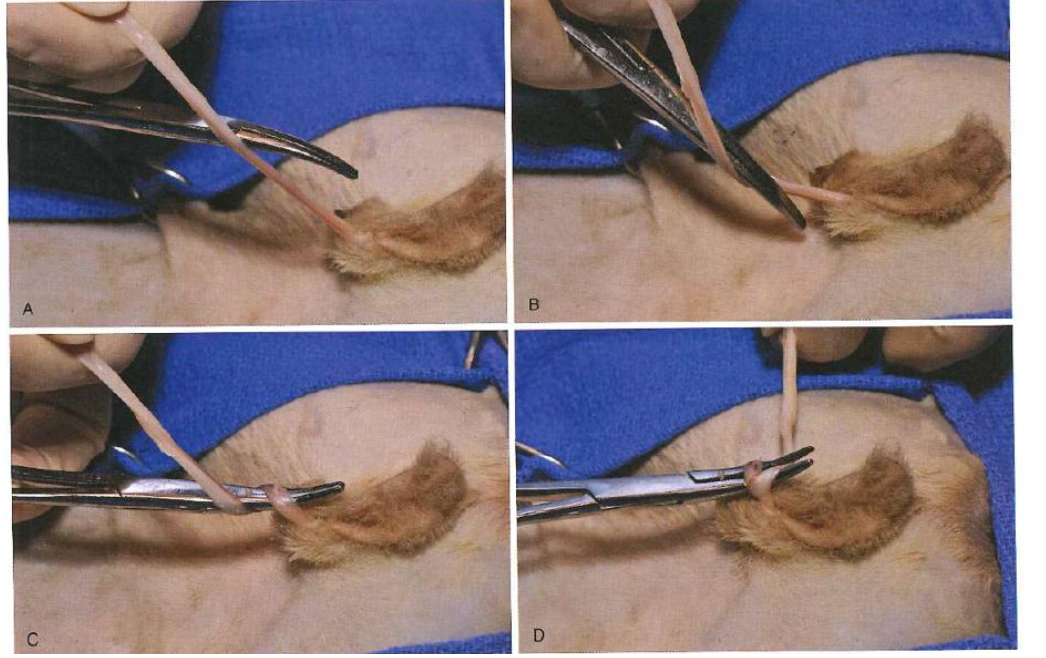
What technique is this?
overhand hemostat technique
Canine castration reduced overpopulation by inhibiting:
• male fertility and decreases male aggressiveness
• roaming
• undesirable urination behavior
What androgen-related disease does canine castration help prevent?
• prostatic diseases
• perianal adenomas
• perineal hernias
What are the indications for canine castration?
• Congenital abnormalities
• Testicular or epididymal abnormalities
• Scrotal neoplasia
• Trauma or abscesses
• Inguinal-scrotal herniorrhaphy
• Scrotal urethrostomy
• Epilepsy control
• Control of endocrine abnormalities
• Testicular Infection
• Testicular Torsion
• Testicular Trauma
• Perianal Adenomas (Prevention or Treatment)
• Prostatic Cysts
• Prostatitis
• Benign Prostatic Hyperplasia (BPH)
• Prostatic Abscesses
• Sex Hormone–associated Alopecia
Testicular tumors occur in _____ of intact males.
29%
What neoplasias may intact male canines have a higher risk for?
• Prostatic Carcinoma
• Hemangiosarcoma
• Osteosarcoma
• Transitional Cell Carcinoma
What are the approaches for canine castration?
• Prescrotal: Most common, Easier
• Perineal: Testicles more difficult to exteriorize, Used to avoid repositioning when patient already in perineal position
• Scrotal: Sometimes used if patient is prepubertal
• Abdominal: Retained testicle
For right-handed surgeons, castration of an adult dog is easier when performed from the dog’s _______ side.
left (left hand pushes testicle forward and right hand makes incision)
Closed castration can be used in any size dog as long as the spermatic cord (stretched & stripped) < ______ in diameter.
1 cm
True or false: spermatic cords may be clamped during canine castration, but large cords are easier to transfix if they are not clamped.
true
Scrotal Ablation is performed concurrently in dogs with:
• Scrotal Dermatitis
• Neoplasia
• Dogs with thin, pendulous scrotal sacs
• Dogs that live in kennels (on the floor)
How is a closed prescrotal canine castration performed?
push testicle craniall and incise prescrotal skin and subcutis to level of parietal tunic
break down scrotal ligament
identify junction between spermatic cord and surrounding soft tissues
lift testicle upwards while stripping base of cord with a sponge - cord elongates as it separates from soft tissues at junction
flatten cord between thumb and index finger to separate cremaster from vessels and pass suture through cord and around vessels - ligate vessel side first, then pass end of suture around entire cord and tie four throws
3 clamp technique may be used: encircling ligature in crush of clamp 1, transfixation ligature proximal to clamp 2, cut between clamps 2 & 3
inspect cords for hemorrhage before replacing cords in patient
appose incised dense fascia on either side of penis w/ interrupted or continuous sutures
close SQ tissue w/ continuous pattern
appose skin w/ intradermal, subcuticular, or simple interrupted pattern
What is the scrotal ligament formed by?
the remnant of the embryonic structure called the gubernaculum. It was once referred to as the ligament of the epididymis.
When suturing the incised dense fascia during a closed prescrotal canine castration, what should you be careful to avoid?
urethra
How is an open prescrotal canine castration performed?
advance one testicle into the prescrotal area by applying pressure over the scrotum. Make an incision over the testicle
Incise the spermatic fascia and parietal vaginal tunic
Place a hemostat across the tunic where it attaches to the epididymis and digitally separate the ligament of the tail of the epididymis from the tunic
Ligate the ductus deferens and vascular cord individually, and then encircle both with a proximal circumferential ligature. Apply a Carmalt forceps distal to the ligatures and transect between the clamp and ligatures
inspect cord for hemorrhage and replace cord within tunic
encircle cremaster muscle and tunic with ligature
advance second testicle into incision, incise fascial covering, and remove testicle
How is a modified open prescrotal canine castration performed?
push testicle cranially and incise overlying prescrotal skin and subcutis to level of parietal tunic
break down scrotal ligament
identify junction between spermatic cord and surrounding soft tissues
lift testicle upwards while stripping base of cord with sponge - cord will elongate as it separates from the soft tissues at junction
incise spermatic fascia and parietal vaginal tunic creating window into spermatic cord
extract ductus deferens and vascular cord through window
ligate ductus deferens and vascular cord individually, and then encircle both w a prox circumferential ligature, apply carmalt forceps distal to ligatures and transect between clamp and ligatures
place ligated ends of ductus deferens and vascular cord back through window in parietal tunic
place encirclin ligature around spermatic cord, distal to ligated structures inside
transect cord distal to encircling ligature, removing testicle and overlying tunic
What are the indications for castration with scrotal ablation?
• Older dog - pendulous scrotum
• Enlarged testicle
• Scrotal Hematoma
• Severe scrotal dermatitis
• Dogs that live in kennels
• Neoplasia
What are the complications commonly seen in castration with scrotal ablation?
• Excessive tension at suture line
• Wound disruption, self mutilation
• Infection
What is the technique for scrotal ablation?
• Broad clip
• Plan incision to leave ample skin
• Penis/urethra deep to excision
• 3 layer closure
• Release leg ties if tension seems excessive
What is OHE?
surgical removal of the ovaries and uterus
What are the indications for OHE?
• Prevent estrus and unwanted offspring
• Prevention of mammary tumors or congenital anomalies
• Prevention and treatment of pyometra, metritis, neoplasia (i.e., ovarian, uterine, or vaginal), cysts
• Uterine trauma/Uterine torsion/Uterine prolapse
• Subinvolution of placental sites
• Vaginal prolapse, vaginal hyperplasia
• Control of some endocrine abnormalities: Diabetes, Epilepsy
• Control of some dermatoses: Generalized Demodex
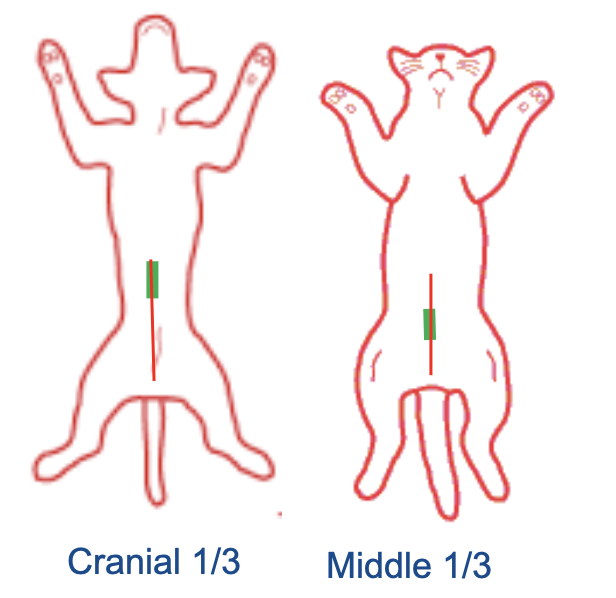
Where do you make your incision for an OHE in dogs, puppies, and cats?
draw imaginary line from umbilicus and pubis and divide lines into thirds
dogs: cranial 1/3
puppies: middle 1/3
cats: middle 1/3
How do you use a spay hook?
• Using Brown-Adson thumb forceps, gently grasp the abdominal wall on the side that you are attempting to retrieve the ovary.
• Using your finger, sweep the spleen or other organs cranially and laterally, out of the surgical field if necessary.
• With the “hook” against the body wall, insert the spay hook and advance it cranially-to-caudally, at approximately a 45° angle, toward the inguinal canal on the side you are retrieving, until it stops
• Rotate the handle of the spay hook 180 °
• Sweep the hook across the dorsal body wall to the midline.
• Gently lift the spay hook straight up, paying close attention to the amount of tension you can feel on the tissue
What is the “goldie locks theory” of spay hooks?
feels too tight: hook feels snagged deep against dorsal body wall and does not want to pull up
feels too loose: hook comes up out of incision often with omentum or a loop of small intestines
feels just right: if it feels right, it’s in there, peel through tissues in hook and find it
Which ovary is tighter?
right
What is ovarian remnant syndrome?
disorder characterized by clinical signs related to functional residual ovarian tissue after an OHE
How is ovarian remnant syndrome diagnosed in dogs?
baseline progesterone concentrations
How is ovarian remnant syndrome diagnosed in cats?
progesterone concentrations measured 7 days after administration of HCG
When should animals affected by ovarian remnant syndrome be surgically explored?
while they are in estrus
What is the general canine OHE procedure?
grasp proper ligament w/ hemostat and retract caudally as you break most cranial extent of suspensory ligament w/ index finger - press caudally and medially to stretch ligament
open forceps parallel to ovarian vessels to make window in broad ligament
triple clamp pedicle: two clamps on pedicle below ovary and one above → ligate below and between bottom two clamps and cut above second clamp
expose second uterine horn and repeat process
grasp round ligament and pull from caudal abdomen
ligate uterus and uterine arteries and veins with encirlcing and trasnfixing-encircling sutures
same closure as celiotomy (3 layered closure w/ monofilament absorbable)
What may happen while using clamps on a uterine body that is friable and appears unhealthy (ex. postpartum)?
use of clamps may have same effect as scissors, severing the uterus (even suture could slice through if overtightened
Some blood will normally pool on top of the intestines or in the paraspinal regions because of subcutaneous bleeding after an OHE. This is especially true if:
dog is in heat
lactating
pregnant
How is the suspensory ligament broken in cats?
by pulling caudally on the proper ligament clamp while pressing down on the abdominal wall over the palpable, taut ligament
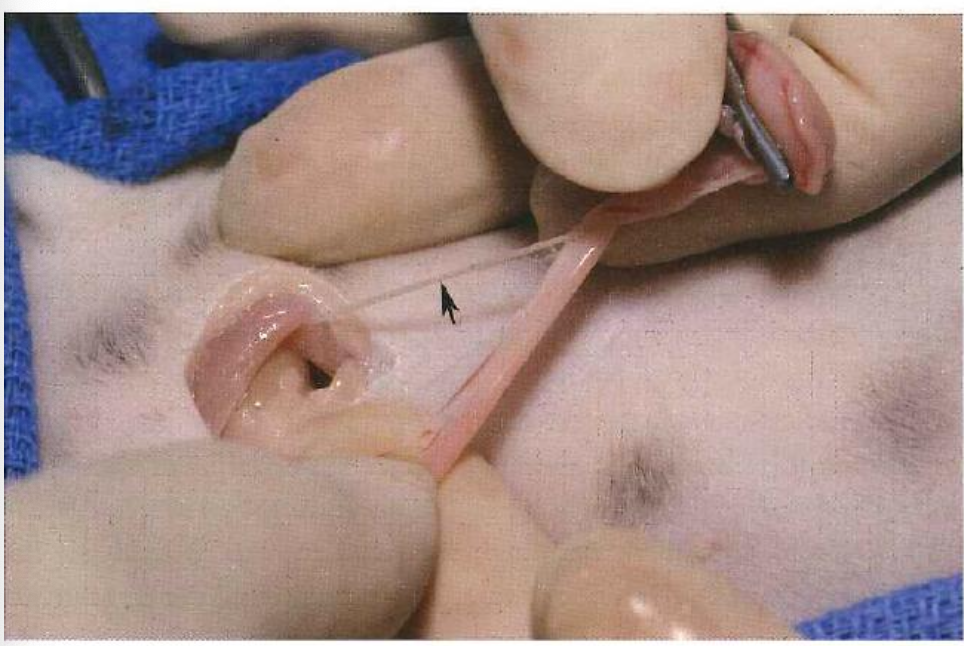
What is the arrow pointing to in this cat?
round ligament of uterus
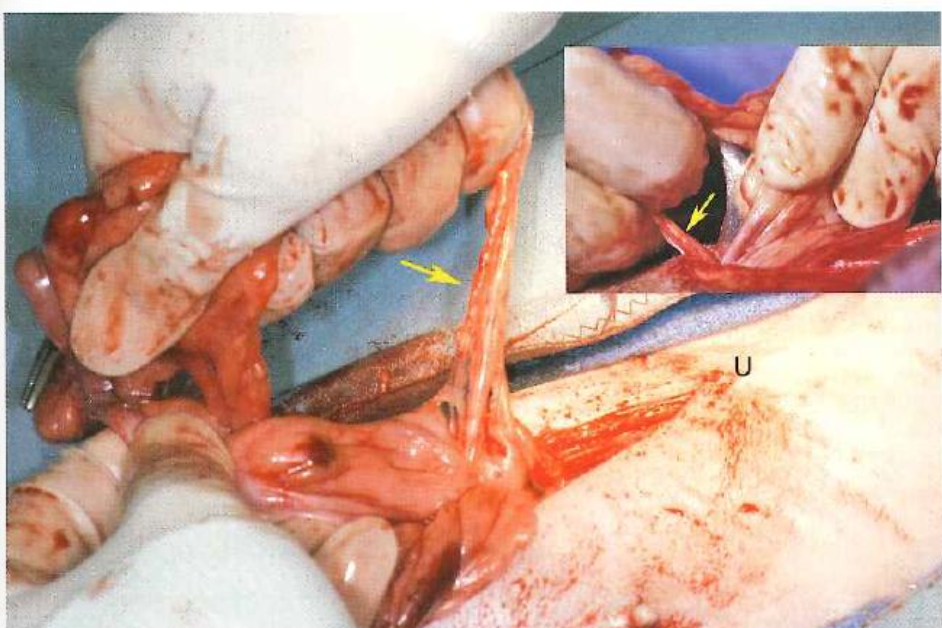
What is the arrow pointing to in this dog?
round ligament
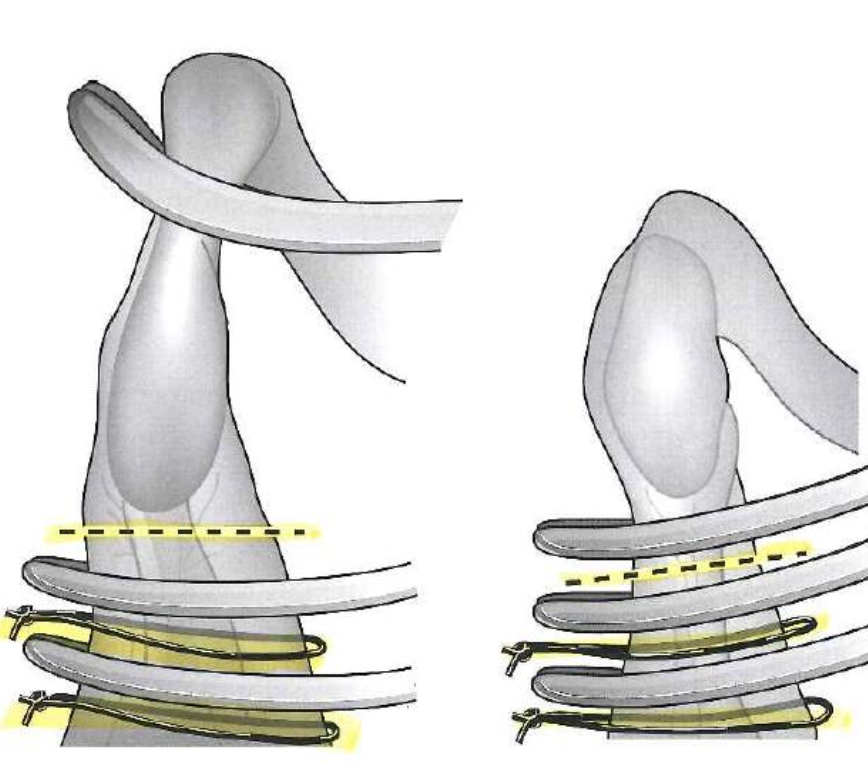
Which clamp method is which?
left: modified 3 clamp
right: 3 clamp
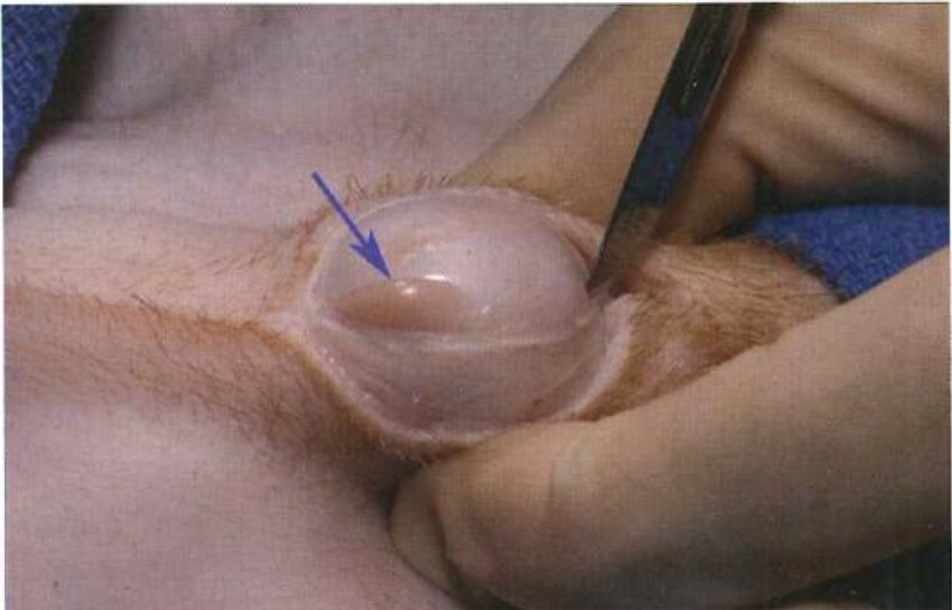
What is the arrow pointing to?
small conglomeration of fat on the parietal tunic
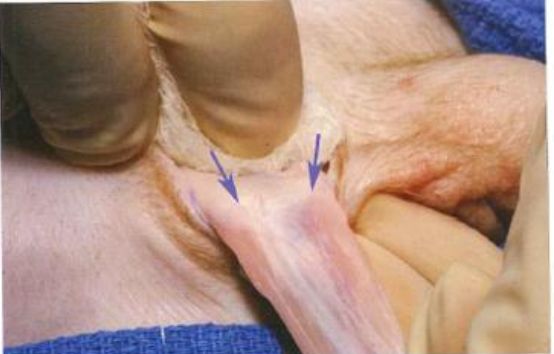
What are the arrows pointing to?
the junction between the spermatic cod and surrounding soft tissues

