Bio Midterm
Nature of Science:
The scientific method is a series of steps used to investigate a natural occurrence that can be tested.
An observation is something that is apparent and uses all 5 senses.
A qualitative observation is an observation that uses numbers.
A quantitative observation is an observation that uses the senses.
An inference is an assumption based on reasoning and prior knowledge.
A hypothesis is a tentative explanation that needs further investigation.
A null hypothesis states that changing the independent variable has no significant difference on the dependent variable.
An alternative hypothesis states that changing the independent variable has a significant difference on the dependent variable.
An independent variable is the variable that is manipulated or changed.
A dependent variable is the variable that is measured.
The experimental groups are the variables that the experiment is interested in testing (as opposed to the controls).
The constants or controlled variables are the things that the experimenter attempts to keep the same for all experimental groups.
A control group is the standard of comparison.
A positive control is the control that is known to cause a significant change. If the experiment works, it will test positive.
A negative control is the control that has normal or no exposure to the variable. If the experiment works, it will test negative.
Variance is a measure of how spread out the data is from the average
Standard deviation is a measure of how spread out the data is from the mean
Standard error of mean allows you to infer how well the sample mean represents the entire population. The larger the error bars, the less accurate the representation.
Vocabulary:
Natural occurrence - occurs in nature; observable
Statistical significance - uses +/-2SE error bars to find if the data is statistically significant
Placebo - sugar pill; a negative control that contains no drug but still makes the mind think there are drugs
Verification - verifying the data is correct by creating a controlled experiment
Correlation - finding patterns in data
Key/Legend - shows the code of what different colors or shapes represent
Mean/Average - the midway point of the data
Axis Break - a zigzag line on the scale of a graph that represents a break in the numbers
Equidistant - at an equal distance from a point
Trendline/line of best fit - the line that shows the correlation between two variables
Parts of a Scientific Graph:
Title - Dependent Variable vs. Independent Variable
Axes - x goes horizontally and y goes vertically
Intervals - Appropriate spacing
Labels - label units on axes
Scale - appropriate and even spacing
Graph Types:
Line graphs are used for continuous changes over time.
Bar graphs are used for comparisons among categories.
Scatter plots are used to show correlations or trends.
Analyze Error Bars:
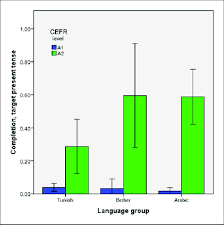
Null hypothesis (H₀) - If Turkish, Berber, and Arabic are tested, then there will be no significant difference in completion.
Alternative hypothesis (H₁) - If Turkish, Berber, and Arabic are tested, then Berber will have the most completion.
Analyze null hypothesis: Because the ±2SE error bars overlap, then there is not a significant difference between the data points. We fail to reject the null hypothesis.
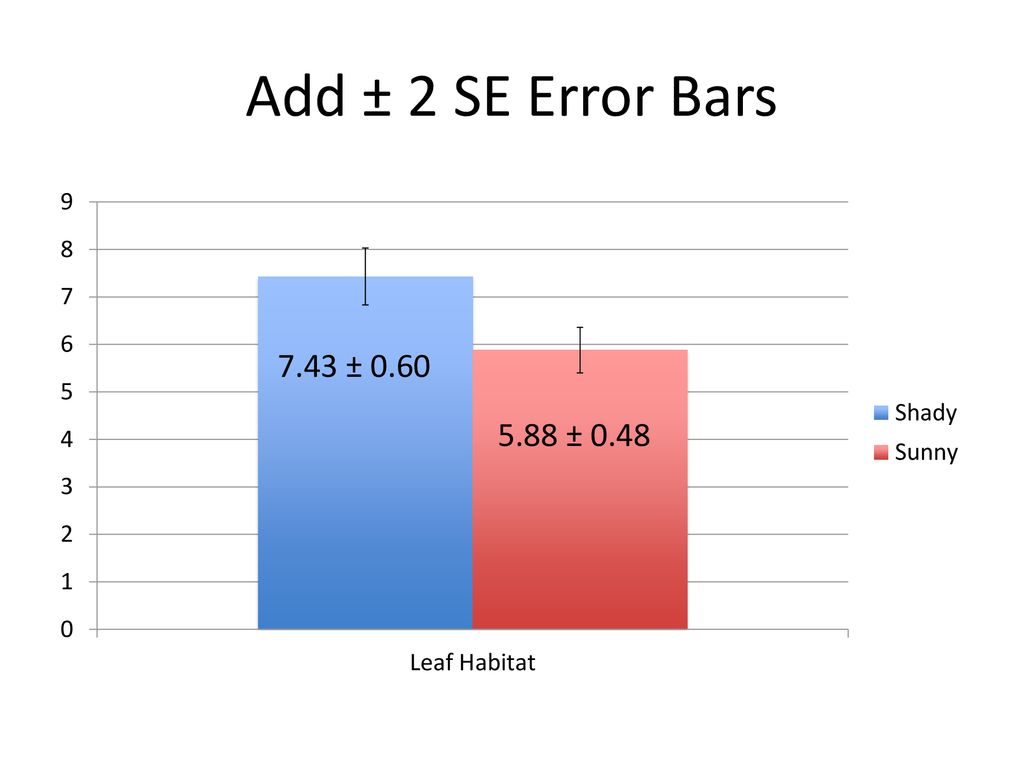
Null Hypothesis (H₀) - If we test shady and sunny habitats, then there will be no significant difference in plant height.
Alternative Hypothesis (H₁) - If we test shady and sunny habitats, then the sunny habitat, will have a greater height.
Analyze null hypothesis: Because the ±2SE error bars do not overlap, then there is a significant difference between the data points. We reject the null hypothesis.
Analyze alternative hypothesis: Because the ±2SE error bars do not overlap, then there is a significant difference between the data points. Because the shady habitat has a greater height, we reject the alternative hypothesis.
Characteristics of Life:
The eight characteristics of life are cell(s), organization, maintaining homeostasis, response to stimuli, reproduction, having adaptations and contributing to evolution, growth and development, and energy
Biology is the study of living things
Cell(s):
The four kingdoms are Animalia (multicellular heterotrophs), Plantae (multicellular autotrophs), Protista (unicellular eukaryotes), and Fungi (multicellular or unicellular heterotrophs)
Prokaryotic cells have no nucleus and instead have a nucleoid while eukaryotic cells have a nucleus
A cell is the simplest piece of an organism that can do all eight characteristics of life
A prokaryote is an organism that is made up of one or more cells that have a nucleoid instead of a nucleus
A eukaryote is an organism that is made up of one or more cells that have a nucleus
The nucleus is the structure in a eukaryotic cell that carries genetic material
The nucleoid is the area in a prokaryotic cell that contains genetic material
Bacteria is a unicellular organism that always has a nucleoid and may cause diseases
Organization:
The levels of organization are atoms, molecules, organelles, cells, tissues, organs, organ systems, multicellular organisms, population, community, ecosystem, and biosphere
A population is a group of organisms from the same species living in the same place at the same time
A community is a group of organisms from many different species living in the same place at the same time
An ecosystem is the environment with both biotic and abiotic factors
A biosphere is the place on Earth that life takes place
Abiotic factors are non-living things and biotic factors are living things
Ecology is the study of how organisms relate and interact with each other and their environment
Energy:
The ultimate source of energy is the Sun
Photosynthesis: sunlight + H₂O + CO₂ —> glucose + O₂
Cellular respiration: glucose + O₂ —> ATP + H₂O + CO₂
Reactants are the inputs in a chemical formula and products are the outputs in a chemical formula
Breathing is just the exchange of oxygen and carbon dioxide while cellular respiration breaks down glucose into energy
The tropic levels are producers, primary consumers, secondary consumers, and tertiary consumers
Producers are autotrophs who make their own glucose
Primary consumers are heterotrophs and herbivores who eat producers
Secondary consumers are heterotrophs and carnivores who eat primary consumers
Tertiary consumers are heterotrophs and carnivores who eat secondary consumers
Each tropic level gets 10% of the energy from the level beneath it
Biomagnification is the phenomenon that explains why top predators consume the most pollutants. Since tertiary consumers receive 0.1% of the energy that producers do, they need to eat a lot more to get the same amount of energy so if there are pollutants, they will receive a lot more of it
If a producer has 10,000 units of energy, the primary consumer will have 1,000 units, the secondary consumer will have 100 units, and the tertiary consumer will have 10 units
An autotroph is an organism that produces its own glucose
A heterotroph is an organism that eats other organisms to obtain glucose
Photosynthesis is the process autotrophs use to make glucose
Cellular respiration is the process organisms use to break down glucose into energy
An herbivore is a heterotroph that only eats autotrophs while a carnivore is a heterotroph that only eats other heterotrophs
Homeostasis:
Humans shiver when it’s cold to increase internal temperature
Humans sweat when it’s hot to decrease internal temperature
When the body detects bacteria, it heats the body and triggers a fever to kill bacteria
A positive feedback loop is when the body amplifies the initial signal while a negative feedback loop is when the body reduces the initial signal
Homeostasis is the conditions necessary for an organism to survive that it needs to maintain
An ectotherm is a “cold-blooded” organism that adjusts to the temperature of its environment
An endotherm is a warm-blooded" organism that regulates its body temperature
Grow and Develop:
Growth is when an organism simply enlarges while development is when an organism's features, shape, color, etc. change
When the egg is fertilized, it becomes a zygote which, through mitosis, growth, and development, becomes an embryo which becomes a fetus. The fetus grows and develops into an adult. Females have ovaries and males have testes.
Growth is when an organism enlarges
Development is when an organism's features, shape, color, etc. change
Metamorphosis is when an organism goes through a rapid and abrupt change before adulthood.
Respond to Stimuli:
When a light tums off, people’s pupils enlarge. The light is the stimuli and the pupils enlarging is the response
Hydrotropism is when an organism grows towards or away from water
Geotropism or gravitropism is when an organism grows towards or away from Earth or gravity
Phototropism is when an organism grows towards or away from light
Thigmotropism is when an organism has a positive or negative response to touch
Reproduction:
Sex is an act that can result in reproduction but reproduction can occur without sex
A benefit to sexual reproduction is that there are unique offspring that can have mutations, which can lead to different adaptations and evolution
A disadvantage to asexual reproduction is that it produces genetically identical offspring so it is much harder to evolve
Different species cannot reproduce with each other because they have to have compatible genetics to reproduce
Organisms belong to the same species if they can reproduce and create fertile offspring
Budding is when offspring grows off of the parent and separates when mature
Fragmentation is when an organism breaks into pieces and each of the pieces creates a new organism
Binary Fission is when the parent copies its DNA and splits in half
Fragmentation creates a whole new organism while regeneration just grows back body parts
Pollinators get covered in pollen and deposit it into the female flower
A flower produces nectar to attract pollinators who spreads pollen and fertilizes the egg in the ovary and creates a zygote. The zygote performs mitosis and becomes an embryo which develops into a seed inside the ovary which becomes a fruit
The ovary produces an egg and the testes produce sperm. The sperm fertilizes the egg and it becomes a zygote which performs mitosis and becomes an embryo. The embryo develops into a fetus.
If a hermaphroditic plant reproduces with itself, there will be major birth defects in its offspring
A species is a group of organisms who can produce fertile offspring with each other
A hybrid is the offspring of two organisms from different species
Sterile means an organism cannot reproduce while fertile means an organism can reproduce
Grafting is cutting pieces of different plants and growing them together
Gametes are sex cells like sperm and eggs and somatic cells are body cells
Meiosis is the process by which sex cells are made and mitosis is the process by which body cells are made
A hermaphrodite is a plant that is both male and female
An anther is the male sex organ in a plant and an ovary is the female sex organ in a plant
Pollen is the male sex cell in a plant and an egg is the female sex cell in a plant
Pollination is how plants reproduce while fertilization is how animals reproduce
A seed is the embryo in a plant and a fruit is the ovary in a plant
Adapt and Evolve:
Natural selection is when some organisms with certain mutations are more likely to survive and reproduce so these mutations are passed down and become adaptations
Survival of the Fittest is the idea that organisms who are better equipped to survive and reproduce will have their genes passed down
Some people think Survival of the Fittest means the strongest and fastest organism will survive but they have to reproduce too
Mrs. Moody thinks it should be called Survival of the Sexiest because natural selection is really about which organisms reproduce to pass on their mutations
A single organism cannot adapt or evolve but it can acclimate and has adaptations
An organism is born with an inherited genetic mutation that allows it to win competitions, survive, and reproduce. Its offspring inherits the adaptation and over many generations and accumulated mutations, the population evolves. The new organism can no longer produce fertile offspring with the initial species so there are now two separate species.
Acclimation is when a single organism adjusts to its environment and adaptation is when a genetic mutation that is beneficial for survival and reproduction is passed down
Mutation is a random genetic difference in an organism
Artificial selection is when humans choose favorable traits in organisms that they breed together
Biochemistry:
Chemistry:
An atom's atomic number is the total number of electrons it has. The innermost shell has two electrons and the rest have eight. The number of electrons an atom has on the outer shell are its valence electrons.
Carbon can make four bonds and Hydrogen can make one bond.
Water:
H₂O (two hydrogens and one oxygen)
cohesion is water molecules sticking to themselves and adhesion is water molecules sticking to other substances
surface tension is caused by cohesion and causes water to have a "skin" that is hard to break (ex: skipping stones)
Capillary action is caused by cohesion and adhesion and causes water to move up through tight spaces (ex: transpiration)
water is polar which makes it able to dissolve a lot of things (ex: salt water)
when water freezes, it expands which causes it to be less dense and float (ex: ponds' top layer freezes)
water has a high specific heat which means it takes a lot of heat for it to change temperature (ex: water vs. sand)
water has a high heat of vaporization which means it takes a lot of heat for it to vaporize (ex: evaporative cooling (sweating) uses a lot of heat to evaporate sweat so it cools you down)
coffee filters: cohesion & adhesion, capillary action, universal solvent
paper clip: surface tension, cohesion & adhesion
cotton swab: high heat of vaporization
penny: cohesion & adhesion, surface tension
vegetable oil: universal solvent, water cannot dissolve lipids
balloon: polarity
sand and water: high specific heat
Organic Chemistry:
The 6 elements found in life are C,H,O,N, P, S
carbohydrates are polymers, lipids are not polymers, proteins are polymers, and nucleic acids are polymers
Any corner, end of a line, or intersection is a carbon and hydrogens go wherever they fit
Protein:
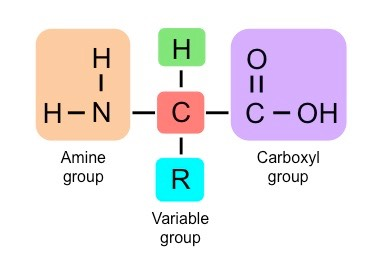 Lipid (Steroid):
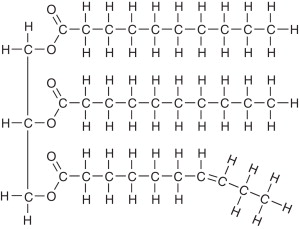
 Lipid (Triglyceride):
 Nucleic Acid:
 Carbohydrate:

Carbohydrates:
C, H, O at a 1:2:1 ratio
the monomer is a monosaccharide
their function is short-term energy in animals, long-term energy storage in plants, and structure
monosaccharides have one polymer, disaccharides have two polymers, and polysaccharides have many polymers
Starch is used for long-term energy storage in plants and is found underground as potatoes, turnips, carrots, etc.
glycogen is used for short-term energy in animals and is wrapped around the muscles and liver
Cellulose is used to build plant cell walls and is found in any plant or fruit as fiber
When a Benedict's test is performed, it is blue when not in the presence of simple carbohydrates but turns different colors on a spectrum when in the presence of simple carbs
an Iodine test is rust-colored out turns black in the presence of starch
Lipids:
C,H,O not in any ratio
made of fatty acids (strings of C and H) and glycerol, three fatty acids makes a triglyceride, 4 rings of carbon makes a steroid
long-term energy storage in animals and insulation
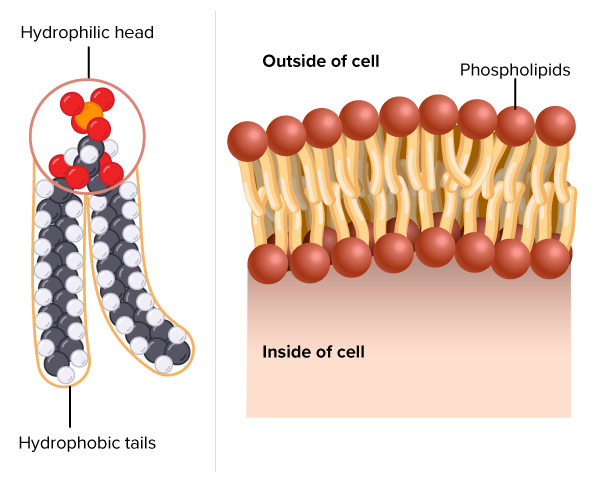
Phospholipids make up cell membranes
cell membranes ae made of two layers of phospholipids
If a fatty acid has at least one double bond and has a kink or bend, it is unsaturated
saturated fats are solid and unsaturated fats are liquid at room temperature
saturated fats can cause heart disease and strokes
if a Sudan III test has a red layer at the top, the sample contains lipids
if an Emulsion Test has a floating cloudy white layer, the sample contains lipids
if the brown bag test has a greasy translucent smear, the sample contains lipids
Proteins:
contains C, H,O, N, and sometimes S
amino acids are the monomer
polypeptide chains are the polymer
each amino acid has a different R Group which is how they are differentiated
the bond between amino acids is called a peptide bond
R-Groups with O, N, or S can interact with water because they are polar, nonpolar R-Groups cannot interact with water
Primary folding is when amino acids bond together, Secondary folding is when the polypeptide chains wrap into helixes or pleats, Tertiary folding is when the polypeptide chains become a 3d structure, Quaternary folding is when the polypeptide chains interact with each other
Proteins are used for structure and speeding up reactions
When proteins' pH changes, temperature increases, or salinity changes, its shape falls apart and it is denatured and can't do its job
If a Biuret test is blue, there are no peptide bonds in the sample but if it is purple, there are peptide bonds
Enzymes:
main function is to speed up reactions (catalyst)
made of proteins
Synthesis enzymes build molecules while digestive enzymes break down molecules
Nucleic Acids:
contains C, H, O, N, P
used to store and transfer genetic in formation
nucleotides are the monomer
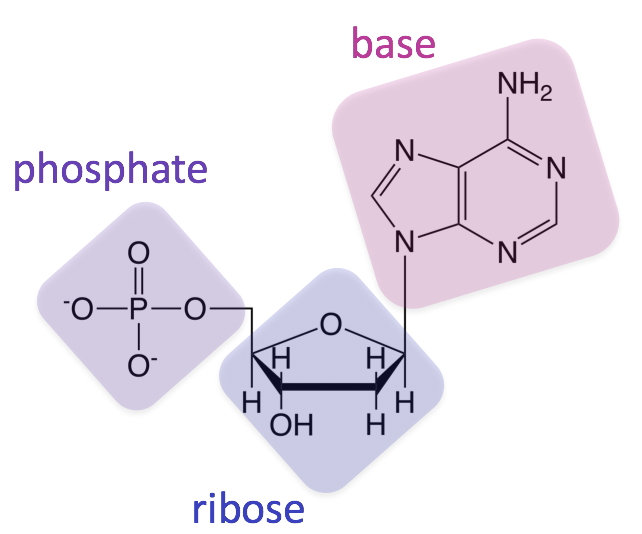
the three components of a nucleotide are phosphates, 5-carbon sugars, and nitrogenous bases
DNA uses deoxyribose, is a double helix, and has a T base while RNA uses ribose, is a helix, and has a U base
hydrogen bonds are between bases A and T and C and G
ATP has three phosphates instead of two
phosphates repel each other which causes magnetic potential energy which is released when the phosphate detaches itself
ATP has 3 phosphates, ADP has 2 phosphates, and AMP has 1 phosphate and has no potential energy
Vocabulary:
atom -the smallest unit of matter
ion - an atom that has a different number of electrons as protons, making it charged
octet rule - atoms want to gain, lose, or share elections until their valence shell is full
ionic bond -a bond in which one atom "steals" electrons from the other atom
covalent bond- a bond in which two atoms "share" electrons
polar covalent bond- covalent bonds in which one atom has an electron for more time than the other atom (O or N)
nonpolar covalent bond - a covalent bond in which each atom shares electrons equally (no O or N)
solvent - a substance that dissolves something
solute - the substance that is dissolved
solution- a solvent and solute together
electronegativity - an ion that has more electrons than protons
hydrogen bond- a weak bond between water molecules
organic compound - a compound that has carbon and hydrogen
biomolecule -a molecule that has C and H
polymer - a biomolecule consisting of repeating pieces
monomer - the piece that is repeated
chitin- polysaccharide that makes up the exoskeleton of arthropods and cell walls of fungi
phospholipid bilayer - the two layers of phospholipids that make up the cell membrane
desaturation - a change in pH, temperature, or salinity that causes proteins to unfold
catalyst - speeds up reactions
digestive enzyme - breaks down molecules
synthesis enzyme - builds up molecules
gene - a piece of DNA that has the instructions to make proteins
Cells Part 1:
Cell theory: All living things are made up of at least one cell. The cell is the basic unit of structure and function of all living things. Cells come from pre-existing cells.
Protein Synthesis:
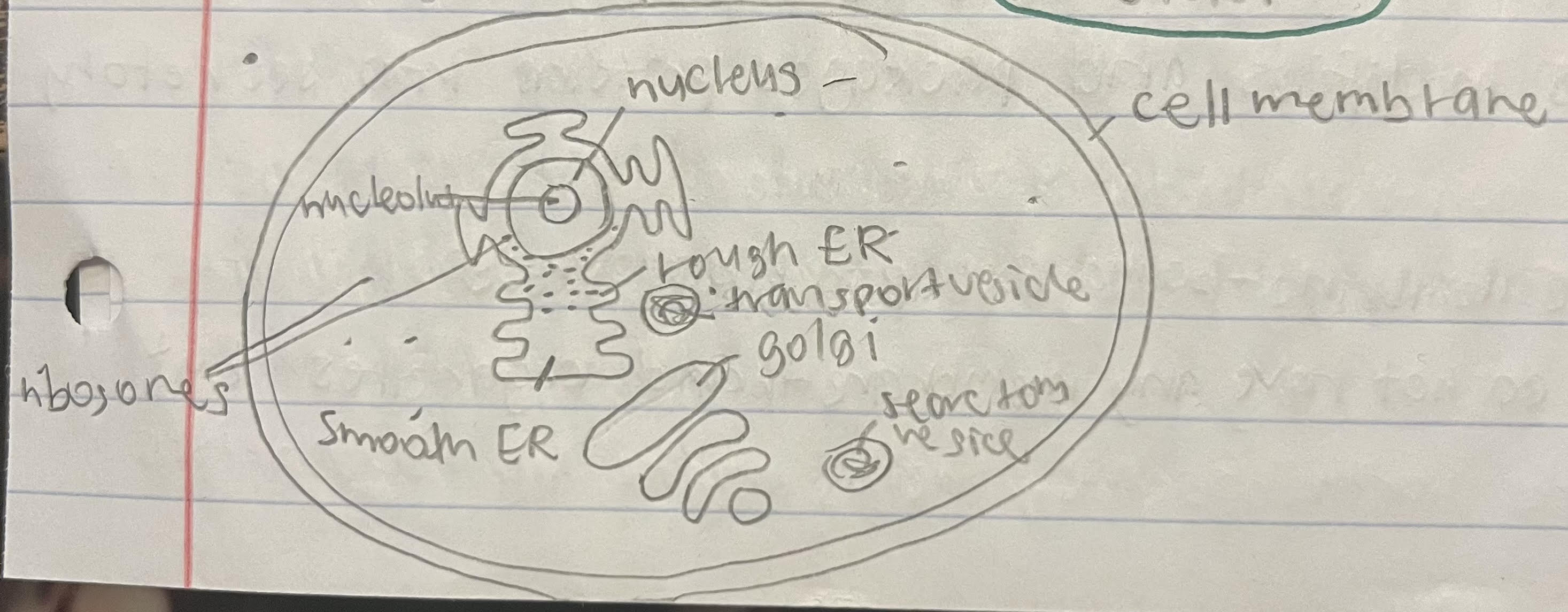
The endomembrane system helps create and transport proteins. It uses the nucleus, nucleolus, ribosomes, rough ER, smooth ER, transport vesicle, golgi apparatus, secretory vesicle, and cell membrane.
• The nucleus protects the DNA. Through the process of transcription, a quick, cheap copy of the DNA is made called mRNA. The mRNA leaves the nucleus through a nucleus pore and goes to a ribosome on the rough endoplasmic reticulum. The ribosome reads the mRNA and creates a polypeptide chain through the process of translation. The polypeptide chain goes inside the rough endoplasmic reticulum, where it is folded into a protein and packaged in a transport vesicle. It then goes to the golgi apparatus, where the transport vesicle is absorbed and the protein is modified and packaged into a secretory vesicle. Then the protein goes to the cell membrane, and through the process of exocytosis, leaves the cell.
 Organelles:
The nucleus stores DNA, the nuclear membrane is a phospholipid bilayer with holes called nuclear pores that regulate what goes in and out
The nucleolus makes rRNA, which helps make up ribosomes
Ribosomes are made of nucleic acids (rRNA) and proteins
large subunit is the bigger piece on top and the small subunit is the smaller piece on the bottom
Ribosomes can be found on the rough ER (makes proteins to leave the cell) or floating in cytoplasm (makes proteins to use inside the cell)
A rough endoplasmic reticulum has ribosomes on it and folds polypeptide chains into proteins
Attached to the nucleus so mRNA does not have very far to travel
the smooth endoplasmic reticulum is connected to the rough ER and helps with detoxification and making lipids
a secretory vesicle is used to move something outside a cell
a transport vesicle is used to move something around inside a cell
golgi apparatus modifies and packages proteins into secretory vesicles
all organelles are membrane-bound except ribosomes
prokaryotic cells do not have any membrane-bound organelles but eukaryotes do
Transcription & Translation:
A gene is a segment of DNA that has code for one protein
transcription is when a quick, cheap copy of DNA is made called mRNA (m stands for messenger)
mRNA is quick because it is one strand instead of two and it is cheap because if it is killed by a lysosome, a new one can easily be created, unlike DNA
Translation is when a ribosome reads mRNA and creates a polypeptide chain, which is made of amino acids
Exocytosis:
exocytosis is the process by which something sheds its secretory vesicle and leaves the cell
the cell membrane absorbs the secretory vesicle
Lactase Lab:
the reactant is lactose and the products are glucose and galactose
If someone is lactase-persistent, their glucose levels will dramatically increase after consuming lactose.
genetic mutations that cause lactose intolerance or lactase-persistence are a one-base difference in a noncoding "switch" region near the lactase gene
If the cell cannot create and transport lactase enzymes (proteins), a person will be lactose intolerant.
A lactase-persistent person can digest lactose and a lactose intolerant person can't
Vocabulary:
endomembrane system- system of organelles that help create and transport proteins
DNA-deoxyribonucleic acid that stores genetic information, double helix, stored in nucleus
RNA- ribonucleic acid that stores genetic information, single helix, can go outside of nucleus
protein- a biomolecule made up of amino acids and polypeptide chains that are folded, multi-purpose molecules
gene - a segment of DNA that stores the code for one protein
nucleus - stores DNA in a cell
nuclear membrane- regulates what goes in and out of the nucleus
membrane-bound - an organelle that has a membrane (not ribosomes)
phospholipid bilayer- two layers of fatty acids and phosphates that makes up all membranes
hydrophilic - polar; can interact with water
hydrophobic-nonpolar; cannot Interact with water
transcription - a quick, cheap copy of DNA, called mRNA, is made
polypeptide chain - the polymer of proteins, made by ribosomes, and made up of amino acids
ribosome - only non-membrane bound organelle, can be on the rough ER or floating in cytoplasm, create polypeptide chains
rRNA - r stands for ribosome, helps make up ribosome
large subunit - larger top part of a ribosome
small subunit-smaller bottom part of a ribosome
rough ER- has ribosomes on it, folds polypeptide chains into proteins and packages them in transport vesicles
smooth ER- does not have ribosomes on it, detoxification and making lipids for membranes
transport vesicle - membrane that transports things inside a cell
secretory vesicle - membrane that transports things outside the cell
golgi apparatus - modifies proteins and packages them in secretory vesicles
cell membrane - the membrane that surrounds the cell, phospholipid bilayer
prokaryotic cell - cell with no nucleus or other membrane-bound organelles, nucleoid
eukaryotic cell - cell with nucleus and membrane-bound organelles
exocytosis - the process by which something leaves a cell
lactase - the enzyme that breaks down lactose into glucose and galactose
lactose - the sugar found in milk
lactase persistent- lactase is still present into adulthood
lactase non-persistent - lactase is not present into adulthood
lactose tolerent - body can digest lactose (lactase persisent)
lactose intolerant - body cannot digest lactose (lactase non-persistent)
Cells Part 2:
Enzymes:
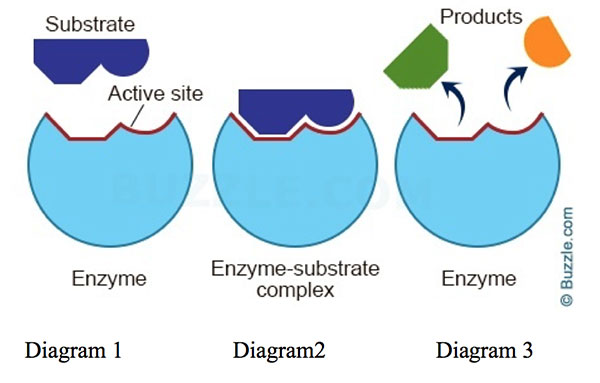
The substrate fits into the enzyme’s active site and is digested or synthesized by the enzyme to create the products.
Activation energy is how much energy it takes to perform a reaction.
A catalyst is something that speeds up a reaction.
A digestive enzyme is an enzyme that breaks things down.
A synthesis enzyme is an enzyme that builds things together.
Enzymes and substrates are like a lock and key because only one kind of substrate fits into one kind of enzyme.
Enzymes are reusable because they can be used over and over without being damaged or used up.
Enzymes can denature because of high temperatures, different pH, or different salinity. Cold temperatures will not denature an enzyme but they will make the reaction slower. The optimal conditions for an enzyme are the ones under which it performs the fastest.
The substrate of the catalase lab was hydrogen peroxide and the products were oxygen and hydrogen.
The liver is associated with high amounts of catalase.
Organelles:
Mitochondria & Chloroplasts
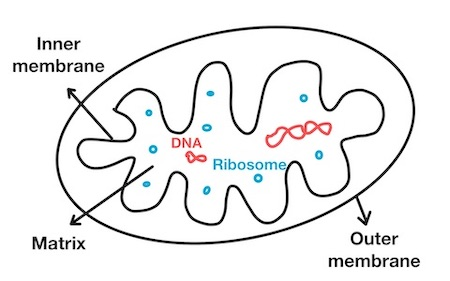
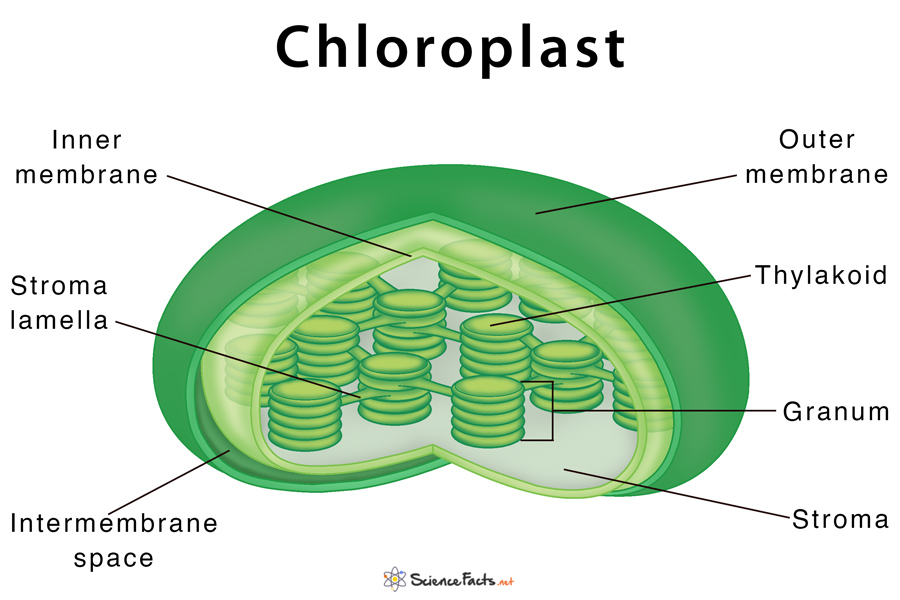
The main pigment in green plants is chlorophyll and it is found in the thylakoid membrane.
The more cristae, the more ATP is produced. The more thylakoids, the more glucose is produced.
Ribosomes and DNA are found floating in the mitochondrial matrix and stroma of a chloroplast.
An autotroph makes its own glucose using photosynthesis and a heterotroph eats other organisms for glucose.
Photosynthesis happens in chloroplasts and cellular respiration happens in mitochondria.
Photosynthesis: sunlight + H₂O+ CO₂→ glucose + O₂
Cellular respitation: glucose + O₂ → ATP + H₂O+CO₂
Muscle cells contain the most mitochondria because they need the most energy.
Endosymbiosis Theory:
The six pieces of evidence of the endosymbiosis theory are the double membranes, size of mitochondria and chloroplast (similar bacteria size), ribosomes, DNA, cytoplasm (matrix & stroma), and that mitochondria and chloroplasts reproduce by binary fission like prokaryotes.
A bacteria cell was engulfed by a eukaryote and had a symbiotic relationship because the bacteria gave the eukaryote ATP or glucose and the eukaryote gave the bacteria protection. Over time, the bacteria became an organelle and was no longer alive. This is how mitochondria and later chloroplasts were formed.
Symbiosis is when to organisms help each other survive. An endosymbiont is an organism that has a symbiotic relationship with another organism. Endocytosis is the process by which something enters a cell.
Mitochondria and chloroplasts each have two membranes because the first one was the original cell membrane of the prokaryotic cell and the second was the transport vesicle that the bacteria was put in upon entering the eukaryote
The cell needed more surface area to absorb more glucose so it created folds in the membrane, which pinched off to create the endoplasmic reticulum which blocked out a sphere for the nucleus.
Lysosomes:
Lysosomes are vesicles filled with enzymes that recycle food and old organelles.
Apoptosis is programmed cell death.
Apoptosis is used when a cell is cancerous or damaged beyond repair.
Digestive enzymes are synthesized in ribosomes and travel through the rough ER. They are packaged into vesicles and sent to the golgi apparatus. The golgi apparatus modifies enzymes and puts them in a lysosome.
Cancer is the uncontrolled cell division in a mutated cell.
Cytoskeleton:
The cytoskeleton is used for transport vesicles to travel along it. It is made of microtubules, which are straw-like structures.
Microtubules are used for vesicles to travel along, to make cilia and flagella, and aids in nuclear splitting.
Cytoplasm:
Cytoplasm holds all the organelles and protects them.
Cytoplasm is made up of cytosol and membrane-bound organelles. Cytosol is mostly water but it also contains salts, dissolved gasses, nutrients, and enzymes.
Cilia & Flagella:
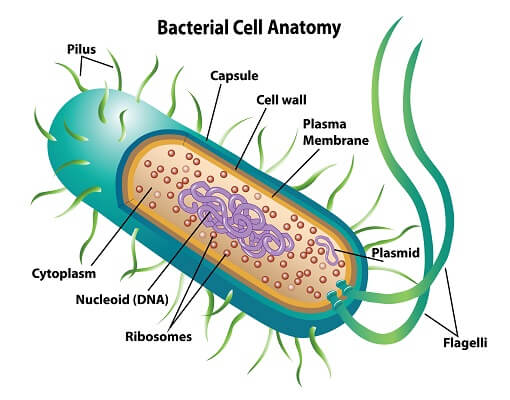
Cilia and flagella are used for cell mobility. Cilia are hair-like structures found in only eukaryotes while flagella are tail-like structures found in both eukaryotes and prokaryotes.
Sperm cells hare flagella and bronchi cells in the throat have cilia. Pili looks like cilia but they are found only in prokaryotic cells and are used to share DNA between prokaryotes.
Nucleoid
Nucleoids are the center of prokaryotes where DNA is stored.
Plasmid is DNA not found in the nucleoid that is used to share DNA with other prokaryotes.
Small Vacuoles:
- Animal cells have small vesicles filled with water, food, and waste.
Central Vacuole:
Plant cells have a large vacuole in the middle of the cell that holds water.
Turgor pressure is a measure of how much water a plant cell’s central vacuole has in it and the lower the turgor pressure is, the more wilted the plant is.
Cell Wall:
Cell walls of plants are made of cellulose and fungal cell walls are made of chitin. All cell walls are made of polysaccharides. Cell walls of prokaryotes are made of peptidoglycan.
Cell walls are the outer shell of plant cells and they protect the cell and give it a boxy shape.
Cellulose is sometimes called fiber.
Plant cells build a cell wall down the middle of a cell with vesicles full of cellulose.
Plant cells’ boxy shape makes them easier to stack and stronger.
When the central vacuole shrivels, the cell is not turpid and the plant wilts.
Cell Types:
prokaryotic cells have a nucleoid, pili, DNA, and non-membrane-bound organelles. Eukaryotes have a nucleus, flagella, DNA, and membrane-bound organelles. Eukaryotes are bigger.
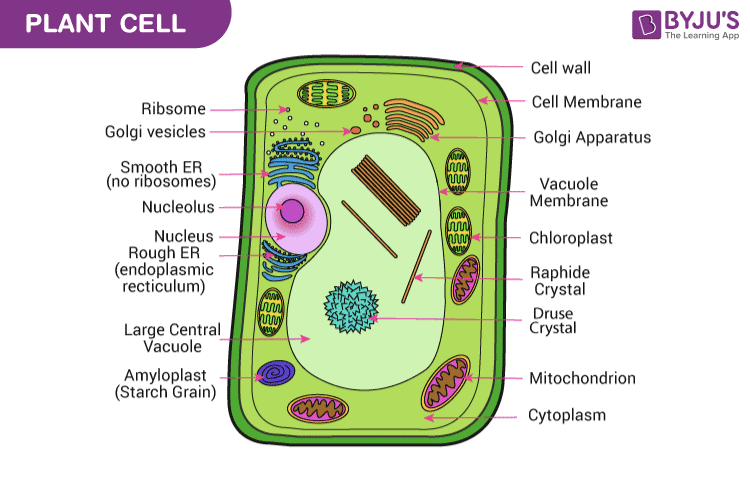
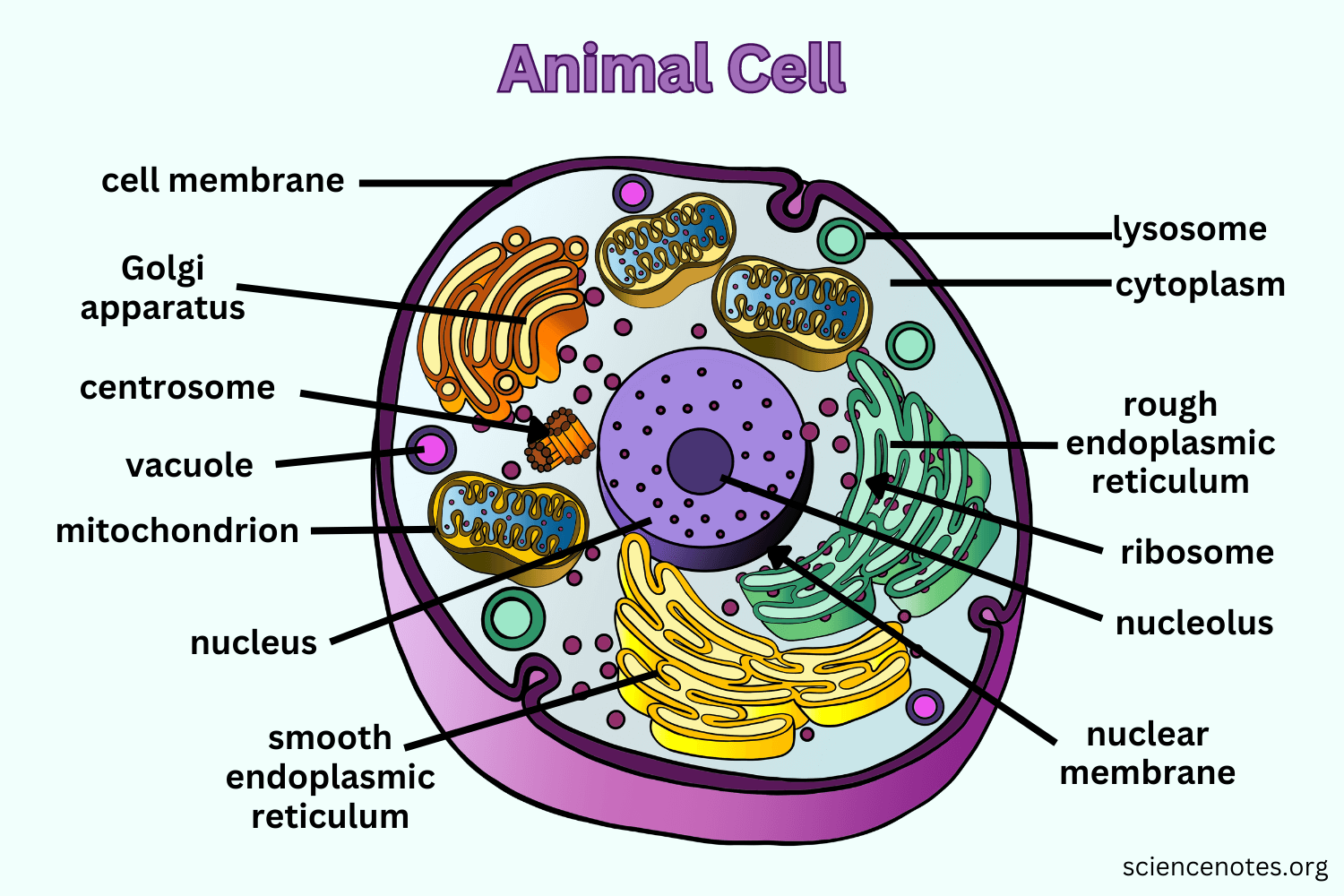
 Cell Wall
Animals
Plants
Prokaryotes
Capsule
Animals
Plants
Prokaryotes
Cell Membrane
Animals
Plants
Prokaryotes
Nucleus
Animals
Plants
Prokaryotes
Nucleolus
Animals
Plants
Prokaryotes
Nucleoid
Animals
Plants
Prokaryotes
Cilia
Animals
Plants
Prokaryotes
Flagella
Animals
Plants
Prokaryotes
Pili
Animals
Plants
Prokaryotes
Small Vacuoles
Animals
Plants
Prokaryotes
Central Vacuole
Animals
Plants
Prokaryotes
Cytoplasm
Animals
Plants
Prokaryotes
Cytoskeleton
Animals
Plants
Prokaryotes
Cytosol
Animals
Plants
Prokaryotes
Mitochondria
Animals
Plants
Prokaryotes
Chloroplast
Animals
Plants
Prokaryotes
Rough ER
Animals
Plants
Prokaryotes
Smooth ER
Animals
Plants
Prokaryotes
Golgi Apparatus
Animals
Plants
Prokaryotes
Plasmid
Animals
Plants
Prokaryotes
Ribosome
Animals
Plants
Prokaryotes
Lysosome
Animals
Plants
Prokaryotes
Matrix
Animals
Plants
Prokaryotes
Stroma
Animals
Plants
Prokaryotes
digestive enzyme - an enzyme that breaks down molecules
hydrolytic - another name for a digestive enzyme
pH - the acidity of a substance
endomembrane system - a system that uses membranes to synthesize proteins
apoptosis - programmed cell death
enzyme - a protein that builds or breaks down molecules
catalyst - speeds up a reaction
activation energy - the energy needed to perform a reaction
active site - the place where the enzyme and substrate connect
substrate - the molecule(s) that is/are broken down or built by an enzyme
product - the final product of an enzyme
lock & key model - the enzyme and substrate fit together like a lock and key
optimal - the best conditions for an enzyme to speed up reactions
denature - an enzyme is damaged by high heat, pH, or salinity
cell plate - a cell wall in the process of being built
cytoskeleton - vesicles travel on it to get around a cell
microtubule - straw-shaped cytoskeleton that makes up cilia and flagella
motility -the ability of a cell to move on its own
cilia - hair-like structures cells use to move around
flagella - tail-like structures cells use to more around
cristae - the inner membrane in a mitochondria
matrix - the liquid inside a mitochondria
cellular respiration - what cells do to get ATP from glucose
chloroplast - organelle used to perform photosynthesis
thylakoid disk - disks inside chloroplast that perform photosynthesis
granum - a stack of thylakoids
stroma - the liquid inside a chloroplast
photosynthesis - what plant cells do to make glucose out of sunlight
autotroph - an organism that makes its own glucose
heterotroph - an organism that eats other organisms for glucose
chlorophyll - the pigment that makes plants green
endosymbiosis - symbiosis during which a cell is engulfed by another cell
prokaryote - a cell without a nucleus
eukaryote - a cell with a nucleus
nucleoid - where DNA is stored in prokaryotes
DNA - instructions for organisms to live
transcription - a copy of DNA called mRNA is made
translation - a ribosome reads mRA and makes a polypeptide chain
plasmid - circular DNA molecules used to share DNA with prokaryotes
cytoplasm - everything inside of a cell
cytosol - the liquid inside a cell
turgor pressure - a measure of how much water is in a plant's central vacuole
turgid - a plant cell with a full central vacuole
cell wall - protects and structures a cell
capsule - sticky outer shell of a prokaryote used to stick to hosts
cellulose - the polysaccharide used to build cell walls in plants
fiber - the normal term for cellulose
The Cell Membrane & Transport
Membrane Basics:
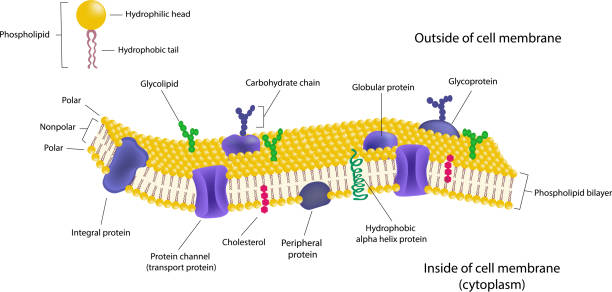
The Fluid Mosaic Model means that the cell membrane is constantly in motion and made of many different pieces.
The proteins in the cell membrane are the anchor protein, the junction protein, carrier protein, channel protein, receptor protein, synthesis & digestive enzymes, antibody, and glycoprotein.
Synthesis enzymes are catalysts that build molecules and digestive enzymes are catalysts that break down molecules.
Anchor proteins are used for structural support and they attach the membrane to the cytoskeleton.
Junction proteins are used for structural support and connect cells to other cells to form tissues, organs, etc.
Carrier proteins are used for passive and active transport
Channel proteins are used for passive transport.
Receptor proteins are used for endocytosis because the receptor only brings in a specific ligand
antibody = protein; antigen = carbohydrate
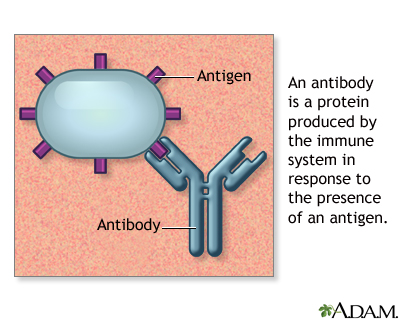
Antibodies and antigens act like a name tag to distinguish between body cells and viruses or other invaders.
Glycoproteins are an antigen and the protein it is attached to.
The cell membrane filters what can go in and out of the cell.
Fibrous proteins have long string-like structures and globular proteins are solid structures.
The heads of a phospholipid are polar, hydrophilic, and charged while the tails are nonpolar, hydrophobic, and uncharged.
Peripheral proteins do not come into contact with the tails and integral proteins do come into contact with the tails. Transmembrane proteins are a type of integral protein that goes across the whole membrane.
Three factors that affect membrane fluidity: temperature, cholesterol, and saturated/unsaturated fatty acids
Unsaturated fatty acids make the membrane more fluid than saturated. The more cholesterol in the membrane, the less fluid it is.
An antigen is a carbohydrate and an antibody is a protein. Antigens act as nametags for cell recognition. When an invading antigen is detected, antibodies stick to it until the immune system kills it.
Lipids are found in the phospholipid bilayer of the membrane, carbohydrates are found in cholesterol or antigens, and proteins are found as carrier, channel, synthesis & digestive enzyme, junction, anchor, receptor, glycoprotein, and antibody
Passive Transport:
Second Law of Thermodynamics: Energy flows from high to low, order to disorder (chaos/entropy), and hot to cold
The concentration gradient is when molecules are unevenly distributed and energy frows with it.
Simple diffusion is when molecules go straight through the men-brane, facilitated diffusron is when molecules go through a channel
carrier proter, and osmosis is the diffusion of water.
The cell membrare is seli-permeable because it allows some mol-coules to get through but not others. Small, hanpolar molecules use simple diffusion, large or polar molecules use facilitated diffe usion, and only water uses osmosis.
The solute is the solid part of a soluton and the solent is the liquid part of a solution.
If a sottien has a higher percentage of solutes, it is hypertonic;, equal percentage, isotonic; and lomer percentage, hypotonic.
It water is added to a cell (hypotonic), animal cells will go through cytolysis and plant cells hill be fungid. If water is taken from a cell (hypertonic), animal cells will go trough crenation and plant cells willgo tmough plasmolysis. It waer is both takoh and added to the cell in equal amants (isotonic, animal cells will reach dynamic equilibrium and plant cells will be flaccid.
Fish ih saltwater don't intake enough water because it is a hypertonic solution so they use gills to actrely intake water. Fish in freshwater Intake 16o much water because it is a hypotohic soM-tion so they use gills to actrely release water. Protists lung i freshwater Mtare too much water because it is a hypotonic soltich so have contractite vacuoles that collect water then squeeze it back Mto the embarment.
hypertonie
isolanc
woaemit了车一才
MOLARITY=
イ
% SOLUTE CONCENTRATION
Active Transport:
し
-Passive ransport does not se ATP and goes with the concentration while actre transport goes agaret the concentration gradient and use s
Three types of actuansport: endocytosis, exocytors, and protein
pumpEndocy tos is is the intake of molecules trough the Cell membrane.
Pinocy tosis is the intake of liquids, Phagocytases is the itake of solids, and receptor-mediated endocytosis is the mtare of a specific ligand.