Unit 4: Social Perceptions
 Studied by 0 people
 Call with Kai
 Learn
Learn Practice Test
 Spaced Repetition
 Match
Match Flashcards
 Knowt Play
1/30

There's no tags or description
Looks like no tags are added yet.
Name | Mastery | Learn | Test | Matching | Spaced | Call with Kai |
|---|
No study sessions yet.
31 Terms
Social Perceptions
____________: How we perceive and form impressions of others
Personal Attributions
__________: How we form impressions of others based on their traits and behaviors; focuses on how information is combined to judge a person.
Summation vs Averaging Model
Dilution effect
Information Integration Theory
Trait Negativity Bias
Implicit Personality Theory
Primacy Effect
Summation Model
_________: more you say the better, more positive traits = better impression
Averaging Model
____________:Overall impression is the average, adding neutral traits can lower evaluation. (better supported)
Dilution effect
_________:Adding weak information reduces impact of strong points.
if you’re giving a speech, make only your best points, if you start adding others, you dilute the effects of your good points
Information Integration Theory
___________:Trait importance varies by perceiver
Trait Negativity Bias
_________: Negative traits outweigh positive ones; one bad trait can dominate many good ones.
Ex. Student going to Montréal, did great work, run-off
Implicit Personality Theory (Soloman Asch)
_____________: People hold assumptions about which traits go together. says theories of personality plays a role
Central traits: Strongly shape impressions
intelligent, skillful, industrious, (warm/cold), determined, practical, cautious
Peripheral traits: Have weaker influence
Primacy Effect
____________: Information received first has greater impact
“You only get one chance to make a good first impression”
Intelligent, industrious, impulsive, critical, stubborn
Ex. Job Interviews
_________:Little empirical support for accuracy, still widely used.
Only true diagnostic question: “What do you know about our company?”
Attribution Theory
_______: Concerned with answering “Why did this happen?”
Internal vs External
Fundamental Attribution Error
Heider: “Internal vs. External”
___________: Behaviour explained as Internal (personality, ability) or External (situation, environment).
Ex. Taking a test
Fundamental Attribution Error—Jones and Nisbett
__________: We tend to attribute our own behaviour (especially if it is negative in consequences) to external factors but we attribute others’ behaviour to internal factors
Ex. Milgram, observers attribute obedience to personality rather than situation
Ex. Class “Difficult Conversations” students assigned positions are still judged as holding these beliefs
Ex. Public Defender—people will still make internal attributes to you
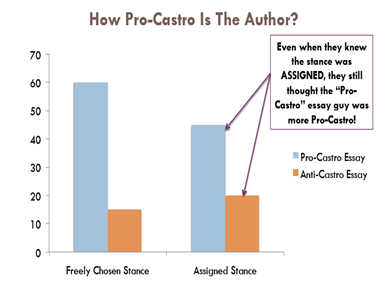
Ex. Fidel Castro Study
Fidel Castro Study
Fundamental Attribution Error
Participants assigned or chose to write pro- or anti-Castro essays
Observers still assumed writers’ attitudes matches the essay
Even when writers had no choice
Demonstrates failure to account for situation
We should be making the attribution to the situation, something external, yet we’re still making an internal attribution. It should tell us nothing about what their true attitudes are
Just-World Hypothesis—Lerner
_________:Belief that good things happen to good people and bad things happen to bad people
Closely linked to the fundamental attribution
Leads to victim blaming
Marla Hansen Case
Marla Hansen Case
Just World Hypothesis
Model whose landlord hired attackers to slash her face
Initial public sympathy faded
People began blaming her character or behavior
Reflects just-world thinking and FAE
“If something bad happened, she must have caused it”
Linking to internal attributions
She became a victim’s rights advocate, spent the rest of her career looking at how we often blame the victim
Correspondent Inference Theory—Jones and Davis
Theory to explain FAE
_________: Explains why people make internal attributions. We are all trying to make attributions all the time, typically internal.
We try to infer whether behavior reflects true disposition
Non-Common effects
Ex. Seinfeld (fire episode)
Behaviour stood out, made internal attributions easy
If he acted like everyone else, people wouldn’t make them
Non-Common effects
Correspondence Inference Theory
_________: Behaviour that is unusual or goes against situational expectations
Common behaviours give little information about personality
Kelley’s Covariation Model
Theory to explain FAE
_________:when you make attributions you weigh consistency, distinctiveness, and consensus
Consistency: This actor in similar situations
Distinctiveness: This actor in other situations
Consensus: Other actors in the same situation
Ex. Student asleep in class
Discounting Principle
Caveat to Kelley’s Covariation Modle
____________: When behavior is expected due to the situation, we discount it.
Ex. Job interviewees acting friendly, waiters being polite
Behaviour gives limited information about true personality.
Ex. Student Asleep in class
Situation A
Consistency: high, (always asleep in this class)
Distinctiveness: low (sleeps in other classes)
Consensus: low (no one else is asleep)
Attribution: the problem is them, making an internal attribution
Situation B
Consistency: high (always asleep in this class)
Distinctiveness: high (not asleep in other classes)
Consensus: high (many students asleep)
Attribution: internal to the prof, they’re boring
Weiner’s Attribution Theory (WAT)
Theory to explain FAE
Focuses on outcomes like success or failure
Explains how attributions affect emotion, expectations, and behaviour
Step 1: Outcome (WAT)
Failing a midterm
Step 2: Primary emotional response (WAT)
_______: Your immediate emotional response, stomach drops, haven’t thought about it yet
Step 3: Importance, unexpectedness, negative (WAT)
it’s a midterm so it’s important,
I thought I passed it was unexpected,
this event was negative
If none of these were true, the model is done
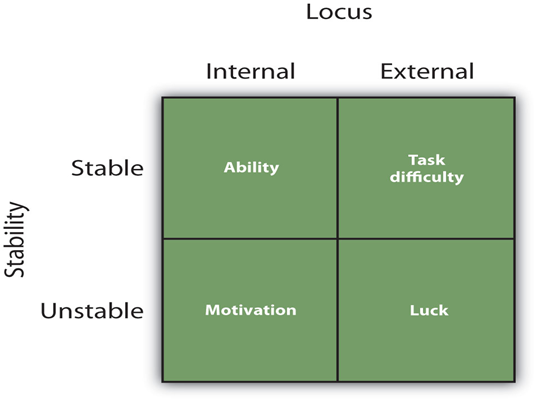
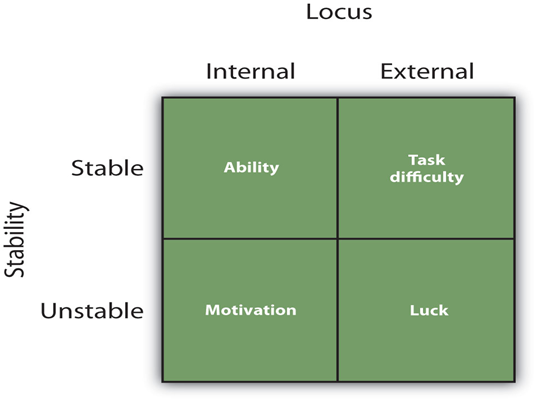
Step 4: Causes evaluated along two dimensions: (WAT)
Locus: internal vs. external
Stability: stable vs. unstable
Stable: consistent and unlikely to change over time
Unstable: temporary and changeable
Step 5: Expectations, Emotions (WAT)
_________: Influence feelings (hope, shame, pride, depression) which in turn affects behavior
Step 6: Behaviour
Ex. Do you drop the course, study harder, persist
Attribution Retraining
_________: Shifts your attributions typically towards motivation/effort
Ex. Grad school, prof says you all have imposter syndrome, but whether you fail is in this model (WAE)
Success is not luck or task difficulty
Ability is assumed
Outcomes depend on effort/motivation
Flaws in Weiner’s Attribution Theory
Not everyone has the ability, no matter how much they try
Effort has emotional and physical costs
Quote (Gandhi): “Satisfaction lies in the effort, not in the attainment”
 Note
Note  Flashcards (60)