PNS: CPG
 Studied by 0 people
 Call Kai
 Learn
Learn Practice Test
 Spaced Repetition
 Match
Match Flashcards
 Knowt Play
1/19

Earn XP
Description and Tags
Write the correct description to each question.
Name | Mastery | Learn | Test | Matching | Spaced |
|---|
No study sessions yet.
20 Terms
What is the locomotion step cycle?
The locomotion step cycle is a repetitive sequence of movements that occur during walking or running, characterized by phases such as stance and swing.

How many CPGs are in the locomotion step cycle?
Typically, there are two main CPGs responsible for walking: one for flexion and one for extension of the limbs.
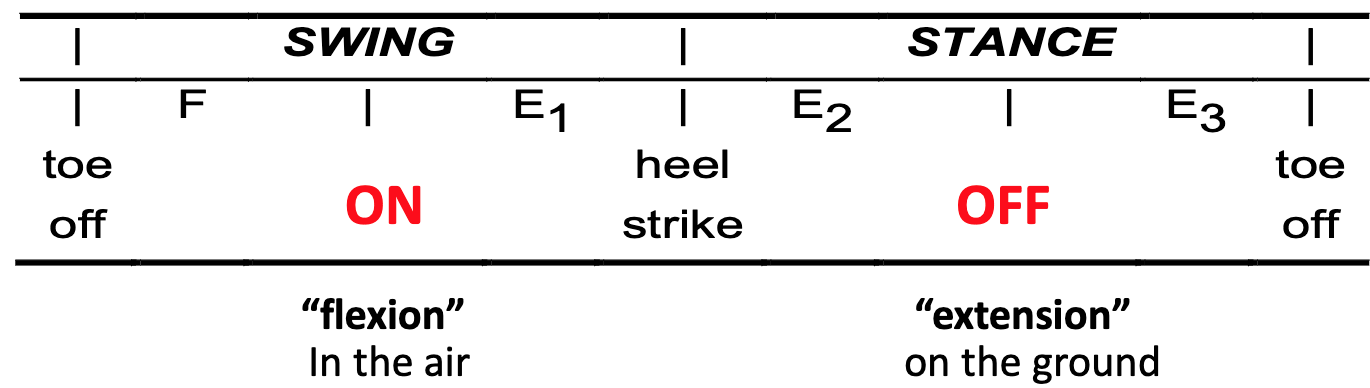
Does the “Half-Centre” Structure involve the flexor burst generators and the extensor burst generators inhibiting each other?
Yes, the “Half-Centre” Structure describes a neural mechanism where flexor and extensor burst generators inhibit one another to coordinate rhythmic limb movements.
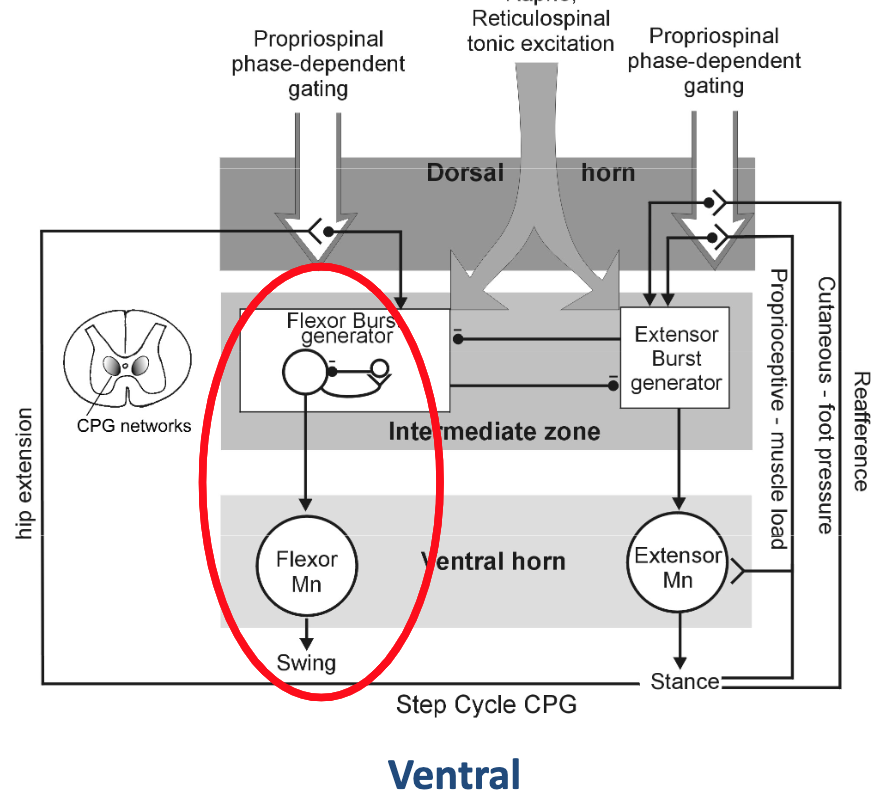
Explain how the flexor burst generator makes the leg swing.
The flexor burst generator activates flexor motor neurons, causing the leg to lift and swing forward by contracting the flexor muscles while inhibiting the extensors.
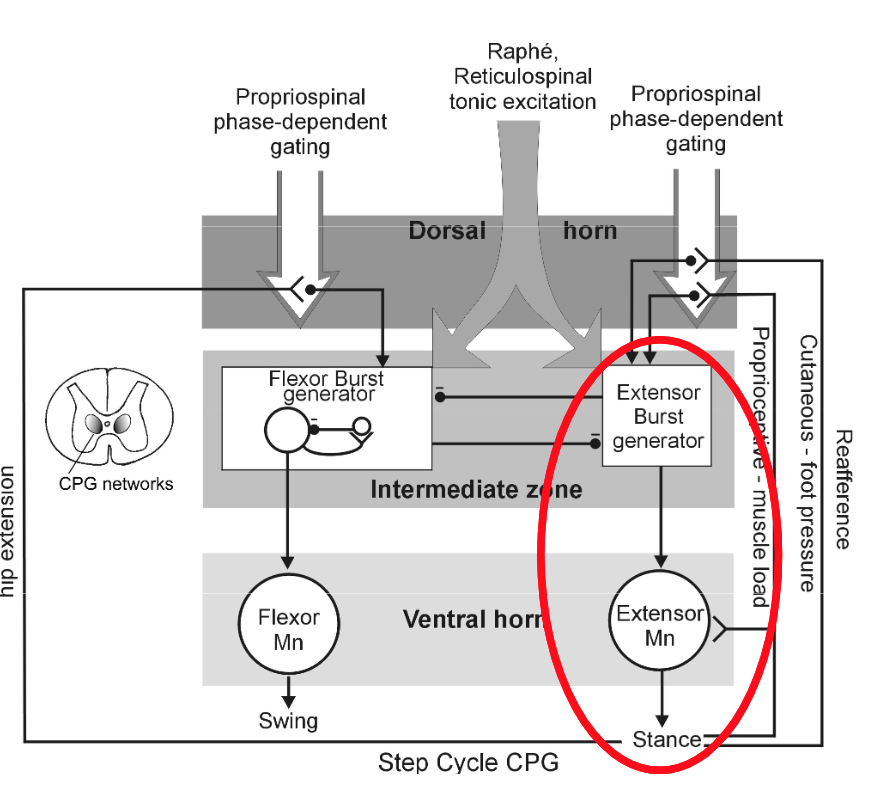
Explain how the extensor burst generator makes the leg stance.
The extensor burst generator activates extensor motor neurons, causing the leg to extend and stabilize during stance by contracting the extensor muscles while inhibiting the flexors.
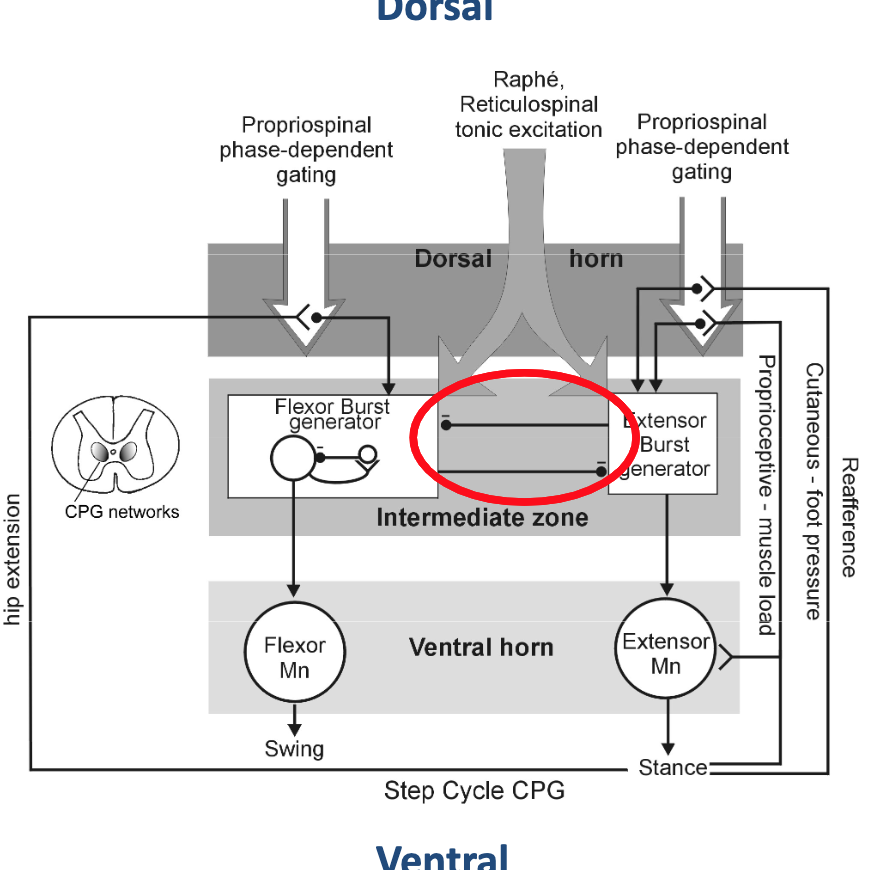
Explain how both the extensor burst generator and the flexor burst generator are mutually inhibitory.
If the extensor burst generator is active, it will inhibit the flexor burst generator. If the flexor burst generator is active, it will inhibit the extensor burst generator.
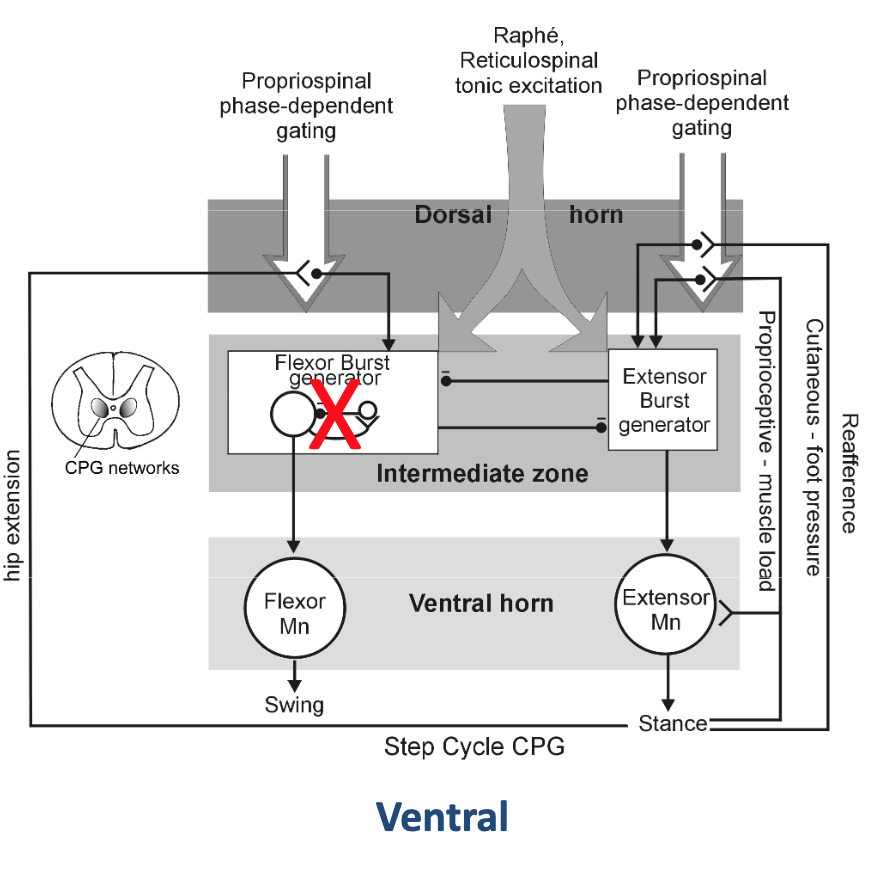
Once the flexor burst network has a buildup of inhibition that eventually stops, what will happen?
The activation of flexor motor neurons will stop firing AP.
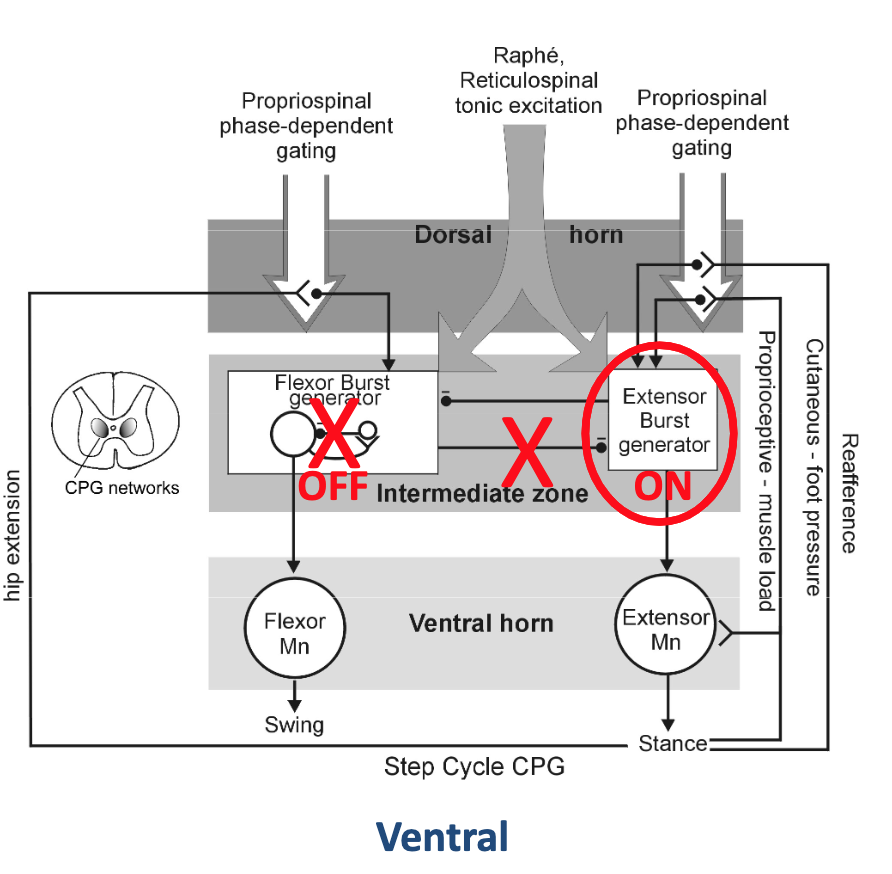
Once the inhibition of the flexor burst network ceases, what will happen to the extensor burst generator?
The extensor burst generator will become more active, leading to the stimulation of extensor motor neurons and promoting leg extension during stance.
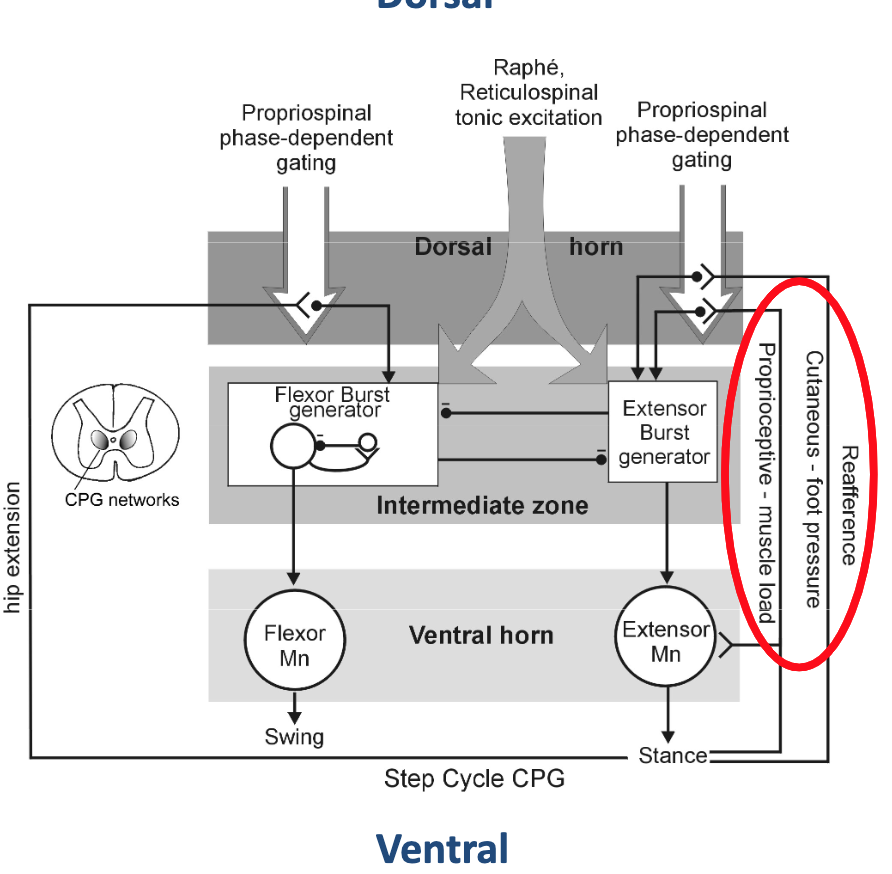
What do you need in order to walk properly?
You need foot pressure or muscle load to walk properly.
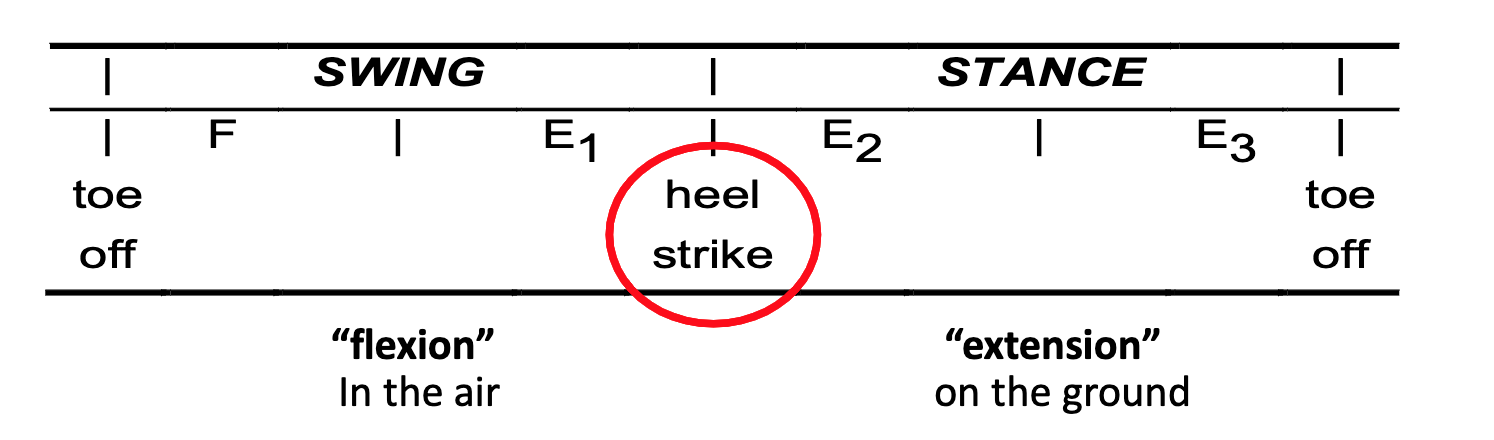
What is the stance phase regulated by?
The stance phase is regulated by the activity of the extensor burst generator and sensory feedback from the feet.
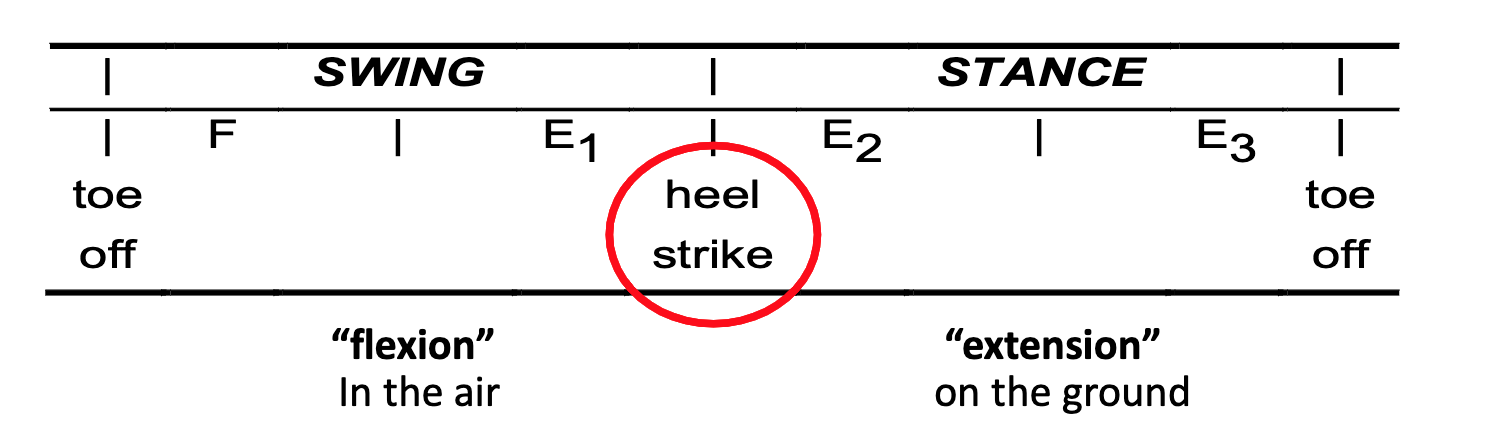
How do mechanoreceptors pick up sensory information?
On the back of your feet, as your feet hit the ground. Sensory information will be fed before you start the swing phase again.
What are the 3 reflexes that can be modulated by the stance phase?
The three reflexes are the stretch reflex, the extensor thrust reflex, and the Golgi tendon reflex.
Explain the need for sensory control if the floor is slippery.
If the floor is slippery, you’ll reduce the force of stance.
If you are in a stance phase, are you still able to balance while the ground starts to shake?
Yes, you can maintain balance by using sensory feedback to adjust your posture and stabilize your centre of gravity, but it may not be safe to start a swing phase.
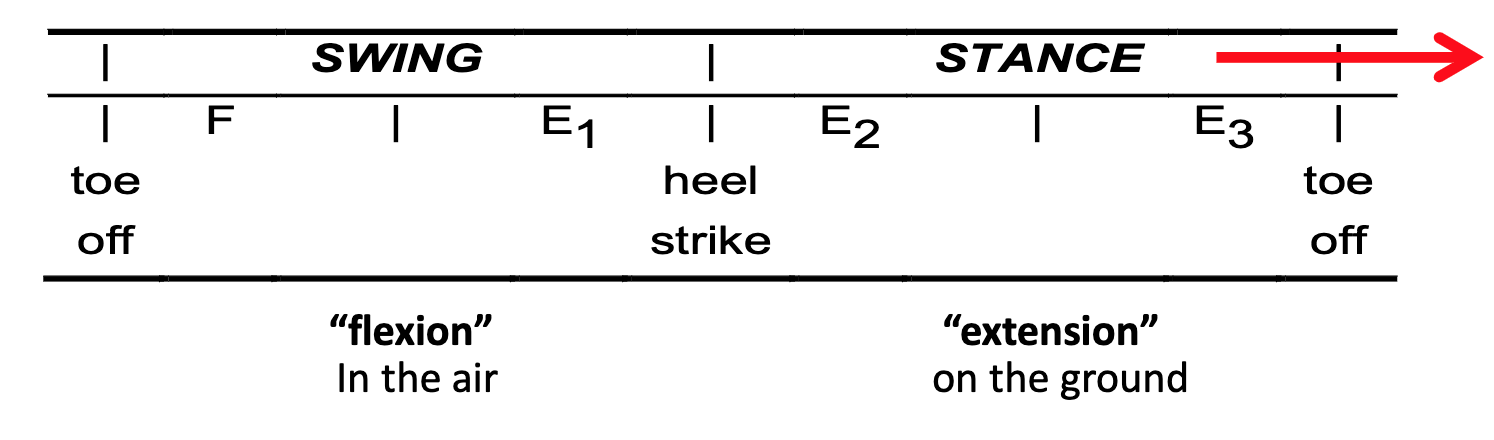
Provide an example to explain the transition to the leg swing theory.
If the flexor burst generator is on in the right leg and the right leg is swinging, then the extensor burst generator must be on in the left leg.
How does the cervical cord program the motion of the arms during walking?
You need to be able to link the lumbar part of the spinal cord, where the CPGs of the legs are, with the cervical region of the spinal cord, where the CPGs of the arms are.
How do you maintain postural stability when your legs are moving?
When your legs are moving, you would need to activate the reticular formation located in the brainstem for postural stability.
Why are spinal cord-injured patients not able to walk properly without trunk support?
The legs are not coordinated with te upper body motion because the tracts are damaged.
Your head angle…
is maintained constantly while walking to help with balance and orientation.
Why is it so hard to maintain posture with your eyes closed if your vestibular system gets taken away?
Without the vestibular system, balance relies heavily on visual and proprioceptive inputs, which can be insufficient for stability, leading to difficulties in maintaining posture. If you get an ear infection or a toes infection, this could happen.
 Note
Note  Flashcards (26)