Theories of personality 1
 Studied by 0 people
 Call Kai
 Learn
Learn Practice Test
 Spaced Repetition
 Match
Match Flashcards
 Knowt Play
1/79

There's no tags or description
Looks like no tags are added yet.
Name | Mastery | Learn | Test | Matching | Spaced | Call with Kai |
|---|
No analytics yet
Send a link to your students to track their progress
80 Terms
Honest--Humility (H)
sincere, honest, faithful, loyal, modest/unassuming versus sly, deceitful, greedy, pretentious, hypocritical, boastful, pompous
Internal causal properties
Internal: individuals carry their desires, needs, and wants from one situation to the next
Causal: desires and needs explain the behavior of the individuals who possess them
EX:Cheryl goes to parties because she is extraverted and likes the stimulation of being around people
Purely Descriptive Summaries
Make no assumptions about internality, nor is causality assumed
Trait describes expressed behavior
The basis for interpersonal perception and personality development
Ex:Cheryl goes to a lot of parties, strikes up conversations with strangers, and frequently initiates party games. She is exhibiting extraverted behavior.
Act Frequency Research (Descriptive)
Act Nomination ( Vote traits common for extroverted)
Prototypicality Judgment (does this actively represent someone is extroverted)
Recording Act Performance
The more observable the acts, the higher the agreement between observers (extraversion, conscientiousness)
Learn the characteristics of the three major approaches to defining traits
Lexical Approach
Statistical Approach
Theoretical Approach
Lexical Approach
All important individual differences have become encoded within the natural language
Synonym Frequency
Cross-Cultural Universality
The lexical approach in psychology, or the sedimentation hypothesis, assumes that the most significant personality traits are encoded into natural language as single words.
Ex: Resilient, hard-working, courageous
Statistical Approach
Pools of personality items are assembled and a large sample rates themselves on the items
Statistical procedures, such as factor analysis, identify groups/clusters that covary
Theoretical Approach
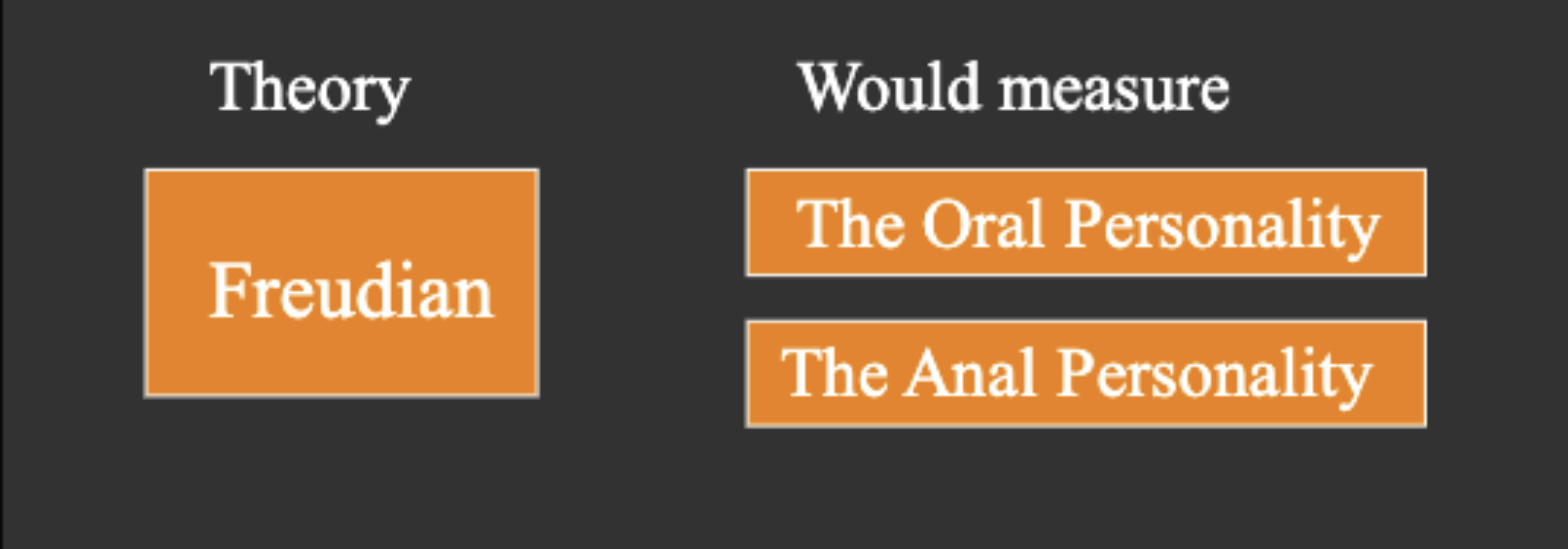
Starts with a theory, which then determines which variables are important.
"Dust-Bowl" Empiricism: Separate people into groups, find test items that differentiate them. - MMPI
- TARGET learns an expensive lesson
Eysenck's Hierarchical Model (PEN
> Extraversion-Intraversion
— Sociable, Lively, Active, Assertive
> Neuroticism-Emotional Stability
— Anxious, Depressed, Tense, Moody
> Psychoticism
— Aggressive, Cold, Unempathic, Egocentric
Good: Moderate Heritability ( Twins preform the same or sae personality traits)
Bad:
- Argued for Physiological Substrate
Extraversion = Low CNS arousal
Neuroticism = CNS instability
Psychoticism = High testosterone,
low MAO - Eysenck's P ProblemEysenck used the term Psychoticism in a highly idiosyncratic, non-clinical way
P subtraits are: Aggressive, Cold, Egocentric, Impersonal, Impulsive, Antisocial, Unempathic, Creative, Tough-Minded
Solution:Eysenck's P Problem
Other researchers have suggested psychopathy, sensation seeking, constraint (low), honesty/humility (low)
as alternative names is The Dark Triad of personality
Cattell's Taxonomy
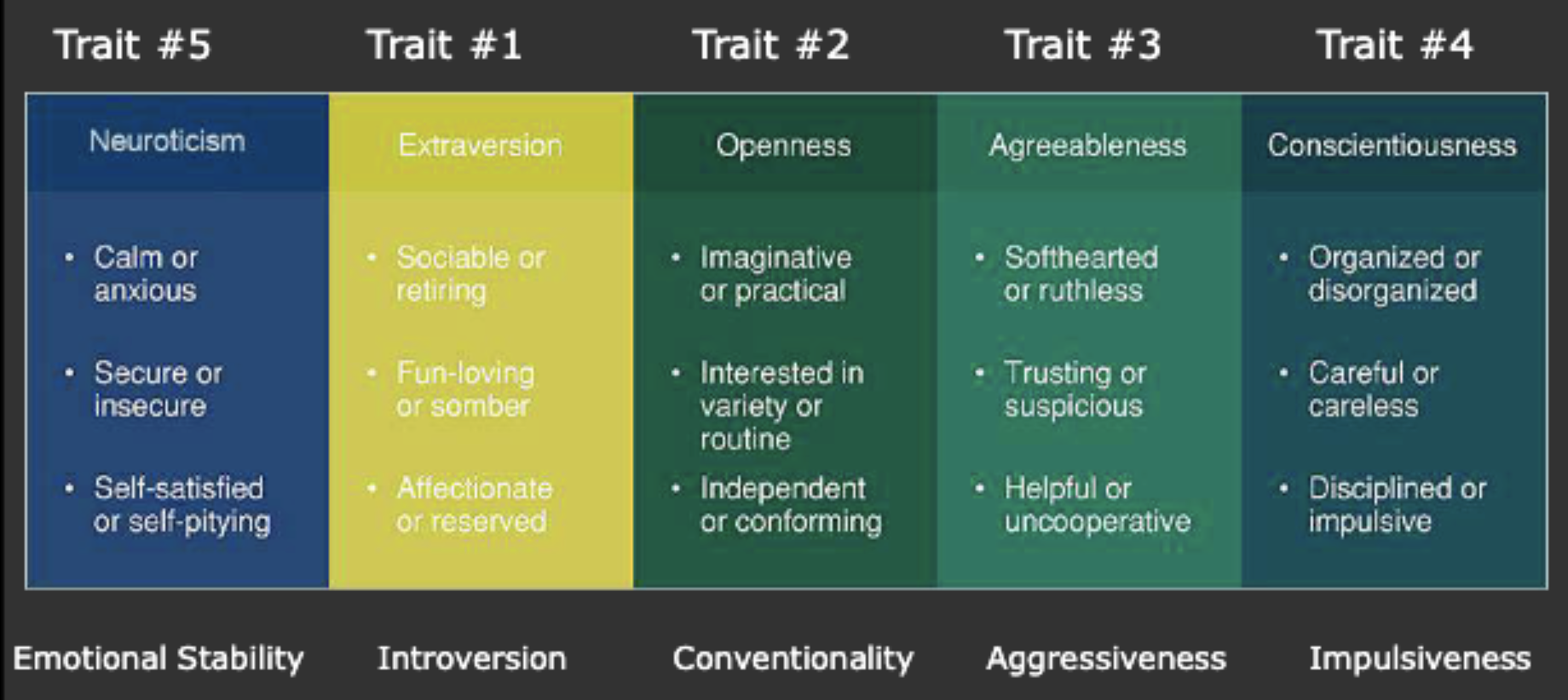
The Big 5: NEO-PI
(Costa & McCrae)
Consistency Over Time
Trait theories assume that there is a degree of consistency in personality over time
Expression of trait may change over time
Consistency Across Situations
Trait psychologists assume that traits will exhibit some consistency across situations
Situationism (Mischel, 1968)
Situtation determines behavior
Lack of consistency across situation ex: cheating behavior if one cheats in a game like a kid they were not likely to cheat on exams or other things
Is 16% of explained variance meaningful?
Hypothetical: No test - 50% job failure rate
Assume a correlation of .40 between predictor and success.
100 trainees $10,000 eachNo test: 50 fail, $20,000/employee
With test: 30 fail, $14,300/employee
Failure rate of 50% reduces to 30%
100 successful trainees w/o test = $2,000,000
100 successful trainees w/test = $1,430,000
Situationism combined with personaity psychologists
Both personality and situation interact to produce behavior
B = f(Px S)
Situational selection:
Situational selection: Picking your environment
Evocation:
Eliciting responses from others
Manipulation:
Manipulating others
Aggregation
Adding or averaging several single observations results in a better measure of a personality trait than a single observation of behavior, e.g., greater reliability
e.g., The full NEO-PI has 30 questions per dimension vs. only 4 questions in the version you took.
 Note
Note  Flashcards (131)