social 8 emotions 2
 Studied by 0 people
 Call with Kai
 Learn
Learn Practice Test
 Spaced Repetition
 Match
Match Flashcards
 Knowt Play
1/48

There's no tags or description
Looks like no tags are added yet.
Name | Mastery | Learn | Test | Matching | Spaced | Call with Kai |
|---|
No study sessions yet.
49 Terms
what can emotions effect
-judgements
-communication as social info
Emotions and Judgment
• Common argument is that when a stimulus is vividly present, it might excite or agitate us (whether directly...or via appraisal), and this arousal might then affect our judgments and behaviours
• eg social facilitation from last year - presence of (especially attractive) others increases physiological arousal, which then led to numerous judgment effects.
visceral info
instinctive (deep inward feelings over intelect)
visceral information is immediately linked to emotional responses, which can bias judgment.
Ditto et al. (2006): cookies set up
Participants have to decide whether to take a gamble concerning cookie-eating.
- Choice A: gamble to draw one card out of 10. If WIN, be able to eat as many cookies as they want, plus participation complete;
if LOSE, no cookies and stay in the lab to do Raven matrices -gruelling cognitive puzzles
- Choice B: not play the gamble, i.e., no cookies, and just a few more easy questionnaires to fill out (safe options)
Ditto et al. (2006) IVs
-high vs low risk (rationality test) - 80% of win vs 60&
-viscerality - descriptions of cookies (control) vs. smell of freshly baked cookies (visceral).
Ditto et al. (2006) results
-emotional arousal has possibility to effected our judgement so should effect the affect of rationality
-in non-viceral conditions low vs high risk had big effect on judgement
-but in visceral none
ditto et al evaluation
• Is this a compelling example of emotions per se? Or did Ditto et al. manipulate vividness or
something else? - think abut vividness in persuaiveness
• If the cookie smell didn't operate by 'exciting' participants, how else might it have shifted judgments?
Dutton and Aron (1974) -shaky bridge
• Male participants are approached in the field, by an attractive female confederate who asked them to complete questionnaire
• Either met along a shaky bridge, or along a plain wooden bridge.
• Higher rate of sexual imagery on a TAT.
• More likely to call the researcher back later when provided with a phone number
Inference: physiological arousal (from fear) mistaken for romantic attraction... AND physiological arousal emboldens, increases sexual desires.
TAT
thematic attribution test, ambigous/neutral situations which could be read as sexual or not
-projection test
but is Dutton and Aron (1974) examplle of irrational emotions?
• Ignoring risk information is 'poor judgment'. Calling a girl back because a bridge is scary doesn't make logical sense.
• Though even here, in the real world maybe meeting people in exciting situations IS a good reason to consider them more attractive. (they choose to be on a shaky bridge)
are emotions irrational -other options
• The prior effects may be perceived as irrationality-producing.
• Naïve stoicism: what if we just 'do away' with emotions? - also doesn't seem ideal
• Being emotional has functional importance that can protect and enhance our lives.
Zeigler-Hill et al., 2013: Noise blasts concept
replicated a version of Milgram's shock experiments using noise blasts.
• "Teachers" have to blast "learners" with increasingly punishing sound blasts. -increasingly loud, highest decibells could deafen someone
-told is dangerous but fault of experimenter
• Here, resistance would probably be rational. It is pretty bad to permanently deafen a fellow human
being just because a researcher tells you to...(respecting others, legal issues)
Zeigler-Hill et al., 2013:variables
IV - low vs high neuroticism
DV -number of prods used (all went all the way)
- recalled neative affect during the session
neuroticism
reflects how regularly you are experiencing negative emotions , high neuroticism usually experience neg emotions all the time
Zeigler-Hill et al., 2013: results
Low-N people responded to their own emotion: when they felt bad, they stopped. (until prod)
High-N people "ignored their emotions" by continuing to blast at a similar rate when they felt bad or good.
Here, resistance would probably be rational. It is bad to deafen someone just because a researcher tells you to...(respecting others, legal issues)
-in low N people emotions were seemingly more diagnostic - negative affect serves a function making them question the situation
-but in high n people functiion doest work -normally feel negative so amount isnt relative?
-perhaps attributional (your normal so attribute less strongly)
-emotion have system which can be disabled
what is reational about emotions
it is rational to at least express emotions.
• Emotions play important roles in communication and influence.
• Managers self-report exaggerating their anger to compel obedience from subordinates. (seems bad but functional)
emotions as communication model
• Emotions are social information (EASI) model: much of the functional point of emotions is to
communicate information to others efficiently and powerfully -help them interpret situations
• Persuasion often increases with an appropriate emotional display.
• As long as people are sufficiently able to process a source's emotional expressions and understand
their relevance, they can shape persuasion.
Van Kleef et al. (2010) - kite surfing
an ambiguous message about kite surfing (describes it vaguely: could be good, could be bad) was delivered to recipients either distracted or able to process, who saw the author as looking either happy or sad
-people who aren't distracted has a social function served by this emotion
-most people don't know lots about kite surfing, use experts opinon and as is ambigous actually use their emotion
-in distracted condition this effect disppares
-not mindless queue but sophisticated adding all the parts together
emotions diff in context
EASY model - different emotions have signalling functions which may differ in cooperative vs competitive contexts
-critical thing not remember them all but remember that situation effects the sgnalling functions
-complex way people go from the emotions they are seeing to a ehvioural function
Peter de Jong on Blushing
• A lot of people are afraid to blush: which is usually construed as an explicit signal of emotion.
• People often attribute negative expectations of how an observer will appraise their blushing.
• However, blushing has signal value. It also might make us seem more human.
• Some research shows that blushing in a context where you have made a social error eg accidental shoplifitinghas a "face- saving" benefit (de Jong, 1999) - makes them seem more moral
Peter de Jong on Blushing - experiment
• In three experiments, people imagined observing people engaging in shopping misbehaviors such as breaking objects.
• Following the mishap the actor left while displaying a blush (target condition), without overt signs of shame or embarrassment (baseline condition), or while displaying shame by nonverbal behaviors other than blushing (comparison condition).
• Blushing specifically reduced negative evaluations of the incident, lowered perceived responsibility of the shopper, and sustained the actor's trustworthiness
Vaughan- Johnston unpublished research
testing how perceivers perceive a target whose facial expressions respond emotionally to a story they are reading.
• Emotional expressivity was rewarded with higher warmth and competence ratings (compared to a
non-expressive control).
• However, competence effects reversed if the face responded with large emotions to emotionally
modest stimuli.
• Implication: it is not simply any expressivity that is
rewarded, but appropriately scaled emotions.
controlling emotions
Emotion Regulation
Emotion Regulation
refers to techniques used to increase or decrease the intensity of emotions, or
instill new emotions one does not presently feel. (sub clinical techniques)
• Often siloed into a variety of basic techniques and approaches, some more effective than others.
emotion reg techniques
• Distraction: think about something else, usually something emotionally neutral.
• Suppression: try to 'will away' an emotion.
• Reappraisal: re-assess a situation, with the assumption that construal shapes emotions.
• Acceptance: increase "willingness to feel" an emotion to either alleviate intensity, or to reduce
"suffering".
Vaugh Johnstan efficacy
personality affects efficacy of specific techniques.
• University students were asked to recall a sadness- provoking memory.
• Next, they applied one of three ER techniques: distraction, acceptance, and reappraisal, as conveyed by a clinical psychologist (as a video recording)
-distraction seemingly worked best in reducing negative emotions
why non effectiveness of acceptance may be misleading
-it worked well for those low in experiential avoidance - large effect
-whereas non-sig reduction for those hgih in experientia avoidanc
Experiential avoidance: lack of willingness to experience negative emotions.
• Can be thought of as "meta-affect": emotions about emotions. ("I'm scared to feel scared",
or "I hate feeling so angry.")
Interesting because ideally acceptance would benefit precisely these people( they don't wanna feel). Might speak to
backfire from a short-term intervention.
• Positive Psychology movement
- Psychologists often emphasize negative emotions. We shouldn't ignore positive emotions.
- More obvious what the evo-benefit is of fear (flee!), anger (fight!), etc.
- What is the point of positive emotions like calm, excitement, awe?
-they do have uses
3 examples of pos emotion
- Awe: experiencing something that feels "beyond and above" us
- Gratitude: feeling positively towards others because of their actions towards us.
- Pride: feeling confident, strong, powerful
Awe
• Awe is experiencing things that feel beyond and
above us, often relating to the cosmos, religious
experience, and nature.
• Zhao et al. (2018): awe inductions
lead people to become more willing to make behavioural sacrifices for the benefit of nature.
Awe manipulation -think about recent time natural scene made you feel awe
Found social dominance orientation mediated the relationship between awe and ecological behaviour
-social domnance orientation - thinking some social groups benefit more than others and that's fine - tweaked to be about humans and naturre - right that people domnate over nature more broadly
E.g., "Human beings were created or evolved to dominate the rest of nature"
• Zhao et al. (2018): awe inductions discussion
-induction of nature awe (thinking) can reduce social dominance orientation(at least temporarily)
-more of this reduction more willing you are to engage in ecological behaviour
So awe partially worked by reducing people's feelings of being superior.
-behavioral intentions rather than actual behaviours
Gratitude + experiment
• Gratitude is feeling positively towards others, usually due to their positive actions or relationship
with us.
• An example manipulation is assigning participants to write letters of gratitude to people in their lives.
• Doing so boosted happiness and even life satisfaction for writers in one study, even a month
after writing the letter.
types of pride
• Pride is a complicated state usually broken down into two different forms.
• authentic pride, characterized by feelings of accomplishment and confidence; and
• hubristic pride, characterized by feelings of arrogance and conceit.
types of pride associated with
• Authentic pride is associated with higher self- esteem, self-efficacy, extraversion, conscientiousness.
• Hubristic pride is associated with envy, interpersonal dominance.
changing happiness hard concepts
happiness paradox
hedonistic treadmill
hedonistic treadmill
(almost) no matter what happens to us, our happiness levels remain extremely consistent. (, mainly only things like marriage and kids do)
- People greatly exaggerate how much major life events (eg losing a limb , or moving to a warmer U.S. state) affects their day-on-day happiness.
-what actually happens is an immediate effect but then goes more back to normal - stll have same friends, vlaue, priorities, will go about things from other ways
- This is due to something called a focalism bias: when asked about such events, people hyper-focus on that event and discount all the other things in their life - ignoring the massive amount of things that make you happy
The Happiness Paradox
When we try to make ourselves be happier, we often end up less happy.
Mauss et al happiness paradox study
collected 59 women's responses to a variety of measures. Considered how their valuing happiness combined with life stress factors to produce various outcomes
-Valuing happiness backfires when stress is low - lower wellbeing, increased depressive symtoms
-When stress is high, everyone is doing poorly so it doesn't matter#
(pressure to be happy, colud improve?)
The Happiness Paradox: Why??
- When people value something, they put more effort/exertion into getting it. (This may be quite
frustrating if exertion doesn't actually help.)
- When people value something, their standards for that thing increase, paradoxically make it
impossible to satisfy those standards.
- Other work found that measured or manipulated valuing of happiness predicted more loneliness.
Pursuing vs Doing Happines (model)
• Lyubomirksy et al. model of happiness
- Happiness occurs due to three main factors:
1. Genetic factors
2. Present circumstance
3. Happiness activities
-kind behaviours, exercise, goal striving
-how do you go about doing these activities without pursuing the goal of happiness...
Kumar and Epley - Random Acts of Kindness
eries of studies in which they had participants perform random acts of
kindness.
• They asked people to estimate the likely effect on their "target". Then they also asked the recipients how they felt.
-performers underestimated how good it would be in lots of different ways
-also over estimated how awks
• Essentially, because givers tend to under estimate how much warmth (i.e., good-will, positive intention) is communicated by a positive action.
Obligatory Kindness
• Dunn et al. (2008):
gave participants money to spend by the end of the day: either $5 or $20.
• Half told they had to spend it on themselves.
• Half told they had to spend it on others.
• Others > Self condition produced greater happiness.
• This study was then replicated across 136 countries!
Wellbeing def
- Overall quality of a person's mental, emotional, and social functioning
- Would encompass mental health, physical wellbeing, positive emotional balance, good relationships, lack of financial stress.........................
wellbeing in life
- Arguably, maximizing wellbeing (in the big picture sense) is the point of life?
- However, also seems likely that only caring about our own wellbeing would potentially not be best for our wellbeing.
Wellbeing Subtypes
• Hedonic Wellbeing
- This refers to how good we feel.
- Basically, just lots of positive emotions, and a relative absence of negative emotion.
-subtract bad from the good
• Eudaimonic Wellbeing
- Refers to functioning well and feeling purposeful. (knnw what want to do with life and actng in ways to achieve this)
- Carol Ryff: six dimensions
-don't memorise just understand all these different ways people describe wellbeng
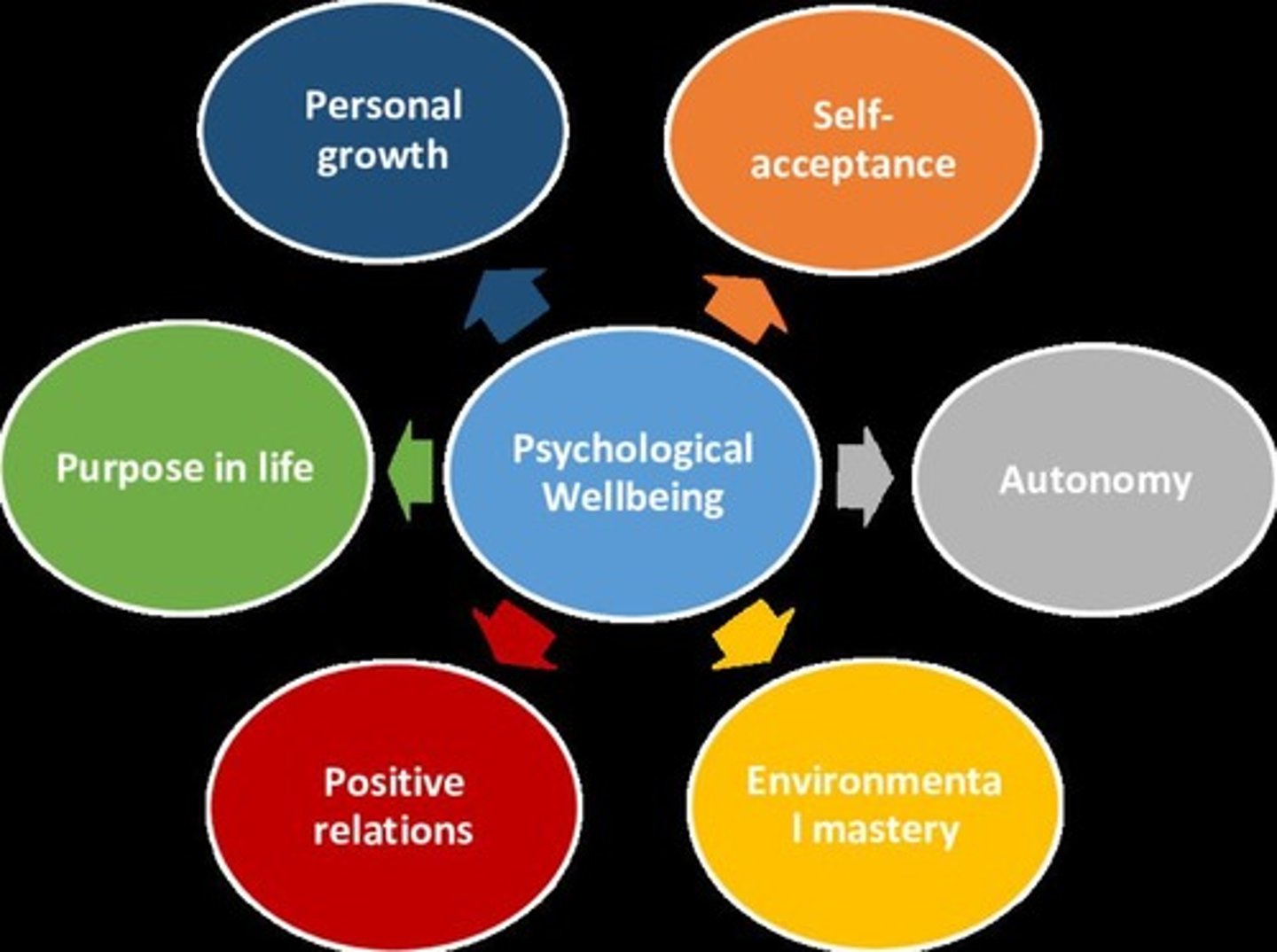
Age & Eudaimonic Wellbeing
-we've seen inverted u of happiness also stereotype it decreases
-falling in personal growth and purpose in life
-bit increase in autonomy and environmental mastery
-lsight differences between genders and differences acrosss educational outocme s
wellbeing overall
Wellbeing includes but goes beyond emotions, and is not evenly distributed by age or education.
 Note
Note  Flashcards (80)