AP US Government & Politics- Unit 2
 Studied by 16 people
 Call Kai
 Learn
Learn Practice Test
 Spaced Repetition
 Match
Match Flashcards
 Knowt Play
1/40

There's no tags or description
Looks like no tags are added yet.
Name | Mastery | Learn | Test | Matching | Spaced | Call with Kai |
|---|
No study sessions yet.
41 Terms
"We the People of the United States, in Order to form a more perfect Union, establish Justice, insure domestic Tranquility, provide for the common defense, promote the general Welfare, and secure the Blessings of Liberty to ourselves and our Posterity, do ordain and establish this Constitution for the United States of America."
US Constitution
The above excerpt of the US Constitution could be used as a counter-argument by the federal government in regard to the decision in which of the following cases?
United States v Lopez (1995)
Federalism reflects the dynamic distribution of power between national and state governments. Which of the following scenarios best illustrates a shared policy responsibility between the two levels of government?
The creation of a new interstate highway.
Which of the following statements is an accurate description of Congress utilizing the "Necessary and Proper Clause" found in the U.S. Constitution?
Congress authorizes the Federal Reserve System in 1913.
Which of the following BEST demonstrates the principle of republicanism as reflected in the bicameral structure of Congress?
The Senate has two members from each state, while the House of Representatives’ seats are based on population.
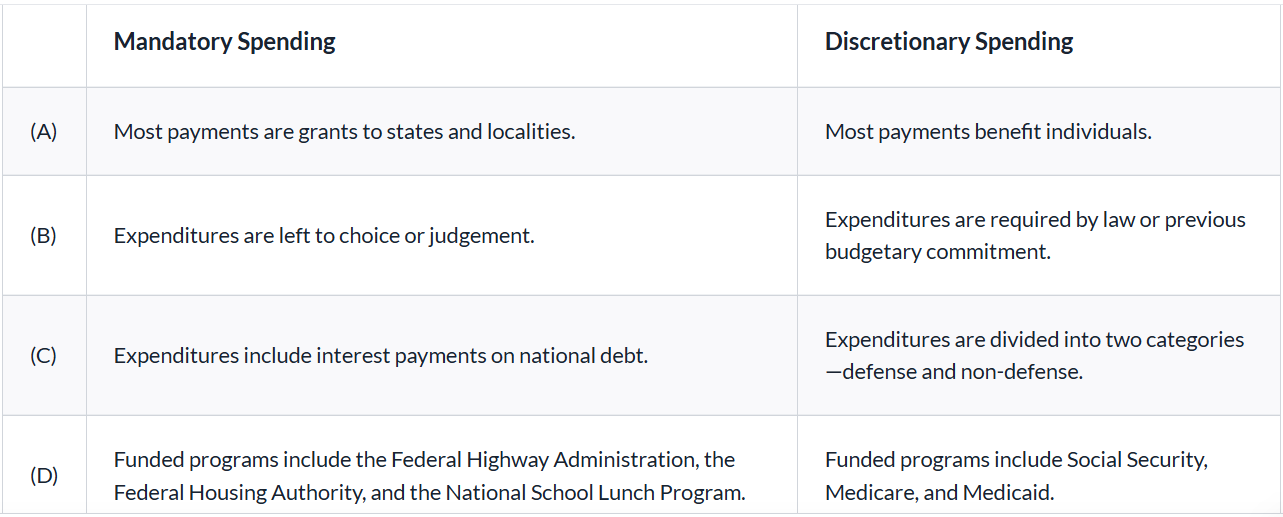
Which of the following is an accurate statement regarding mandatory and discretionary spending by Congress?
Row C
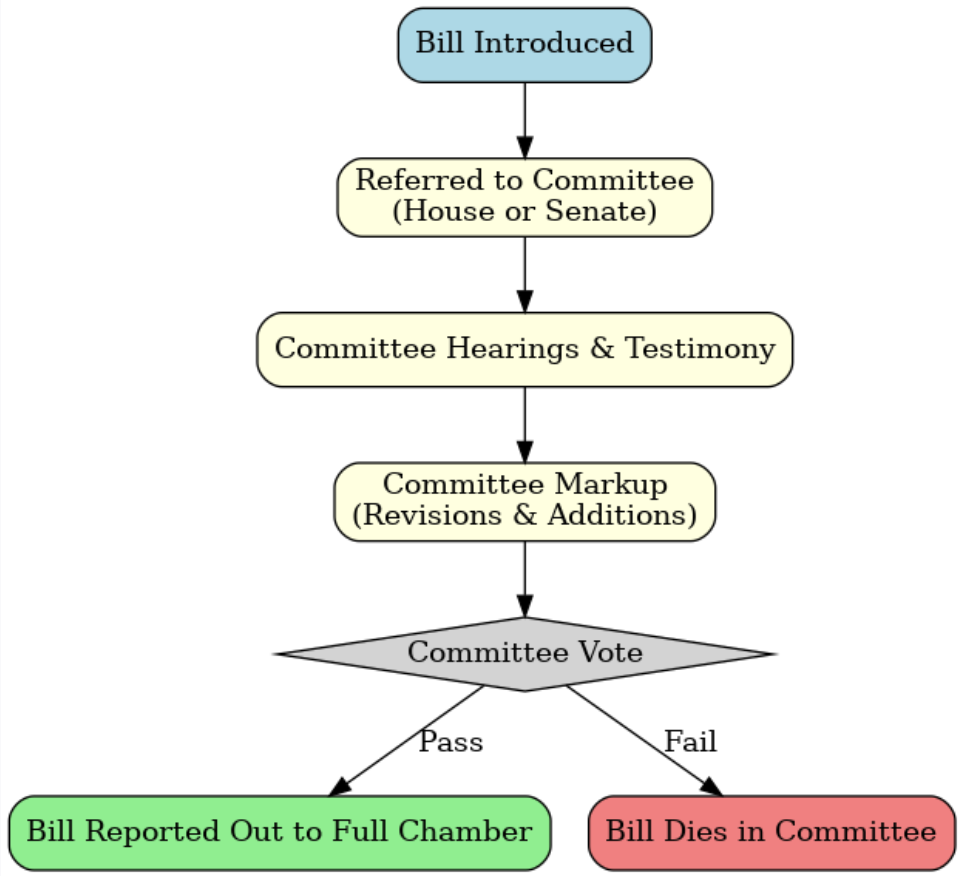
Note: Committee chairs, chosen by the majority party, decide when hearings are held and what bills move forward.
Based on the flowchart and the role of committees, which of the following best explains why most bills never become law?
Committee chairs often choose not to schedule hearings or votes on bills.
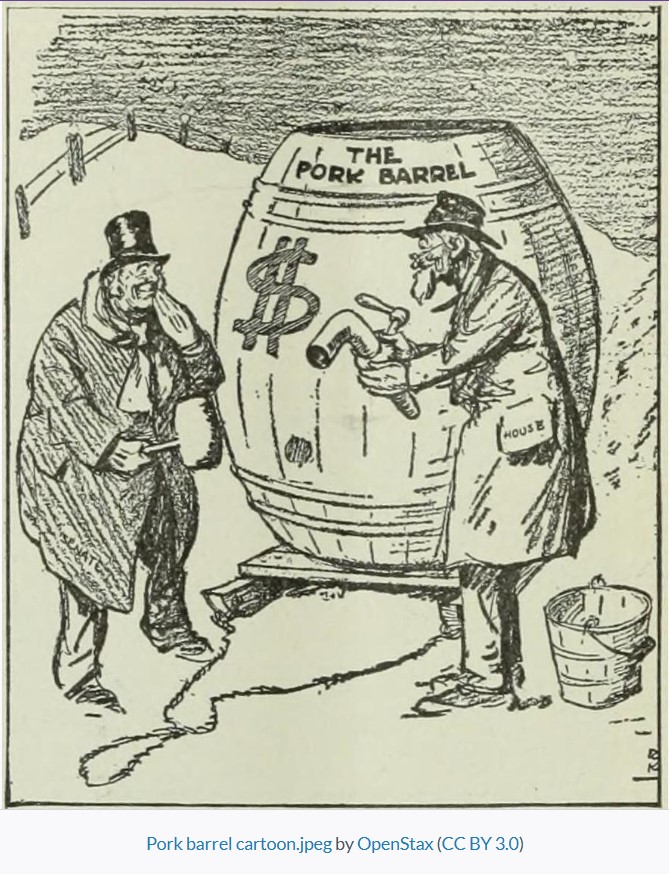
What connection does pork-barrel legislation have to the practice of logrolling in Congress?
Members combine unrelated projects into one bill so that each representative gains support for their district’s project.
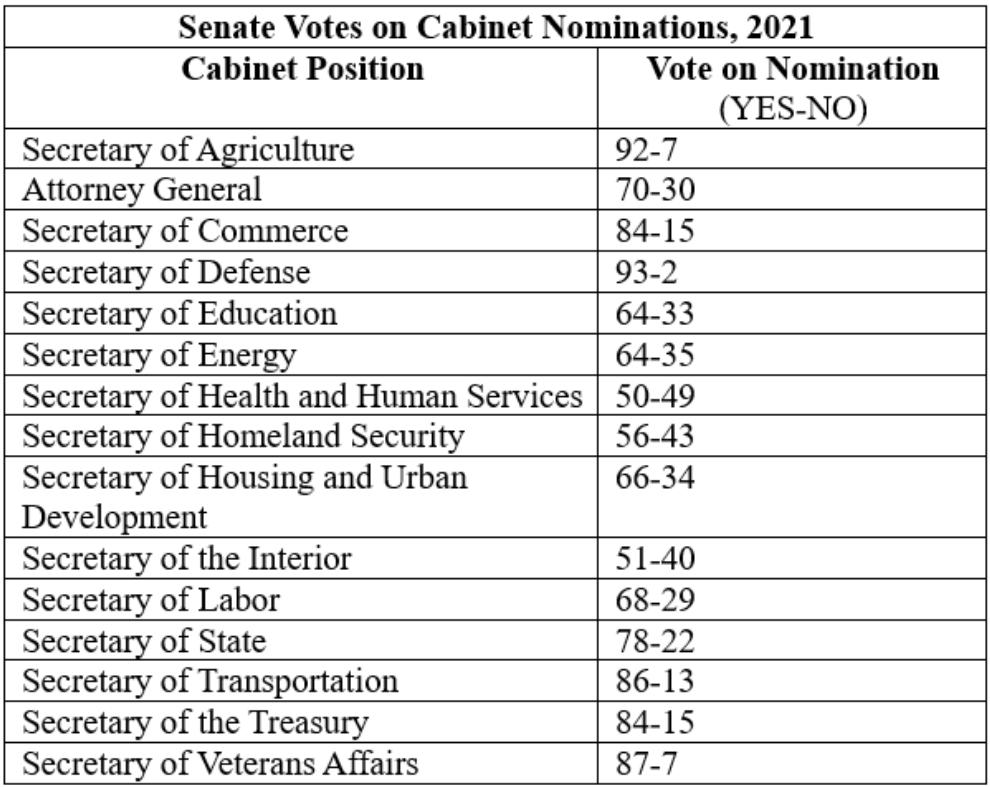
What is a limitation that Cabinet secretaries face?
They often face conflict because they must please both Congress and the president.
Which of the following is true about the impeachment process in the United States?
Federal officials and state officials can be subject to impeachment if they are accused of a crime.
“But quitting the dim light of historical research, and attaching ourselves purely to the dictates of reason and good sense, we shall discover much greater cause to reject than to approve the idea of plurality in the executive, under any modification whatever.
"Wherever two or more persons are engaged in any common enterprise or pursuit, there is always danger of difference of opinion.. Whenever these happen, they lessen the respectability, weaken the authority, and distract the plans and operations of those whom they divide. If they should unfortunately assail the supreme executive magistracy of a country, consisting of a plurality of persons, they might impede or frustrate the most important measures of the government in the most critical emergencies of the state. And what is still worse, they might split the community into the most violent and irreconcilable factions, adhering differently to the different individuals who composed the magistracy.”
Alexander Hamilton- Federalist No. 70
Which of the following best summarizes Hamilton’s argument?
A single chief executive is the most efficient and most sensible approach to governance.
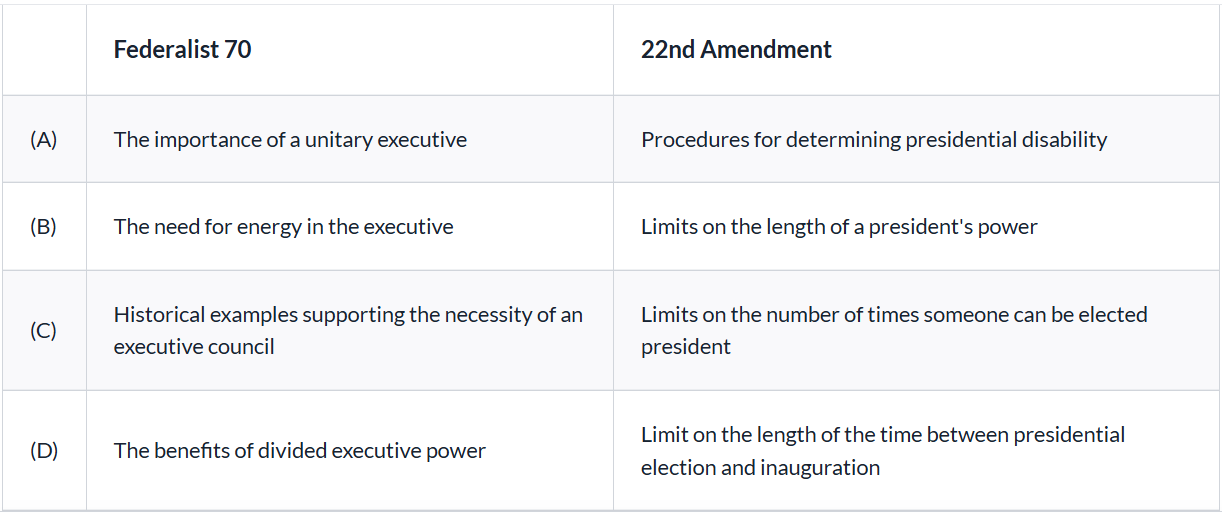
Which of the following accurately describes arguments regarding presidential power in Federalist 70 and limitations on presidential power in the 22nd Amendment?
Row B
"The judicial power shall extend to all cases, in law and equity, arising under this Constitution, the laws of the United States, and treaties made, or which shall be made, under their authority;--to all cases affecting ambassadors, other public ministers and consuls;--to all cases of admiralty and maritime jurisdiction;--to controversies to which the United States shall be a party;--to controversies between two or more states;--between a state and citizens of another state;--between citizens of different states;--between citizens of the same state claiming lands under grants of different states, and between a state, or the citizens thereof, and foreign states, citizens or subjects.
In all cases affecting ambassadors, other public ministers and consuls, and those in which a state shall be party, the Supreme Court shall have original jurisdiction. In all the other cases before mentioned, the Supreme Court shall have appellate jurisdiction, both as to law and fact, with such exceptions, and under such regulations as the Congress shall make."
-U. S. Constitution Article III, Section 2
Based on the constitutional provision above, in which of the following cases would federal courts have jurisdiction?
A lawsuit brought by the national government.
Federalist No. 78, Alexander Hamilton, 1788
"[W]here the will of the legislature, declared in its statutes, stands in opposition to that of the people, declared in the Constitution, the judges ought to be governed by the latter rather than the former. They ought to regulate their decisions by the fundamental laws, rather than by those which are not fundamental. . . .[W]henever a particular statute contravenes the Constitution, it will be the duty of the judicial tribunals to adhere to the latter and disregard the former.
Quoted in the Avalon Project, Yale Law School. http://avalon.law.yale.edu/18th_century/fed78.asp. Accessed 13 August 2018.
Hamilton’s argument most directly favors a check on the legislative process known as
Judicial Review
Of course, courts often hear cases where following precedent may lead—in the view of the judges for the case—to unjust outcomes. In those cases, the judges may offer reasons...to avoid following precedential decisions or to outright overturn prior rulings...Many rulings are based on specific facts at a given moment in history, and as the nation develops and changes...the justifications and interpretations of prior decisions may lose support...
Some constitutional scholars propose the idea that certain legal opinions...are so fundamental to American justice that they are virtually permanent decisions...The list...gets debated nearly every time a U.S. Supreme Court justice goes through a Senate confirmation hearing.
-American Bar Association, 2022
Which judicial decision-making principle is described in the excerpt?
stare decisis
...[W]hat Obergefell illustrates...is the interplay between stare decisis and the division of powers between the federal and state governments. Prior to the Court’s ruling, the regulation of marriage rested almost entirely with the states. Several, of course, had recently changed their law and begun recognizing same-sex marriages. But that “precedent”—resting the regulation of marriage with the states—was limited by Obergefell ...as states can no longer refuse to recognize same-sex marriages.
...The division of powers between federal and state governments reflects American federalism. But that arrangement was fundamentally changed by the...Fourteenth Amendment...The Obergefell petitioners brought their case on both grounds, claiming that the states deprived them of their right to marry their partners and denied them the equal protection of the laws.
-"The Separation of Powers, 'Stare Decisis,' and the Constitution", Roger Pilon, September 9, 2015.
Why did the U.S. Supreme Court fail to apply U.S. v. Windsor (2013), a case in which the Court voided the federal same-sex marriage ban, when it decided Obergefell v. Hodges?
The U.S. v. Windsor and Obergefell v. Hodges were based on different constitutional questions.
The Supreme Court’s decisions in Marbury v. Madison and McCulloch v. Maryland are similar in that
implied powers of the federal government were established.
In 1971, President Richard Nixon attempted to thwart the publishing of the Pentagon Papers, classified documents leaked by RAND Corporation analyst Daniel Ellsberg outlining the history of U.S. involvement in Southeast Asia. The Nixon administration sued the New York Times arguing that it had the prerogative through executive authority to prevent the publishing of documents that could be injurious to national security.
In its ruling New York Times v. United States (1971), the Supreme Court upheld the sanctity of freedom of the press, even when national security issues were a factor to be considered. Nixon responded to this setback by
attempting to discredit Ellsberg’s credibility by questioning his psychiatric condition.
In which of the following ways was the impact of the Supreme Court's decision in Brown v. Board of Education limited in the years following the ruling?
States refused to desegregate schools despite the ruling.
The primary purpose of which of the following amendments was to limit the impact of a specific decision of the Supreme Court and thus act as a check on the judiciary?
16th Amendment
"Energy in the executive is a leading character in the definition of good government. It is essential to the protection of the community against foreign attacks; it is not less essential to the steady administration of the laws.”
Alexander Hamilton, Federalist #70
Which of the following best explains how the role of bureaucracy relates to the quote from Federalist 70?
The bureaucracy is tasked with enforcing the laws fairly which will ensure steady enforcement of the laws.
Scenario: Congress is concerned about the safety of travelers as they pass through American airports after a series of recent security breaches. Instead of passing a new law, representatives in Congress decided it would be best to pursue other methods of regulation to secure American airports.
If Congress wanted to gather more information on the situation outlined above, how could an agency like the Transportation Safety Administration (TSA) most likely assist Congress in this process?
Testify before a Congressional committee
Which of the following represents an exercise of the discretionary authority of the Department of Transportation?
Deciding which specific items are prohibited from being brought onto airplanes in carry-on luggage.
Which of the following represents the Securities and Exchange Commission exercising its discretionary authority?
Imposing a fine on an individual who has traded stocks based on insider information.
Reversing the well-established laws and judicial precedents barring direct corporate and union financing of elections is a radical affront to American political culture and poses grave dangers to the integrity of our democracy.
--"Citizens United: The Supreme Court Ruling", Public Citizen
Indeed, to exclude or impede corporate speech is to muzzle the principal agents of the modern free economy. We should celebrate rather than condemn the addition of this speech to the public debate.
--Associate Justice Antonin Scalia, Citizens United v. Federal Election Commission (2010), concurring opinion
Based on the excerpt, with which Federal Election Commission action would the authors of both excerpts most likely agree?
Monitor enforcement of disclosure requirements.
The president and the Defense Department have made it a major priority to increase the size of the fleet to counter new threats in the Pacific. To this end, the administration secured congressional funding for a new class of destroyers. The Armed Services Committee has heard rumors that these new ships undergoing construction have been incurring tremendous cost overruns and that this fact is being concealed.
Which of the following strategies would best suit the Armed Services Committee in its oversight role of the military?
The committee should launch an independent, Government Accountability Office (GAO) investigation of the defense contractor.
United States Attorney Gregory W. Kehoe announces that Thomas B. Hoffman...has pleaded guilty to theft of federal funds. Hoffman faces a maximum penalty of 10 years in federal prison, as well as forfeiture in the amount of $155,706 and restitution to the victim...
Hoffman was an employee of the Palatka Housing Authority (PHA), which received federal funds from the United States Department of Housing and Urban Development (HUD) to administer public housing programs...During an audit...PHA identified an unapproved company called “Data Max,” which had received approximately 48 fraudulently issued payments from PHA’s general account between July 2023 and February 2025, totaling $155,706. A federal investigation determined that Hoffman owned and controlled Data Max...and that Hoffman had caused the fraudulent payments to be issued. The investigation showed that Hoffman used the funds for his personal benefit. Bank surveillance footage obtained by investigators showed Hoffman cashing PHA checks issued to Data Max on numerous occasions.
"Former Palatka Housing Authority Employee Pleads Guilty To Theft Of Federal Funds", Department of Housing and Urban Development, September 19, 2025.
Based on the excerpt, how does the Executive Branch carry out its responsibilities?
The Executive Branch develops procedures to make sure that policies are implemented.
Which of the following statements characterizes one way the president can independently hold a federal bureaucratic agency accountable for its performance?
The president can enlist the Office of Management and Budget (OMB) to evaluate the performance of a bureaucratic agency.
"It is also not entirely unworthy of observation that, in declaring what shall be the supreme law of the land, the Constitution itself is first mentioned, and not the laws of the United States generally, but those only which shall be made in pursuance of the Constitution, have that rank.
Thus, the particular phraseology of the Constitution of the United States confirms and strengthens the principle, supposed to be essential to all written Constitutions, that a law repugnant to the Constitution is void, and that courts, as well as other departments, are bound by that instrument.
The rule must be discharged."
Marbury v. Madison, 1803
How does this statement from Marbury v. Madison create multiple access points for stakeholders to influence public policy?
It allows interest groups and individuals to challenge government actions in court, giving the judiciary a role in shaping policy outcomes.
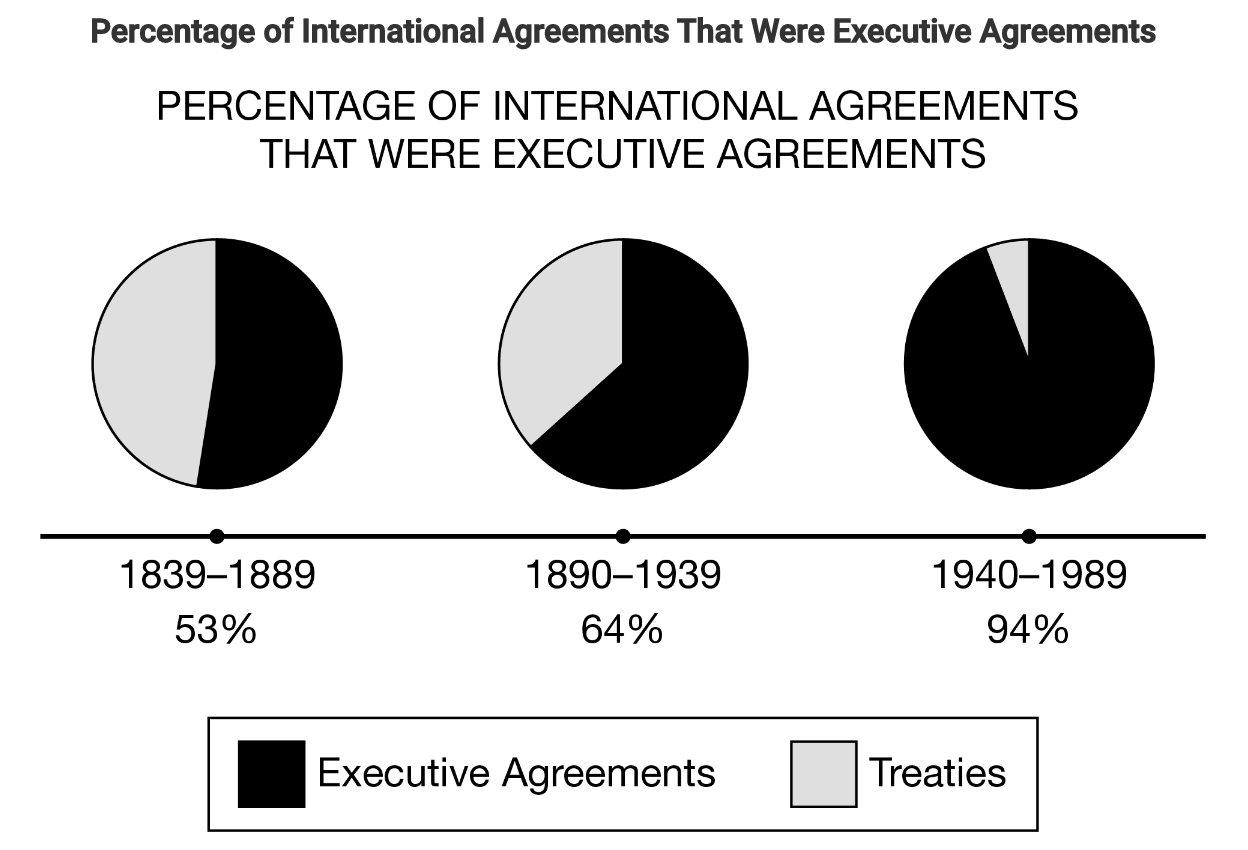
Which of the following statements about the use of executive agreements by presidents is supported by the data in the pie charts?
The percentage of international agreements that were executive agreements has increased since 1839.
President Theodore Roosevelt took his case directly to the American people to gain public support for his progressive reform initiatives by appearing in a movie newsreel. This type of presidential communication is an example of which of the following?
Using the bully pulpit
In 1973, Congress passed the War Powers Act (also known as the War Powers Resolution) to compel the president to seek congressional approval before committing the nation to armed conflict. The act may be viewed as a reassertion of
Article I, Section 8 of the U.S. Constitution
Federalist No. 70, Alexander Hamilton, 1788
"There is an idea, which is not without its advocates, that a vigorous Executive is inconsistent with the genius of republican government. The enlightened well-wishers to this species of government must at least hope that the supposition is destitute of foundation; since they can never admit its truth, without at the same time admitting the condemnation of their own principles. Energy in the Executive is a leading character in the definition of good government. It is essential to the protection of the community against foreign attacks; it is not less essential to the steady administration of the laws; to the protection of property against those irregular and high-handed combinations which sometimes interrupt the ordinary course of justice; to the security of liberty against the enterprises and assaults of ambition, of faction, and of anarchy. Every man the least conversant in Roman history, knows how often that republic was obliged to take refuge in the absolute power of a single man, under the formidable title of Dictator, as well against the intrigues of ambitious individuals who aspired to the tyranny, and the seditions of whole classes of the community whose conduct threatened the existence of all government, as against the invasions of external enemies who menaced the conquest and destruction of Rome."
Which of the following statements is most consistent with Hamilton’s argument in the passage above?
A strong executive is needed to preserve the nation in a time of war.
Federalist No. 70, Alexander Hamilton, 1788
There is an idea, which is not without its advocates, that a vigorous Executive is inconsistent with the genius of republican government. The enlightened well-wishers to this species of government must at least hope that the supposition is destitute of foundation; since they can never admit its truth, without at the same time admitting the condemnation of their own principles. Energy in the Executive is a leading character in the definition of good government. It is essential to the protection of the community against foreign attacks; it is not less essential to the steady administration of the laws; to the protection of property against those irregular and high-handed combinations which sometimes interrupt the ordinary course of justice; to the security of liberty against the enterprises and assaults of ambition, of faction, and of anarchy. Every man the least conversant in Roman history, knows how often that republic was obliged to take refuge in the absolute power of a single man, under the formidable title of Dictator, as well against the intrigues of ambitious individuals who aspired to the tyranny, and the seditions of whole classes of the community whose conduct threatened the existence of all government, as against the invasions of external enemies who menaced the conquest and destruction of Rome."
An opponent of Hamilton’s argument in the passage above would likely be supportive of which of the following?
The New Jersey plan
Federalist No. 70, Alexander Hamilton, 1788
There is an idea, which is not without its advocates, that a vigorous Executive is inconsistent with the genius of republican government. The enlightened well-wishers to this species of government must at least hope that the supposition is destitute of foundation; since they can never admit its truth, without at the same time admitting the condemnation of their own principles. Energy in the Executive is a leading character in the definition of good government. It is essential to the protection of the community against foreign attacks; it is not less essential to the steady administration of the laws; to the protection of property against those irregular and high-handed combinations which sometimes interrupt the ordinary course of justice; to the security of liberty against the enterprises and assaults of ambition, of faction, and of anarchy. Every man the least conversant in Roman history, knows how often that republic was obliged to take refuge in the absolute power of a single man, under the formidable title of Dictator, as well against the intrigues of ambitious individuals who aspired to the tyranny, and the seditions of whole classes of the community whose conduct threatened the existence of all government, as against the invasions of external enemies who menaced the conquest and destruction of Rome."
Which of the following sections in the U.S. Constitution places the most severe brake on Hamilton’s beliefs about the powers of the presidency, as argued in the passage above?
Article II, Section 4
Which of the following cases was most likely to derive the basis of its decision from the argument presented in The Federalist No. 78 that states: “that, accordingly, whenever a particular statute [contradicts] the Constitution, it will be the duty of the judicial tribunals to adhere to the latter and disregard the former”?
Marbury v. Madison (1803)
During a television interview on July 1, 2018, Senator Lindsey Graham stated that "one of the concepts that really means a lot in America is stare decisis. That means you don't overturn precedent unless there's a good reason." About which ongoing debate was Senator Graham sharing his position?
Judicial activism versus judicial restraint
In the case Randall v. Sorrell (2006), Supreme Court Justice Stephen Breyer argued that following judicial precedent “avoids the instability and unfairness that accompany disruption of settled legal expectations. For this reason, the rule of law demands that adhering to our prior case law be the norm. Departure from precedent is exceptional and requires special justification.”
Justice Breyer is referring to which of the following legal principles?
Stare decisis
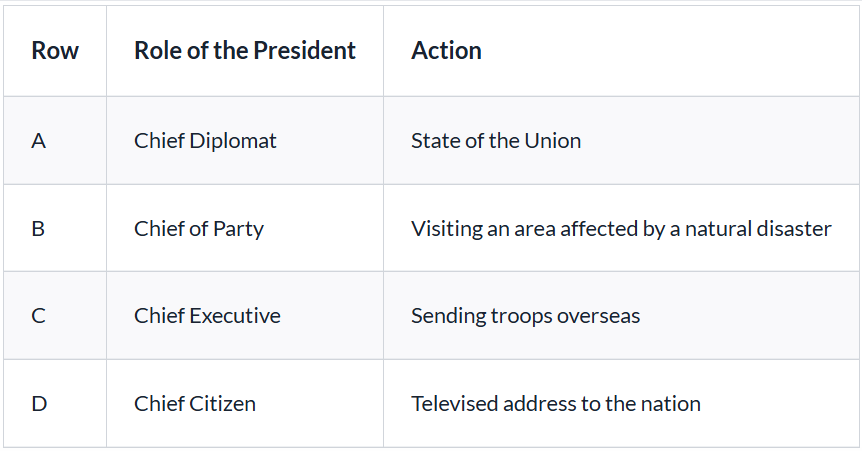
Which pairing correctly matches the role of the President with the action they are taking?
Row D
In which of the following ways did the Pendleton Civil Service Reform Act of 1883 change the federal bureaucracy?
It provided for the selection of most government employees based on a competitive exam rather than political affiliation.
Which of the following most accurately describes an impact of the Bill of Rights?
Schools-sponsored prayers are not allowed in public schools.
Writing the Bill of Rights
The amendments James Madison proposed were designed to win support in both houses of Congress and the states. He focused on rights-related amendments, ignoring suggestions that would have structurally changed the government.
Opposition to the Constitution
Many Americans, persuaded by a pamphlet written by George Mason, opposed the new government. Mason was one of three delegates present on the final day of the convention who refused to sign the Constitution because it lacked a bill of rights.
James Madison and other supporters of the Constitution argued that a bill of rights wasn't necessary because - “the government can only exert the powers specified by the Constitution.” But they agreed to consider adding amendments when ratification was in danger in the key state of Massachusetts.
Introducing the Bill of Rights in the First Congress
Few members of the First Congress wanted to make amending the new Constitution a priority. But James Madison, once the most vocal opponent of the Bill of Rights, introduced a list of amendments to the Constitution on June 8, 1789, and “hounded his colleagues relentlessly” to secure its passage. Madison had come to appreciate the importance voters attached to these protections, the role that enshrining them in the Constitution could have in educating people about their rights, and the chance that adding them might prevent its opponents from making more drastic changes to it.
Ratifying the Bill of Rights
The House passed a joint resolution containing 17 amendments based on Madison’s proposal. The Senate changed the joint resolution to consist of 12 amendments. A joint House and Senate Conference Committee settled remaining disagreements in September. On October 2, 1789, President Washington sent copies of the 12 amendments adopted by Congress to the states. By December 15, 1791, three-fourths of the states had ratified 10 of these, now known as the “Bill of Rights.”
National Archives. “The Bill of Rights: How Did It Happen?” National Archives and Records Administration, National Archives and Records Administration, www.archives.gov/founding-docs/bill-of-rights/how-did-it-happen. Accessed 24 Sept. 2025.
Despite the initial lack of interest in adding the Bill of Rights to the Constitution, opponents ultimately realized that its inclusion would facilitate ratification of the U.S. Constitution. Which of the following reasons best explains this big change of interest amongst opponents of the Bill of Rights?
Opponents realized that citizens wanted their rights in the Constitution, making its passage easier in Congress
 Note
Note  Flashcards (20)